Here is a fact that trips up most casual museum visitors: the term "Impressionism" was coined as an insult. A critic named Louis Leroy attended the 1874 group exhibition in Paris and mocked Claude Monet's "Impression, Sunrise" for looking like an unfinished sketch. The painters took the insult and wore it as a badge. That single anecdote tells you something important about how art history actually works: movements rarely name themselves, critics rarely understand what they're seeing in real time, and the art that gets remembered is almost never the art that was considered safe.
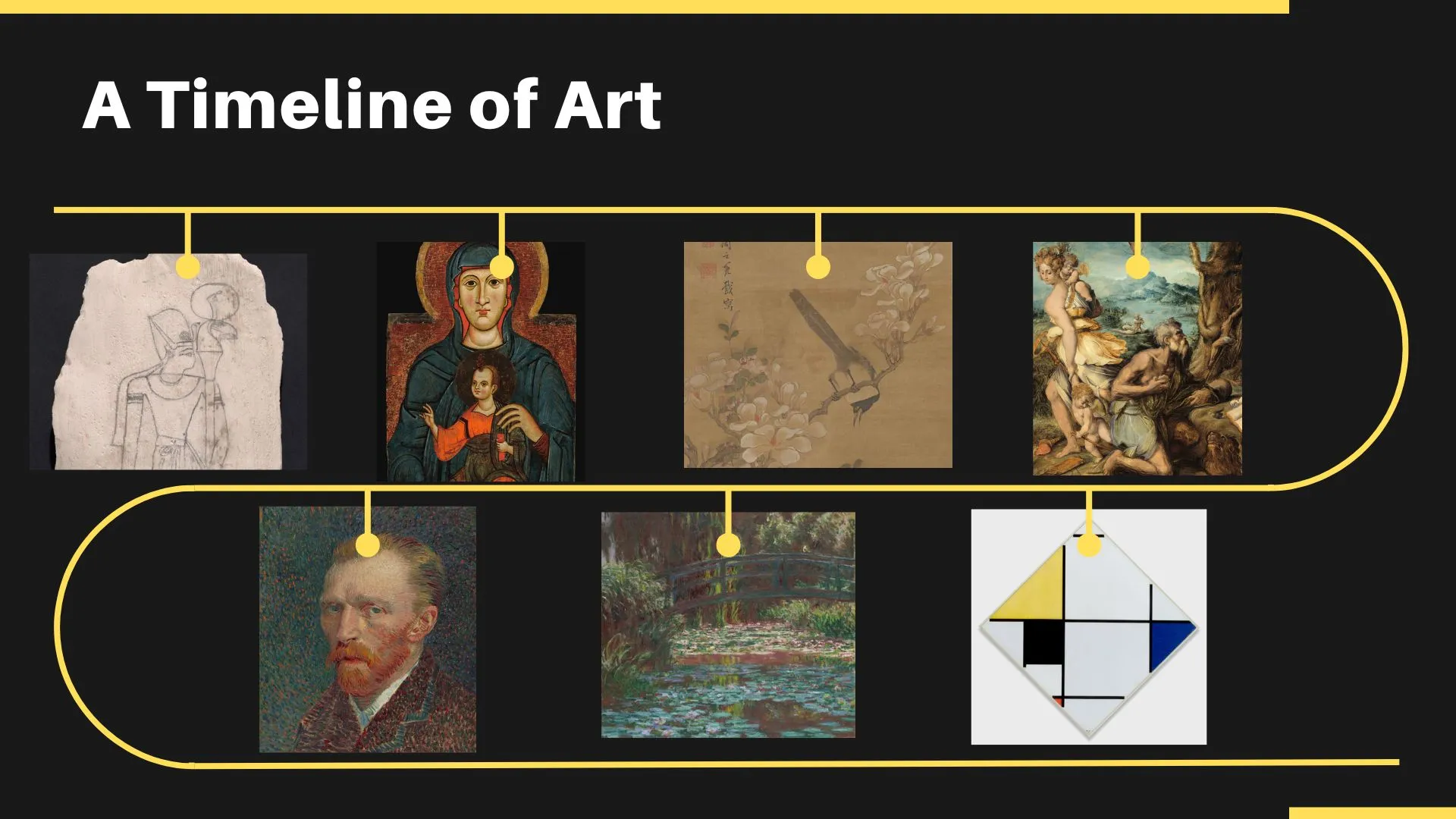
This cheat sheet gives you the skeleton of Western art history from ancient Egypt to the present day. No extended analysis, no lengthy context, just the major movements, their dates, their defining ideas, their key artists, and the one thing you need to remember about each. Use it before a museum visit, as a refresher when you hit an unfamiliar term, or as the starting point before going deeper into any period.
For the full narrative behind this timeline, read The Complete Guide to Art Movements: A Timeline from Ancient to Now. For the beginner reading path that takes you through each period in sequence, see Art for Beginners: The Complete Reading Order for This Blog. For how to apply this knowledge in front of a real painting, use How to Read a Painting: A Step-by-Step Framework.
Ancient Art
Ancient Egyptian Art (c. 3100–30 BCE)
- Key idea: Art serves the eternal, not the moment. Images show what things are, not how they look.
- Style: Composite view (head in profile, eye forward, torso frontal, legs in profile), hieratic scale, flat colour.
- Key works: Bust of Nefertiti, paintings in the tomb of Nebamun, the Great Sphinx.
- One thing to remember: Three thousand years with almost no stylistic change. Stability was the point.
Ancient Greek and Roman Art (c. 800 BCE–400 CE)
- Key idea: The ideal human body, mathematically proportioned, reflects divine order.
- Style: Naturalistic, idealized, anatomically based. Contrapposto (weight-shift) stance.
- Key works: Discobolus (Myron), Venus de Milo, Augustus of Prima Porta, Laocoön.
- One thing to remember: The classical tradition established the standard that Western art spent two millennia following and breaking.
Medieval Art
Byzantine Art (c. 330–1453 CE)
- Key idea: Sacred images communicate divine truth, not physical reality.
- Style: Flat, hieratic, gold backgrounds, frontal figures, symbolic rather than naturalistic.
- Key works: Hagia Sophia mosaics, icons of Christ Pantocrator, mosaics at Ravenna.
- One thing to remember: The gold background is not decoration. It is sacred space outside ordinary time.
- Deep guide:Byzantine Art: Gold, Icons, and the Sacred Image
Gothic Art (c. 1100–1400)
- Key idea: Architecture as theology. Light as divine presence.
- Style: Pointed arches, flying buttresses, stained glass, elongated figures, increasing naturalism in manuscripts.
- Key works: Notre-Dame de Paris, Chartres Cathedral, Limbourg Brothers' "Très Riches Heures."
- One thing to remember: Gothic cathedrals were built to fill entire cities with coloured light. The stained glass was the art.
The Renaissance (c. 1300–1600)
Early Renaissance (c. 1300–1490, Italy)
- Key idea: Rebirth of classical ideas, humanism, and the rediscovery of perspective.
- Style: Linear perspective, naturalistic figures, emotional expression, classical architectural settings.
- Key artists: Giotto, Brunelleschi, Donatello, Botticelli, Ghiberti.
- Key works: Botticelli's "Birth of Venus," Ghiberti's Baptistry Doors, Donatello's David.
- One thing to remember: Brunelleschi's perspective demonstration in 1420 gave painters a mathematical system for showing three-dimensional space. Everything changed.
High Renaissance (c. 1490–1527, Italy)
- Key idea: Perfect synthesis of naturalism, idealism, and technical mastery.
- Key artists: Leonardo da Vinci, Michelangelo, Raphael, Titian.
- Key works: Mona Lisa, Sistine Chapel ceiling, School of Athens, Venus of Urbino.
- One thing to remember: The "genius" as cultural concept was largely invented in this period. Leonardo, Michelangelo, and Raphael were treated as something more than craftsmen for the first time in Western history.
- Artist spotlights:Leonardo da Vinci | Michelangelo
Northern Renaissance (c. 1430–1580)
- Key idea: Technical mastery of oil paint, meticulous naturalism, Protestant religious imagery.
- Key artists: Jan van Eyck, Albrecht Dürer, Hans Holbein, Pieter Bruegel the Elder.
- Key works: Van Eyck's "Arnolfini Portrait," Dürer's self-portraits, Bruegel's peasant scenes.
- One thing to remember: Van Eyck's development of oil paint technique in the 15th century created the technical foundation for the next five centuries of Western painting.
The Baroque and Rococo (c. 1600–1780)
Baroque (c. 1600–1750)
- Key idea: Drama, emotion, and the direct address of the viewer. Art as theatre.
- Style: Tenebrism (dramatic light/dark contrast), dynamic diagonal compositions, intense emotion, grandeur of scale.
- Key artists: Caravaggio, Rembrandt, Vermeer, Rubens, Velázquez, Bernini, Artemisia Gentileschi.
- Key works: Caravaggio's "Calling of Saint Matthew," Rembrandt's "Night Watch," Bernini's "Ecstasy of Saint Teresa."
- One thing to remember: The Catholic Church used Baroque art as a propaganda tool after the Protestant Reformation. Make it emotional, dramatic, overwhelming. Make people feel faith.
- Artist spotlights:Rembrandt | Vermeer | Gentileschi
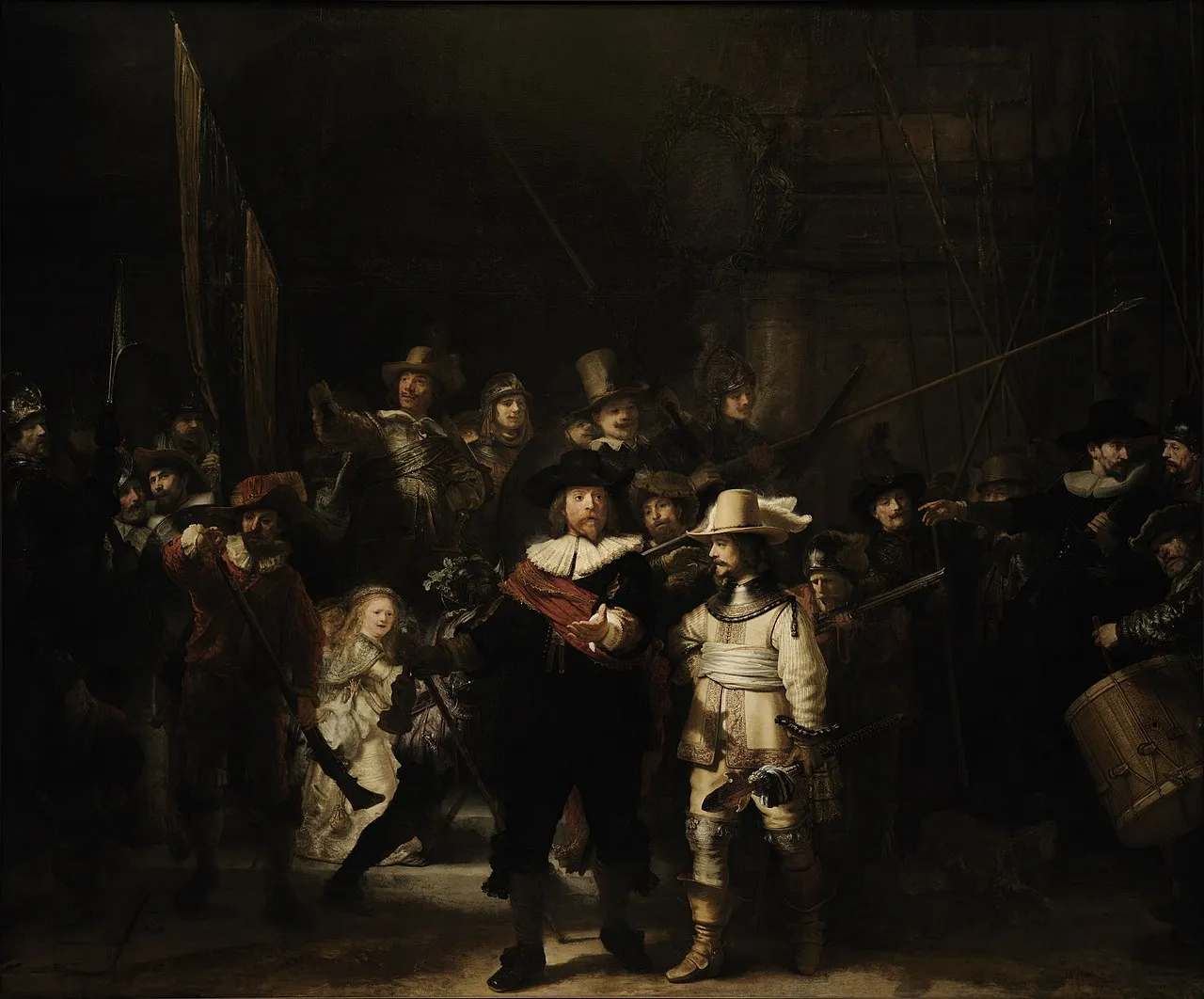
Rembrandt van Rijn, "The Night Watch" (1642), oil on canvas, 379.5 x 453.5 cm. Rijksmuseum, Amsterdam. The defining Baroque group portrait: dynamic, theatrical, and far more interested in art than in satisfying its commissioners. Image: Public domain, via Wikimedia Commons
Rococo (c. 1720–1780, France)
- Key idea: Lightness, elegance, pleasure. Art for aristocratic entertainment.
- Style: Pastel colours, ornate decoration, playful subject matter, soft light.
- Key artists: Watteau, Fragonard, Boucher.
- One thing to remember: Rococo ended with the French Revolution. When the aristocracy lost its head, so did its favourite art style.
The 19th Century
Neoclassicism (c. 1750–1850)
- Key idea: Return to classical Greek and Roman order, rationality, and civic virtue.
- Key artists: Jacques-Louis David, Ingres, Antonio Canova.
- Key works: David's "Oath of the Horatii," Ingres' "Grande Odalisque."
- One thing to remember: David became the official painter of the French Revolution and Napoleon, showing how classicism could serve radical politics as well as royal courts.
Romanticism (c. 1780–1850)
- Key idea: Emotion, the individual imagination, and the power of nature against Enlightenment rationalism.
- Key artists: Géricault, Delacroix, Caspar David Friedrich, J.M.W. Turner, Francisco Goya.
- Key works: Géricault's "Raft of the Medusa," Friedrich's "Wanderer Above the Sea of Fog," Turner's "Rain, Steam and Speed."
- One thing to remember: Turner dissolved landscape into pure light and atmosphere thirty years before the Impressionists. They knew it.
- Deep guide:Romanticism: Emotion, Nature, and the Revolt Against Reason
Realism (c. 1840–1870)
- Key idea: Ordinary working people, shown without idealization, are legitimate subjects for serious art.
- Key artists: Gustave Courbet, Jean-François Millet, Honoré Daumier.
- Key works: Courbet's "The Stone Breakers," "Burial at Ornans," Millet's "The Gleaners."
- One thing to remember: Courbet's monumental paintings of peasants and workers were a political provocation. Treating the poor with the same gravity previously reserved for historical and religious subjects was genuinely radical.
Impressionism (c. 1860–1890)
- Key idea: Paint what the eye actually sees: changing light, atmospheric conditions, the fleeting moment.
- Style: Broken brushwork, pure colour, outdoor painting (en plein air), everyday subjects.
- Key artists: Monet, Renoir, Degas, Pissarro, Berthe Morisot, Mary Cassatt.
- Key works: Monet's "Impression, Sunrise," "Water Lilies" series; Degas' ballet paintings; Renoir's "Luncheon of the Boating Party."
- One thing to remember: The name "Impressionism" was invented as an insult by a critic mocking Monet's "Impression, Sunrise." The painters adopted it.
- Deep guide:Impressionism: Monet, Light, and Breaking Academic Rules | Monet spotlight
Post-Impressionism (c. 1886–1910)
- Key idea: Four painters, four directions: structure (Cézanne), emotion (Van Gogh), primitivism (Gauguin), science (Seurat).
- Key artists: Paul Cézanne, Vincent van Gogh, Paul Gauguin, Georges Seurat.
- Key works: Van Gogh's "Starry Night," Cézanne's "Mont Sainte-Victoire" series, Seurat's "Sunday on La Grande Jatte," Gauguin's "Where Do We Come From?"
- One thing to remember: Cézanne's simplification of natural forms into geometric shapes directly inspired Picasso and Braque's Cubism. He is the hinge of modern art.
- Artist spotlights:Van Gogh | Cézanne
The Early 20th Century
Fauvism (c. 1905–1910)
- Key idea: Color liberated from any descriptive function. Paint as pure chromatic energy.
- Key artists: Henri Matisse, André Derain, Maurice de Vlaminck.
- One thing to remember: "Les Fauves" means "wild beasts." Another critic insult that stuck.
- Artist spotlight:Henri Matisse: Color, Cutouts, and the Joy of Looking
Expressionism (c. 1905–1925, Germany and Austria)
- Key idea: Distort the visible world to show inner psychological states: anxiety, alienation, desire.
- Key artists: Edvard Munch, Ernst Ludwig Kirchner, Egon Schiele, Oskar Kokoschka, Gustav Klimt (Vienna Secession).
- Key works: Munch's "The Scream," Schiele's self-portraits, Klimt's "The Kiss."
- One thing to remember: Expressionism was declared "degenerate art" by the Nazis in 1937. The regime confiscated or destroyed thousands of works and banned its practitioners from making art.
- Artist spotlight:Gustav Klimt: Gold, Symbolism, and the Vienna Secession
Cubism (c. 1907–1920)
- Key idea: Show all sides of an object simultaneously. Abandon single-point perspective.
- Key artists: Pablo Picasso, Georges Braque, Juan Gris, Fernand Léger.
- Key works: Picasso's "Les Demoiselles d'Avignon," "Guernica"; Braque's "Violin and Candlestick."
- One thing to remember: Cubism freed painting from the obligation to look like the visible world. Everything that came after in 20th-century abstraction flows from this.
- Deep guide:Cubism: Picasso, Braque, and Seeing All Sides at Once | Picasso spotlight
Dada (c. 1916–1924)
- Key idea: Art is absurd. Civilization is absurd. Prove it.
- Key artists: Marcel Duchamp, Hannah Höch, Hugo Ball, Man Ray, Jean Arp.
- Key works: Duchamp's "Fountain" (urinal submitted to an art exhibition), Höch's photomontages.
- One thing to remember: Duchamp's readymades — manufactured objects submitted as artworks — raised the question of whether a work of art needed to be made by an artist's hand, a question that still has not been fully answered.
Bauhaus (1919–1933, Germany)
- Key idea: Unify fine art, craft, and industrial design. Form follows function.
- Key figures: Walter Gropius (founder), Kandinsky, Paul Klee, László Moholy-Nagy, Marcel Breuer.
- Legacy: Modern graphic design, typography, industrial design, architecture. Essentially every clean minimal design you see today.
- One thing to remember: The Nazis closed the Bauhaus in 1933. Its faculty scattered to the US, Britain, and beyond, spreading its design principles globally.
- Deep guide:The Bauhaus Movement: Where Art Met Design and Function
Surrealism (c. 1924–1945)
- Key idea: The unconscious mind is more real than the conscious. Art should access it directly.
- Key artists: Salvador Dalí, René Magritte, Max Ernst, Joan Miró, Frida Kahlo, Man Ray.
- Key works: Dalí's "Persistence of Memory," Magritte's "The Treachery of Images" (This is not a pipe), Ernst's "The Elephant Celebes."
- One thing to remember: Surrealism began as a literary movement with a manifesto by André Breton. The visual artists joined later. Always a movement with too many manifestos.
- Deep guide:Surrealism and the Subconscious | Dalí spotlight | Kahlo spotlight
Post-War Art
Abstract Expressionism (c. 1943–1965, New York)
- Key idea: The act of painting is the subject. Emotion and gesture, not representation.
- Key artists: Jackson Pollock, Mark Rothko, Willem de Kooning, Franz Kline, Lee Krasner, Helen Frankenthaler.
- Key works: Pollock's drip paintings, Rothko's color fields, de Kooning's "Woman" series.
- One thing to remember: This was the first American movement to dominate global art. New York replaced Paris as the center of the art world after World War II.
- Deep guide:Abstract Expressionism: When Art Became About the Act of Painting
Pop Art (c. 1955–1970, UK and USA)
- Key idea: Consumer culture, mass media, and advertising are legitimate artistic subjects. What is the difference between art and product?
- Key artists: Andy Warhol, Roy Lichtenstein, Richard Hamilton, David Hockney, Claes Oldenburg, Jasper Johns.
- Key works: Warhol's "Campbell's Soup Cans," Lichtenstein's comic strip paintings, Hockney's "A Bigger Splash."
- One thing to remember: Pop Art was not celebration of consumer culture. It was a question mark placed beside it.
- Deep guide:Pop Art: History, Traits, Artists, and Modern Takes | Warhol spotlight
David Hockney, "A Bigger Splash" (1967), acrylic on canvas, 243 x 243 cm. Tate Modern, London. The flat, poster-bright colours and cool Californian setting are characteristic of Hockney's Pop-adjacent practice. Image: Fair use, via Wikipedia
Minimalism (c. 1960–1975)
- Key idea: Reduce art to its most basic formal elements. No representation, no personal expression, no illusion.
- Key artists: Donald Judd, Dan Flavin, Carl Andre, Frank Stella, Agnes Martin.
- Key works: Judd's stacked metal boxes, Flavin's fluorescent light installations, Andre's "Equivalent VIII" (bricks on the floor).
- One thing to remember: Andre's "Equivalent VIII" was attacked by a visitor who threw ink on it, protesting that bricks on a floor were not art. The attack is now part of its history.
Conceptual Art (c. 1965–present)
- Key idea: The idea is the artwork. The physical object is optional.
- Key artists: Joseph Kosuth, Sol LeWitt, Lawrence Weiner, Jenny Holzer.
- Key works: Kosuth's "One and Three Chairs," LeWitt's wall drawings.
- One thing to remember: If the concept is the artwork, then anyone who understands the concept owns the artwork in some meaningful sense. The implications for the art market were never fully resolved.
Contemporary Art (1980–Present)
Neo-Expressionism (c. 1980–1990)
- Key idea: Return to figuration, painterly gesture, and personal imagery after the austerity of Minimalism and Conceptualism.
- Key artists: Jean-Michel Basquiat, Georg Baselitz, Anselm Kiefer, Julian Schnabel.
- One thing to remember: Basquiat went from unknown graffiti artist to gallery darling in less than three years. His work now sells for hundreds of millions of dollars.
- Artist spotlight:Jean-Michel Basquiat: Neo-Expressionism and Cultural Commentary
Street Art (c. 1970–present)
- Key idea: Art belongs in public space, not just galleries. The street is the gallery.
- Key artists: Banksy, Shepard Fairey, JR, Os Gemeos, Keith Haring.
- One thing to remember: Street art began as illegal activity. Some of its most prominent practitioners became wealthy fine artists. The tension between its anti-establishment origins and its commercial success is the central story of the genre.
- Artist spotlight:Banksy: Street Art's Most Mysterious Figure
Digital Art and NFTs (c. 1960–present, mainstream from 2020)
- Key idea: The computer as medium. Digital images, generative art, interactive experiences, and blockchain-verified ownership.
- Key artists: Beeple, Refik Anadol, Casey Reas, Yayoi Kusama (digital works), David Hockney (iPad painting).
- One thing to remember: Beeple's "Everydays: The First 5000 Days" sold for $69 million at Christie's in 2021 as an NFT. Whether that represents the birth of a new market or a speculative bubble is still being debated.
- Deep guides:Digital Art: The Modern Creative Frontier | NFT Art Explained
Quick Reference Table
Below is a summary table for fast lookups:
| Period | Dates | Key Word | One Artist | |---|---|---|---| | Ancient Egypt | 3100–30 BCE | Eternal | Imhotep | | Classical Greece/Rome | 800 BCE–400 CE | Ideal | Phidias | | Byzantine | 330–1453 CE | Sacred | Unknown (icon painters) | | Gothic | 1100–1400 | Divine light | Villard de Honnecourt | | Early Renaissance | 1300–1490 | Perspective | Botticelli | | High Renaissance | 1490–1527 | Mastery | Leonardo da Vinci | | Northern Renaissance | 1430–1580 | Oil paint | Jan van Eyck | | Baroque | 1600–1750 | Drama | Caravaggio | | Rococo | 1720–1780 | Elegance | Fragonard | | Neoclassicism | 1750–1850 | Reason | David | | Romanticism | 1780–1850 | Emotion | Turner | | Realism | 1840–1870 | Truth | Courbet | | Impressionism | 1860–1890 | Light | Monet | | Post-Impressionism | 1886–1910 | Aftermath | Cézanne | | Fauvism | 1905–1910 | Colour | Matisse | | Expressionism | 1905–1925 | Feeling | Munch | | Cubism | 1907–1920 | Facets | Picasso | | Dada | 1916–1924 | Absurdity | Duchamp | | Bauhaus | 1919–1933 | Function | Gropius | | Surrealism | 1924–1945 | Unconscious | Dalí | | Abstract Expressionism | 1943–1965 | Gesture | Pollock | | Pop Art | 1955–1970 | Consumer culture | Warhol | | Minimalism | 1960–1975 | Reduction | Judd | | Conceptual Art | 1965–present | Idea | Kosuth | | Neo-Expressionism | 1980–1990 | Return | Basquiat | | Street Art | 1970–present | Public | Banksy | | Digital/NFT | 2010–present | Ownership | Beeple |Where to Go From Here
This cheat sheet is the skeleton. The deep guides are the rest. Art history is not a list of facts to memorize; it is an ongoing argument about what images are for, who gets to make them, and what counts as beauty. Every period above is in conversation with the ones before it, and usually in revolt against at least one of them.
If any entry above sparked curiosity, the reading order at Art for Beginners: The Complete Reading Order for This Blog will show you exactly which guide to read next. For practical application in front of actual art, start with How to Read a Painting: A Step-by-Step Framework and Famous Paintings Explained: What 20 Iconic Works Are Actually About. The art vocabulary guide will also help you speak the language once you know the history. Which movement here do you most want to explore further? Leave a comment below and I will point you to the best starting post.