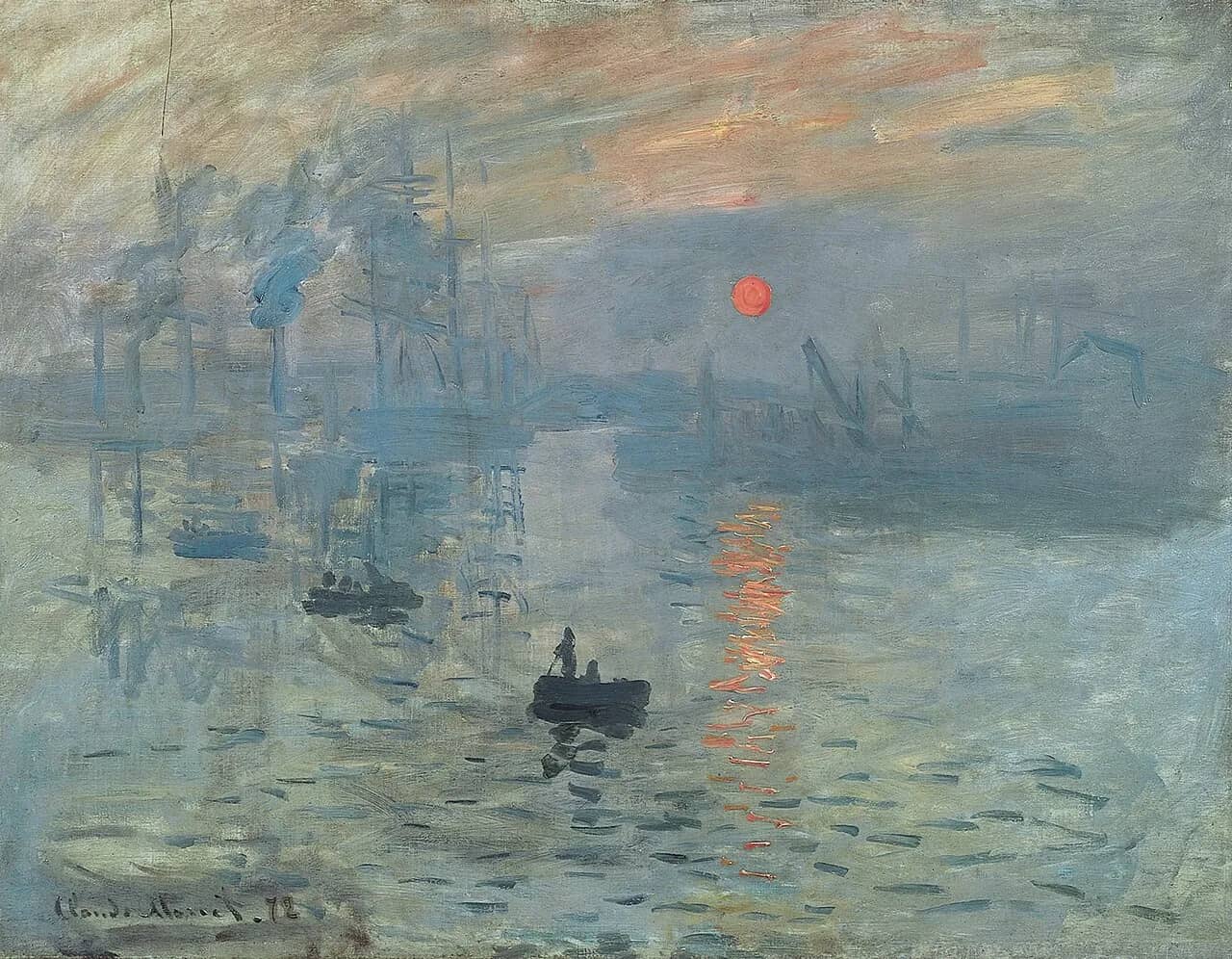
The Orangerie museum in Paris has two oval rooms, each about 197 feet long. The walls are painted floor to ceiling with enormous water lily canvases, and when you walk inside, photographs have not prepared you for what it actually feels like. The paintings are not representations of a pond. They are environments. The color surrounds you on every side, and the boundary between the canvas and the air you're standing in dissolves in a way that is genuinely disorienting. Monet conceived this installation as a memorial gift to France after World War One. He spent the final decade of his life building it. Nothing in painting quite compares.
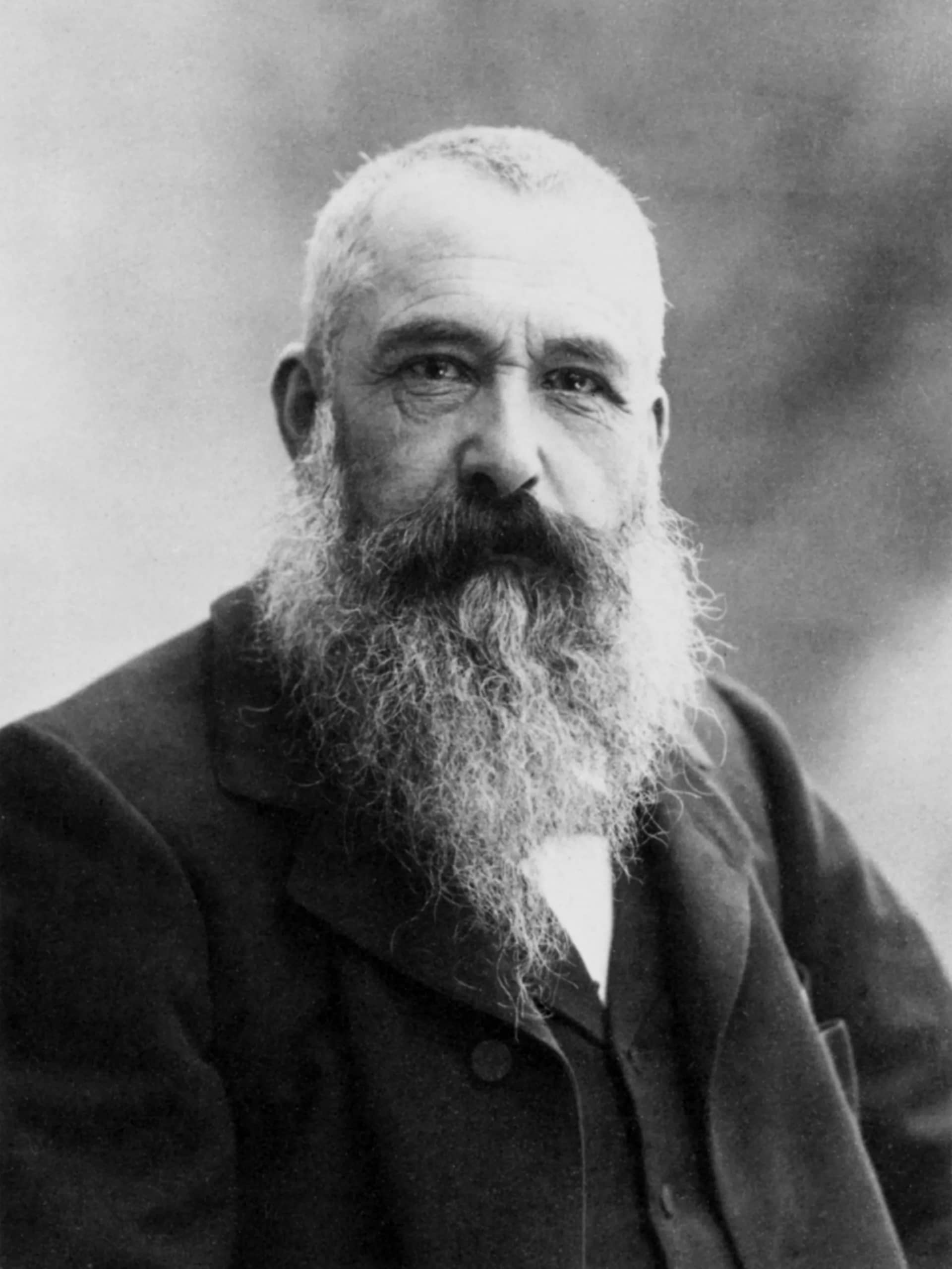
What is easy to miss about Monet, because the Water Lilies have become such familiar cultural furniture, is how genuinely strange his whole project was. He spent sixty years obsessively painting light, not objects, not people, not stories. Light on water. Light on haystacks. Light on a cathedral facade at 6 a.m. versus 3 p.m. He built a garden specifically so he could paint it. He had cataracts in his final years and kept painting anyway, producing canvases that look abstract partly because he could no longer see clearly. That is not the biography of a decorator. It is the biography of someone who had a single burning idea and refused to let anything stop him from pursuing it.
This guide traces Monet's life from his teenage years selling caricatures in Normandy to the Orangerie's grand rooms. It covers what made his technique so radical, how the Giverny garden became both subject and obsession, and what to look for the next time you stand in front of one of his paintings.
From Normandy Caricatures to the Plein Air Revelation
Oscar-Claude Monet was born on November 14, 1840, in Paris, but his family moved to Normandy when he was five. Growing up near Le Havre, he developed a talent for caricature that was noticed early. By fifteen he was selling portrait caricatures for ten to twenty francs each, a real income for a teenager, and his work was displayed in a local framing shop alongside landscapes by a painter named Eugène Boudin.
Boudin changed everything. He was a dedicated practitioner of plein air painting, working outdoors directly from nature rather than in the studio, and he pushed the teenage Monet to try it. Monet later described the experience in terms that sound like a conversion: "It was as if a veil had been torn from my eyes; I understood what painting could be." The specific quality of coastal Normandy light, the way sea and sky merge on overcast days, the speed with which weather changes along the Channel, all of this shaped what Monet would spend his life pursuing.
He moved to Paris in 1859, studied at the Académie Suisse, and found his people: Auguste Renoir, Alfred Sisley, and Frédéric Bazille, all young painters chafing against the rigid priorities of the Académie des Beaux-Arts. The Academy favored polished historical and mythological paintings with invisible brushwork. This group wanted to paint the world they could see around them, with the evidence of their hands left on the surface. According to records held at the Musée d'Orsay, these artists were repeatedly rejected by the official Salon juries throughout the 1860s, which ultimately led them to organize their own exhibition.
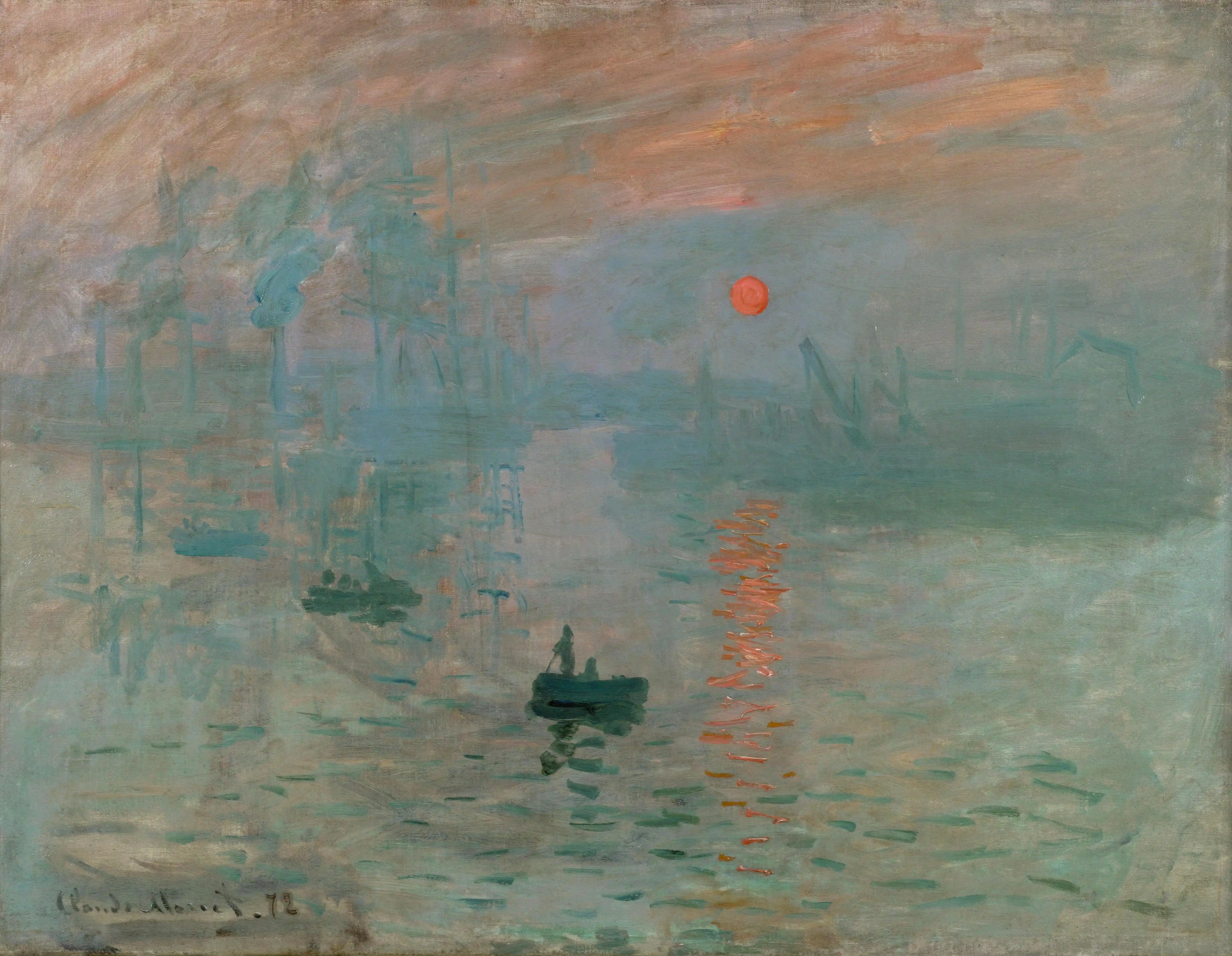
Claude Monet, "Impression, Sunrise" (1872), oil on canvas, 48 x 63 cm. Musée Marmottan Monet, Paris. The painting that named a movement, after a hostile critic used it as evidence of the group's incompetence. Image: Public domain, via Wikimedia Commons
How Impressionism Actually Started
In April 1874, Monet and about thirty other painters organized an independent exhibition in Paris, using studio space lent by the photographer Nadar. They called themselves the Anonymous Society of Painters, Sculptors, and Printmakers. The press was largely hostile. The critic Louis Leroy wrote a mocking review in the satirical magazine Le Charivari, using Monet's "Impression, Sunrise" (1872) as his example of the group's apparent laziness and incompetence. The painters adopted the label "Impressionists" in defiance, and the name stuck.
What made Monet's work look unfinished to trained academic eyes was exactly what made it radical. Academic painting required smooth surfaces, invisible brushstrokes, and carefully blended tones. Monet applied paint in short, separate strokes of pure or near-pure color that remained visible on the surface. Stand too close to one of his canvases and it looks like a chaos of disconnected marks. Step back to a normal viewing distance and the marks merge in your eye into shimmering light effects that conventional blended paint cannot produce. He was not making shortcuts. He was using how human vision actually works.
The technique was built on a specific understanding of color theory, particularly the principle of simultaneous contrast documented by the French chemist Michel Eugène Chevreul in 1839: complementary colors placed side by side each make the other appear more saturated. Monet put orange against blue, violet against yellow, pink against green. The result is optical energy that one blended tone could never achieve. He also observed, consistently and systematically, that shadows are not black or brown but full of reflected color from sky and surrounding surfaces. Shadows in his snow scenes are typically blue or violet. Shadows on sunlit walls are orange-pink. This was not artistic license. It was accurate observation.
Series Painting: The Same Subject, Endlessly
By the late 1880s, Monet had developed a working method nobody had attempted at this scale: painting the same subject repeatedly under different light conditions. He sometimes worked on twenty or more canvases simultaneously, rotating between them as the light changed each hour. If the light conditions he needed did not reappear on a given day, he would put that canvas aside and pick up another.
The Haystacks series (1890-1891) is the clearest demonstration of what this produced. Twenty-five paintings of grain stacks in fields near Giverny, at different times of day, in different seasons. Summer noon haystacks are ochre and gold. Winter haystacks in snow are violet and blue. The haystacks in early morning fog barely exist as form at all. When Monet exhibited fifteen of them together in 1891, the show sold out in three days. People finally understood that the light was the subject, not the stacks.
The Rouen Cathedral series (1892-1894) went further. He rented a room across from the facade and painted it more than thirty times. The stone surface reads as warm gold in afternoon sun, near-white in morning haze, and a deep cold grey under cloud cover. No two paintings look like the same building. What Monet was demonstrating, through sheer repetition, was that there is no stable "true" appearance of anything. There is only light, and light is always changing. The Metropolitan Museum of Art's overview of Monet's series paintings explains how this working method influenced later artists all the way through to Abstract Expressionism.
The Garden at Giverny: He Built the Subject
In 1883, Monet rented a house in the village of Giverny, about 75 kilometers northwest of Paris. He had eight children to support (two from his first marriage, six stepchildren from his second) and the house was affordable. Within months, he began transforming the property. He planted flower gardens with the same deliberate thinking he brought to composition on canvas, placing complementary colors in beds next to each other, arranging plants by height and bloom time to ensure the garden was always producing something worth painting.
By 1890, financially successful from his painting sales, he bought the house outright. In 1893 he purchased a strip of land across a small road and diverted a tributary of the River Epte to create a water garden. He installed a Japanese-style wooden footbridge, planted weeping willows and water irises along the banks, and introduced water lilies imported from South America and Egypt. Local authorities objected initially, worried the exotic plants would contaminate the water supply. Monet pushed back hard, and eventually got his pond.
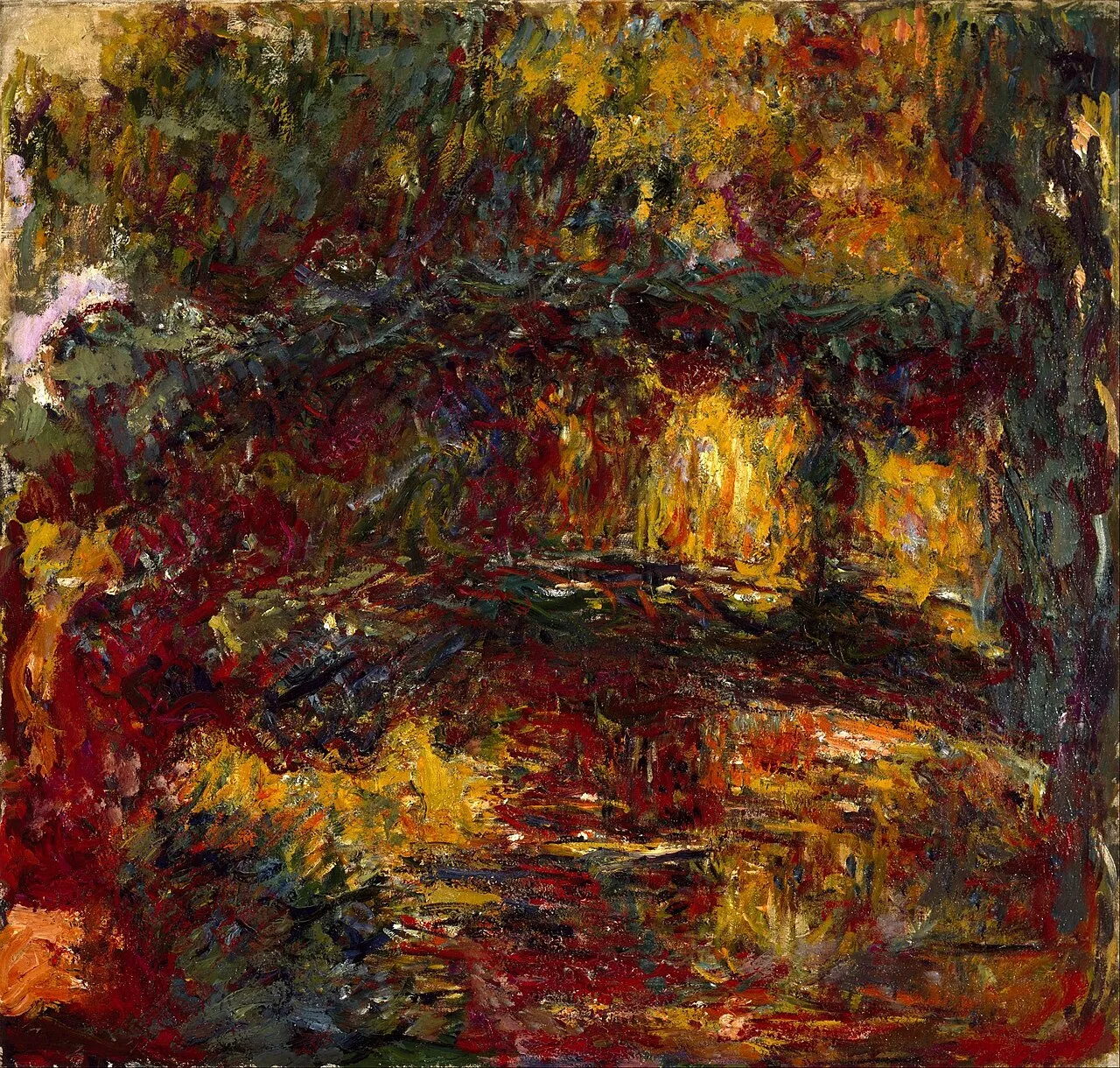
Claude Monet, "The Japanese Footbridge" (1899), oil on canvas, 81.3 x 101.6 cm. National Gallery of Art, Washington D.C. Monet painted this motif eighteen times between 1899 and 1900, under different light conditions. Image: Public domain, via Wikimedia Commons
The water garden became his subject for the rest of his life. The pond's surface is a genuinely unusual visual problem: it combines the flatness of lily pads and flowers with the reflected depth of sky and overhanging willows, so the painting has to operate at two spatial registers simultaneously. There is no horizon. There is no clear sense of distance or orientation. Monet had been building toward exactly this kind of subject for forty years.
Cataracts, Ambition, and the Orangerie
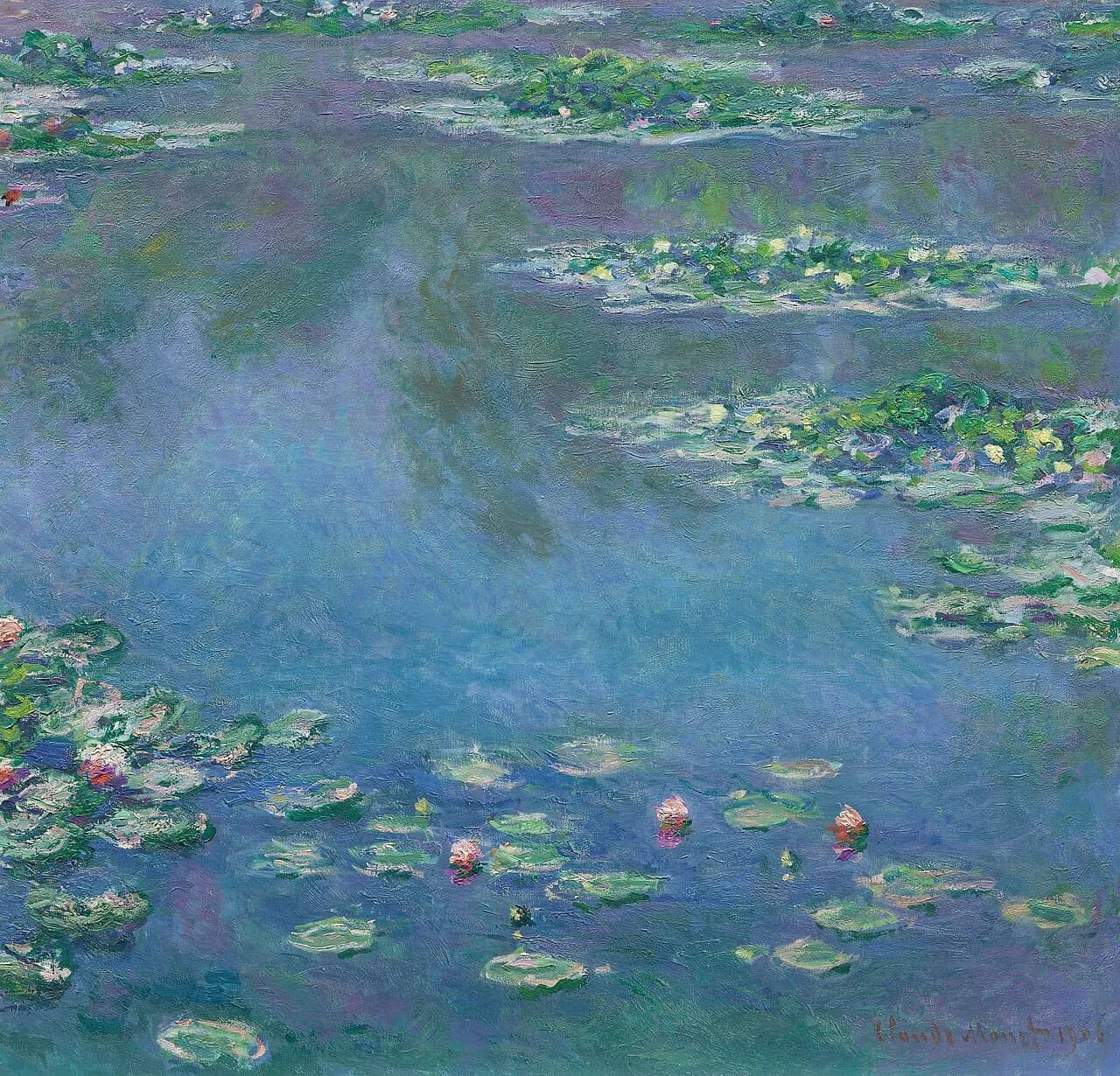
The Water Lilies series grew to more than 250 paintings over three decades. In his final years, Monet's vision deteriorated severely from cataracts. He delayed surgery for years, afraid of what the outcome might be, and kept painting through worsening eyesight. During this period some of his canvases became looser and more turbulent, with colors that no longer corresponded to what a clear-sighted observer would see, partly because cataracts filter out shorter wavelengths and produce a yellowing of vision. He was working from memory and from the distorted perceptions of damaged eyes.
After a cataract operation in 1923, he reportedly looked back at some of his recent canvases and repainted or destroyed several he found unsatisfactory. This is worth knowing the next time someone argues that Monet's late work is purely expressive or accidental. He had standards. He was just working with tools that were failing him.
In 1914, his close friend Georges Clemenceau, the French statesman, convinced Monet to donate a series of large-scale water lily panels to the French state as a memorial to those killed in World War One. Monet designed a purpose-built studio at Giverny to produce canvases on an unprecedented scale, some stretching over four meters across. He worked on them for more than a decade. The Orangerie installation was unveiled in May 1927, five months after Monet died on December 5, 1926, at eighty-six.
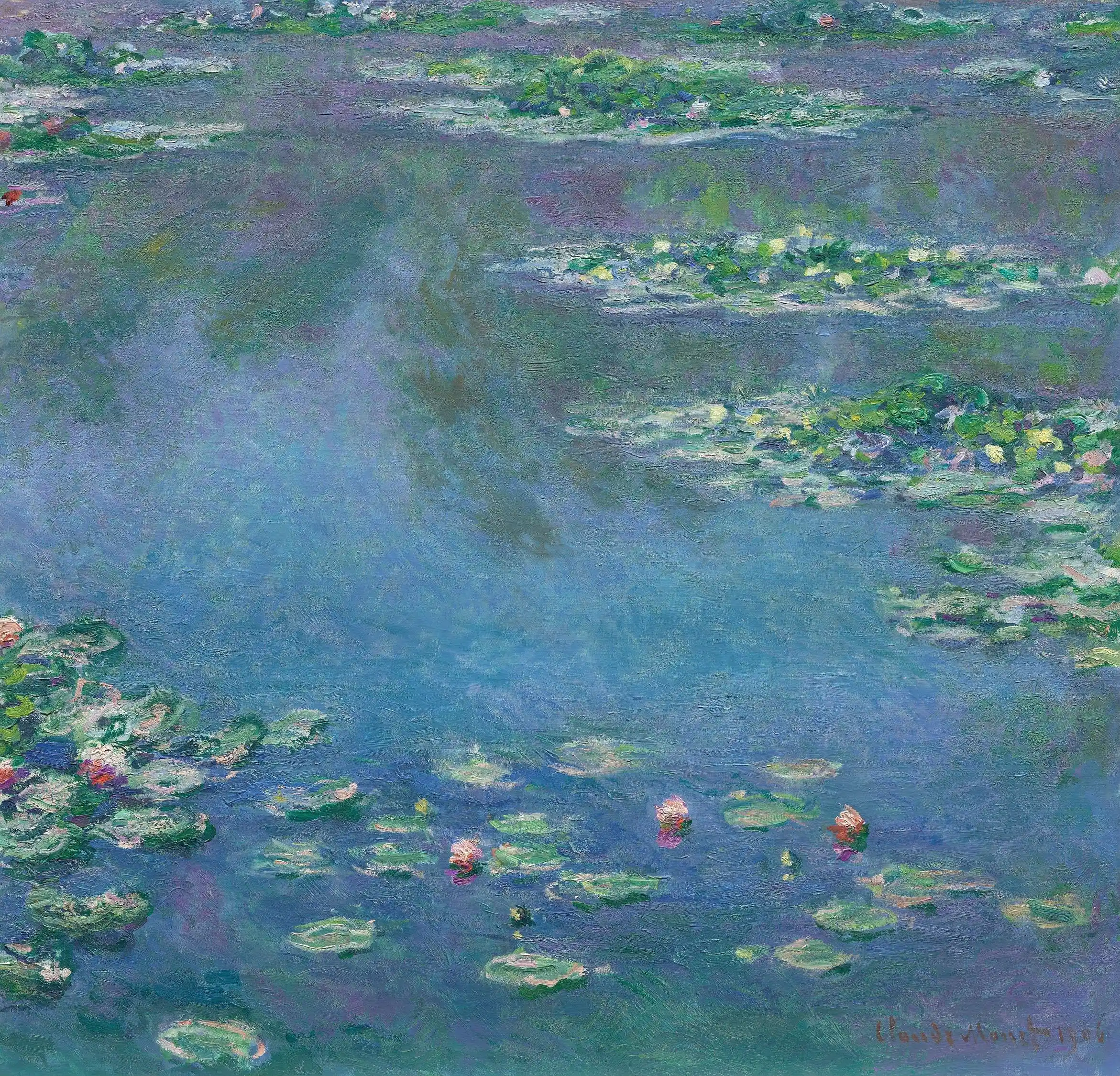
Claude Monet, "Water Lilies" (1906), oil on canvas, 87.6 x 92.7 cm. The Art Institute of Chicago. One of more than 250 paintings Monet made of his Giverny pond. Image: Public domain, via Wikimedia Commons
What to Look for in a Monet Painting
Seeing Monet's work in person matters more than almost any other artist, because reproductions compress the scale and flatten the texture that make his technique legible. The Musée d'Orsay in Paris and the Orangerie both have major holdings. The Art Institute of Chicago and the National Gallery in London also have important works. If you go, stand close enough to see individual brushstrokes, then step back to where the strokes merge. Notice the shift. That is the whole point of the technique.
In any Monet painting, look at the shadows first. He almost never used black or brown to darken a tone. Shadows are built from complementary and cool colors: blue-violet in snow scenes, green in foliage shadows, warm violet and orange in shadows on sunlit walls. This reflects actual observation: shadows on a sunny day are lit by the blue sky above, not by the sun, so they are genuinely cooler and bluer than the lit surfaces beside them. Academic painters before Monet used brown-black shadows as convention. Monet painted what he saw.
Second, look at how he handles composition in the late Water Lilies. He removes the horizon completely. There is no sky, no bank, no fixed orientation. The viewer has no anchor. This is not an accident or a limitation of his failing eyesight. He was making paintings that refuse the conventions of landscape composition entirely, and they work because the pond's surface is genuinely horizon-free when you look straight down into it. The paintings are as close to abstract as anything produced in Europe before abstract painting was formally invented.
Third, compare the Water Lilies to his earlier series work. The Haystacks are still conventional landscapes with sky, fields, and a clear sense of place. By the time of the late Water Lilies, place has dissolved into pure optical experience. That forty-year progression from Normandy coastal scenes to the Orangerie's floating color environments is one of the most sustained artistic developments in the history of painting. To understand the broader context of how painters use color, reading about color mixing reveals exactly why Monet's approach to pure pigment was technically as well as visually radical.
Why Monet's Work Still Matters
About half a million people visit Giverny every year. The garden has been restored to how it looked in Monet's time. The water lilies are still there, still floating, still catching afternoon light on the same pond Monet built in 1893. That a garden constructed by a painter to serve as raw material for his paintings should become one of the most visited sites in France, more than a century after his death, is a strange and telling fact.
What Monet's work changed, and what keeps it relevant, is a question. Before Monet, the standard ambition of painting was to show what a place or person looked like. After Monet, painting could ask what it feels like to see something at a specific moment in specific light, and that question turned out to open much more territory than the old one. Fauvism, Expressionism, Abstract Expressionism, and eventually abstract painting all follow from the permission Monet's work granted: that the painter's perception, not the subject's objective appearance, is what a painting needs to record.
To understand the movement Monet helped found, the full guide to Impressionism: Monet, Light, and Breaking Academic Rules covers the technical and historical context in depth. For the broader arc from Monet's era to the present, see The Evolution of Art Styles: From Realism to Contemporary. And for a look at how the Post-Impressionists built directly on Monet's foundations, the complete guide to art movements places his work in the wider timeline. Which Monet series do you find most compelling? Share your thoughts in the comments below.