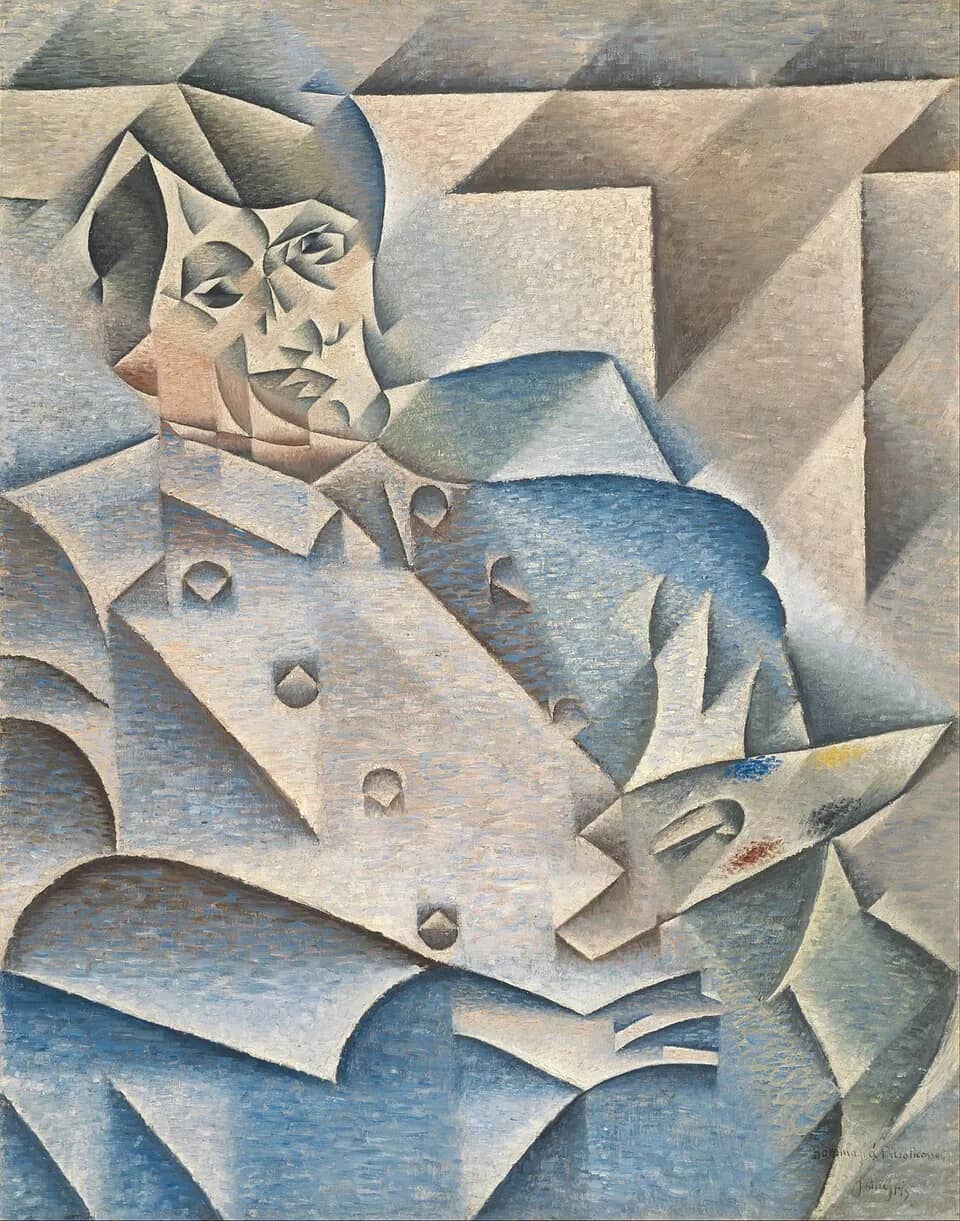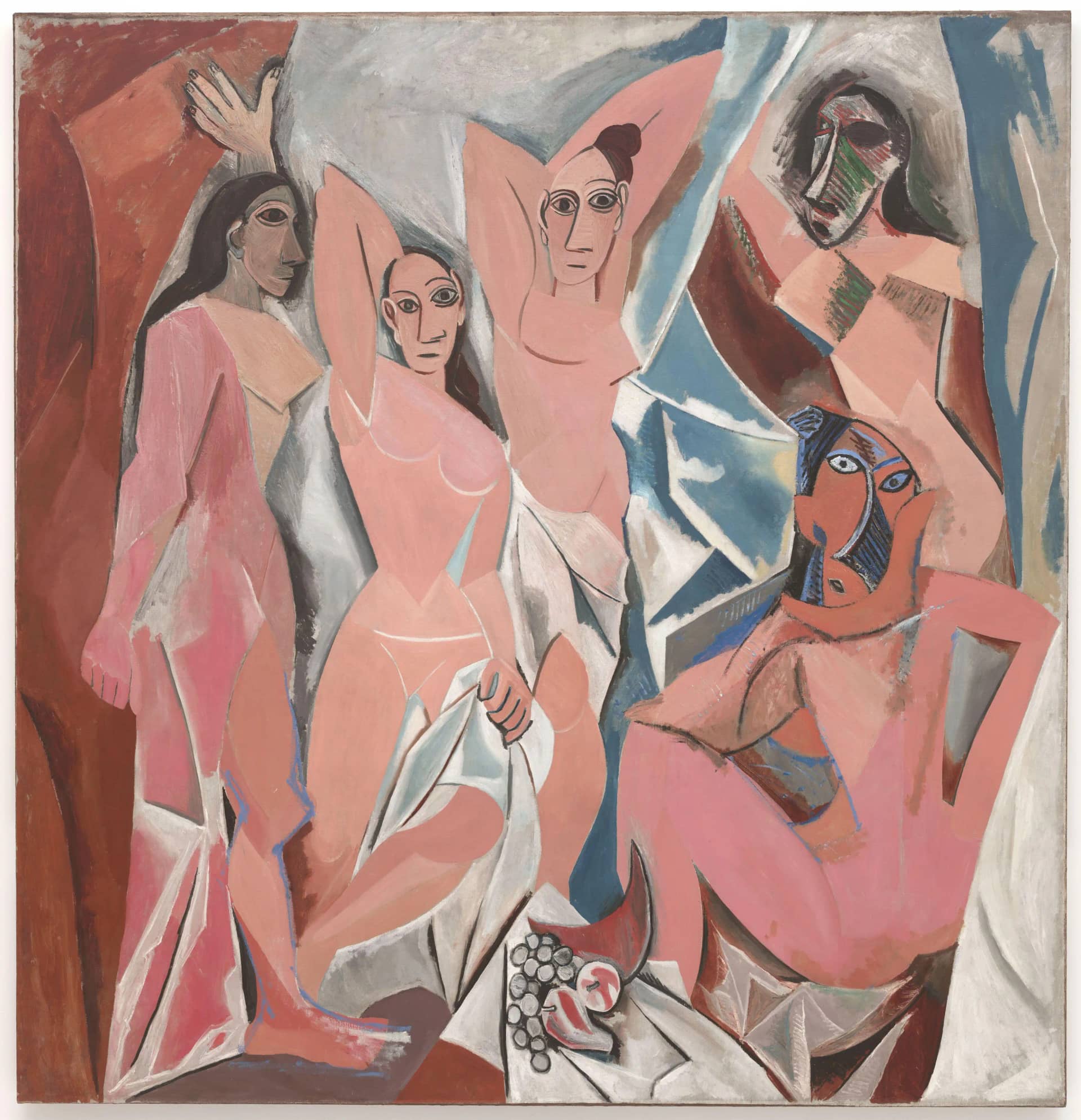
When Georges Braque first saw "Les Demoiselles d'Avignon" in Picasso's studio in 1907, he reportedly said it made him feel as though someone had drunk petrol and was spitting fire. This was not a compliment, not exactly. Braque was genuinely unsettled. Matisse was furious. Derain told a mutual friend he thought Picasso would be found hanging behind the canvas one day, driven mad by what he had tried to do. The painting that launched Cubism spent several years rolled up in Picasso's studio because no one could figure out what to do with it.
This context matters because "Les Demoiselles d'Avignon" tends to look obvious in retrospect, a logical step toward abstraction, almost inevitable. It was not. It was a violent rupture that confused even Picasso's admirers. And yet within a decade, Cubism had transformed the visual language of 20th-century art so thoroughly that its methods became the shared grammar of modern visual culture. Understanding how Picasso arrived at Cubism, what he was actually trying to solve, and what he went on to do for the next sixty-five years is the only way to take seriously what the 20th century actually looked like in paint.
This profile covers Picasso's full career, from his prodigy childhood in Málaga through the Blue Period, Cubism, Guernica, and his long, disputed late work.
Early Life: The Prodigy
Pablo Diego José Francisco de Paula Juan Nepomuceno Cipriano de la Santísima Trinidad Ruiz y Picasso was born on October 25, 1881, in Málaga, in southern Spain. His father, José Ruiz Blasco, was a drawing teacher who recognized his son's talent immediately. By thirteen, Picasso was producing academic drawings of professional quality. He sat the entrance examination to the Barcelona School of Fine Arts and completed it in a single day rather than the allocated month.
Conventional academic training at the Royal Academy of San Fernando in Madrid bored him. He spent his time in the cafes and cabarets of Barcelona, absorbing the bohemian culture of the city. In 1900, at eighteen, he made his first trip to Paris. He returned permanently in 1904, settling in a ramshackle building in Montmartre called the Bateau-Lavoir, where he lived in poverty among a circle of poets, dealers, and artists that included Guillaume Apollinaire, Max Jacob, and eventually Gertrude Stein, whose patronage provided both financial support and critical attention.
The Blue Period and Rose Period (1901-1906)
Picasso's first fully personal style emerged after the suicide of his close friend Carlos Casagemas in 1901. For roughly three years, he painted in an almost exclusively blue and blue-green palette: beggars, prisoners, the blind, isolated figures on the margins of urban life. "The Old Guitarist" (1903-04), now at the Art Institute of Chicago, shows a skeletal musician hunched over his instrument in cold, saturated blue tones. These are the most emotionally direct paintings Picasso ever made, and they are also, notably, the most conventional in terms of subject and technique.
By 1904, his circumstances had shifted. He met Fernande Olivier, his first long-term partner, and his palette warmed. The Rose Period (1904-1906) features circus performers, harlequins, and acrobats, painted with more fluidity. The mood is still melancholy but differently so. "Family of Saltimbanques" (1905), in the National Gallery of Art in Washington, is the best of these: six circus figures grouped in a barren landscape with a quality of quiet sadness that resists easy explanation. The National Gallery of Art's collection notes on this painting are worth reading for the biographical context.
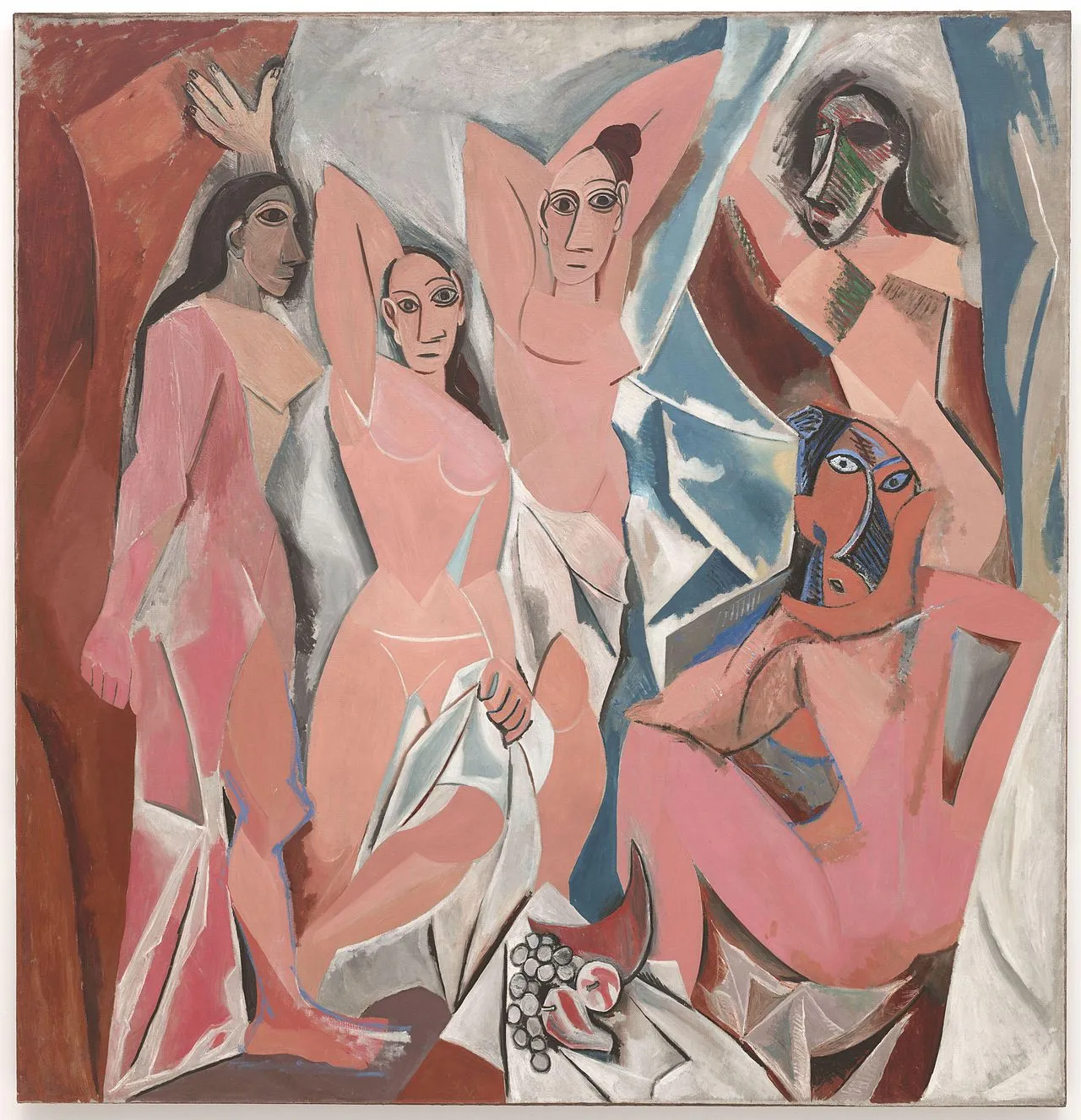
Pablo Picasso, "Les Demoiselles d'Avignon" (1907), oil on canvas, 243.9 x 233.7 cm. Museum of Modern Art, New York. The two right-hand figures show faces directly influenced by the African masks Picasso encountered at the Trocadéro in 1906. Image: Public domain in the US, via Wikipedia
The Invention of Cubism (1907-1914)
In 1906, Picasso visited the Trocadéro museum in Paris and encountered African and Iberian masks. What struck him was not their aesthetic beauty but their conceptual logic: these were not images trying to show how a face looked. They were objects trying to capture what a face meant, its force, its presence, using formal abstraction rather than visual imitation. This gave Picasso a different question to answer with painting than the one academic training had given him. Not "how does this look?" but "what is this?"
The nine months of work and over a hundred preparatory studies that followed produced "Les Demoiselles d'Avignon" (1907). The five figures in the painting are viewed from multiple angles simultaneously. Their bodies are fragmented and angular. There is no coherent perspective, no consistent light source, no unified space. The two right-hand figures show faces directly modeled on the African masks. The painting is not a window onto a scene. It is a collision of viewpoints on a flat surface, and the collision itself is the content.
Working in daily collaboration with Georges Braque from 1908 to 1914, Picasso developed these ideas into what became Analytic Cubism: subjects reduced to interlocking facets and planes, multiple viewpoints compressed onto a single surface, painted in muted browns and grays that emptied the work of color sensation to focus attention entirely on structure. Picasso described the aim plainly: "I paint forms as I think them, not as I see them."
By 1912, the collaboration with Braque had shifted toward Synthetic Cubism, which introduced collage: newspaper fragments, wallpaper, patterned papers attached directly to the canvas alongside painted areas. This permanently expanded what counted as legitimate painting material and anticipated every subsequent use of found objects in art. The full context of how this development connects to what came after is in the guide to how art movements evolve through creative collaboration.
Guernica (1937)
After Cubism, Picasso moved through a Neoclassical period in the early 1920s and a sustained engagement with Surrealism in the late 1920s and 1930s, never joining the Surrealist movement officially but absorbing its interest in dream states and psychological distortion. The anguished, fragmented figures of "Weeping Woman" (1937) are the most direct expression of this influence.
On April 26, 1937, German and Italian warplanes bombed the Basque market town of Guernica in northern Spain in support of Franco's Nationalist forces. The attack killed several hundred civilians during a busy market day. Picasso, already commissioned by the Spanish Republican government to create a work for the Paris International Exposition, responded immediately. Within six weeks, he completed "Guernica": oil on canvas, 349.3 x 776.6 cm, in black, white, and grey, showing a compressed scene of screaming figures, a wounded horse, a bull, a dead infant, and burning buildings.
"Guernica" is the single most powerful anti-war painting in Western art history. That is not a modest claim, but it is defensible. The scale forces physical submission: you cannot step back far enough to see it whole in the Museo Reina Sofía without entering a different room. The absence of color removes any possibility of beauty to retreat into. The Cubist fragmentation, which in earlier work expressed intellectual play, here produces literal dismemberment. The painting has hung at the Museo Reina Sofía in Madrid since 1992 after years in MoMA while Franco remained in power. To understand how Picasso used formal structure to express political horror, see how art communicates what words cannot.
Pablo Picasso, "Guernica" (1937), oil on canvas, 349.3 x 776.6 cm. Museo Reina Sofía, Madrid. At nearly eight meters wide, the painting overwhelms the viewer physically in a way that reproductions cannot replicate. Image: Public domain in the US, via Wikipedia
Late Career: The Underrated Decades
Picasso remained in Paris during the German occupation of World War II, joined the French Communist Party in 1944, and moved progressively to the south of France after the war: first Antibes, then Vallauris where he began making ceramics, then various homes in Provence. Art historians initially dismissed his work from the 1950s onward as the output of an old man revisiting past glories. That reading has not aged well.
His series of variations on Velázquez's "Las Meninas," fifty-eight canvases completed in just over three months in 1957, represents one of the most sustained formal investigations of a single painting ever undertaken by any artist. His late work engaged Manet, Delacroix, Rembrandt, and Ingres with the same improvisational intensity he had brought to everything earlier. The art historian John Richardson, whose four-volume biography of Picasso is the definitive scholarly account, argued that the late work deserves reassessment as among the most inventive of the career.
Picasso died on April 8, 1973, in Mougins, France, at ninety-one. He was working almost until the end. His estate inventory ran to over 45,000 works.
Why Picasso's Influence Has Not Faded
Cubism's formal innovations, fragmenting form, abandoning single-point perspective, treating the picture surface as a field of simultaneous viewpoints rather than a window onto depth, fed directly into Futurism, Constructivism, Abstract Expressionism, and Conceptual Art. Collage, which Picasso and Braque developed together in 1912, permanently changed what counted as painting. The series format of his late work anticipated the appropriation strategies that became central to postmodern art.
The broader influence is harder to quantify but more significant. Picasso demonstrated that an artist could have multiple styles rather than one signature approach, that an entire career could be structured around restless formal experimentation, and that this was a legitimate artistic position rather than a failure of coherence. Before Picasso, artists were expected to develop a recognizable style and refine it. After Picasso, reinvention became an option. Every artist since who has insisted on the right to change owes something to this precedent. For more on the movement that built most directly on Cubism, read our guide to Abstract Expressionism. Which period of Picasso's work do you find most compelling? Share your thoughts below.