Pick up a coffee cup and hold it in front of you. From where you sit, you see one side: a curve of ceramic, maybe the handle. Now imagine being able to show someone the inside of the cup, the bottom, the other side, the handle profile, and the opening all at the same time in a single image. That is the problem Cubism was trying to solve, and it is one of the most radical proposals in the history of Western art.
Between 1907 and roughly 1925, Pablo Picasso and Georges Braque invented a new visual language from scratch. They shattered the single-point perspective that had organized Western painting since the Renaissance and rebuilt reality from fragments, showing objects from multiple viewpoints simultaneously. The result was strange, difficult, and unlike anything painting had produced before. It was also the hinge point between classical Western art and everything that followed. Abstract painting, Futurism, Constructivism, and much of 20th-century graphic design all trace back to what Picasso and Braque were doing in a few studios in Paris between 1907 and 1914.
This guide covers what they did, why they did it, and what it means to look at a Cubist painting today without feeling lost.
Where Cubism Comes From
Cezanne's Legacy
Cubism begins, intellectually, with Paul Cezanne. The Post-Impressionist painter spent the last decades of his life in Provence painting the same subjects repeatedly: Mont Sainte-Victoire, apples on a tablecloth, bathers. What he wanted was something more solid than the Impressionists' fleeting atmospheric effects. He wanted to "treat nature by the cylinder, the sphere, the cone," as he wrote in a letter to Emile Bernard in 1904. His late paintings show objects slightly distorted, viewed from shifting vantage points within a single canvas, with their underlying geometric structure exposed.
When Picasso and Braque encountered Cezanne's work in 1907, both independently recognized it as pointing toward something that could be pushed further: a systematic analysis of form that abandoned the pretense of a single fixed viewpoint entirely. Cezanne had loosened the rule. Picasso and Braque broke it. The Metropolitan Museum's Cubism overview describes Cezanne's late work as the direct intellectual foundation for what followed.
African and Iberian Art
Around the same time, Picasso was spending time at the Trocadero museum in Paris, studying African masks and Iberian sculptures. What struck him was how these objects conveyed power, presence, and formal complexity without using Western conventions of naturalistic representation. A face could have two eyes on the same plane and still be unmistakably a face. Features could be abstracted, displaced, and multiplied. The expressive vocabulary was wider than anything European academic training offered.
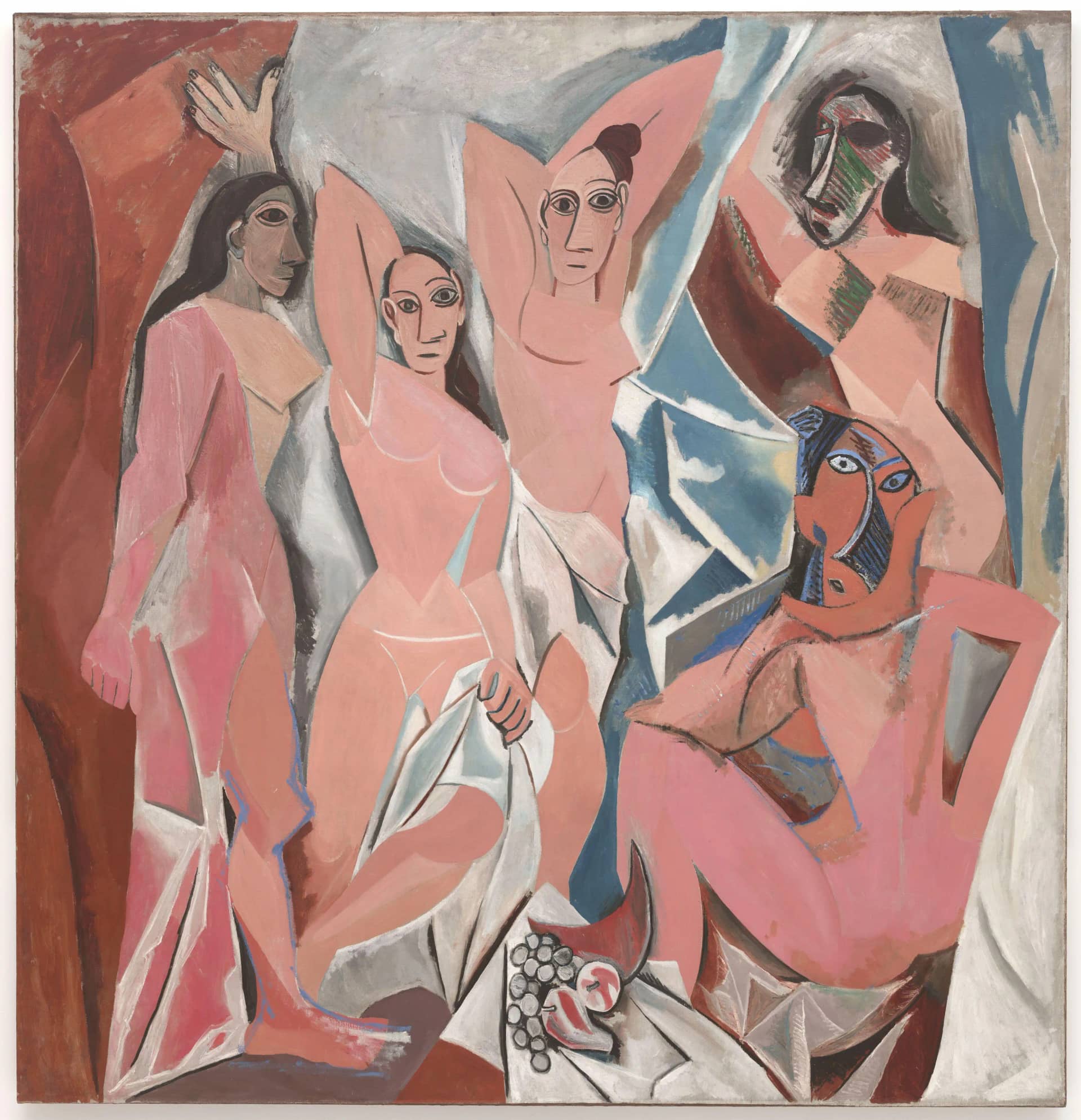
These influences converged in 1907 when Picasso painted "Les Demoiselles d'Avignon," a large canvas showing five women from a Barcelona brothel in a style that synthesizes Iberian frontality with African mask-derived distortion. It is one of the most fought-over paintings in art history. The painter Andre Derain reportedly said after seeing it that Picasso would be found hanging behind his canvas, having hanged himself in despair. It was not exhibited publicly until 1916, and not widely seen until the 1920s. It is not yet Cubism, but it is the direct precursor: the moment where the conventions break and something new is being worked out in real time on the canvas.
Analytic Cubism: Taking Objects Apart
Between 1908 and 1912, Picasso and Braque worked in such close dialogue that their paintings from this period are sometimes difficult to attribute without checking signatures or exhibition records. This was deliberate. Both were exploring the same problem together, and they treated each other's experiments as part of a shared project rather than as competition.
In Analytic Cubism, objects are broken into facets and planes that appear to show different views simultaneously. A guitar might reveal its front, back, and cross-section in a single image. A face might show both eyes on the same plane while also presenting a three-quarter profile. The palette is deliberately restricted: khakis, grays, and ochres, eliminating the distraction of color so that the structural analysis remains central. These paintings are genuinely difficult to read at first. The trained response is to look for a subject and orient yourself. Analytic Cubism denies you that orientation as a matter of principle: the point is that reality cannot be captured from a single fixed viewpoint, so painting should not pretend that it can.
How to Read an Analytic Cubist Painting
The key is to look for overlapping planes rather than a unified figure. Objects often remain partially legible: strings of a musical instrument, a bottle's neck, a newspaper headline fragment. These legible anchors give the eye something to hold while the overall structure refuses conventional coherence. The experience is active rather than passive: you construct the subject from evidence rather than receiving it whole. Understanding how composition in art works helps here, because Cubism fundamentally challenged every principle that traditional composition relies on, which is part of why it was so disorienting and so influential.
Synthetic Cubism: Building Images Up
Around 1912, the approach shifted. Where Analytic Cubism took objects apart, Synthetic Cubism built images up from simpler shapes and introduced collage: newspaper clippings, sheet music, wallpaper, and other found materials pasted directly onto canvases and drawings. This was unprecedented. For the first time, real-world materials that were not paint appeared in fine art paintings. Picasso's "Still Life with Chair Caning" (1912) is the canonical first work: a canvas with a piece of printed oilcloth depicting a chair caning pattern glued to its surface, framed with actual rope.
The effect is playful rather than austere. Synthetic Cubist paintings often have recognizable subjects, brighter colors, and a decorative surface quality. Picasso and Braque used newspaper fragments partly for their visual texture and partly for the conceptual frisson of having actual news in a painting. A fragment reading "LE JOU" might be from "Le Journal" (The Newspaper) but could also be the beginning of "Le Jour" (The Day) or even "jouer" (to play). The ambiguity is deliberate, and it opened a territory that collage as an art form would spend the next century exploring.
Juan Gris: Cubism's Architect
If Picasso and Braque invented Cubism through intuition and experiment, Juan Gris systematized it. His paintings are more architecturally precise, with cleaner planes and more deliberate color relationships. Gris approached each painting as a formal problem: how to construct a coherent image from geometric elements while maintaining the multi-viewpoint logic that defines the movement.
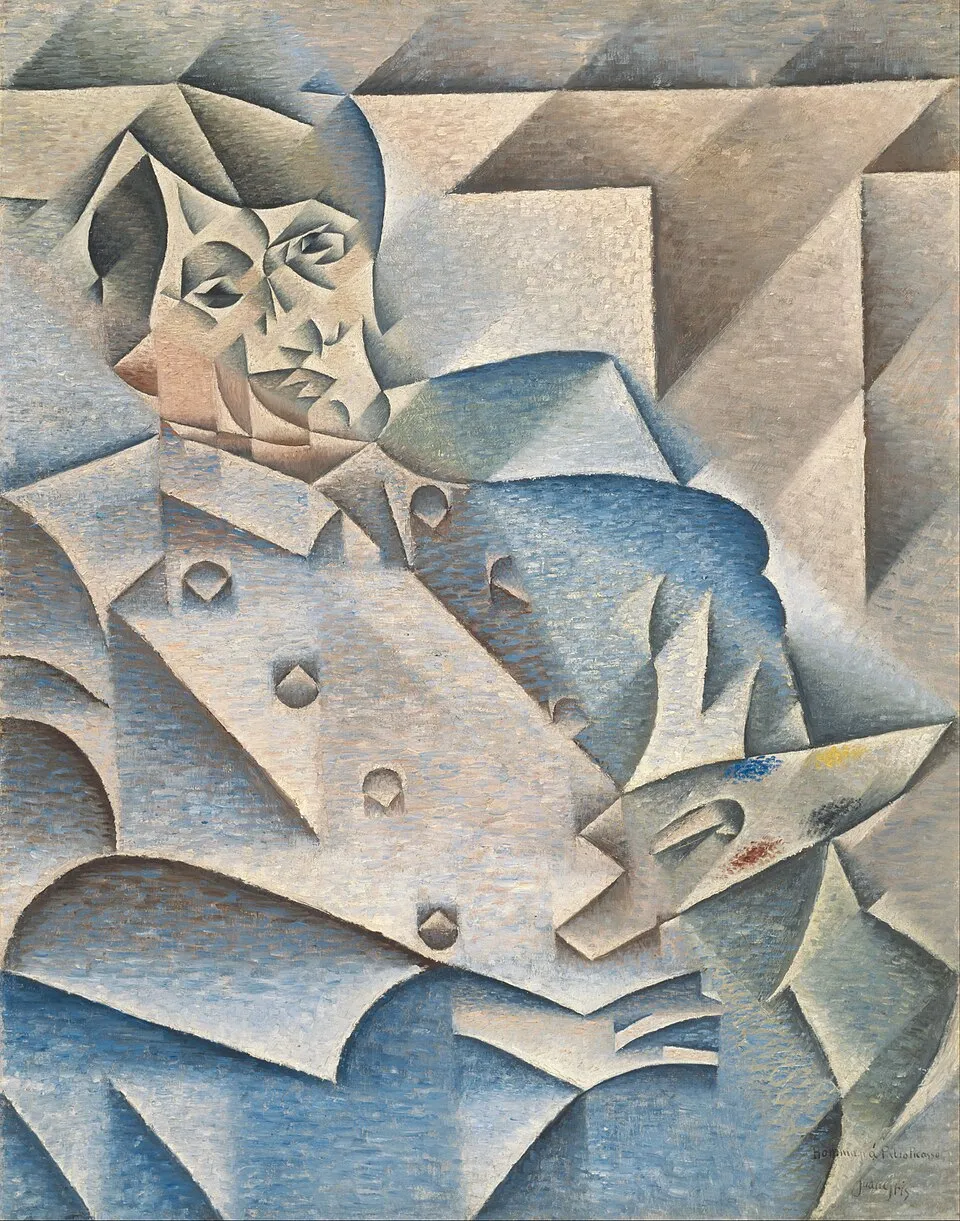
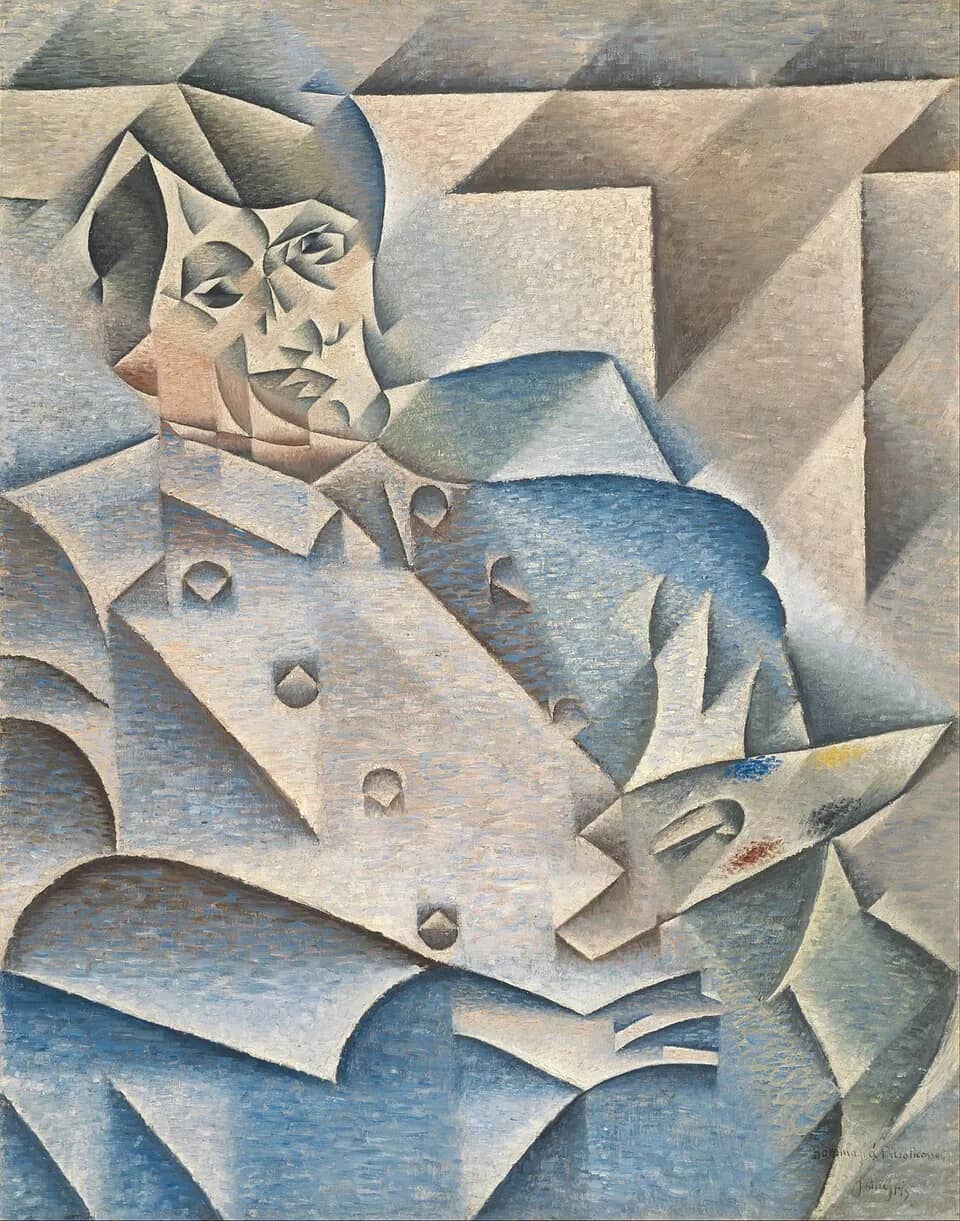
Juan Gris, "Portrait of Pablo Picasso" (1912), oil on canvas, 93.4 x 73.3 cm. Art Institute of Chicago. Gris painted Picasso fragmented into facets that still read as a convincing portrait. You know immediately who this is, even though no conventional representational technique is used. Image: Public domain, via Wikimedia Commons
That balance between abstraction and recognition is Gris's great contribution. Picasso and Braque's Analytic paintings can be so fragmented that the subject nearly disappears. Gris maintained the multi-viewpoint logic while keeping the subject legible, which made Cubism accessible to a wider audience without diluting its structural innovation.
Cubism's Immediate Influence
By 1910, Cubism had already spread beyond Picasso and Braque's studios. In Italy, Futurism borrowed Cubism's fragmented multiple viewpoints to show objects in motion. In Russia, Constructivism took Cubism's geometric logic in a political direction. In France, the Purists and later the architects of the International Style drew on Cubism's reduction of form to geometric essentials. Even fashion and graphic design were reshaped: the fractured geometric patterns of Art Deco owe something to Cubism's visual vocabulary.
The connection to Abstract Expressionism is more indirect but real. By proving that a painting did not need to represent reality in any conventional sense to be serious, meaningful, and emotionally powerful, Cubism opened the door to pure abstraction. For the full story of Picasso's place in this revolution, see Pablo Picasso: Cubism, Controversy, and a Century of Influence.
How to Look at a Cubist Painting
The biggest mistake people make with Cubism is trying to find a complete image the way you would with a conventional painting. Instead, try this approach.
First, identify the subject from the title or any legible elements. If you know it is a guitar or a portrait, begin from there. Second, look for planes and facets rather than outlines of whole objects. Cubist paintings are built from intersecting flat shapes, and your eye can learn to read them as you would read a map rather than a photograph. Third, follow the areas of higher contrast: lighter planes tend to indicate forward-facing surfaces, darker planes recession. Fourth, let the painting be multiple things at once rather than forcing it to resolve into a single image.
That last instruction is the most important and the most Cubist. The world is always more than one view at a time. Cubism is the art that finally admitted it. For a broader view of where Cubism sits in the history of visual art, the evolution of art styles guide traces the full arc from realism through abstraction. And for the complete context of how Cubism fits among the other major 20th-century movements, the complete guide to art movements places it in the wider timeline. Which Cubist painting have you spent time with, and what did you see in it? Share your thoughts in the comments.