
In 1873, Claude Monet and Pierre-Auguste Renoir set up their easels side by side and painted the same duck pond. The resulting canvases were so similar that, decades later, art historians genuinely argued about which artist had painted which. A 2024 book by art historian Harmon Siegel, Painting with Monet (Princeton University Press), unpacks exactly this kind of collaborative looking and asks what it means that two distinct painters, looking at the same scene, could produce paintings this close. The answer matters for understanding what Impressionism actually was: not just a technique, but a philosophical project about how we see the world and whether anyone sees the same thing.
Impressionism emerged in 1870s Paris when a group of young painters rejected the precise, polished style taught in the French academies. Instead of working in studios under controlled lighting, they hauled their easels outdoors and painted what they actually saw: fleeting moments of sunlight on water, crowds moving through city streets, dancers caught mid-step. The art establishment was horrified. Critics mocked them. Within a few decades, however, these rebels had fundamentally altered how artists think about color, light, and the purpose of painting itself.
In this guide, you will learn how to recognize Impressionist paintings, understand the techniques that made them radical, and discover the key artists who shaped one of art history's most consequential movements.
What Is Impressionism?
Impressionism is an art movement that originated in France during the 1860s and 1870s. The name came from a hostile review. When Claude Monet exhibited his painting "Impression, Sunrise" (1872) at an independent exhibition in 1874, critic Louis Leroy seized on the title to ridicule the entire group, calling them "Impressionists" — painters who merely sketched impressions rather than finishing proper pictures.
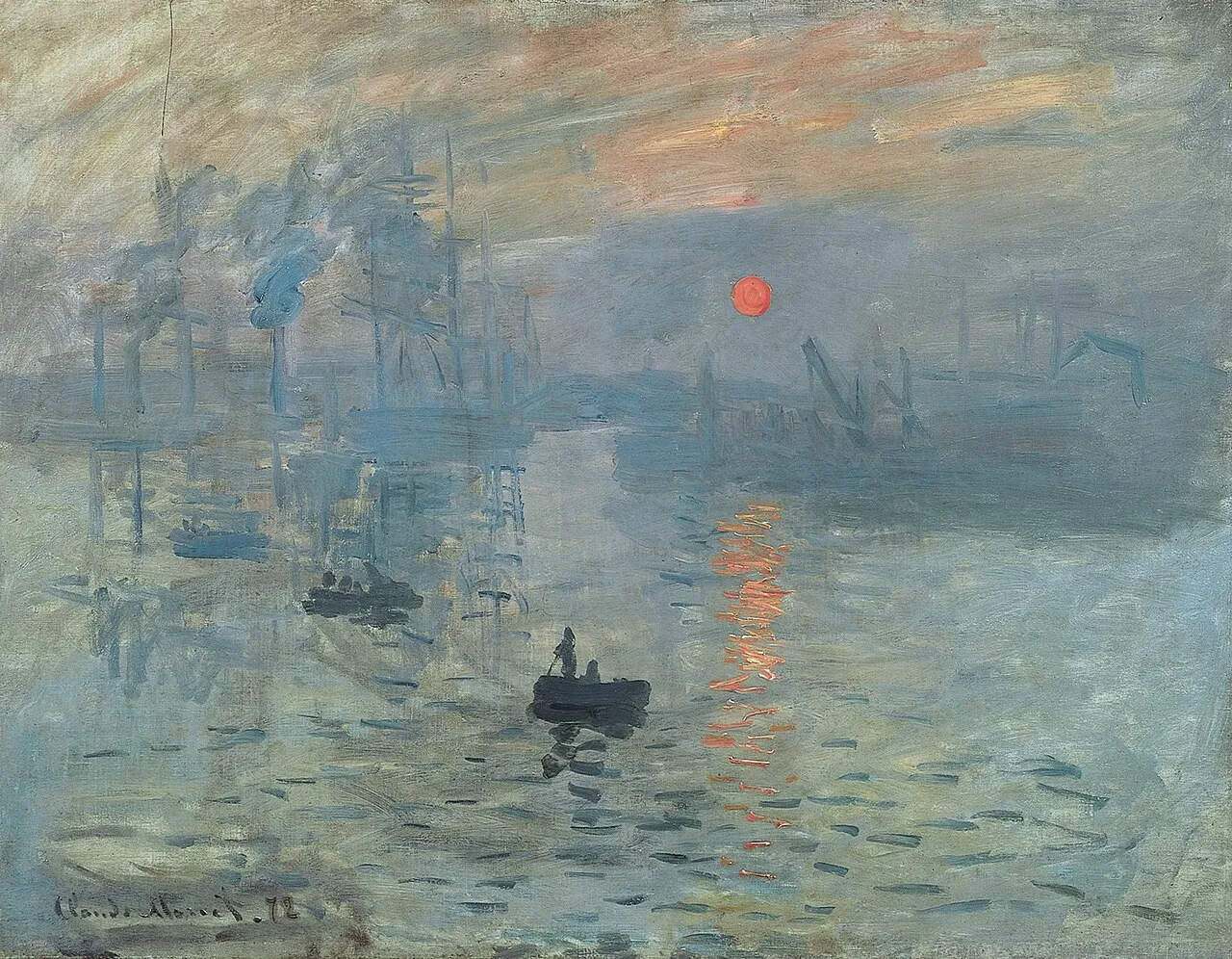
Claude Monet, "Impression, Sunrise" (1872), oil on canvas, 48 × 63 cm. Musée Marmottan Monet, Paris. The painting that accidentally named an entire movement. Image: Public domain, via Wikimedia Commons
The Impressionists wore that insult as a badge of honor. At its core, Impressionism prioritizes capturing the visual impression of a moment: how light falls across a landscape at a specific time of day, how colors shift in shadow, how atmosphere changes the appearance of solid objects. Rather than creating idealized, highly detailed compositions in the academic tradition, Impressionists painted what the eye actually perceives rather than what the intellect knows to be there.
This sounds simple. It was not. For centuries, the French Academy had dictated that serious painting required historical or mythological subjects, smooth brushwork that concealed the artist's hand, and dark palettes built up through careful glazing. The Impressionists broke every one of these rules, and they broke them on purpose.
How Impressionism Started: Rebellion Against the Academy
To understand why Impressionism mattered, you need to understand what it was rebelling against. In 19th-century France, the Académie des Beaux-Arts controlled virtually everything about an artist's career. The Academy ran the official art school, set the curriculum, and organized the annual Salon, the only major public exhibition where artists could show and sell their work.
The Salon jury favored large-scale history paintings with smooth, invisible brushwork and somber color schemes. Artists like Jean-Auguste-Dominique Ingres and Alexandre Cabanel represented the ideal. Their paintings looked almost photographic in their precision, with every surface polished to a glossy finish.
Young painters like Monet, Renoir, Alfred Sisley, and Frédéric Bazille found this approach stifling. They had been shaped by earlier rebels: Eugène Delacroix's expressive color, Gustave Courbet's commitment to painting ordinary life, and Édouard Manet, whose bold, flat compositions scandalized the art world in the 1860s. They also benefited from a practical innovation: the invention of portable paint tubes in the 1840s, which made it possible to paint outdoors without grinding pigments on site. Before the collapsible metal tube, oil painting outdoors meant hauling bladders of paint that dried out quickly and made a mess. The tube changed everything.
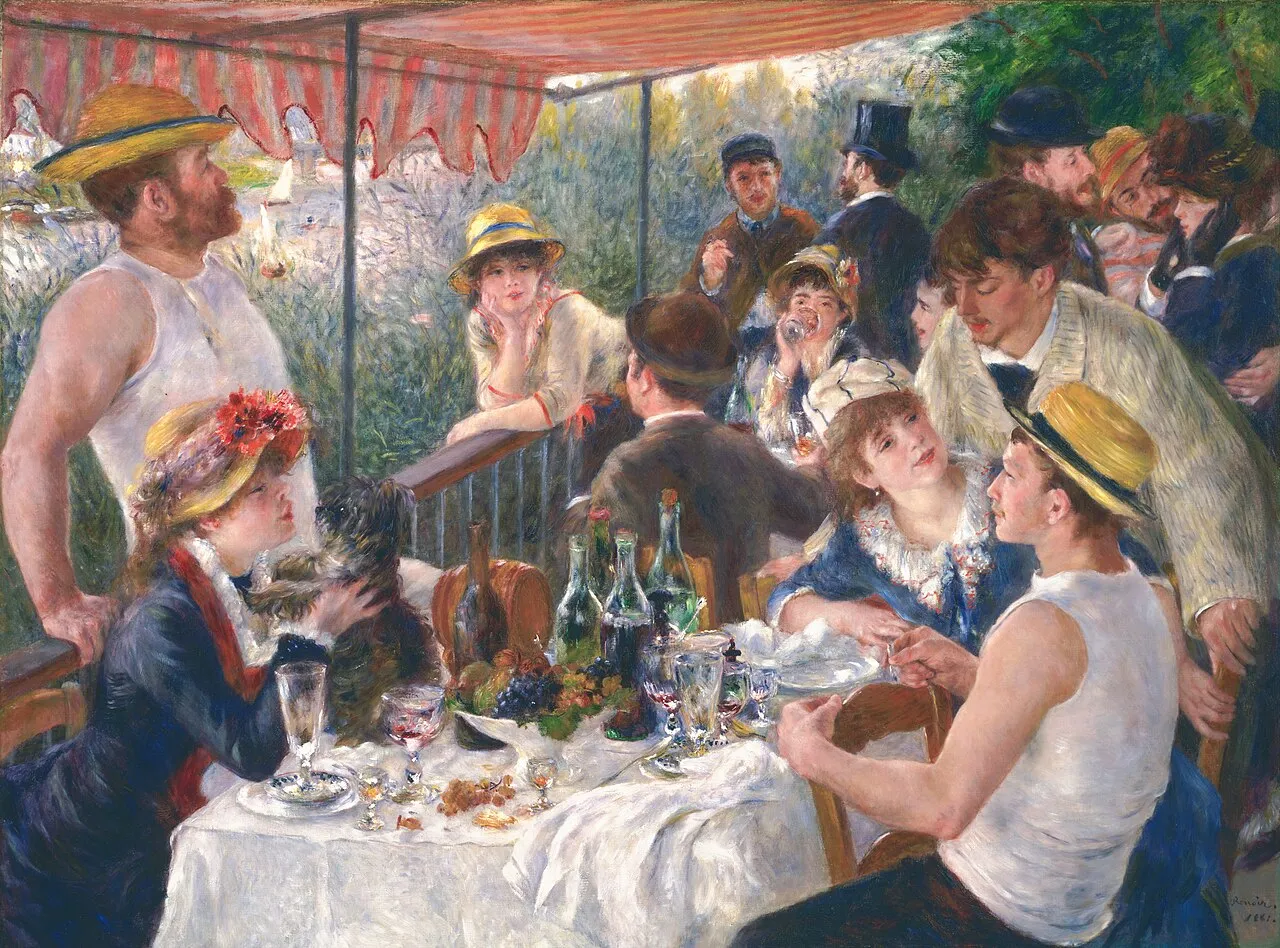
Pierre-Auguste Renoir, "Luncheon of the Boating Party" (1881), oil on canvas, 130 × 173 cm. The Phillips Collection, Washington, D.C. Renoir painted this scene at the Maison Fournaise restaurant on the Seine. Image: Public domain, via Wikimedia Commons
After repeated Salon rejections, these artists organized their own independent exhibition in April 1874 at the studio of photographer Nadar on Boulevard des Capucines. Thirty artists participated, showing 165 works. The public was bewildered, the critics were mostly hostile, but the movement had officially begun.
Key Techniques That Define Impressionist Painting
Impressionism was not just a change in subject matter. It was a fundamental rethinking of how paint could be applied to canvas, and several specific techniques set Impressionist work apart from everything that came before.
Broken Color and Optical Mixing
Unlike academic painters who blended colors smoothly on the palette, Impressionists applied pure pigments directly to the canvas in small, distinct strokes. This technique, called broken color, creates optical mixing: your eye blends the adjacent colors rather than the painter doing it beforehand. Stand close to a Monet haystack painting and you will see dabs of purple, orange, pink, and blue sitting side by side. Step back, and they merge into a luminous golden field.
The Impressionists drew on the color theories of chemist Michel Eugène Chevreul, whose law of simultaneous contrast demonstrated that complementary colors placed next to each other appear more vibrant. Orange looks more intense against blue. Red pops against green. This is why Impressionist paintings seem to glow in ways that smoothly blended academic paintings simply do not. The effect is perceptual, not technical: the painting makes your visual system do the work.
Plein Air Painting
The French term plein air means "open air," and it became the Impressionists' defining practice. Rather than sketching outdoors and finishing in the studio, Impressionists completed entire works on location. This forced them to work fast, since natural light changes constantly.
Monet pushed this further than anyone. He would set up multiple canvases and switch between them as the light shifted throughout the day. His series paintings, including the Haystacks (1890 to 1891), Rouen Cathedral (1892 to 1894), and Water Lilies (1896 to 1926), show the same subject under dramatically different lighting conditions. The haystacks are purple at dusk, gold at noon, pale blue in winter snow. The series proved that color is never a fixed property of an object. Color is always relative to the light that falls on it at a specific moment. That observation was scientifically correct and aesthetically radical.
Visible Brushwork
Academic painting prized invisible brushwork: the surface should look smooth, as if the image appeared by magic. Impressionists deliberately left their marks visible. Each stroke records a specific observation: this patch of light, that reflection on water, the way a leaf catches the sun. The visible brushwork gives Impressionist paintings their characteristic energy and immediacy. You are not just seeing a haystack. You are seeing what Monet saw, at the moment he saw it, through the movements of his hand.
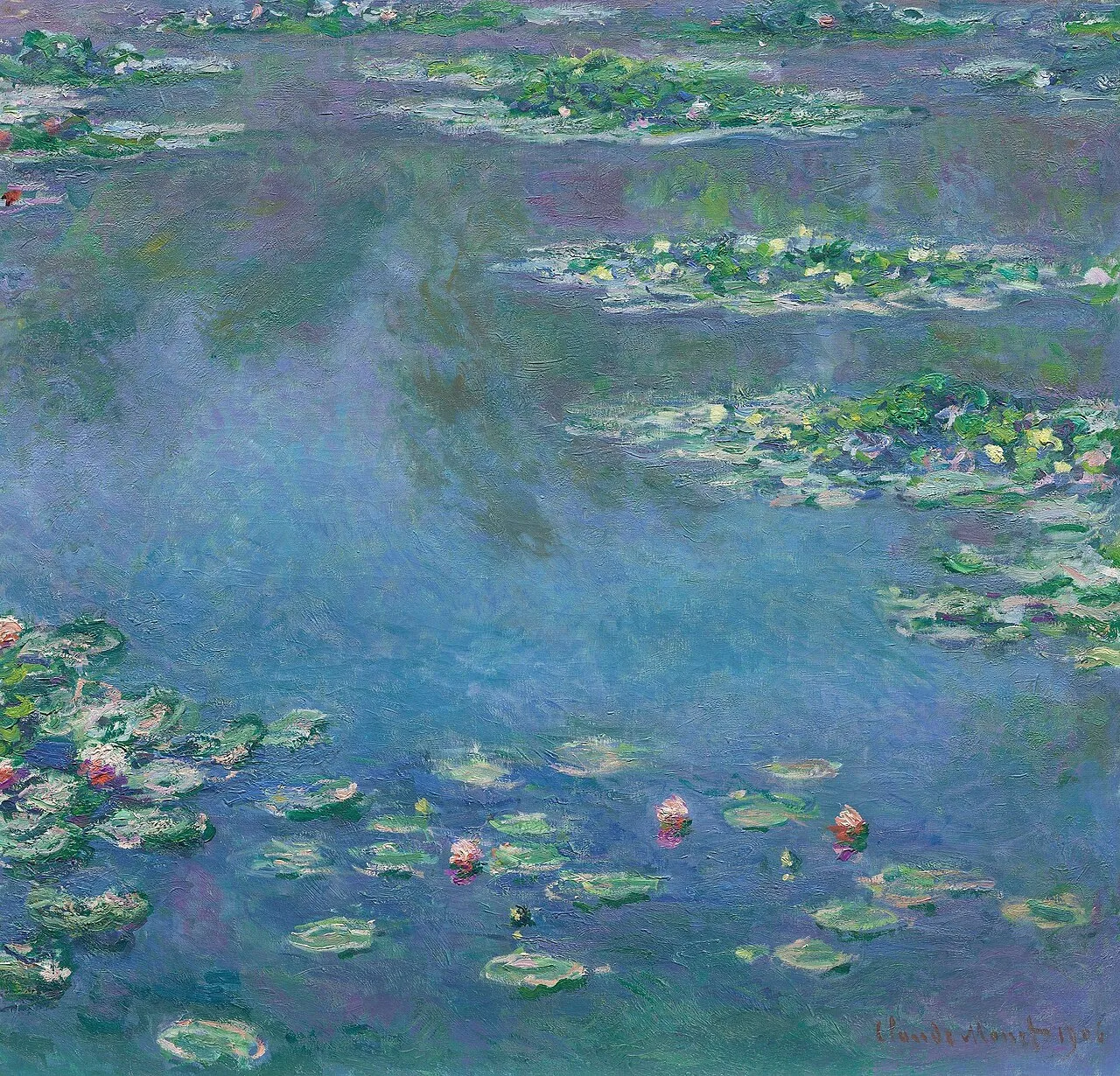
Claude Monet, "Water Lilies" (1906), oil on canvas. Art Institute of Chicago. Monet's water lily paintings demonstrate how visible brushwork creates shimmering, light-filled surfaces. Image: Public domain, via Wikimedia Commons
Everyday Subjects
The Impressionists turned away from mythology, religion, and ancient history. They painted modern Parisian life instead: café scenes, railway stations, boating parties, ballet rehearsals, horse races, and picnics. This was a deliberate intellectual choice. Poet and critic Charles Baudelaire had called on artists to become "painters of modern life," and the Impressionists answered that call directly. Their subject was the world as it looked right now, not the world as it looked in a history book.
The Major Impressionist Artists
While dozens of painters participated in the Impressionist exhibitions, several figures stand out for what they specifically contributed.
Claude Monet (1840–1926)
Monet is the most single-minded of the group. Throughout his entire career, he was essentially asking one question: how does light transform what we see? His early harbor scenes and his late water lily murals at the Orangerie in Paris are completely different paintings technically, but they are the same project. The Orangerie murals, eight enormous canvases installed in two oval rooms, were designed so that viewers stand inside the painting rather than in front of it. That ambition, creating an immersive environment from the observation of light on water, is as radical now as it was when the rooms opened in 1927.
Pierre-Auguste Renoir (1841–1919)
Where Monet focused on light and landscape, Renoir was drawn to people. His paintings radiate pleasure: sun-dappled garden parties, rosy-cheeked children, intimate portraits. "Bal du moulin de la Galette" (1876), showing a crowded outdoor dance in Montmartre, remains one of the most unambiguously joyful paintings ever created. Renoir's brushwork is softer and more fluid than Monet's, giving his figures a luminous quality that later critics found too sweet. But Renoir knew exactly what he was doing. He was not interested in struggle. He was interested in happiness, and he was skilled enough to make that interesting.
Edgar Degas (1834–1917)
Degas is the Impressionist who does not quite fit. He rarely painted outdoors, preferred artificial light to sunlight, and drew more than he painted. Yet his compositions, featuring dancers seen from unexpected angles, women bathing in private moments, racehorses caught mid-stride, embody the Impressionist interest in capturing fleeting movement. Degas was also a sculptor of real ability, creating wax figures that were cast in bronze after his death. His "Little Dancer Aged Fourteen" (1881), now at the Metropolitan Museum of Art among other collections, is one of the most observed figures in 19th-century art.
Berthe Morisot (1841–1895)
Morisot exhibited in seven of the eight Impressionist exhibitions, more than Monet or Renoir. Her paintings of domestic life, gardens, and women reading or dressing have a luminous quality achieved through loose, feathery brushwork. She is not just a footnote to the movement. Art historians have increasingly argued that her treatment of domestic interiors and the female experience of private space is more formally inventive than her contemporaries recognized. The Musée d'Orsay's collection of her work is a good place to start.
Camille Pissarro (1830–1903)
Pissarro was the only artist to exhibit in all eight Impressionist exhibitions. His rural landscapes and later urban scenes of Paris boulevards combine Impressionist light effects with a structured sense of composition. He was also a generous mentor. He worked with both Paul Cézanne and Paul Gauguin, and his willingness to push young artists in new directions helped bridge Impressionism to the Post-Impressionist movements that followed.
How Impressionism Changed Art
The Impressionists proved that artists could succeed outside the official system. By organizing independent exhibitions, they created a model that every avant-garde movement since has followed. The idea that artists should show their work on their own terms, rather than seeking approval from academic juries, is now so commonplace that we forget how radical it once was.
They also opened the door to abstraction. By prioritizing the act of seeing over the object being seen, the Impressionists shifted attention from what a painting depicts to how it depicts it. Monet's late water lily paintings, with their dissolving forms and shimmering surfaces, come remarkably close to pure abstraction. Without this shift, movements like Post-Impressionism, Fauvism, and Abstract Expressionism would look very different, if they emerged at all.
And they changed how artists and viewers think about color. Their insight that shadows contain color (purple and blue, not just black), that light transforms every surface, and that adjacent colors interact optically laid the groundwork for modern color theory in painting. If you have ever noticed that a sunset looks more vivid when framed by dark clouds, you are seeing what the Impressionists discovered and painted.
How to Recognize an Impressionist Painting
Next time you visit a museum, look for these signs that you are standing in front of an Impressionist work:
Visible brushstrokes that record individual observations, often short dabs or comma-shaped marks
Bright, saturated colors applied directly from the tube rather than blended to dullness
Colored shadows that appear purple, blue, or green rather than black
Everyday subjects, especially landscapes, city scenes, and leisure activities
Soft edges where forms blend into their surroundings rather than being sharply outlined
A sense of a specific moment, as if the light will be different in five minutes
The Musée d'Orsay in Paris holds the largest collection of Impressionist paintings in the world. The Art Institute of Chicago, the National Gallery in London, the Metropolitan Museum of Art in New York, and the Courtauld Gallery all have outstanding holdings that reward close attention.
Final Thoughts
Impressionism is one of those movements that seems familiar until you actually look at the paintings. Stand in front of a Monet haystack at the Art Institute of Chicago, close enough to see the individual strokes, and it stops looking like the art-calendar image you have seen a hundred times. It looks urgent. It looks fast. It looks like someone working against the clock because the light is changing and they are trying to hold it in paint before it slips away. That urgency is what the Impressionists were after, and it is still there 150 years later.
Ready to go deeper? Our guide to the evolution of art styles puts Impressionism in its broader historical context, and learning how to look at art as a beginner will make your next museum visit considerably more rewarding. What is the Impressionist painting you keep coming back to? We would like to know.


