The Mona Lisa at the Louvre is 77 x 53 centimeters. Most visitors see it from roughly ten meters away, through a protective barrier, surrounded by hundreds of other visitors taking photographs of the protective barrier. The actual painting is a small, dark object behind glass. What you cannot see from that distance is the sfumato, Leonardo's technique of infinitely gradated tonal transitions that makes the figure's edges dissolve into atmosphere. You cannot see how her expression shifts as you move. You cannot see why this painting was considered almost supernaturally lifelike for two hundred years after it was made.
That gap between the icon and the painting is real with almost every famous work. Guernica is referenced in political arguments by people who have never stood in a room with its 349 x 776 cm surface. The Starry Night shows up on shower curtains. Girl with a Pearl Earring inspired a novel and a film, neither of which has anything to do with the actual painting. Familiarity produces a specific kind of blindness: you see the cultural symbol and miss what the artist actually did.
This guide covers twenty of the most famous paintings in history and explains what they are actually about, not just the subject, but the technical choices, the historical context, and the specific details that most people standing in front of a reproduction never get to see.
The Renaissance Masters
1. Mona Lisa, Leonardo da Vinci (c.1503-17)
The Mona Lisa at the Louvre is smaller than most people expect and darker than reproductions suggest. What made it technically radical is sfumato, a technique Leonardo developed by applying oil paint in layers thin enough to be translucent, each layer modifying the one beneath, with no visible brushstrokes and no hard contour lines at the edges of forms. The effect is that the figure's edges dissolve into atmosphere rather than being defined by line, producing a quality of three-dimensionality and apparent lifelikeness that no painter had achieved before. The landscape behind her is geologically impossible, combining elements from different elevations and geological periods that do not coexist in nature. Leonardo was building an imaginary world behind a real person, anchoring the portrait in something beyond the specific and personal. She is not just Lisa Gherardini, wife of a Florentine cloth merchant. She is a figure existing at the boundary between the human and the natural world.
2. The Last Supper, Leonardo da Vinci (1495-98)
Painted on a refectory wall in Milan's Santa Maria delle Grazie, "The Last Supper" uses the perspective lines of the depicted room to extend the actual architecture of the refectory, making the painted space feel like a continuation of the room the monks ate in. Christ sits at the center in a triangle of light formed by the central window. The twelve apostles are arranged in four groups of three, each responding differently to Christ's announcement that one of them will betray him. Leonardo used physiognomy, the 15th-century belief that character was visible in facial expression and gesture, to show twelve distinct psychological states simultaneously. The painting began deteriorating within decades because Leonardo refused standard fresco technique, which required painting rapidly into wet plaster, in favor of tempera and oil on a dry plaster ground that let him revise and refine endlessly. His perfectionism destroyed the physical painting. What survives is already several layers of restoration away from what Leonardo made.
3. The Creation of Adam, Michelangelo (1512)
On the Sistine Chapel ceiling, the creation scene is one of nine central narrative panels, but it has become the image that defines the whole ceiling. God reaches from a swirling mass of angels and figures toward Adam's outstretched hand, their fingertips separated by a famous charged gap. Researchers have noted that the shape of the cloak surrounding God and the figures within it matches the cross-section of a human brain as depicted in the anatomical drawings circulating in Leonardo's circle at the time. Michelangelo dissected corpses for anatomical study throughout his career. Whether the brain shape is intentional is unresolvable, but the reading is coherent: that divine inspiration enters the world through the human mind. The gap is not an incomplete connection. It is where consciousness lives.
4. The Birth of Venus, Sandro Botticelli (c.1484-86)
Painted for the Medici family and drawing on Neoplatonic philosophy that Lorenzo de' Medici's circle developed from the writings of Marsilio Ficino, "The Birth of Venus" is not simply a mythological scene. The Venus depicted is "Celestial Venus," representing divine beauty and the love that draws the soul toward God, distinct from "Common Venus," the earthly Venus associated with physical desire. The nude figure was thus not erotic but philosophical: a representation of the highest form of beauty. This is almost certainly the first large-scale mythological painting on canvas in Western art, and the use of pagan mythology rather than Christian narrative to convey serious theological ideas was itself a significant intellectual move.
The Dutch and Baroque Masters
5. Las Meninas, Diego Velázquez (1656)
"Las Meninas" at the Prado shows the young Infanta Margarita surrounded by her attendants, with Velázquez himself visible at the left, painting a large canvas. A mirror in the background reflects blurry images of the king and queen watching the scene. The painting's central puzzle: Velázquez is either painting the king and queen, or he is painting us, the viewers occupying the position where the king and queen stand. The artist is in the painting watching us watch him. This recursion, the question of who is looking at whom and what representation does to the relationship between the painter, the subject, and the viewer, was analyzed by Michel Foucault in the opening pages of "The Order of Things" (1966) as a foundational image of Western modernity. At approximately 318 x 276 cm, the painting is roughly life-sized, which amplifies the unsettling effect of being watched by a figure who seems to occupy the same space you do.
6. The Night Watch, Rembrandt van Rijn (1642)
At 379.5 x 453.5 cm, "The Night Watch" at the Rijksmuseum in Amsterdam is enormous. It shows the civic guard company of Captain Frans Banninck Cocq marching out, figures caught in different stages of movement, lit by a combination of light sources that has no coherent physical explanation. Rembrandt made the scene dynamic and theatrical where every previous group portrait had been static. Some of the men who commissioned it were reportedly dissatisfied: they had paid for a group portrait where all contributors would be equally visible, and Rembrandt had buried several of them in shadow. The painting was trimmed on all sides in 1715 when it was moved, and the cropped sections are known only from a small 17th-century copy. In 2021, the Rijksmuseum used AI image reconstruction to digitally restore the missing sections, providing the most complete view of the original composition since the 18th century.
7. Girl with a Pearl Earring, Johannes Vermeer (c.1665)
Vermeer's "Girl with a Pearl Earring" at the Mauritshuis in The Hague is not a portrait. It is a tronie: a Dutch genre of character study showing a type rather than a specific named individual. The figure turns toward the viewer over her shoulder, lips slightly parted, expression unresolvable. The pearl earring is too large to be a real pearl and is probably glass or tin-foil, yet it catches light with a precision that functions as a demonstration of Vermeer's ability to render optical phenomena. Tracy Chevalier's 1999 novel gave the painting a biographical narrative that has no historical basis. The actual mystery is formal rather than biographical: why does this anonymous figure, against an absolute black background with no setting and no narrative, produce such an immediate sense of psychological presence and intimacy? No scholarly explanation has fully answered this. Read more in the spotlight on Johannes Vermeer: Light Through Windows and Domestic Mystery.
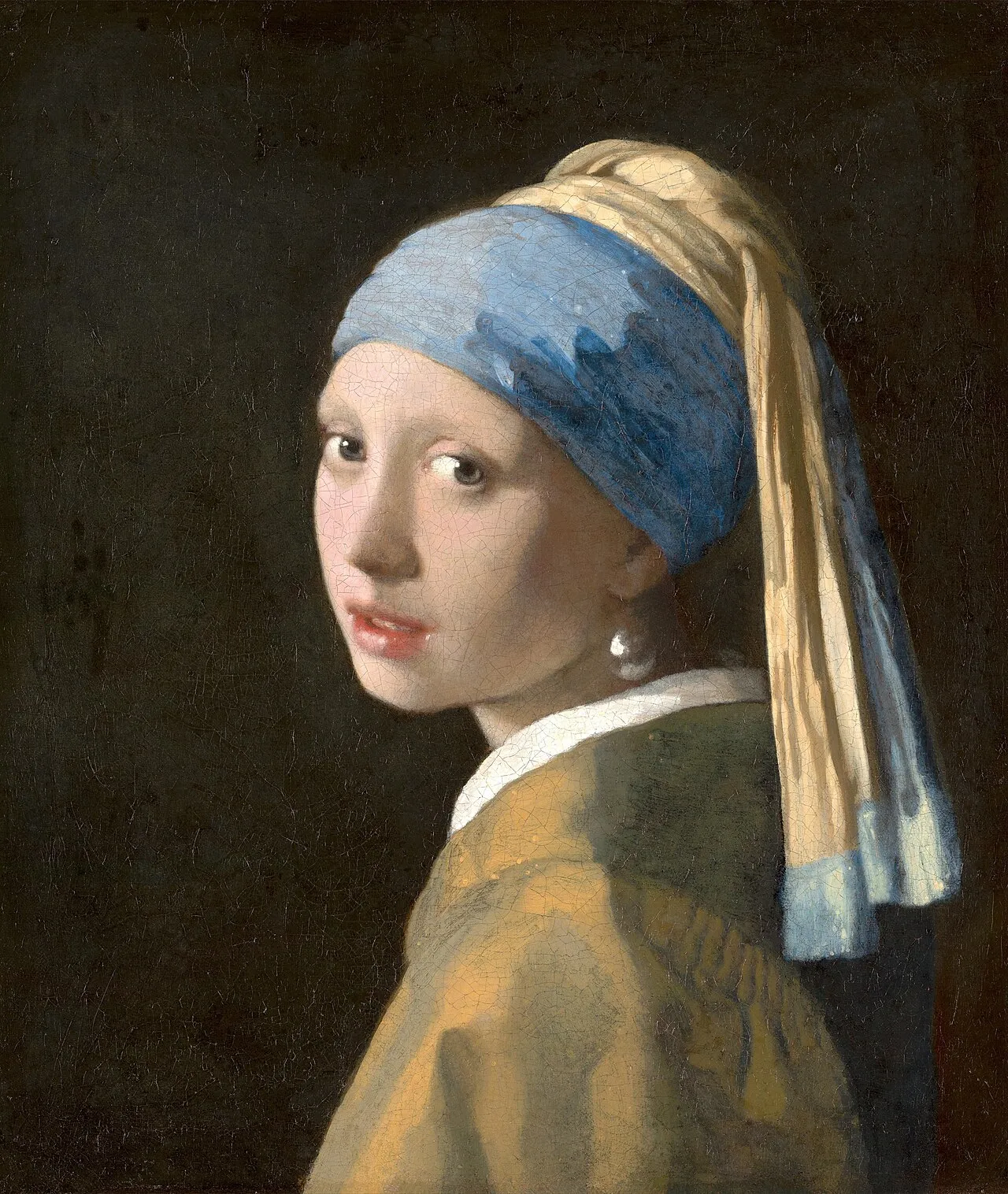
Johannes Vermeer, "Girl with a Pearl Earring" (c.1665). Mauritshuis, The Hague. The identity of the subject remains unknown. The earring is probably glass or tin-foil, not pearl. Image: Public domain, via Wikimedia Commons
Pre-19th Century Outlier and 19th Century Turning Points
8. The Garden of Earthly Delights, Hieronymus Bosch (c.1490-1510)
The triptych by the Flemish painter Bosch, now at the Prado in Madrid, has generated centuries of interpretation and resists all of them. The three panels show the Garden of Eden, a central landscape of human figures among giant fruits and fantastical creatures, and Hell as a landscape of musical instruments used as torture devices. Scholars from the Prado have argued it may be an allegory of human folly before the Fall; others read the central panel as a utopia; others as a warning about sensual excess. The visual density of the imagery, with hundreds of individually observed figures engaged in activities for which there is no conventional iconographic explanation, makes resolution impossible. The contemporary resonances are constant: Surrealists in the 1920s saw it as a precedent, game designers have borrowed from it, musicians have referenced it. Bosch is simultaneously the most medieval and the most modern painter in the Flemish tradition.
9. The Raft of the Medusa, Théodore Géricault (1818-19)
In July 1816, the French frigate Méduse ran aground off the coast of Mauritania. The officers took the lifeboats; 147 people were put on an improvised raft. After thirteen days involving violence, cannibalism, and deaths from exposure and dehydration, fifteen survivors were rescued. Géricault interviewed survivors, bought body parts from hospitals to study decomposition, and spent more than a year on the painting, which at 491 x 716 cm is the size of a history painting. The diagonal composition rises from dead bodies in the lower foreground to living figures straining upward toward a distant ship. Academic convention required historical subjects to be ennobling. Géricault applied the full vocabulary of history painting to a squalid government disaster, making the incompetence of the French navy visible to the Salon audience of 1819. It is one of the founding documents of Romanticism's insistence that difficult realities are more worthy of serious art than elevated fictions.
10. A Sunday on La Grande Jatte, Georges Seurat (1884-86)
Seurat spent two years on this large canvas, applying thousands of small dots of pure color in a technique he called Chromoluminarism, now usually called Pointillism or Divisionism. His method drew on the color science of Michel Eugène Chevreul and Ogden Rood, who demonstrated that adjacent colors of pure pigment appear to mix optically with greater luminosity than colors premixed on the palette. At the Art Institute of Chicago, where the painting now hangs, you can stand close enough to see individual dots and far enough away that the technique becomes invisible. What the technique seems to have produced accidentally, or perhaps inevitably, is a quality of extraordinary stillness. The figures are rigid, almost frozen, giving the park scene a dreamlike, slightly uncanny quality that the scientific method does not fully explain.
The 20th Century
11. The Starry Night, Vincent van Gogh (1889)
Van Gogh painted "The Starry Night" at the Saint-Paul-de-Mausole asylum in Saint-Rémy, where he had committed himself after the episode involving his ear. He wrote to his brother Theo that he was "painting the night sky to express my own terrible passions." The swirling forms of the sky are not arbitrary: they correspond to atmospheric turbulence patterns that scientists working in fluid dynamics have noted are technically accurate for a particular kind of night sky. Whether Van Gogh observed these patterns consciously or intuitively is unknowable, but the painting is not merely emotional. It is scientifically precise about how energy moves through air. The village is based on the view from his room but with a Dutch church spire added from memory. The cypress at the left rises like a dark funerary flame. The painting is at MoMA in New York. Read more in the spotlight on Vincent van Gogh.
12. The Kiss, Gustav Klimt (1907-08)
Klimt's "The Kiss" at the Belvedere in Vienna is one of the most reproduced paintings of the 20th century, which has made it almost impossible to see clearly. A couple embraces on a cliff edge, their bodies wrapped in a golden robe. His robe is decorated with rectangular black and white forms; hers has circular and floral patterns. The gold leaf applied to the surface references Byzantine icon painting that Klimt had studied directly, and the entire painting sits on a border between decorative object and symbolic content. The reading of the embrace, whether it is mutual or whether she is being engulfed, is a question the painting deliberately leaves open. The flowers beneath the cliff are in sharp focus; the drop beneath them is not depicted. The threat beneath the beauty is present but not insisted upon. Read more in the spotlight on Gustav Klimt: Gold, Symbolism, and the Vienna Secession.
13. The Persistence of Memory, Salvador Dalí (1931)
The melting watches in Dalí's most famous painting are 24 x 33 centimeters, which means the entire canvas fits on a large piece of printer paper. The size is worth knowing because the painting's cultural impact is entirely disproportionate to its physical scale. Dalí claimed the image was inspired by watching Camembert cheese melt in the sun. The barren landscape is Port Lligat on the Catalan coast. The central creature with eyelashes draped with a watch is Dalí's self-portrait as a sleeping face. The melting watches have been read as commentary on Einsteinian relativity of time, on the unconscious dream state's different relationship to duration, and as pure Surrealist image-making with no allegorical intention. Dalí encouraged multiple readings and contradicted all of them. Read more in the spotlight on Salvador Dalí: The Showman Behind the Surrealism.
14. Guernica, Pablo Picasso (1937)
On April 26, 1937, Nazi German and Fascist Italian aircraft bombed the Basque town of Guernica during the Spanish Civil War. Picasso, living in Paris, began painting his response within days and completed the 349 x 776 cm canvas in six weeks. The Cubist fragmentation allows multiple horrors to coexist: a screaming mother holds a dead child, a horse screams in agony, a soldier lies dismembered, a bull stands impassively, a figure reaches toward a bare electric lightbulb. No specific reference to Guernica appears in the image. Picasso made a painting about war's impact on ordinary life that is deliberately general enough to apply to any bombing of any civilian population. He refused to allow it to return to Spain while Franco was alive; it arrived at the Reina Sofía in Madrid in 1981. It has been referenced, borrowed, and protested in front of more times than any other painting of the 20th century. Read more in the spotlight on Pablo Picasso: Cubism, Controversy, and a Century of Influence.
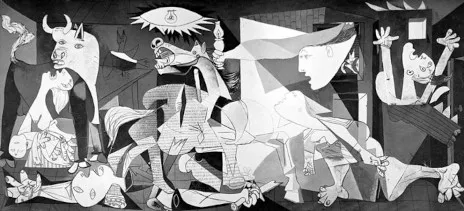
Pablo Picasso, "Guernica" (1937), oil on canvas, 349 x 776 cm. Museo Reina Sofía, Madrid. The painting makes no reference to the specific historical event; it creates an image of war's impact on civilians general enough to apply to any war since. Image: Public domain, via Wikipedia
15. Nighthawks, Edward Hopper (1942)
Hopper painted "Nighthawks" at the Art Institute of Chicago in the weeks following Pearl Harbor. Four people sit in an all-night diner: a couple, a solitary man with his back to us, and a counterman. The diner interior is aggressively lit; the street outside is dark and entirely empty. No one looks at anyone else. There is no visible door from the street into the diner. Hopper did not depict loneliness as a dramatic condition requiring explanation. He depicted it as ambient, the ordinary emotional weather of a modern city at 3 a.m. after a catastrophic event that everyone is pretending not to process. Its influence on film noir, advertising photography, the visual language of late-night television, and any image that uses an isolated figure against a lit interior to suggest interior states is incalculable. Read more in the spotlight on Edward Hopper: Loneliness, Light, and American Solitude.
16. Campbell's Soup Cans, Andy Warhol (1962)
Thirty-two canvases, each showing a different variety of Campbell's Condensed Soup, arranged like products on a supermarket shelf at the Ferus Gallery in Los Angeles, where they sold for $100 each. The paintings are made with care: the lettering is precise, the proportions accurate, the surface clean. They are paintings of commercial products using the visual vocabulary of commercial reproduction. The question they pose is not "is this art?" but something more specific: is the experience of seeing a soup can in an art gallery different from seeing it in a supermarket, and if so, what does that difference consist of? The institutional context, the frame, the price, the critical attention: these are the things that make the difference. Warhol was not being provocative. He was being accurate about how the art world actually operates. Read more in the spotlight on Andy Warhol: The Factory, Fame, and Everything Is Art.
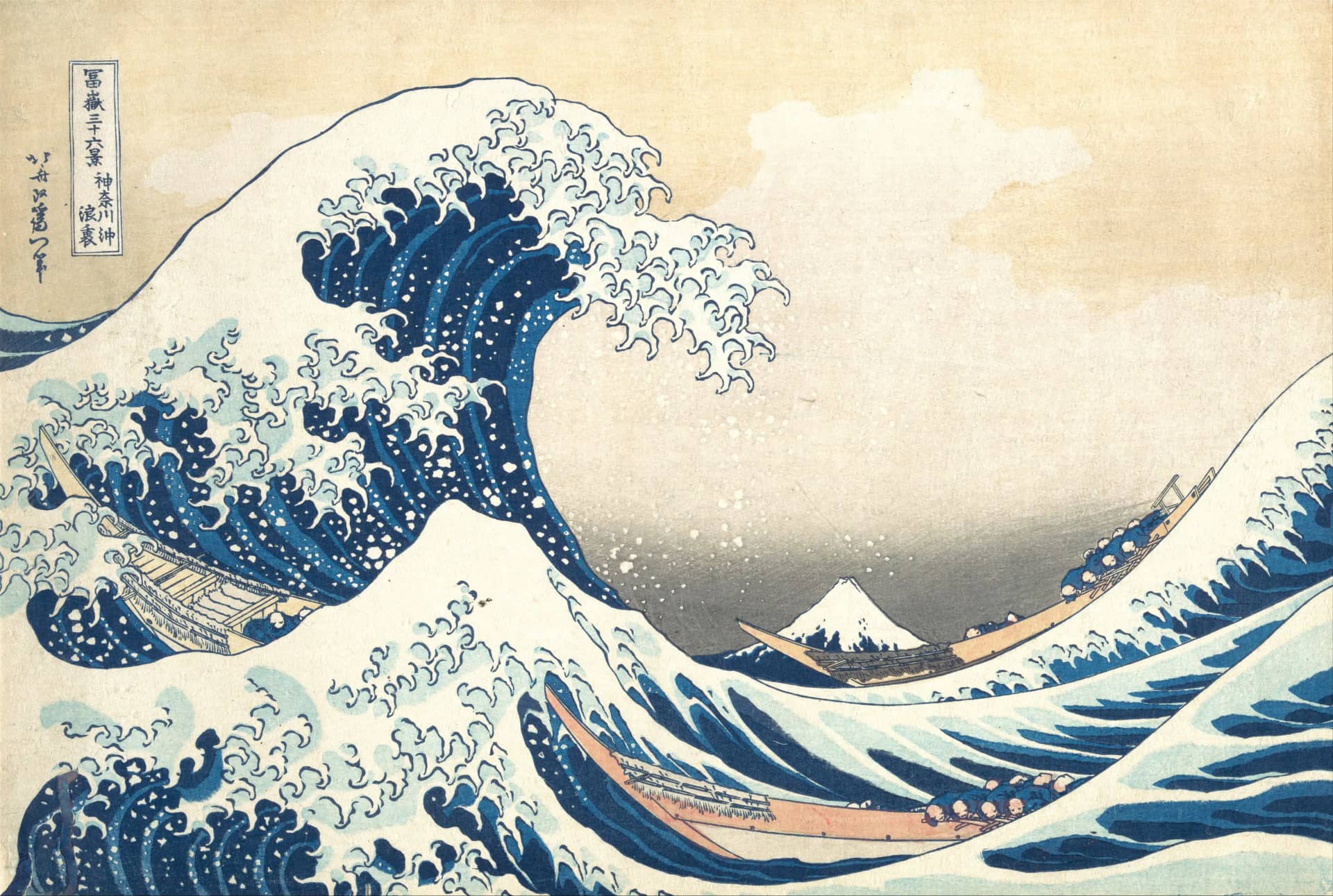
17. The Great Wave off Kanagawa, Katsushika Hokusai (c.1831)
Hokusai's woodblock print inverts the landscape's expected hierarchy: the wave, the most transient element in the scene, dominates the composition, while Mount Fuji, normally a symbol of permanent and overwhelming scale, is a small triangle in the background. The foam fingers of the wave curl like claws over the fishing boats below. The print uses Prussian blue, a pigment that had only recently become available in Japan, at maximum saturation. At roughly 26 x 38 cm, it is a small object. But the compositional intelligence, the precise understanding of how scale relationships produce emotional effect, and the formal decision to make the permanent small and the transient enormous, carries ideas that operate at any size. Read more in the spotlight on Hokusai: The Great Wave, Manga, and a Lifetime of Reinvention.
18. The Two Fridas, Frida Kahlo (1939)
Painted in the year of Kahlo's divorce from Diego Rivera, "The Two Fridas" at the Museo de Arte Moderno in Mexico City shows two self-portraits sitting side by side, hands linked. At 174 x 173 cm, it is one of Kahlo's largest canvases. The Frida on the right, in Tehuana dress, holds a small portrait of Rivera; her heart's artery is intact. The Frida on the left, in European dress, holds surgical scissors; the artery has been cut and blood falls on her white skirt. The painting is simultaneously a statement about romantic loss and a meditation on dual cultural identity, specifically about what it means to hold both a Mexican indigenous and a European self within one body. Kahlo's works entered the public domain in 2025 in most international jurisdictions, seventy years after her death, making them more accessible for study and reproduction than at any previous point. Read more in the spotlight on Frida Kahlo: Self-Portraits, Surrealism, and Personal Pain.
19. Judith Slaying Holofernes, Artemisia Gentileschi (c.1614-20)
Gentileschi painted the biblical story of Judith, who beheaded the Assyrian general Holofernes to save her city, with a physicality that no male painter who depicted the same subject had brought to it. Judith's sleeves are rolled up. Her grip on the sword is technically correct: the blade is already partway through the neck, and both Judith and her maidservant are pulling with the body weight of people doing physical work. Her expression is focused, not horrified or triumphant. The absolute black background and single Caravaggesque light source turn the composition into something closer to a documentary record than a religious illustration. The painting is at the Uffizi in Florence. Gentileschi was raped by her teacher Agostino Tassi when she was seventeen; the year she painted this was the year she was made a member of the Florentine Accademia delle Arti del Disegno. Read more in the spotlight on Artemisia Gentileschi: Baroque Painter and Trailblazer.
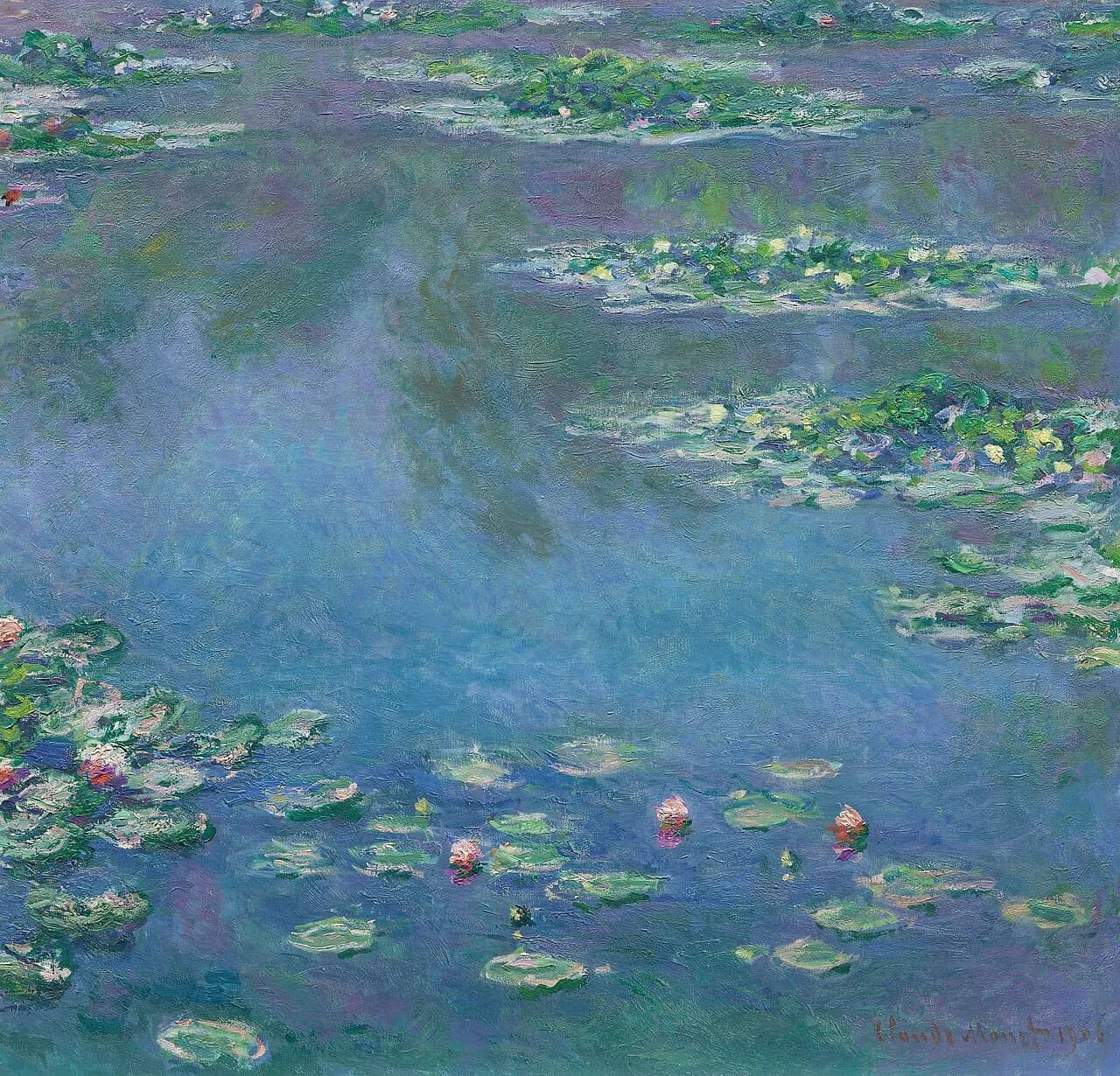
20. Water Lilies (Nymphéas), Claude Monet (1896-1926)
Monet spent the last thirty years of his life painting the pond at his garden in Giverny. The monumental late Water Lily canvases installed in the two oval rooms of the Orangerie museum in Paris, some up to six meters wide, were painted with severely deteriorating eyesight: after a series of cataract operations between 1923 and 1925, Monet could distinguish colors partly by the labels on his paint tubes. The paintings show water surface, reflection, and light in a way that does not quite represent any of these things but produces an experience of visual absorption that visitors frequently describe as overwhelming. Standing in the oval rooms at the Orangerie, with the canvases wrapping around you on all four walls at approximately eye height, is one of the closest things Western painting has produced to total environmental immersion. Read more in the spotlight on Claude Monet: The Garden at Giverny and the Birth of Impressionism.
Final Thoughts
These twenty works are famous for different reasons and by different routes. Some were recognized immediately; Vermeer's paintings were forgotten for two centuries and rediscovered by later scholarship. Some are famous for technical achievement, some for emotional power, some for the questions they pose, and some because they happened to land on a t-shirt at the right moment in cultural history. What they all share is that familiarity is not the same as understanding, and that looking at any of them as though you had never seen them before, without the icon getting in the way, produces something genuinely different from what the icon suggests.
For the practical tools to do this with any painting, see the guides to how to look at art for beginners and understanding composition in art. Which painting here changed what you thought you knew about it? Share in the comments below.