
Walk into any IKEA, open any minimalist website, sit in any tubular steel chair, and you are living inside the legacy of the Bauhaus. This German art school operated for only fourteen years, from 1919 to 1933, before the Nazis shut it down. Yet its influence on art, architecture, graphic design, industrial design, and art education is so pervasive that most people encounter Bauhaus ideas daily without knowing it. The sans-serif font on your phone screen, the open-plan layout of your office, the clean geometric lines of modern furniture. All trace back to a radical experiment in Weimar, Germany, where artists, architects, and craftspeople tried to erase the boundary between fine art and functional design.
The Bauhaus was not just an art movement. It was a school, a philosophy, and a social project. Its founders believed that art should not be confined to galleries and museums. Art should shape everyday life, from the teapot on your table to the building you live in. That conviction, that good design is a form of art and that art has a responsibility to be useful, remains one of the most influential ideas of the 20th century.
A 2024 study published in the Journal of Economic Geography by researchers at the University of Cambridge examined the Bauhaus as a case study in "symbolic knowledge innovation," arguing that the movement emerged through a process of bricolage in the peripheries of Weimar and Dessau. The study identified three phases of innovation: the generation of semiotic codes (the Bauhaus Manifesto and curriculum), the development of material artifacts (the Bauhaus building itself), and commercial success (iconic products like the Wassily chair and Josef Albers's nesting tables). This research reframes the Bauhaus not just as an artistic movement but as an early model of creative-industry innovation that still informs how we think about design ecosystems today.
What Was the Bauhaus?
The Bauhaus (from the German Bau, meaning "building," and Haus, meaning "house") was a state-funded art school founded by architect Walter Gropius in Weimar, Germany, in 1919. Its full name was the Staatliches Bauhaus, and its founding manifesto declared a revolutionary goal: to reunite all the arts, including painting, sculpture, architecture, crafts, and design, under a single creative vision.
Gropius wrote in his 1919 manifesto: "The ultimate aim of all creative activity is the building! Architects, sculptors, painters, we all must return to the crafts!" This was a direct challenge to the traditional hierarchy that placed fine art above applied art. In Gropius's vision, a well-designed lamp was as worthy of artistic attention as a painting hanging in a gallery.
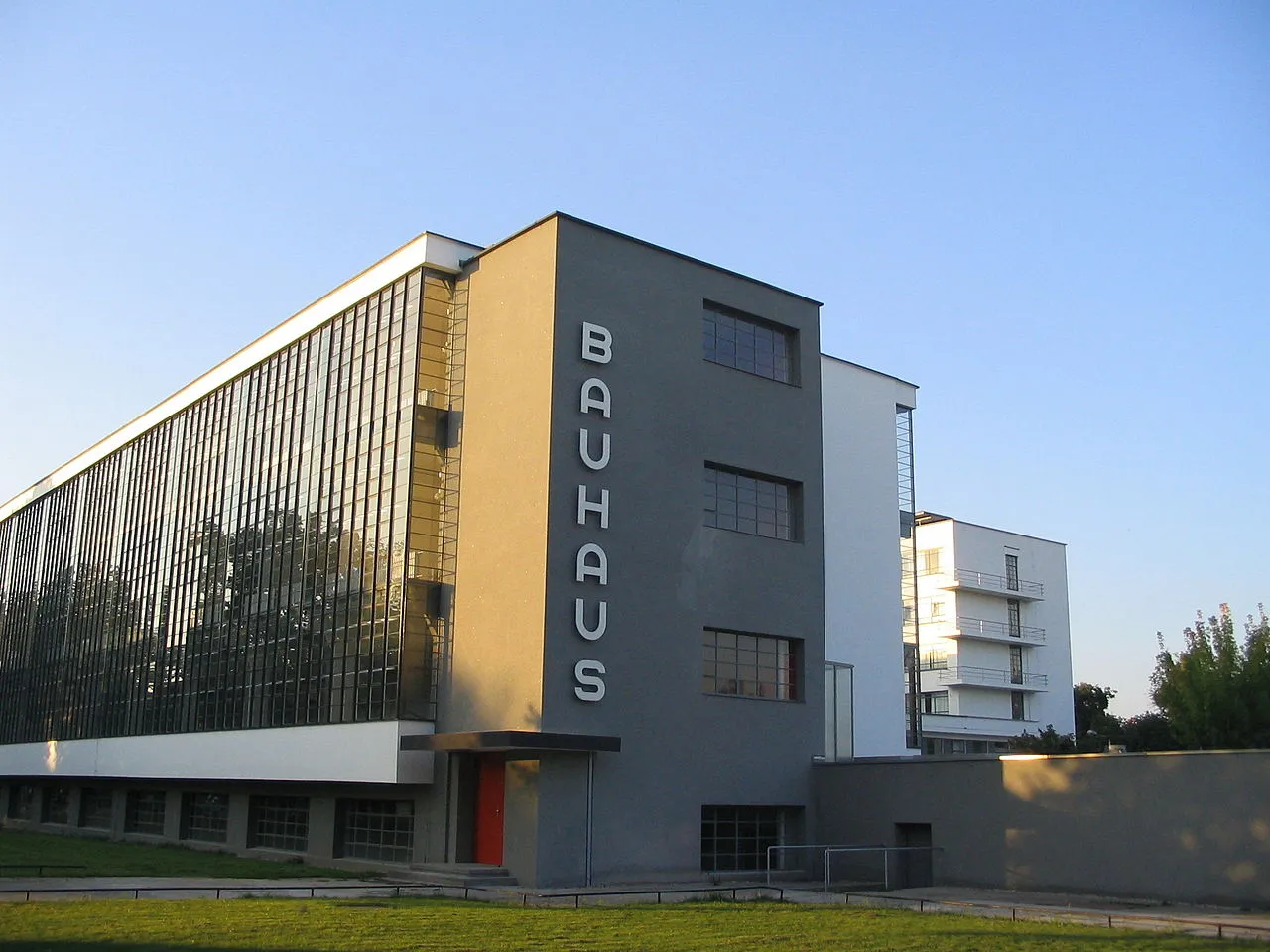
The Bauhaus building in Dessau (1925-1926), designed by Walter Gropius. Its glass curtain wall, flat roof, and asymmetrical composition became iconic examples of modernist architecture. Image: Public domain, via Wikimedia Commons
The school operated in three cities over its brief existence: Weimar (1919-1925), Dessau (1925-1932), and Berlin (1932-1933). Each phase had a different character, but the core mission remained constant. Train a new generation of artists who could design for the modern industrial world without sacrificing aesthetic quality or human values.
The Bauhaus Curriculum: Learning by Making
The Bauhaus curriculum was unlike anything in traditional art education. Instead of dividing students into painters, sculptors, and architects from the start, every student began with a six-month Vorkurs (preliminary course) that explored fundamental principles of form, color, material, and composition through hands-on experimentation.
The Preliminary Course
The Vorkurs was the Bauhaus's most influential educational innovation. Developed first by Johannes Itten and later modified by Laszlo Moholy-Nagy and Josef Albers, it required students to work with diverse materials: wood, metal, textiles, glass, paper. The goal was to discover their inherent properties. Students analyzed how materials behave, how forms interact, and how color affects perception, all before committing to a specialization.
A 2024 paper in the Journal of the International Society for Education through Art used a "powerful knowledge" framework to interpret the Bauhaus pedagogic concept, paying particular attention to the Vorkurs. The authors argued that the enduring impact of Bauhaus designs stems from how the programme linked craft and practice knowledge with generalisable knowledge and action. The curriculum developed analogical reasoning that allowed students to transfer skills across disciplines and historical contexts. This analysis suggests that the Bauhaus model remains relevant for contemporary educators, particularly in post-pandemic learning spaces where interdisciplinary approaches are increasingly valued.
This approach, learning design principles through direct material exploration rather than copying historical models, became the foundation of modern art and design education worldwide. If you have ever taken a college art class that started with exercises in color theory, composition, and material studies, you have the Bauhaus to thank.
The Workshops
After the Vorkurs, students entered specialized workshops: metalwork, weaving, ceramics, carpentry, wall painting, typography, and stage design. Each workshop was led jointly by a Master of Form (a fine artist) and a Master of Craft (a skilled artisan). This dual structure embodied the Bauhaus philosophy that artistic vision and technical skill must work hand in hand.
The weaving workshop, led primarily by women including Anni Albers and Gunta Stolzl, produced some of the Bauhaus's most innovative work. Albers developed textiles that were both structurally functional (sound-absorbing, light-reflecting) and aesthetically beautiful, proving that craft could be as intellectually rigorous as painting or architecture.
Key Bauhaus Figures
Walter Gropius (1883-1969)
As the school's founder and first director, Gropius shaped the Bauhaus's identity. His architecture, especially the Dessau Bauhaus building (1925-1926) with its revolutionary glass curtain wall, demonstrated how industrial materials could create spaces that were both functional and visually striking. After fleeing Nazi Germany, Gropius joined Harvard's architecture department and continued spreading Bauhaus principles in America.
Wassily Kandinsky (1866-1944)
Kandinsky, often credited as the pioneer of purely abstract painting, taught at the Bauhaus from 1922 to 1933. His theoretical work "Point and Line to Plane" (1926) analyzed the fundamental elements of visual composition with almost scientific precision. Kandinsky taught students to think about how individual visual elements, a dot, a line, a plane of color, create psychological and emotional effects.

Wassily Kandinsky, "Composition VII" (1913), oil on canvas, 200 by 300 cm. The Tretyakov Gallery, Moscow. Kandinsky's abstract compositions explored how color and form communicate without representing objects. Image: Public domain, via Wikimedia Commons
Paul Klee (1879-1940)
Klee's teaching at the Bauhaus (1921-1931) was legendary for its depth and inventiveness. His notebooks, published posthumously as the "Pedagogical Sketchbook" and "Notebooks," reveal a mind that moved fluidly between art and science, intuition and analysis. Klee taught students to see natural forms, plants, landscapes, crystals, as sources of abstract compositional principles. His own paintings, with their playful lines, delicate colors, and witty titles, remain among the most beloved works of modern art.
Ludwig Mies van der Rohe (1886-1969)
Mies became the Bauhaus's third and final director in 1930, after Gropius and Hannes Meyer. His architectural philosophy, famously summarized as "less is more," pushed modernism toward its most refined, minimal expression. The Barcelona Pavilion (1929) and later buildings like the Farnsworth House and the Seagram Building in New York demonstrate how restraint, proportion, and carefully chosen materials can create spaces of extraordinary elegance.
The Bauhaus Aesthetic: Form Follows Function
The phrase "form follows function" is often attributed to the Bauhaus, though it actually originated with American architect Louis Sullivan in the 1890s. Nonetheless, the Bauhaus made it a guiding principle. Every design decision, whether the shape of a chair, the layout of a page, or the plan of a building, should emerge from the object's intended purpose, not from arbitrary decoration.
This principle produced a recognizable Bauhaus aesthetic:
Geometric simplicity: Circles, squares, triangles, and rectangles as primary forms
Primary colors: Red, blue, and yellow, often combined with black, white, and gray
Clean typography: Sans-serif fonts, asymmetric page layouts, bold use of whitespace
Industrial materials: Steel, glass, concrete, and plywood used honestly, without concealment
Minimal ornament: Decoration that serves no structural or functional purpose is eliminated
Marcel Breuer's "Wassily Chair" (1925), made from bent tubular steel and leather straps, perfectly embodies this aesthetic. It is light, comfortable, mass-producible, and built entirely from industrial materials. It is also still in production and still looks modern a century later, which says more about the durability of good design principles than about any single object.
The Bauhaus Legacy
When the Nazis closed the Bauhaus in 1933, its faculty scattered across the globe and took Bauhaus ideas with them. Gropius and Breuer went to Harvard. Mies went to the Illinois Institute of Technology in Chicago. Moholy-Nagy founded the New Bauhaus (later IIT Institute of Design) in Chicago. Josef and Anni Albers went to Black Mountain College in North Carolina, where they influenced a generation of American artists including Robert Rauschenberg and John Cage.
The Bauhaus legacy is visible everywhere in contemporary life:
Graphic design: The International Typographic Style (Swiss Style), which shaped corporate design from the 1950s onward, drew directly from Bauhaus typography principles.
Architecture: The glass-and-steel skyscrapers that define modern cities owe their existence to Bauhaus-trained architects, especially Mies van der Rohe.
Industrial design: Companies like Braun, Apple, and MUJI follow design philosophies rooted in Bauhaus principles of simplicity, functionality, and honest materials.
Art education: The foundation course model used in art and design schools worldwide is a direct descendant of the Bauhaus Vorkurs.
Digital design: The flat design aesthetic in modern user interfaces, with clean lines, geometric shapes, and minimal decoration, is pure Bauhaus adapted for screens.
The connection between Bauhaus principles and Art Deco, its contemporary rival that embraced ornamentation and luxury, highlights how the 1920s produced competing visions of modernity. Where Art Deco celebrated decorative excess, the Bauhaus championed functional purity. Both shaped the modern world, but the Bauhaus's influence on everyday design has arguably been more pervasive.
The New European Bauhaus
In 2020, the European Commission launched the New European Bauhaus (NEB), an initiative that explicitly references the historical Bauhaus to promote the European Green Deal's aesthetic, social, and ecological objectives. A 2025 thesis from TU Delft examined the tension between the historical Bauhaus of 1919 and the NEB, asking how far the new initiative utilizes the symbolic radiance of the original movement to promote current political and societal reforms. The analysis, using the flagship project "Creating NEBourhoods Together" in Munich as a case study, found that the NEB often functions as a political instrument that references the historical Bauhaus idea to aim for societal transformation, but without the radical break with conventions that characterized the original.
The NEB has initiated projects across five EU countries focusing on natural building materials, energy efficiency, demographics, future-oriented mobility, and resource-efficient digital innovation. Whether it can truly evolve into the "Bauhaus movement of the future" depends on its ability to move beyond political branding and establish itself as an independent and inclusive design culture. The historical Bauhaus, in this framing, serves not only as a source of inspiration but as a benchmark for the depth of reform processes.
How to Appreciate Bauhaus Design
You can experience Bauhaus design at major museums worldwide. The Bauhaus-Museum Weimar, Bauhaus-Museum Dessau, and the Bauhaus-Archiv in Berlin all hold significant collections. MoMA in New York, the Art Institute of Chicago, and the Victoria and Albert Museum in London also have important Bauhaus holdings.
When looking at Bauhaus objects, consider:
How does the form serve the function?: Look at how the design solves a practical problem elegantly.
What materials are used?: Notice how industrial materials are employed honestly, not disguised.
What is absent?: Bauhaus design is as much about what is removed as what is included. Every unnecessary element has been stripped away.
Does it still look modern?: The best Bauhaus designs transcend their era because their logic is timeless.
Final Thoughts
The Bauhaus lasted only fourteen years, but its ambition, to create a world where art, technology, and daily life are inseparable, has only grown more relevant. In an age of mass production, digital design, and sustainable living, the Bauhaus question is still the right one: how do we make the objects and spaces of everyday life both functional and beautiful?
The school's greatest achievement was not any single building, chair, or painting. It was the idea that creativity and practicality are not opposites. That the best design emerges when artists think like engineers and engineers think like artists. Every time you use a product whose form perfectly serves its function, whose materials are honest and elegant, whose design makes your life a little better and a little more beautiful, you are benefiting from what a small group of visionaries started in Weimar over a century ago.
Want to explore more art movements that shaped the modern world? Read about the evolution of art styles, or discover how modern art differs from contemporary art. For more on one of the Bauhaus's most important textile artists, see our guide to textile art and the loom as canvas.


