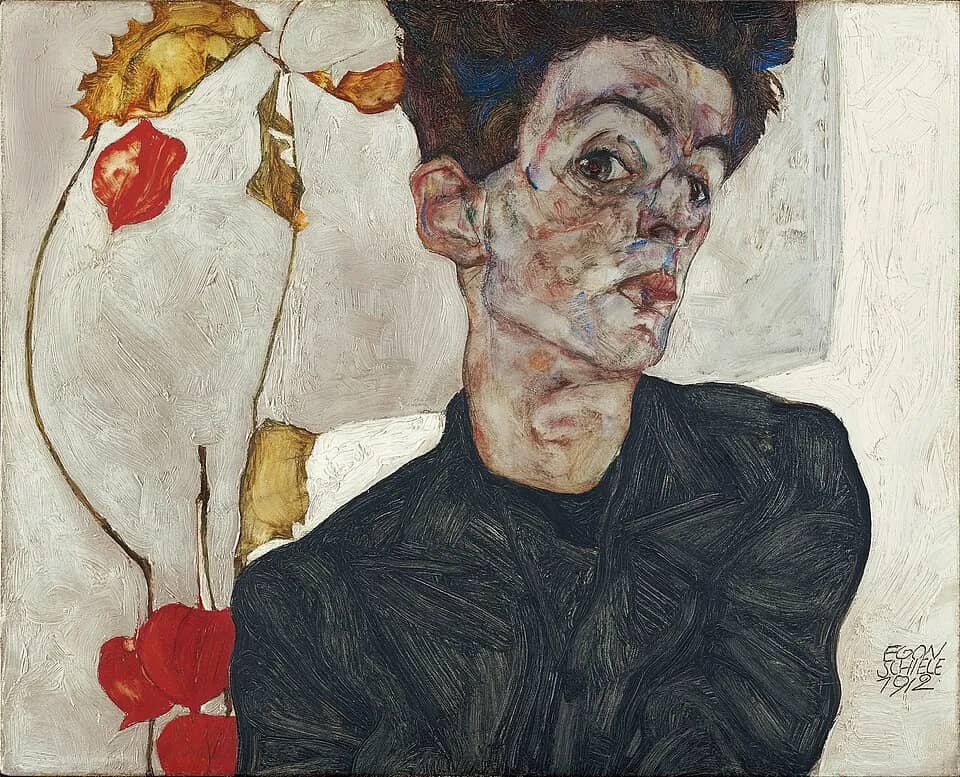
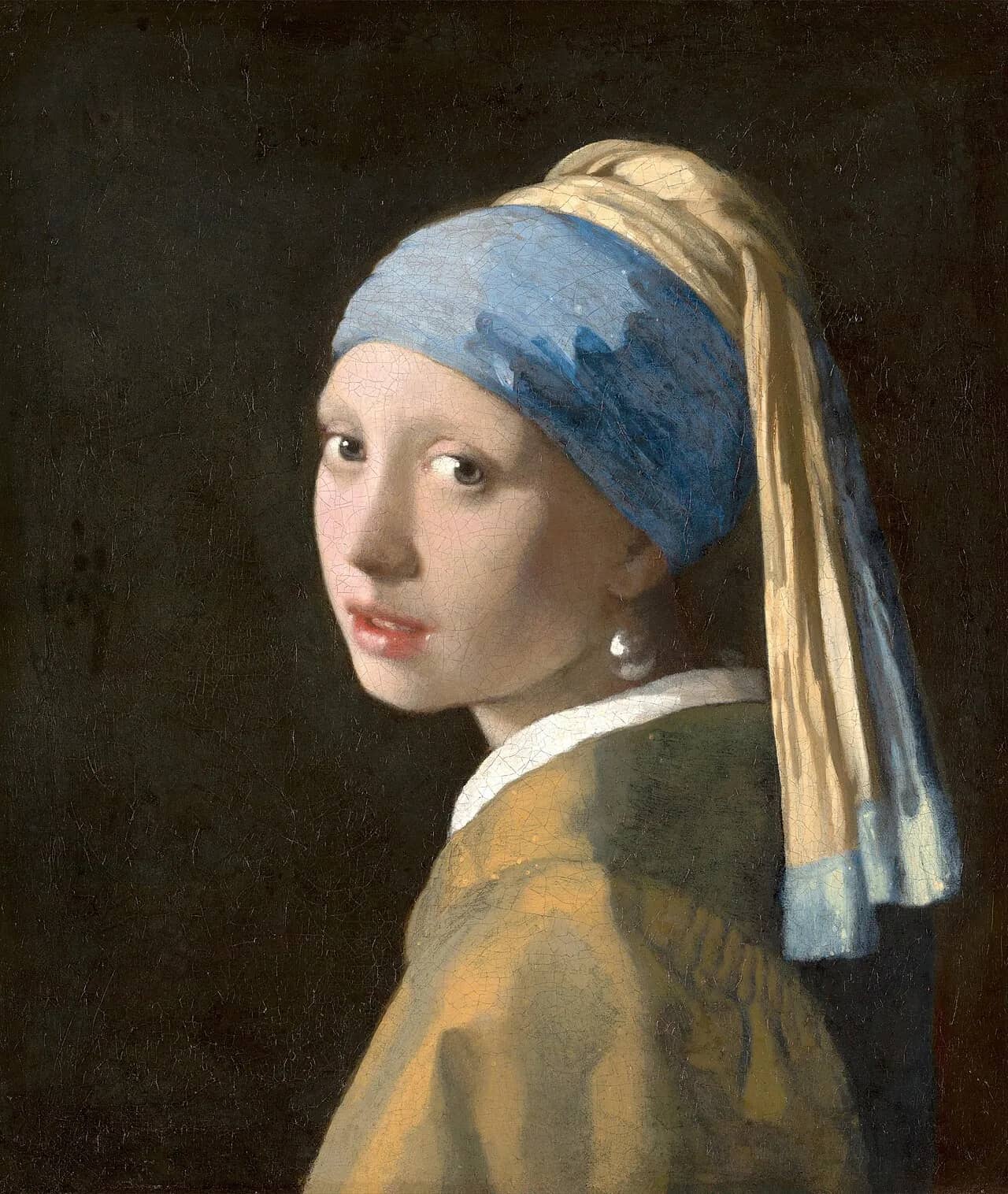
"The Kiss" (1907-08) hangs in the Belvedere Museum in Vienna, and it is one of the few paintings in the world that people recognize from across a room before they can see any detail. The two figures wrapped in golden robes, their faces turned toward each other in an embrace that turns both bodies into a single decorative form, have become one of the most reproduced images in the history of art. It appears on posters, mugs, umbrellas, phone cases, and gift shop merchandise worldwide. This commercial ubiquity makes it easy to overlook how strange and original the painting actually is: the bodies are barely distinguishable as bodies at all, the gold is real gold leaf applied to the canvas surface, and the subject of the painting is not so much a kiss as an obliteration of individual identity through erotic union.
Gustav Klimt understood seduction as an artistic strategy. His paintings draw you in through beauty, through pattern, through the appeal of luxury materials, and then confront you with psychological and erotic themes that Vienna's conservative establishment found deeply uncomfortable. His university paintings, commissioned for the ceiling of Vienna University at the turn of the 20th century, caused such outrage with their frank depictions of human sexuality and mortality that they were eventually rejected and Klimt bought them back. He never worked for a public commission again and never appeared to regret the decision.
This profile examines Klimt's development from conventional decorative painter to the central figure of the Vienna Secession, his golden period technique, and why his work remains so compelling more than a century after his death.
Early Career: From Decorative Craft to Artistic Revolution
Gustav Klimt was born on July 14, 1862, in Baumgarten, near Vienna, the second of seven children of a gold engraver named Ernst Klimt. The family was poor, and Gustav's father struggled financially throughout his life. Gustav showed artistic talent early, and in 1876, at age fourteen, he received a scholarship to the Vienna School of Arts and Crafts. He studied there for seven years, receiving thorough training in decorative painting, mosaic, and design.
After graduating, Klimt and his brother Ernst, along with a fellow student named Franz Matsch, formed the Künstler-Compagnie (Artists' Company), which won contracts to decorate theaters and other public buildings throughout the Austro-Hungarian Empire. The commissions were conventional by the standards of the time: allegorical figures in classical styles, decorative borders, ceiling paintings in the tradition of academic Renaissance and Baroque art. The work was well-received, prestigious, and completely without the qualities that would eventually make Klimt famous.
The turning point came in the early 1890s. Klimt's brother Ernst died in 1892, followed shortly by his father. The losses seem to have cracked open something in Klimt's artistic sensibility. He began reading widely in philosophy, particularly Schopenhauer and Nietzsche, and in the emerging literature of psychoanalysis being developed in Vienna by Sigmund Freud. He became increasingly preoccupied with themes of sexuality, death, and the unconscious, and increasingly restless with the conventional decorative style he had mastered.
The Vienna Secession: Breaking from the Establishment
In 1897, Klimt led a group of artists in breaking away from the conservative Vienna Künstlerhaus, the official artists' association that controlled exhibition access and maintained academic standards. The group called themselves the Vienna Secession, adopting the Latin motto "Ver Sacrum" (Sacred Spring) and publishing a journal of the same name. Their founding principle was simple: art should not be subject to institutional orthodoxy. Every exhibition should present the best of international contemporary work alongside Viennese artists, without the hierarchies that placed painting above applied arts and academic work above experimentation.
Klimt designed the poster for the first Secession exhibition in 1898, showing Theseus and the Minotaur: Theseus standing over the defeated monster while Athena watches. The image was not subtle about what it represented. The censors required him to cover the nude Theseus with a tree, and Klimt complied, but the point had been made. The Secession built its own exhibition building, designed by architect Joseph Maria Olbrich, with a golden dome made of laurel leaves above an inscription that became one of the most famous statements in modern art history: "Der Zeit ihre Kunst, der Kunst ihre Freiheit" (To the time its art, to art its freedom).
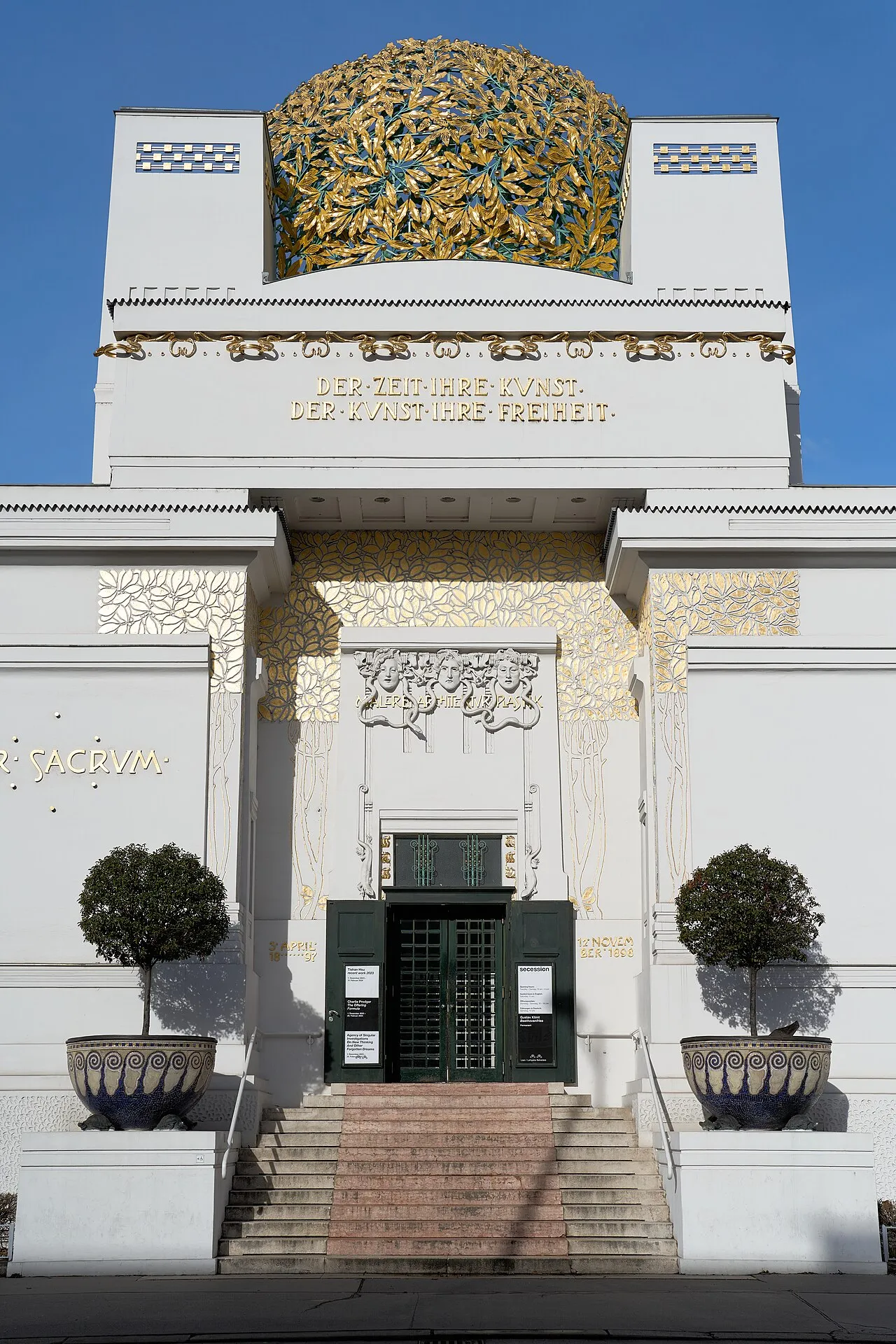
The Vienna Secession building (1898), designed by Joseph Maria Olbrich, Vienna. The golden "Cabbage Dome" crowning the building was Klimt's idea. The inscription reads "To the time its art, to art its freedom." Image: Public domain, via Wikimedia Commons
The Golden Period: Where Painting Met Mosaic
Klimt's "golden period" runs roughly from 1899 to 1910 and represents his most immediately recognizable and commercially successful work. The technique he developed during this period combined oil painting with areas of genuine gold and silver leaf applied to the canvas surface, a practice he derived partly from his early training in decorative arts and partly from his study of Byzantine mosaics, which he encountered on a trip to Ravenna in 1903.
The Byzantine mosaics in Ravenna, particularly those at San Vitale, appear to have been a revelation for Klimt. Their flat gold backgrounds, patterned robes, and schematic rather than naturalistic treatment of the human figure offered an alternative to the Western tradition of illusionistic depth. In Byzantine art, the gold was not a color; it was a reference to divine light, to a sacred space outside ordinary time and space. Klimt secularized this idea, using gold to create spaces of pure sensory luxury where his figures existed outside any identifiable time or place.
The technique is most fully realized in "Portrait of Adele Bloch-Bauer I" (1907), which consumed three years and over 100 preparatory drawings. The subject, the wife of a wealthy Viennese sugar magnate, is shown seated in a dress that merges into and is almost indistinguishable from the golden background. The traditional distinction between figure and ground nearly dissolves. What remains is a surface of extraordinary richness: triangles, spirals, Egyptian eyes, Byzantine roundels, and organic curves all woven together in gold, silver, and oil color around the sharp, naturalistic face of the sitter. The painting, seized by the Nazis during the Anschluss and recovered by Adele's niece Maria Altmann in a famous legal battle, was sold to the Neue Galerie in New York in 2006 for $135 million, then a record for a painting.
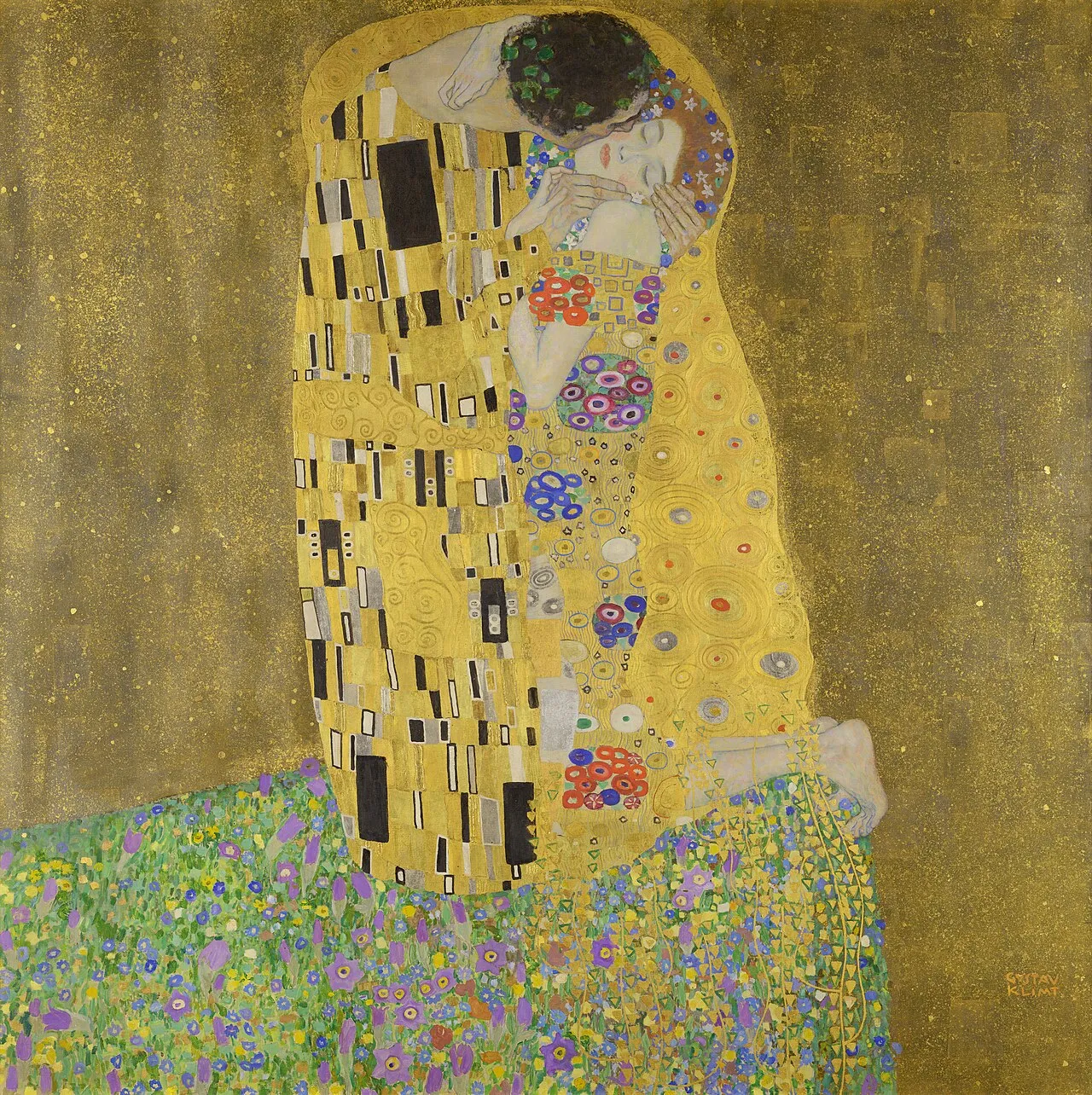
Gustav Klimt, "The Kiss" (1907-08), oil and gold leaf on canvas, 180 x 180 cm. Österreichische Galerie Belvedere, Vienna. The work belongs to Klimt's "golden period" and represents the fullest expression of his mature style. Image: Public domain, via Wikimedia Commons
Later Work and the Beethoven Frieze
One of Klimt's most ambitious and important works is the Beethoven Frieze, created in 1902 for the 14th Secession exhibition, which was organized around a monumental sculpture of Beethoven by Max Klinger. Klimt painted a 34-meter continuous frieze along three walls of the exhibition space as a visual interpretation of Beethoven's Ninth Symphony, using figures representing suffering humanity, the forces of evil, poetry and music, and the embrace of happiness. The frieze shows Klimt's full expressive range: figures of extraordinary grace alongside deliberately grotesque personifications of vice, disease, and madness, painted in a combination of oil, casein, gold leaf, glass, and semi-precious stones applied directly to the plaster wall.
After 1910, Klimt's style became less golden and more painterly, influenced partly by the work of his younger colleague Egon Schiele, whose raw, angular Expressionism pushed back against Klimt's decorative sensuality. The late paintings, particularly the landscapes Klimt painted every summer in the Salzkammergut region of Austria, show a different side of his work: densely patterned surfaces of meadows, orchards, and gardens in which the decorative impulse is applied to nature rather than to the human figure. These are among the most beautiful, and most underrated, works in his oeuvre.
Final Thoughts
Gustav Klimt died on February 6, 1918, in Vienna, following a stroke, at age 55. The first epidemic wave of the Spanish flu followed shortly after and claimed his colleague Egon Schiele, among many others. Vienna's golden age of art, literature, and philosophy, represented by Klimt, Schiele, Kokoschka, Mahler, Freud, Wittgenstein, and Schnitzler, was effectively over.
Klimt's legacy is both clear and contested. His visual language, combining decorative pattern with psychological content, influenced Art Nouveau across Europe and anticipates the graphic sensibility that would later inform everything from advertising design to tattoo culture. But his reputation has also been shaped by the enormous commercial reproduction of "The Kiss" and the Adele Bloch-Bauer portraits, which can make it seem as though the paintings are primarily luxury objects. They are not. They are serious attempts to use beauty as a vehicle for ideas about desire, death, and the limits of individual identity that Vienna's intellectual culture was exploring from every direction at the turn of the 20th century.
For more context on the broader art movement Klimt helped define, explore our guide to The Evolution of Art Styles: From Realism to Contemporary. To see how Klimt's ideas about color and pattern compare to those of his contemporaries, read the guide to Color Theory for Art Appreciation. What is your favorite Klimt work beyond "The Kiss"? Share in the comments.