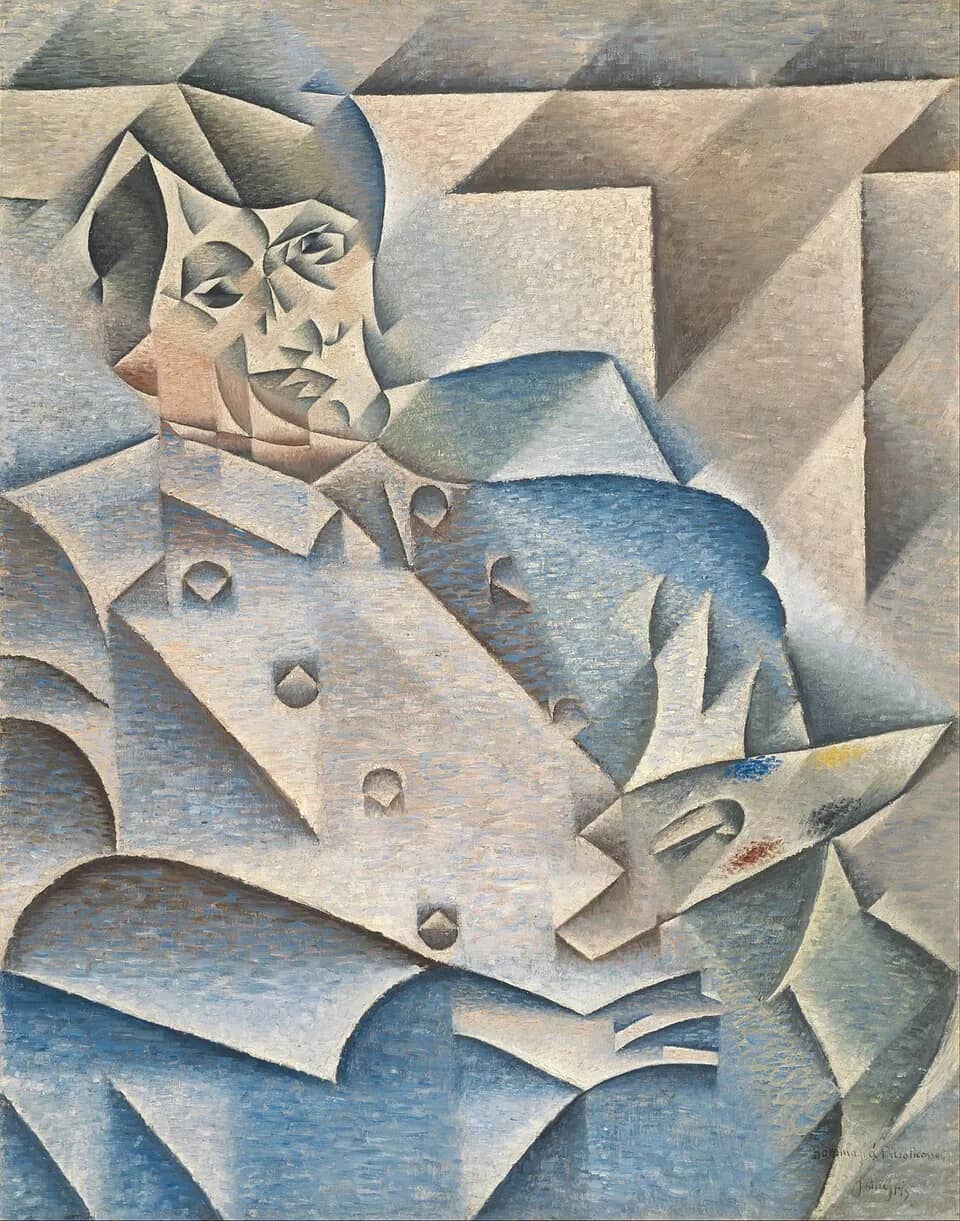
Paul Cézanne died in October 1906. The following year, the Salon d'Automne in Paris mounted a retrospective of his work. Georges Braque walked through it and, by his own account, was fundamentally changed. Within eighteen months, he and Picasso had begun the experiments that became Analytic Cubism. Picasso called Cézanne "my one and only master." Matisse said he was "the father of us all." This level of acknowledged debt is unusual in art history, where major artists tend to minimize their sources. Both men were describing a specific, traceable formal debt, not a general influence.
What Cézanne actually did is deceptively simple to state: he painted how things looked to the eye rather than how convention said they should look on canvas. Not Impressionism's light-dissolved surfaces. Not academic painting's firm contours and consistent perspective. But the way the eye actually experiences an object in space, with edges that shift as focus moves, with adjacent surfaces that bleed into each other, with the same apple looking slightly different depending on how long you look at it. To paint this way, he had to abandon linear perspective, the organizing principle of Western painting since the 15th century. The resulting paintings looked broken and wrong to anyone trained in academic methods in the 1870s and 1880s. They contained the grammar of the next century of art.
This profile traces Cézanne's long, difficult career, from his repeated rejections by the Paris Salon through his isolated middle period in Provence, his specific technical innovations, and the posthumous recognition that transformed modern art.
Early Life and the Paris Rejections
Paul Cézanne was born on January 19, 1839, in Aix-en-Provence in southern France. His father, Louis-Auguste Cézanne, was a banker who had risen from hat manufacturer to one of the most prosperous men in Aix. The family wealth was ultimately what allowed Cézanne to pursue painting without commercial pressure: his father's allowance, and later his inheritance, sustained him through decades of critical rejection that would have ended most careers.
He studied at the Collège Bourbon in Aix, where he became close friends with Émile Zola, later one of the great novelists of the 19th century. The two moved to Paris together in 1861. Cézanne studied at the Académie Suisse, where he met Camille Pissarro, who became the most important artistic influence of his early years. He submitted work to the official Salon repeatedly and was rejected almost every time. The rejections were not just administrative slights. The jury's written comments on his work were often contemptuous. His early canvases were heavily impastoed, darkly colored, and aggressively handled in ways that violated every academic convention.
From 1872 to 1874, Cézanne worked closely with Pissarro in Pontoise and Auvers-sur-Oise, painting outdoors and learning the Impressionist approach directly. Pissarro was a patient and genuinely generous teacher. The collaboration changed Cézanne's work substantially, lightening his palette and loosening his mark-making. He participated in the first Impressionist exhibition in 1874 and the third in 1877. His work was consistently the most poorly received of any participant. One critic described his paintings as the work of "a house-painter who picks up a knife and daubs."
Retreat to Provence: The Isolated Middle Period
By the late 1870s, Cézanne had withdrawn from Parisian art life and returned to Provence. Following his father's death in 1886, he inherited the family estate and became fully financially independent. He settled in Aix, worked in near-isolation, and painted the same subjects again and again for two decades: Mont Sainte-Victoire, the limestone mountain visible from his studio outside Aix; still lifes of apples, peaches, and ceramic pots arranged on cloth; bathers in landscape; portraits of local farmworkers who would sit for him for hours without fidgeting.
The repetition was not a failure of imagination. It was deliberate, methodical investigation. Cézanne needed familiar subjects because what he was studying was not the subject itself but the act of looking at it. He observed that when you look at an apple, your eye does not stay still: it moves, the focus shifts, and the apple looks slightly different from moment to moment. He observed that objects at the edges of your visual field look different from those at the center. He concluded that the relationship between a surface and the space surrounding it is not fixed by any single viewpoint but changes continuously as the eye moves. Painting that pretended otherwise was lying about experience. He wanted to paint experience.
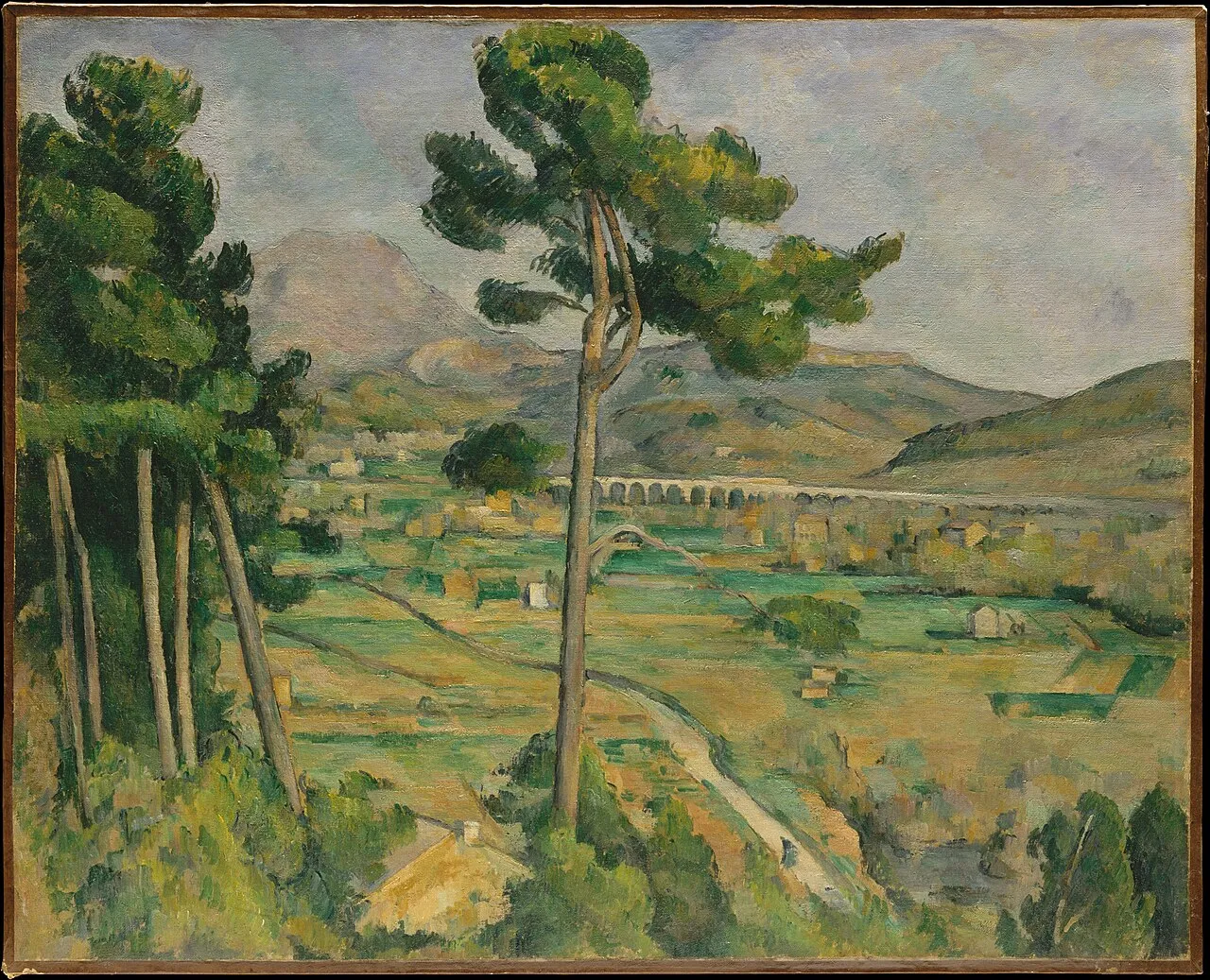
Paul Cézanne, "Mont Sainte-Victoire and the Viaduct of the Arc River Valley" (1882-85), oil on canvas, 65.4 x 81.6 cm. Metropolitan Museum of Art, New York. Cézanne painted Mont Sainte-Victoire more than sixty times. The progression from earlier to later versions shows the forms becoming steadily more abstracted, dissolving into interlocking planes of color. Image: Public domain, via Wikimedia Commons
The Card Players: Figurative Work at Its Most Distilled
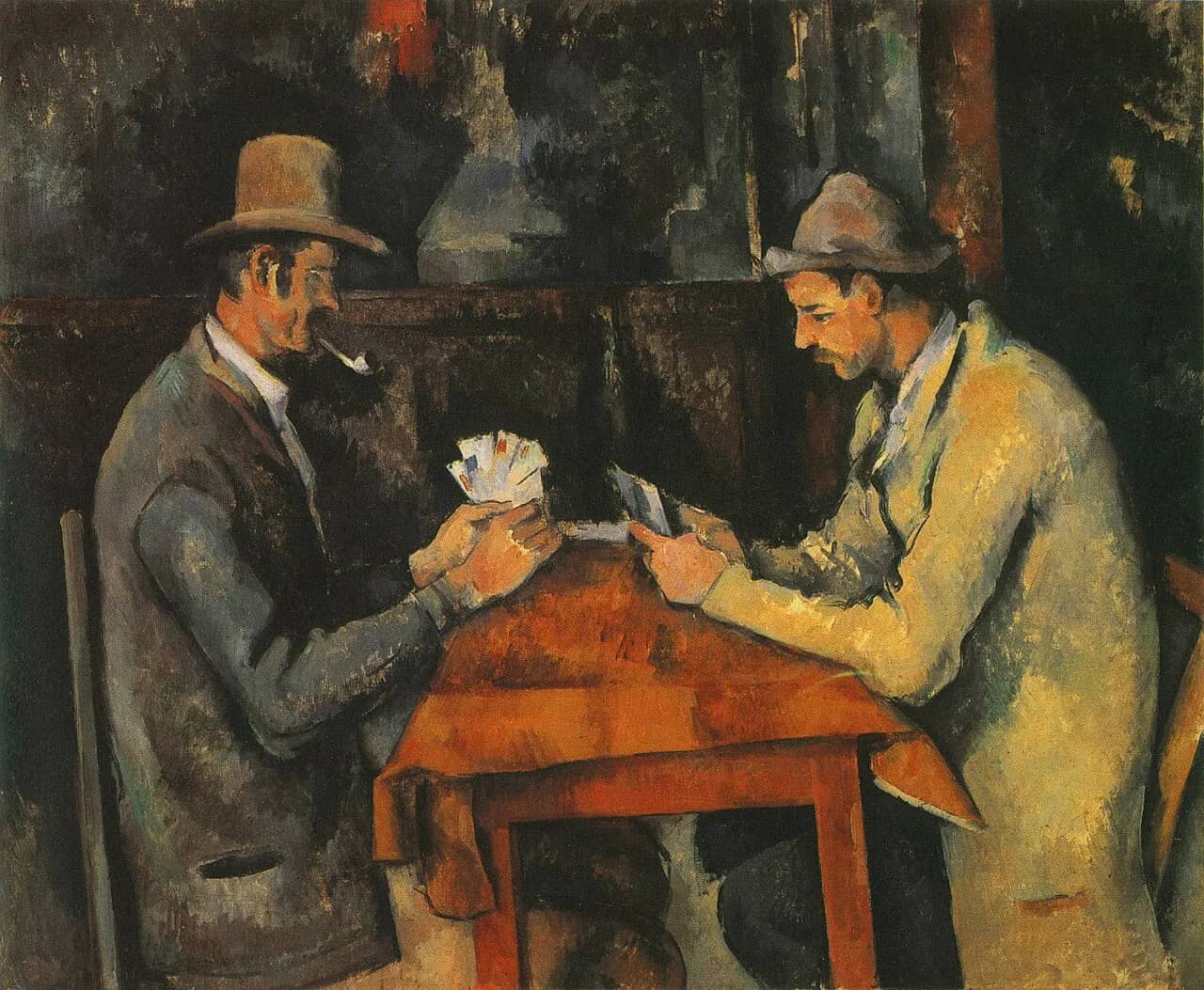
Between 1890 and 1895, Cézanne painted five versions of men playing cards, using local farmworkers from the Aix region as models. The Card Players series is his mature figurative work at its most reduced. There are five versions, ranging from large multi-figure canvases to the tightly focused two-figure compositions at the Musée d'Orsay and the Metropolitan Museum of Art. In 2011, one two-figure version entered the collection of the Royal Family of Qatar for a reported $250 million, briefly making it the most expensive painting ever sold. The Metropolitan's version is accessible online with full curatorial documentation.
What is striking about these figures is that they are not psychologically individualized in the way of Rembrandt portraits or Degas figures. They are structural elements in the same way the bottles and apples of his still lifes are structural elements: volumes in space, defined by color planes, organized in relation to each other and to the containing space of the picture. The emotional weight comes not from any expression on the faces but from the formal gravity of the composition, the way the two figures balance each other across the vertical axis of the bottle between them. This is what Cézanne meant when he said he wanted to "treat nature by the cylinder, the sphere, the cone." He was not describing Cubism. He was describing the formal reduction that Cubism would carry to its logical conclusion.
Cézanne's Two Key Technical Innovations
Two specific technical habits in Cézanne's mature work were the ones Braque and Picasso most directly absorbed and turned into Cubism.
The first is passage. Rather than defining a firm edge between one form and another, Cézanne allowed adjacent color areas to remain open to each other, letting the boundary between them dissolve or leaving it unpainted. Where academic painters drew a sharp, definitive contour between a figure and its background, Cézanne left the edge ambiguous, letting both areas interpenetrate. This produces a sense of space that corresponds more closely to actual visual experience, where edges are never uniformly crisp, than to academic convention. It also allows forms to exist in multiple spatial relationships simultaneously rather than being fixed.
The second is the parallel brushstroke. Cézanne's mature paintings are built from short, roughly parallel marks that run in consistent directions across the canvas regardless of the form being described. These are the opposite of the Impressionist approach, where marks followed the direction of each surface. Cézanne's systematic strokes build volume and create a unified texture across the entire canvas that simultaneously suggests depth and insists on the surface as a flat painted thing. The tension between the spatial reading and the flat painted surface was exactly what Braque and Picasso identified, pushed further, and turned into the fragmented planes of Cubism. The full context of Impressionism and what came after it helps show how specific this departure was.
Recognition and Legacy
In 1895, the dealer Ambroise Vollard organized the first solo exhibition of Cézanne's work in Paris, showing 150 paintings. The response among artists was immediate and serious. Monet, Renoir, Degas, and Pissarro all sought out the work specifically to study it. Matisse borrowed money to buy a small Cézanne figure study and kept it as a reference object for years. Younger artists made pilgrimages to Aix or to Vollard's gallery in Paris to understand what Cézanne was doing.
Paul Cézanne died on October 22, 1906, in Aix-en-Provence, at sixty-seven. He had spent that morning painting outdoors, walked home in a rainstorm, collapsed on the road, was carried inside, and died of pneumonia the following day. The Salon d'Automne retrospective of 1907 was the first time Paris saw his full achievement together. Braque walked through it and began making the work that became Analytic Cubism within eighteen months. Picasso attended the retrospective repeatedly.
The connection between Cézanne and modern art is not metaphorical. It is traceable through specific works, specific statements by specific artists, and specific formal properties that passed directly from his canvases into theirs. Understanding his work is not optional for anyone who wants to understand why 20th-century art looks the way it does. To understand how Cézanne built on and moved beyond his Impressionist context, read the full guide to Impressionism: Monet, Light, and Breaking Academic Rules. For a companion look at a painter developing in a different direction at the same time, see Vincent van Gogh: Post-Impressionism and Emotional Brushwork. Where do you see Cézanne's influence in art or design today? Share in the comments.