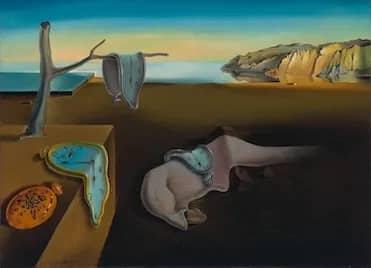
The first thing that surprises visitors at the Museum of Modern Art in New York is the size. "The Persistence of Memory," Salvador Dalí's 1931 painting of melting pocket watches draped across a barren Catalonian landscape, measures 24 by 33 centimeters. That is slightly larger than a standard sheet of printer paper. People walk into the gallery expecting something monumental and find a painting they could carry under one arm. The surprise is not incidental. It is part of how the painting works: a small, precisely rendered trap that pulls you in close and then delivers an image that makes no sense.
Dalí understood something that most of his contemporaries did not: an artist's public persona is part of the artwork. The waxed mustache, the walking stick, the ocelot, the declarations of genius delivered without irony: these were not eccentricity or madness. They were a deliberate construction, as carefully considered as the paintings. Dalí grasped, decades before the art world caught up, that celebrity is a medium, and he worked in it with the same precision he applied to oil paint.
But dismissing Dalí as a showman means missing the painter, who was technically exceptional by any historical standard. His draftsmanship was grounded in Renaissance method. His handling of light owed a direct debt to Vermeer and Velázquez. His ability to render impossible images with the surface quality of a photograph produced a body of work that still operates on viewers in ways that more conceptually sophisticated Surrealists do not. This profile covers Dalí's education in Madrid, his years in Paris with the Surrealists, his American period, and the museum he built in his hometown that remains the most visited single-artist museum in Spain after the Prado.
Madrid, the Residencia, and the Expulsion
Salvador Domingo Felipe Jacinto Dalí i Domènech was born on May 11, 1904, in Figueres, a small town in Catalonia near the French border. His father was a prosperous notary and a strict, opinionated man who both supported and resisted his son's artistic ambitions in complicated ways. His mother died when Dalí was sixteen. He described the loss as the catastrophe of his life, and there is no reason to doubt that he meant it.
In 1922, Dalí enrolled at the Real Academia de Bellas Artes de San Fernando in Madrid and moved into the Residencia de Estudiantes, an intellectual community that happened to house, at the same time, the poet Federico García Lorca and the filmmaker Luis Buñuel. The three became close friends. Lorca's poetry, with its surreal imagery and emotional intensity, and Buñuel's cinematic instincts both shaped Dalí's developing aesthetic. With Buñuel, Dalí would later co-write "Un Chien Andalou" (1929), a seventeen-minute film that opens with a razor blade slicing an eyeball in close-up and proceeds through a sequence of images designed to be as disturbing as possible. The film established the visual grammar of Surrealist cinema in a single stroke.
At the Residencia, Dalí absorbed every available influence: Impressionism, Pointillism, Cubism, Futurism, and the metaphysical paintings of Giorgio de Chirico, whose empty arcades and unsettling perspectives were a direct precursor to Surrealist space. He was expelled from the Academy in 1926, shortly before his final examinations, after declaring that no professor on the faculty was competent to examine him. Whether this was a calculated publicity gesture or genuine arrogance is still debated. The outcome was the same either way: no degree, no academic credentials, and no apparent concern about either.
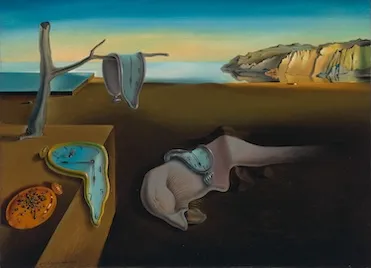
Salvador Dalí, "The Persistence of Memory" (1931), oil on canvas, 24.1 x 33 cm. Museum of Modern Art, New York. The painting's small scale is part of its effect: a meticulously rendered trap that pulls the viewer in close. Image via MoMA Collection Online
Paris, Gala, and the Paranoiac-Critical Method
Dalí first visited Paris in 1926 and met Picasso, whose opinion he valued more than almost anyone else's. In 1929, he moved to Paris more permanently and joined the Surrealist group led by André Breton. That same year, he met Gala Éluard, wife of the Surrealist poet Paul Éluard. She left her husband and became Dalí's lifelong partner, muse, and business manager. He called her "my double" and said she stabilized him. The relationship was complex and not always healthy, but it lasted until Gala's death in 1982.
Dalí's specific contribution to Surrealist technique was what he called the paranoiac-critical method. The term sounds pretentious, but the practice is straightforward: he trained himself to enter a state of controlled self-hallucination, staring at objects until they transformed in his perception into something else, and then painted what he saw with the precision of a naturalist documenting a specimen. The method produced the double images that fill his best work: a face that is also a fruit bowl, a landscape that conceals a reclining figure, a skull assembled from the bodies of seven women viewed from a specific distance.
"The Persistence of Memory" (1931) is the most famous result. Three soft watches drape over a dead tree branch, a rectangular block, and a fleshy amorphous form on the ground that is, on close inspection, a distorted self-portrait. The landscape is based on the cliffs of Cap de Creus near Dalí's home in Port Lligat. The sky is empty and blue. The surface is painted with the meticulous finish of a 17th-century Dutch still life. The watches melt. Dalí claimed the image came from watching Camembert cheese soften in the sun, which may or may not be true. What is true is that the painting captures something about how time behaves in dreams that no amount of philosophical exposition can match. MoMA's collection notes describe the painting as exploring "the collapse of our sense of time."
Other major Surrealist works from this period include "Swans Reflecting Elephants" (1937), a double-image painting where swans on a lake reflect as elephants in the water; "The Elephants" (1948), showing the animals on impossibly elongated legs carrying obelisks; and "Dream Caused by the Flight of a Bee Around a Pomegranate a Second Before Awakening" (1944), a large painting that illustrates Freud's theory of how external stimuli during sleep become incorporated into dream narratives.
The Break with Breton and the American Years
André Breton expelled Dalí from the Surrealist group in 1939. The reasons were political and financial. Breton, a committed Communist, was furious that Dalí refused to condemn fascism and made deliberately ambiguous statements about Hitler. He also accused Dalí of commercial opportunism, rearranging the letters of his name into "Avida Dollars" (Latin for "eager for dollars"). Dalí's response was characteristic: he said the Surrealist movement was irrelevant because he, personally, was Surrealism.
Dalí and Gala moved to the United States in 1940 as German forces occupied France. The American response was immediate and enthusiastic. Dalí designed window displays for Bonwit Teller department store (he smashed a bathtub through the plate glass window when the display was altered without his permission, an incident that resulted in a brief arrest). He collaborated with Alfred Hitchcock on the dream sequence of "Spellbound" (1945), designed jewelry, wrote an autobiography, and appeared on game shows and in magazine profiles. He became the most famous living artist in America, a status that many critics regarded as evidence of something wrong with either Dalí or America or both.
The paintings from the American period and after are what critics usually dismiss. "Galatea of the Spheres" (1952) shows Gala's face dissolving into atomic spheres, reflecting Dalí's interest in quantum physics. "The Sacrament of the Last Supper" (1955), at the National Gallery of Art in Washington, places the biblical scene inside a dodecahedral frame above a Mediterranean bay. He called this phase "nuclear mysticism," an attempt to reconcile Catholic theology with atomic physics and Renaissance painting technique. The work is uneven. Some of it is genuinely strange and visually powerful. Some of it is repetitive. But the idea that Dalí simply stopped being interesting after 1940 is a critical shorthand that does not survive sustained looking at the later paintings.
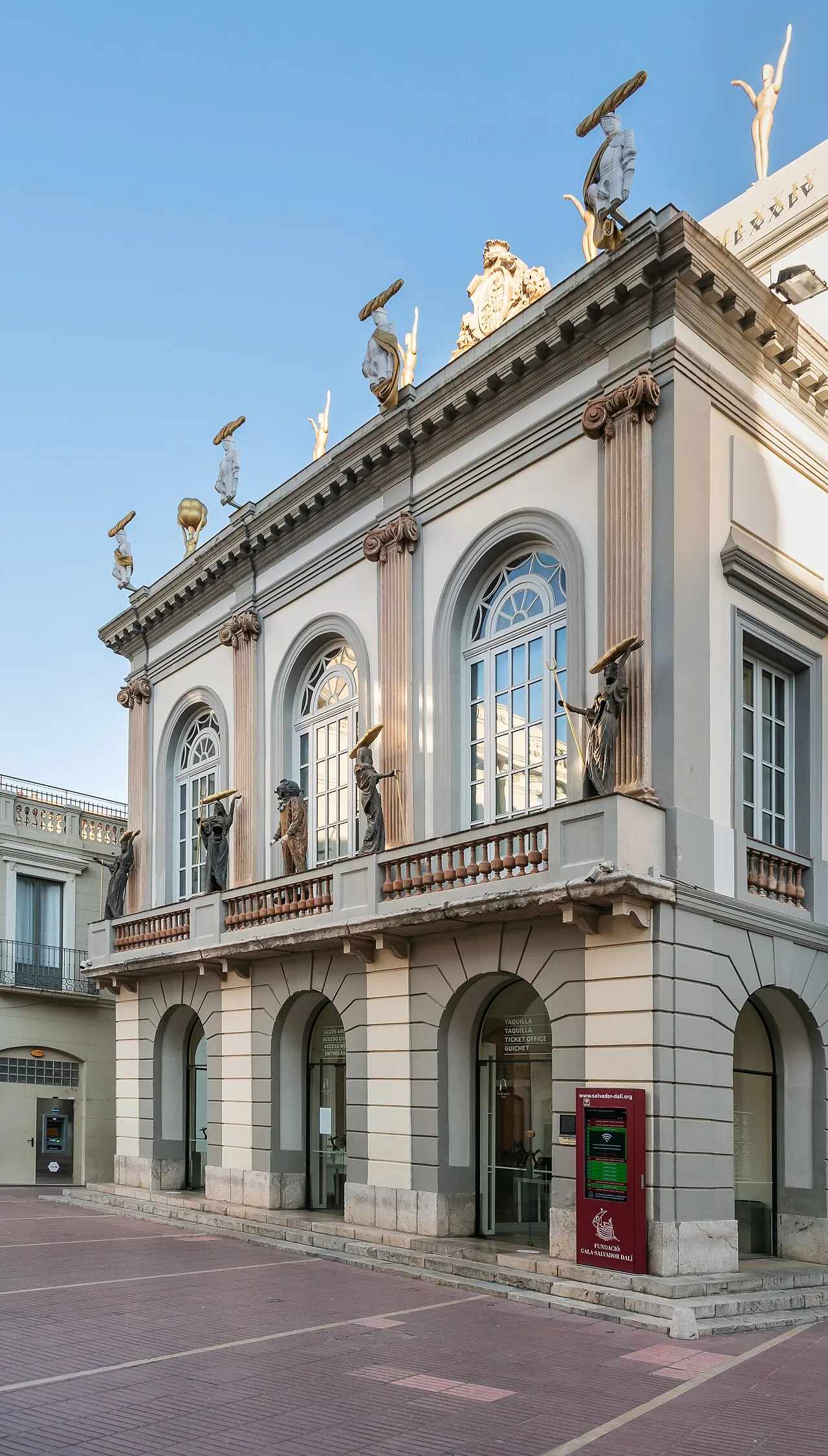
The Teatro-Museo Dalí, Figueres, Catalonia. Dalí designed the entire building, calling it "a single surrealist object." Image: Public domain, via Wikimedia Commons
The Teatro-Museo: His Last and Greatest Work
In 1961, the mayor of Figueres invited Dalí to donate a work to the local municipal museum. Dalí proposed something larger: converting the ruins of the town's 19th-century theater, burned during the Spanish Civil War, into a museum of his own design. He spent over a decade on the project. The Teatro-Museo Dalí opened in 1974 and is now the most visited museum in Spain after the Prado.
Every element was designed by Dalí. The facade is painted deep red and topped with giant egg sculptures. A geodesic dome by the architect Emilio Pérez Piñero covers the former stage. Inside, the museum contains paintings, installations, optical illusions, and rooms designed as immersive environments. The Mae West Room arranges furniture so that, viewed from a specific platform, the entire room forms a portrait of the actress's face: a sofa as lips, curtains as hair, photographs as eyes. The Palace of the Wind ceiling, painted by Dalí, shows him and Gala ascending to heaven. The building is not a museum in the conventional sense. It is a single artwork that you walk through.
Dalí is buried in the crypt beneath the museum, under the stage where he performed as a child. He designed the tomb. When he died in 1989, his body was interred there, and the museum became his last work.
Final Thoughts
Dalí was the most technically gifted Surrealist painter and the most shameless self-promoter in the history of modern art. These are not contradictions. The persona and the paintings were parts of the same project: an insistence that imagination and irrationality are more interesting than convention and common sense. The melting watches, the floating apples, the ants swarming over hands: these images have survived in popular culture for nearly a century because they are precisely engineered to be unforgettable.
What separates the best of Dalí from mere spectacle is the intellectual machinery underneath. He read Freud seriously. He studied Renaissance technique seriously. He followed developments in nuclear physics with genuine engagement. The paintings that resulted look like dreams because they were systematically constructed to produce the effects that dreams produce, and that construction required both technical mastery and a working theory of how the unconscious mind operates. The carnival was real. So was the intelligence behind it.
For a broader exploration of the movement Dalí shaped, read the full guide to Surrealism and the Subconscious: Dalí, Magritte, and Dream Logic. For another perspective on how painters use imagery to access inner states, see the guide to How Art Communicates Emotion Without Words. Have you visited the Teatro-Museo Dalí? Share your experience below.