
In January 2025, Frida Kahlo's paintings entered the public domain in most international jurisdictions, seventy years after her death. In January 2026, the Museum of Fine Arts in Houston opened "Frida: The Making of an Icon," the first exhibition to trace her transformation from a relatively unknown local painter to a global cultural phenomenon. The show features over 30 works by Kahlo alongside more than 120 by artists she influenced, from the 1970s to the present. It travels to Tate Modern in London in June 2026, where it will be the first major Kahlo exhibition in the UK in over two decades. At MoMA in New York, a concurrent exhibition titled "Frida and Diego: The Last Dream" runs from March through September 2026, presented in conjunction with the Metropolitan Opera's premiere of an opera about Kahlo and Rivera's relationship.
That three major museums are simultaneously staging Kahlo exhibitions in 2026 tells you something about where her reputation stands. She is arguably the most recognized woman artist of the 20th century, her face on t-shirts, tote bags, postage stamps, and Barbie dolls. But the familiarity of the icon has done to Kahlo what it does to every artist it touches: it has made the actual paintings harder to see. The woman on the tote bag is not the woman who painted "The Broken Column" at 3 a.m. in a body cast, staring at her own spine rendered as a crumbling stone column and refusing to look away.
This profile covers Kahlo's life, her artistic development, her most important paintings, and the specific trajectory by which she became an icon. The paintings are worth getting back to.
Early Life and the Accident
Magdalena Carmen Frida Kahlo y Calderon was born on July 6, 1907, in Coyoacan, a borough of Mexico City, in the Casa Azul (Blue House) where she would also die forty-seven years later. Her father, Guillermo Kahlo, was a German-Hungarian photographer who had emigrated to Mexico. Her mother, Matilde Calderon, was of mixed Spanish and Indigenous descent. Kahlo later claimed 1910 as her birth year, aligning herself symbolically with the Mexican Revolution, which is a useful detail for understanding how she constructed her own biography as a deliberate artistic act.
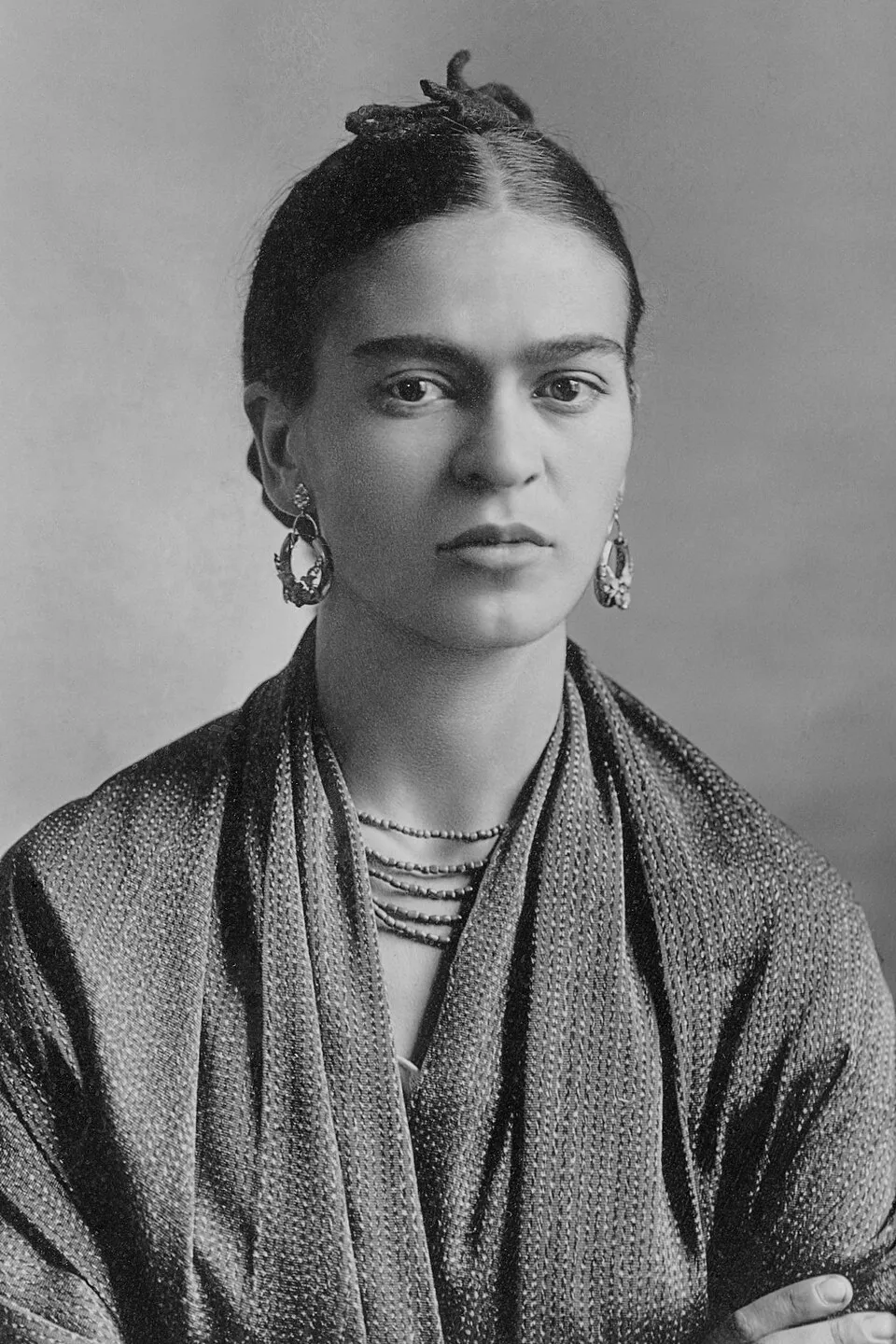
Frida Kahlo, photographed by her father Guillermo Kahlo (1932). Image: Public domain, via Wikimedia Commons
At age six, Frida contracted polio, which left her right leg thinner and shorter than her left, a condition she disguised throughout her life with long skirts. In 1922, she enrolled at the Escuela Nacional Preparatoria in Mexico City, one of only thirty-five girls among two thousand students. She was brilliant, rebellious, and planned to study medicine.
On September 17, 1925, the bus carrying eighteen-year-old Frida home from school collided with a streetcar. An iron handrail pierced her pelvis. Her spinal column was broken in three places. Her collarbone, ribs, and right leg were fractured. Her right foot was crushed. She spent months in a full body cast, endured over thirty surgeries throughout her life, and lived with chronic pain until her death in 1954. During her recovery, her parents had a special easel built so she could paint lying down, and they mounted a mirror on the canopy of her bed. "I paint myself because I am so often alone," she said, "and because I am the subject I know best." The accident did not create her talent. It gave her the time and the subject matter that would define her life's work: her own body, her own pain, and her own refusal to look away from either.
Diego Rivera and a Turbulent Partnership
In 1928, Kahlo showed her paintings to Diego Rivera, Mexico's most famous muralist, who was twenty years her senior. Rivera was impressed and they married in August 1929. Kahlo's mother reportedly called the union "the marriage between an elephant and a dove." The relationship was passionate, volatile, and deeply complicated. Both had affairs. Rivera's included one with Kahlo's younger sister Cristina, which devastated her. Kahlo's affairs included relationships with both men and women, among them the photographer Nickolas Muray and, reportedly, Leon Trotsky, who lived in the Casa Azul during his exile from the Soviet Union. They divorced in 1939 and remarried in 1940, but the pattern of love, betrayal, and reconciliation continued until Kahlo's death.
Rivera's influence on Kahlo's art was significant but often overstated. He encouraged her to embrace Mexican folk art traditions: the bright colors, flat perspectives, and symbolic imagery of retablos (small devotional paintings) and ex-votos (votive offerings). But Kahlo's vision was entirely her own. Where Rivera painted sweeping murals about Mexican history and politics, Kahlo painted intensely personal canvases about her body, her emotions, and her identity. The 2026 MoMA exhibition "Frida and Diego: The Last Dream" presents their work side by side with opera-inspired staging, which is a useful framing for seeing how different their concerns actually were despite the shared household.
Kahlo's Artistic Style and Techniques
Kahlo's paintings are small. Most are under two feet in any dimension. The emotional weight they carry is entirely disproportionate to their physical scale, which is a formal quality worth paying attention to. Her style draws from multiple sources, blended into something unmistakably personal.
Mexican Folk Art and Retablo Tradition
The most immediate visual influence on Kahlo's work is the Mexican retablo tradition. Retablos are small devotional paintings, typically on tin, that depict miraculous events: a person saved from illness, accident, or disaster, with a saint hovering above. Kahlo adopted the retablo format directly: small scale, flat perspective, vivid colors, and narrative imagery that combines the real and the miraculous. Paintings like "Henry Ford Hospital" (1932) and "The Bus" (1929) follow this template closely, translating the devotional format into a vehicle for personal experience rather than religious testimony.
Symbolism and the Surrealist Question
Kahlo's paintings are dense with symbols. Monkeys represent protection and tenderness. Hummingbirds symbolize luck in Mexican culture but, when dead, lost love. Thorns suggest suffering and martyrdom. Roots and vines represent connection to the earth and to Mexico. The broken column, the corset, the surgical pins: these are not metaphors but literal depictions of her physical reality, rendered with symbolic weight.
Andre Breton, the founder of Surrealism, visited Mexico in 1938 and declared Kahlo a Surrealist. She rejected the label firmly: "They thought I was a Surrealist, but I wasn't. I never painted dreams. I painted my own reality." This distinction matters. The Surrealists sought to access the unconscious mind through dreamlike imagery. Kahlo's imagery, however fantastical it appears, was rooted in her lived, bodily experience. The difference is between inventing strange images and depicting a reality that happens to be strange. The 2026 Tate Modern exhibition will include a section examining Kahlo's links to Surrealism following her 1939 Paris exhibition, including "The Frame" (1938), which was shown in the original Paris exhibition and will travel to London for the first time.
Key Paintings
"The Two Fridas" (1939)
This large double self-portrait, one of Kahlo's few large-scale works at 174 x 173 cm, shows two versions of herself sitting side by side, holding hands. The Frida on the left wears a white European-style dress; the Frida on the right wears a traditional Tehuana costume. Both figures have exposed hearts connected by a single artery. The European Frida's artery has been cut, and blood drips onto her white skirt. The Tehuana Frida holds a small portrait of Diego Rivera. Painted shortly after her divorce from Rivera, the painting explores Kahlo's dual identity: European and Mexican, loved and abandoned, whole and broken. It hangs in the Museo de Arte Moderno in Mexico City.
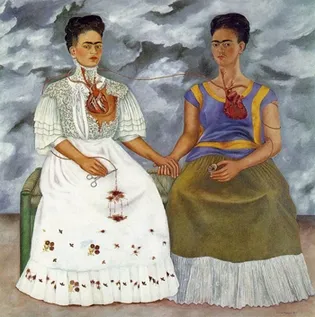
Frida Kahlo, "The Two Fridas" (1939), oil on canvas, 174 x 173 cm. Museo de Arte Moderno, Mexico City. One of Kahlo's largest and most emotionally complex works, painted during her divorce from Diego Rivera. Image: Public domain as of 2025, via Wikipedia
"The Broken Column" (1944)
In this self-portrait, Kahlo depicts herself standing in an open landscape, her torso split open to reveal a crumbling Ionic column in place of her spine. Metal nails pierce her skin and face. A surgical corset holds her body together. Tears stream down her cheeks, but her expression is stoic, almost defiant. The painting was created after a particularly difficult spinal surgery and is one of the most direct depictions of chronic pain in art history. What makes it powerful is not the symbolism alone but the refusal to either dramatize or look away. She painted what was there.
"Self-Portrait with Thorn Necklace and Hummingbird" (1940)
Perhaps Kahlo's most iconic image, this painting shows her facing the viewer directly, wearing a necklace of thorns that draws blood from her neck. A dead hummingbird hangs from the thorns like a pendant. A black cat crouches on one shoulder; a monkey sits on the other. Butterflies rest in her hair. The jungle foliage behind her is dense and claustrophobic. Every element carries symbolic weight: the thorns of Christ's passion, the hummingbird as a Mexican love charm, the monkey as both protector and mischief-maker. The painting hangs in the Harry Ransom Center at the University of Texas at Austin and will be shown in the UK for the first time at the 2026 Tate Modern exhibition.
From Obscurity to Icon: The Making of Frida
Frida Kahlo died on July 13, 1954, at the age of forty-seven. The official cause was pulmonary embolism, though some biographers suspect suicide. Her last diary entry reads: "I hope the exit is joyful, and I hope never to return."
For decades after her death, Kahlo was known primarily as Diego Rivera's wife. That began to change in the 1970s and 1980s, when feminist art historians and the Chicano art movement rediscovered her work. The 2026 MFAH/Tate exhibition traces this trajectory in detail, showing how Kahlo's image was adopted and adapted by artists from the Chicana/o movement of the late 1960s through to contemporary practitioners. The exhibition's curators, led by Mari Carmen Ramirez of the MFAH's International Center for the Arts of the Americas, have assembled over 200 works including archival documents, photographs, and personal items from Kahlo's own collection.
According to Artnet's reporting, the Tate exhibition will include a final section on "Fridamania," exploring how the artist's image dominates popular culture today, appearing on toys, dolls, and even sanitary pads. The curatorial framing raises a question that the exhibition does not resolve: what happens to an artist's work when the artist's face becomes more famous than any individual painting? The Casa Azul in Coyoacan, now the Frida Kahlo Museum, draws hundreds of thousands of visitors annually. Many come for the biography rather than the paintings. The paintings are what justify the biography.
Final Thoughts
Kahlo's self-portraits do not ask for pity. They demand recognition. They say: this is what it means to live in a body that betrays you, to love someone who hurts you, to belong to two cultures at once, to refuse to look away from pain. That honesty is what makes her work resonate with millions of people who have never set foot in Mexico or experienced anything like her specific suffering. The 2025 public domain entry has made her paintings more accessible for study and reproduction than at any previous point, and the 2026 exhibitions at MFAH, Tate Modern, and MoMA provide the most comprehensive opportunity to see her work in context since her lifetime.
To see Kahlo's work in person, the Frida Kahlo Museum in Coyoacan is the essential destination. Major works are also held at MoMA in New York, the San Francisco Museum of Modern Art, and the Museo Dolores Olmedo in Mexico City. For more artist profiles, read our spotlight on David Hockney, or explore how art communicates emotion without words. For the broader context of how political movements shape artistic reputations, the guide to art and politics covers the mechanisms by which Kahlo's work was recovered and revalued decades after her death.


