In the summer of 1508, Pope Julius II summoned Michelangelo Buonarroti to Rome and commissioned him to paint the ceiling of the Sistine Chapel. Michelangelo protested. He considered himself a sculptor, not a painter, and he told the Pope as much. Julius was not interested in protest. Michelangelo spent the next four years largely on his back on a specially constructed scaffold, painting over five thousand square feet of ceiling fresco, mostly without assistance, in one of the most physically grueling artistic undertakings in recorded history. When the ceiling was unveiled in 1512, it was immediately recognized as one of the supreme achievements in the history of art.
Michelangelo was not a comfortable person. He was argumentative, suspicious, difficult to employ, and notoriously reluctant to finish commissions. He left more works incomplete than any other major artist of his era. His letters reveal a man in constant tension between his sense of divine artistic obligation and the petty practicalities of patronage, money, and family responsibility. And yet the works he did complete remain, five centuries later, the most powerful argument for the human capacity to create something that feels transcendent.
This profile examines Michelangelo's life, his technique, his major works, and the intellectual framework that made him the defining figure of the High Renaissance.
Florence and the Making of a Sculptor
Michelangelo di Lodovico Buonarroti Simoni was born on March 6, 1475, in Caprese, a small village in Tuscany. His family were minor Florentine nobility of fallen fortunes. His mother died when he was six, and he was sent to live with a stonecutter's family in Settignano, where the local industry was marble carving. Michelangelo later said he had absorbed his love of marble with his wet nurse's milk — poetic exaggeration, but not entirely without point given how deeply that early environment shaped him.
At thirteen, he was apprenticed to the painter Domenico Ghirlandaio in Florence, one of the leading workshops in the city. He stayed only a year before Lorenzo de' Medici invited him to study sculpture in the garden of San Marco, which Lorenzo had filled with ancient Greek and Roman statues. For two years, the young Michelangelo studied in this extraordinary environment alongside humanist philosophers and poets. He absorbed neo-Platonic philosophy — the idea that ideal beauty is a reflection of divine truth, and that the artist's task is to reveal the ideal form hidden within the marble rather than impose a form onto it. This idea guided his entire career.
He also developed a study of anatomy that became the foundation of his sculptural power. He dissected cadavers at the hospital of Santo Spirito, studying muscles, tendons, and bone structure with an obsessiveness that rivaled Leonardo's. The difference was in purpose: Leonardo dissected to understand how the body works as a machine. Michelangelo dissected to understand how to represent muscular tension and physical exertion with absolute accuracy. According to the Metropolitan Museum of Art's Heilbrunn Timeline, this practice of anatomical study set Michelangelo apart from virtually every sculptor of his generation.
The Pieta and David: Redefining What Sculpture Could Be
In 1498, at age twenty-three, Michelangelo was commissioned by a French cardinal to carve a marble Pieta for St. Peter's Basilica in Rome. The theological and compositional challenge was real: a full-grown adult male body draped across the lap of a seated woman would normally look awkward and top-heavy. Michelangelo solved it by making Mary's figure slightly broader than strict naturalism would allow, spreading her robes to create a wide supporting base, and treating Christ's body as almost weightless in its serpentine grace.
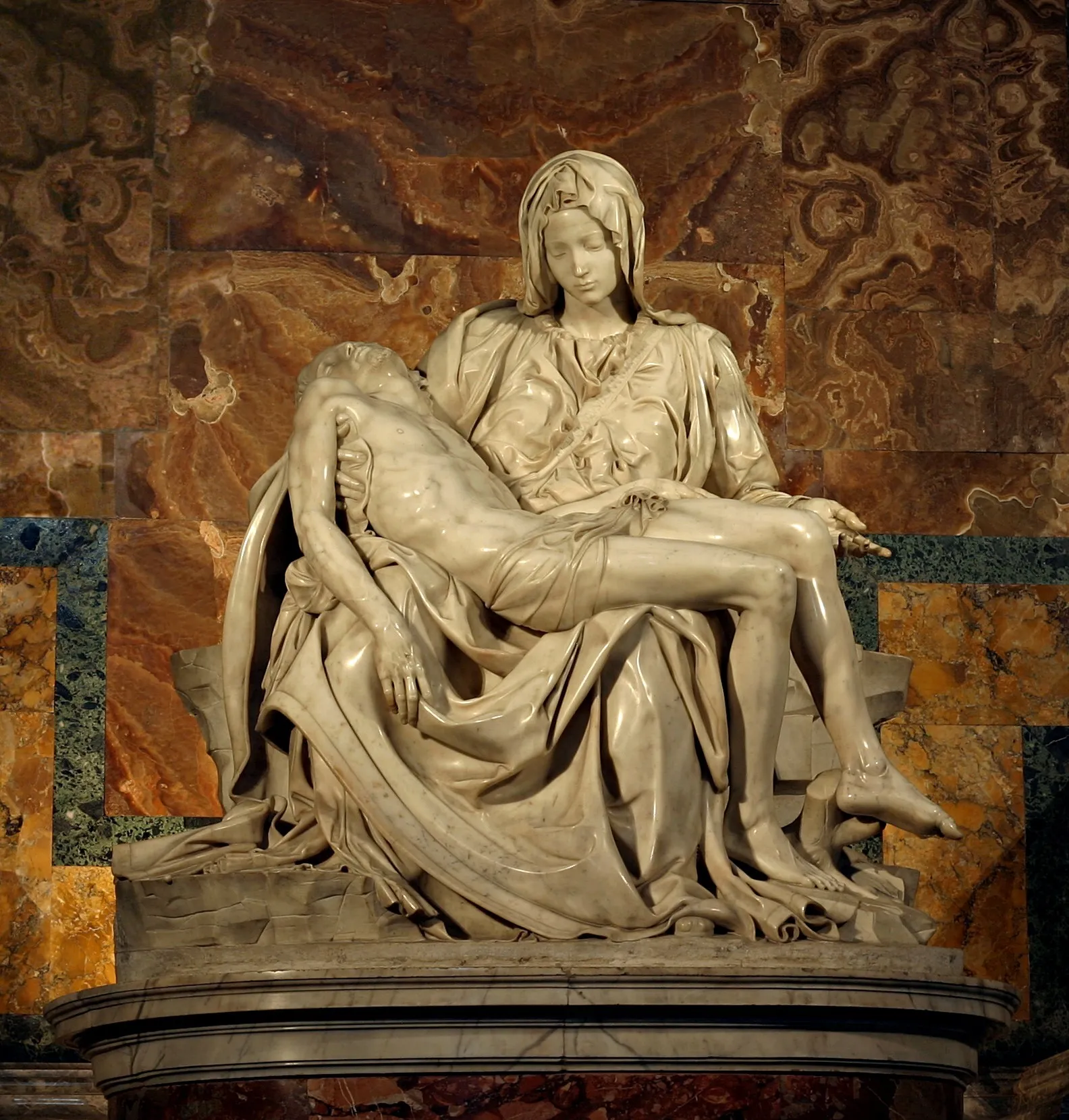
Michelangelo, "Pieta" (1498-1499), marble, 174 x 195 cm. St. Peter's Basilica, Vatican City. The only work Michelangelo ever signed, carved when he was 24 years old. Image: Public domain, via Wikimedia Commons
The Pieta is the only work Michelangelo ever signed. According to Vasari, he overheard visitors attributing the work to another sculptor and, returning alone at night, carved his name across Mary's sash. The surface quality of the marble is extraordinary: the drapery folds have a softness that should be impossible in stone, and the skin surfaces of Christ's body are polished to a smoothness that catches light as if it were actual flesh.
The David (1501 to 1504), carved from a single block of marble nearly seventeen feet tall, confirmed his position as the greatest sculptor alive. The commission had been offered to and declined by other sculptors because the block was damaged: long and thin, with a crack in the lower section, and a previous sculptor had already begun work on it without success. Michelangelo took the commission and carved a figure of tense anticipation rather than triumphant action. This is David before the battle, not after it: his eyes focused on the unseen enemy, his muscles coiled with potential force, his sling held loosely in one hand. The psychological intensity concentrated in the gaze and ready stance was something that marble sculpture had never achieved before.
The Sistine Chapel Ceiling: Four Years of Solitary Labor
The Sistine Chapel commission of 1508 was, from Michelangelo's perspective, an unwanted interruption to his sculptural work. Julius II had originally commissioned him to design an enormous freestanding tomb, a project Michelangelo considered his life's great work. When Julius set the tomb commission aside to demand the ceiling fresco instead, Michelangelo was furious. He accepted anyway, because you did not refuse Pope Julius II.
The ceiling covers approximately 5,000 square feet and contains over 300 individual figures. The central panels depict nine scenes from the Book of Genesis, from the Separation of Light from Darkness to the Drunkenness of Noah. The most famous is "The Creation of Adam," in which God extends his finger toward the reclining figure of Adam, the spark of life passing between them across a nine-inch gap. Along the sides of the ceiling, Michelangelo painted the prophets and sibyls who foretold the coming of Christ, and in the lunettes above the windows, the ancestors of Christ. The scale and ambition of the program were unprecedented in the history of painting.
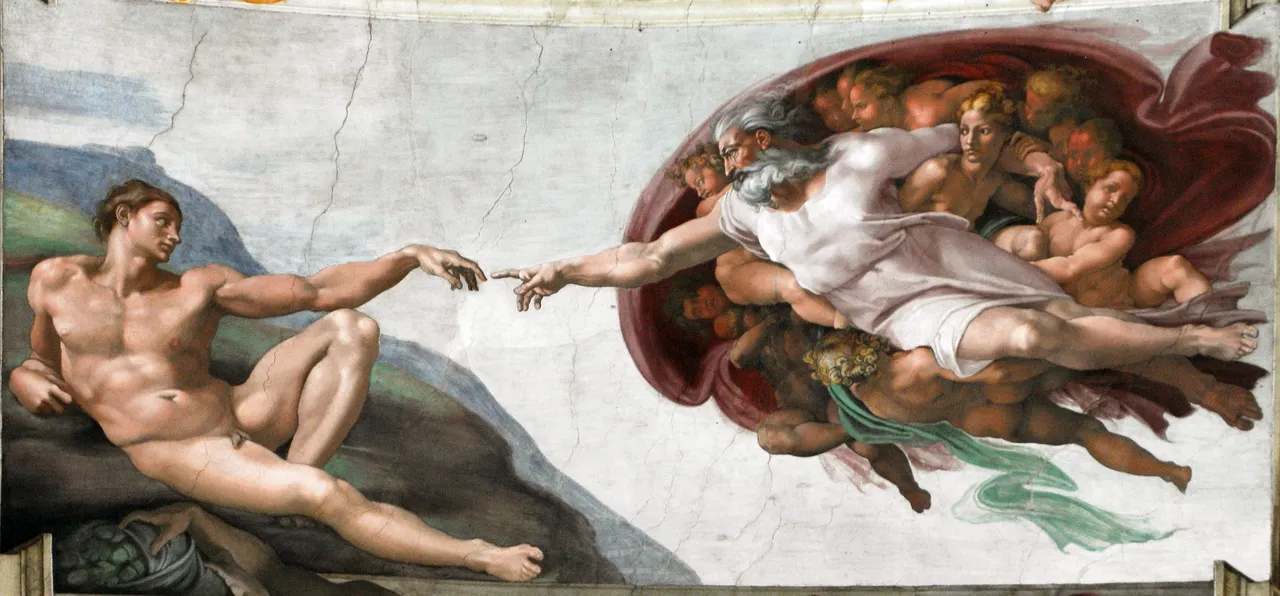
Michelangelo, "The Creation of Adam" (1512), detail from the Sistine Chapel ceiling, fresco. Vatican Museums, Rome. The 9-inch gap between the two fingers has become one of the most reproduced images in art history. Image: Public domain, via Wikimedia Commons
What makes the ceiling technically extraordinary is that Michelangelo achieved it in true fresco, painting directly into wet plaster that had to be completed before it dried, typically within eight to twelve hours. He worked largely alone, firing most of the assistants he initially brought on. The physical demands were extreme: working on a scaffold, paint dripping into his face, the ceiling at an angle requiring him to look constantly upward. He wrote a comic sonnet during the project describing his contorted body and his longing for it to end. The figures he painted are, despite all that, among the most powerful in the Western tradition.
Late Career: The Last Judgment and Architecture
Michelangelo's relationship with the Sistine Chapel did not end with the ceiling. In 1536, Pope Paul III commissioned him to paint the altar wall of the same chapel with a "Last Judgment" fresco. The result, unveiled in 1541, was immediately controversial. Christ is shown not as the serene figure of earlier Renaissance tradition but as a powerful, almost wrathful judge, his arm raised in a gesture that seems to fling the damned downward. The figures are more muscular, more twisting, more violently active than anything in the ceiling. Many were nude, which scandalized conservative critics. After Michelangelo's death, another painter was commissioned to add loincloths and drapery to the more explicit figures, an act of censorship still visible today.
In his final decades, Michelangelo devoted much of his energy to architecture, most notably the redesign of St. Peter's Basilica. Appointed chief architect of the building in 1546 at age seventy-one, he completely redesigned Bramante's original plan and designed the great dome, which remains the dominant feature of the Roman skyline. He did not live to see it completed, but his design was followed so closely that it stands essentially as he envisioned it. Michelangelo died on February 18, 1564, in Rome, at age 88, still working on a final Pieta intended for his own tomb.
Final Thoughts
Michelangelo's influence on art history is so pervasive that it is difficult to isolate. He set the standard for figurative sculpture that dominated Western art for four centuries. His treatment of the human body as the primary vehicle for spiritual expression shaped religious art throughout the Baroque period and beyond. The term "terribilità," describing his capacity to project overwhelming power and grandeur, was coined specifically for him and remains one of the few aesthetic categories that refers to a single artist by implication.
What is perhaps most striking about Michelangelo is that his ambition was not primarily artistic in the worldly sense. He was not trying to impress patrons or outdo rivals, though he did both. He was trying to approach, through the human body carved in stone or painted on plaster, something he understood as divine. Whether you share that spiritual framework or not, standing in front of the David or looking up at the Sistine ceiling, you feel the weight of that intention. Very few things made by human hands produce that feeling.
For a broader look at the movement that shaped Michelangelo's world, read our guide to Renaissance Art: Perspective, Humanism, and the Birth of Modern Art. For more on the materials and techniques of sculpture, explore Sculpture Materials: Clay, Bronze, Marble, and Found Objects. Have you visited the Sistine Chapel? Share what surprised you most in the comments.