
The painting hangs in the Uffizi Gallery in Florence, 199 centimeters tall and 162 centimeters wide. Stand in front of it and the scale alone does something. Judith's forearms are visible, her sleeves rolled up. Her left hand grips Holofernes's hair, pulling his head back. Her right hand holds the sword, which is already halfway through his neck. Her expression is not horror. It is not reluctant necessity. It is focused concentration, the face of someone who knows what she is doing and is doing it correctly. Holofernes's blood sprays across the white sheets. The maidservant holds down his thrashing body. The whole thing is physically credible in a way that most paintings of this subject are not.
Artemisia Gentileschi painted "Judith Slaying Holofernes" around 1614 to 1620, a few years after she had stood in a Roman courtroom and testified against the painter Agostino Tassi, who had raped her in 1611. The trial itself was extraordinary: women rarely received legal redress for sexual assault in 17th-century Rome, and Artemisia was subjected to torture using sibille, metal rings tightened around the fingers to verify that testimony was truthful. She testified under this treatment and did not recant. Tassi was convicted and sentenced to a year in prison, though he served only a few months.
The painting has often been read as a response to that assault and trial. Artemisia never confirmed or denied the reading, and it reduces a technically extraordinary work to autobiography if taken too literally. What the painting undeniably is, regardless of any biographical interpretation, is one of the most psychologically direct and physically convincing depictions of female agency in the history of Western painting. This profile covers her training, her technique, her international career, and why she deserves to be understood as a painter of the first rank, not primarily as a symbol.
Early Life and Training: A Painter's Daughter
Artemisia Gentileschi was born on July 8, 1593, in Rome, the eldest child of the painter Orazio Gentileschi, who was himself a significant figure in the Caravaggesque movement. Her mother died when Artemisia was twelve, and she grew up in her father's workshop, absorbing his technique and the influence of Caravaggio's revolutionary approach to light and shadow. By the standards of her time, this was an unusual education for a girl: women were not accepted into the professional art guilds and were generally expected to work in decorative arts rather than painting.
Orazio recognized his daughter's exceptional talent and arranged for the painter Agostino Tassi to give her additional instruction in perspective. Tassi raped her in 1611, when Artemisia was seventeen. What followed was months of continued pressure from Tassi, including a promise of marriage that he had no intention of fulfilling, before Orazio brought the case to court. The trial exposed Artemisia to public humiliation alongside the justice she sought. That she emerged from it and went on to build one of the most impressive careers in Baroque painting is a remarkable demonstration of resilience and focused ambition.
Caravaggesque Technique: Darkness and Drama
Caravaggio, who had died just two years before Artemisia's trial, had transformed European painting with a technique of extreme chiaroscuro: figures emerging from intense darkness, lit by concentrated sources of light, depicted with unidealized realism including dirty feet, weathered skin, and ordinary fabric. His influence spread rapidly across Europe, and Artemisia absorbed it completely, perhaps more deeply than any other painter of her generation.
Her "Judith Slaying Holofernes" at the Uffizi Gallery (c.1614-20), generally considered her masterpiece, shows the direct application of Caravaggesque technique to a subject that reveals its full expressive power. The darkness is absolute and actual: the background is a near-black that gives nothing away. Out of this darkness, the three figures emerge: Judith with her sword, her maidservant holding Holofernes's head, and the struggling general beneath them. The light falls from a single concentrated source, modeling every surface, catching the flash of the sword, the white fabric, Judith's earrings. The composition is diagonal and dynamic, the violence immediate and physical rather than conventionalized or sanitized.
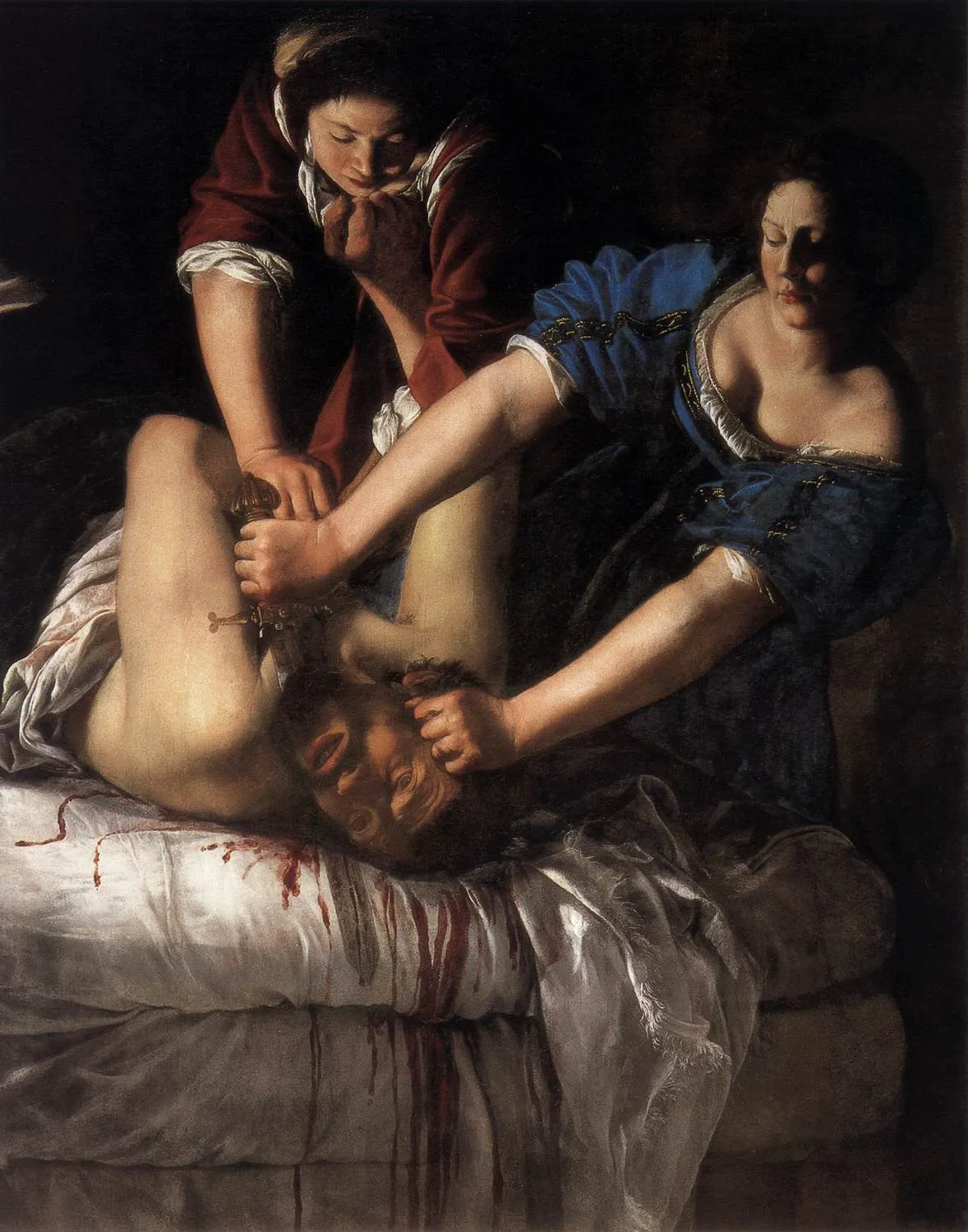
Artemisia Gentileschi, "Judith Slaying Holofernes" (c.1614-20), oil on canvas, 199 x 162 cm. Uffizi Gallery, Florence. This is the second and larger of Artemisia's two versions of the subject; an earlier version is in the Capodimonte Museum, Naples. Image: Public domain, via Wikimedia Commons
What distinguishes Artemisia's handling of this subject from the many male painters who painted it, including Caravaggio himself, is the physical credibility of the female agency. In most versions of the subject, Judith looks uncomfortable with what she is doing, suggesting horror or reluctance. In Artemisia's version, she looks focused and capable. Her body is oriented toward the work. Her hands are properly positioned on the sword. This is not a woman accidentally performing an action while looking away from it; it is a woman who knows exactly what she is doing and is doing it effectively. That distinction, the difference between represented agency and represented discomfort, is felt immediately even without context.
A Career Built Across Italy and England
After the trial and a subsequent arranged marriage to a Florentine painter named Pietro Antonio di Vincenzo Stiattesi, Artemisia moved to Florence in 1613. There she entered the court of the Medici, painted for Grand Duchess Maria Magdalena of Austria, and in 1616 became the first woman admitted to the prestigious Accademia delle Arti del Disegno, the Florentine academy of fine arts. Her Florentine paintings show a broadening of her range beyond the dramatic Caravaggesque mode: softer lighting, more complex spatial compositions, and figures of greater psychological nuance.
She moved to Rome, then Genoa and Venice, then to Naples in 1630, where she based herself for much of the rest of her career. Naples was then a major European art center, and Artemisia built a substantial studio practice there with significant local and international patrons. In 1638-39, she joined her father Orazio at the court of King Charles I of England, working on the ceiling decoration at the Queen's House in Greenwich, one of the few documented collaborations between the two painters.
Her Neapolitan period produced major works including "Corisca and the Satyr" (c.1635), "Lot and His Daughters" (c.1635-38), and the ambitious late work "Susanna and the Elders" and "Self-Portrait as the Allegory of Painting" (c.1638-39), which shows her in the act of painting, a revolutionary image in which the traditional personification of painting, always depicted as a female figure in academic allegory, is realized as a specific woman: herself.
The Other Heroines
While "Judith Slaying Holofernes" is the painting most closely associated with Artemisia, her career included many other significant works that deserve attention. "Susanna and the Elders" (1610), painted when she was sixteen or seventeen, shows the biblical Susanna confronted by two old men, and already displays a command of light, anatomy, and psychological expression that was unusual for any painter of any gender at that age.
"Mary Magdalene in Ecstasy" (c.1620-25) shows the saint in a state of spiritual transport, her face turned upward, her red dress slipping from her shoulder, the ecstasy rendered with emotional directness rather than pietistic convention. "Cleopatra" (c.1621-22) shows the Egyptian queen in the act of pressing the asp to her breast with the same psychological engagement that characterizes all of Artemisia's female subjects. These women are not passive recipients of action or emotion; they are agents in their own narratives. That consistency of perspective, the refusal to depict women as objects of drama rather than its subjects, runs throughout Artemisia's work and is one of the most distinctive features of her oeuvre.
Final Thoughts
Artemisia Gentileschi died sometime after 1654 in Naples and was largely forgotten for nearly three centuries. Her rediscovery began in earnest in the 1970s, driven by feminist art historians who recognized her work as both technically exceptional and historically significant. A major retrospective at the National Gallery in London in 2020 brought her to the widest audience she had received in her lifetime.
The risk of her current recognition is one she could not have anticipated: being remembered more as a symbol than as a painter. She was not primarily a feminist in any anachronistic sense. She was a professional who competed with male contemporaries on their own technical terms and produced work that holds up against theirs. The paintings are the evidence. Her handling of Caravaggesque tenebrism in the Uffizi "Judith" is as confident as anything Caravaggio himself produced. Her range across genres, from the violent drama of Judith to the psychological complexity of "Susanna and the Elders" to the self-portraiture of "Self-Portrait as the Allegory of Painting," shows a painter who never stopped developing.
To understand the broader Baroque context she worked in, the art history cheat sheet covers Baroque's defining characteristics alongside its major figures. For how Artemisia used composition and light, the guide to composition in art covers the specific techniques, including chiaroscuro and diagonal composition, that her Judith paintings deploy so effectively. Which of her works has stayed with you longest? Leave a comment below.


