
René Magritte painted a pipe. Beneath it he wrote, in careful handwriting, "Ceci n'est pas une pipe." This is not a pipe. The statement is literally true. You cannot fill it with tobacco or smoke it. It is a painting of a pipe. But the image is so convincingly rendered that the denial feels like a paradox, and the longer you look at it the more the paradox deepens. Magritte was not playing a word game. He was pointing at a fundamental problem that the Surrealists made their central subject: the gap between what we see and what is actually there, between the image and the thing, between the conscious mind's insistence on order and the unconscious mind's refusal to comply with it.
Surrealism was the most intellectually ambitious art movement of the 20th century. Launched in Paris in 1924 by the poet André Breton, it drew on Sigmund Freud's recently published theories of the unconscious to argue that rational thought was not the summit of human achievement but a prison that suppressed the most interesting parts of the mind. The Surrealists wanted access to the raw, uncensored imagery of dreams, desires, and fears that Freud had shown operating beneath the surface of conscious life. They developed an extraordinary range of techniques to get there, from automatic drawing to self-induced hallucination to collaborative games designed to short-circuit rational control. The movement touched painting, sculpture, film, photography, literature, and theater, and its visual strategies are still embedded in advertising, cinema, and contemporary art today.
This guide covers the origins of Surrealism, its two main technical approaches, its key artists, and the specific reasons its imagery still operates on us nearly a century later. For a deeper look at the movement's most famous practitioner, see the profile of Salvador Dalí.
From Dada to Dreams: The Intellectual Origins
Surrealism grew directly from Dada, the anti-art movement that emerged in Zurich during World War I. Dada artists including Marcel Duchamp, Hans Arp, and Tristan Tzara rejected logic, reason, and conventional aesthetics, all of which, they argued, had produced the catastrophe of industrialized warfare that was killing millions in the trenches. Duchamp submitted a porcelain urinal to an art exhibition in 1917 and called it "Fountain." Tzara composed poems by pulling words randomly from a hat. The point was demolition: destroy the old order of art and thought so completely that something new could emerge from the wreckage.
By the early 1920s, Dada's purely destructive energy was burning out. André Breton, a French poet who had trained in medicine and worked in psychiatric wards during the war, found a more constructive direction in Freud's writings. Freud's theories of the unconscious, the idea that beneath rational awareness lies a vast reservoir of repressed desires, memories, and instincts, offered Breton a creative frontier that Dada's nihilism could not. The Tate's overview of Surrealism traces this transition in detail.
In 1924, Breton published the Manifesto of Surrealism, which defined the movement as "pure psychic automatism," the attempt to express the real functioning of thought, free from the control of reason and outside all aesthetic or moral concerns. The name came from the poet Guillaume Apollinaire, who had coined the term "surréalisme" in 1917 to describe art that went beyond realism into a higher, more complete reality. Breton's manifesto was not a vague aesthetic program. It was a specific intellectual position grounded in Freudian psychology, and it attracted artists across Europe who were already working in compatible directions.
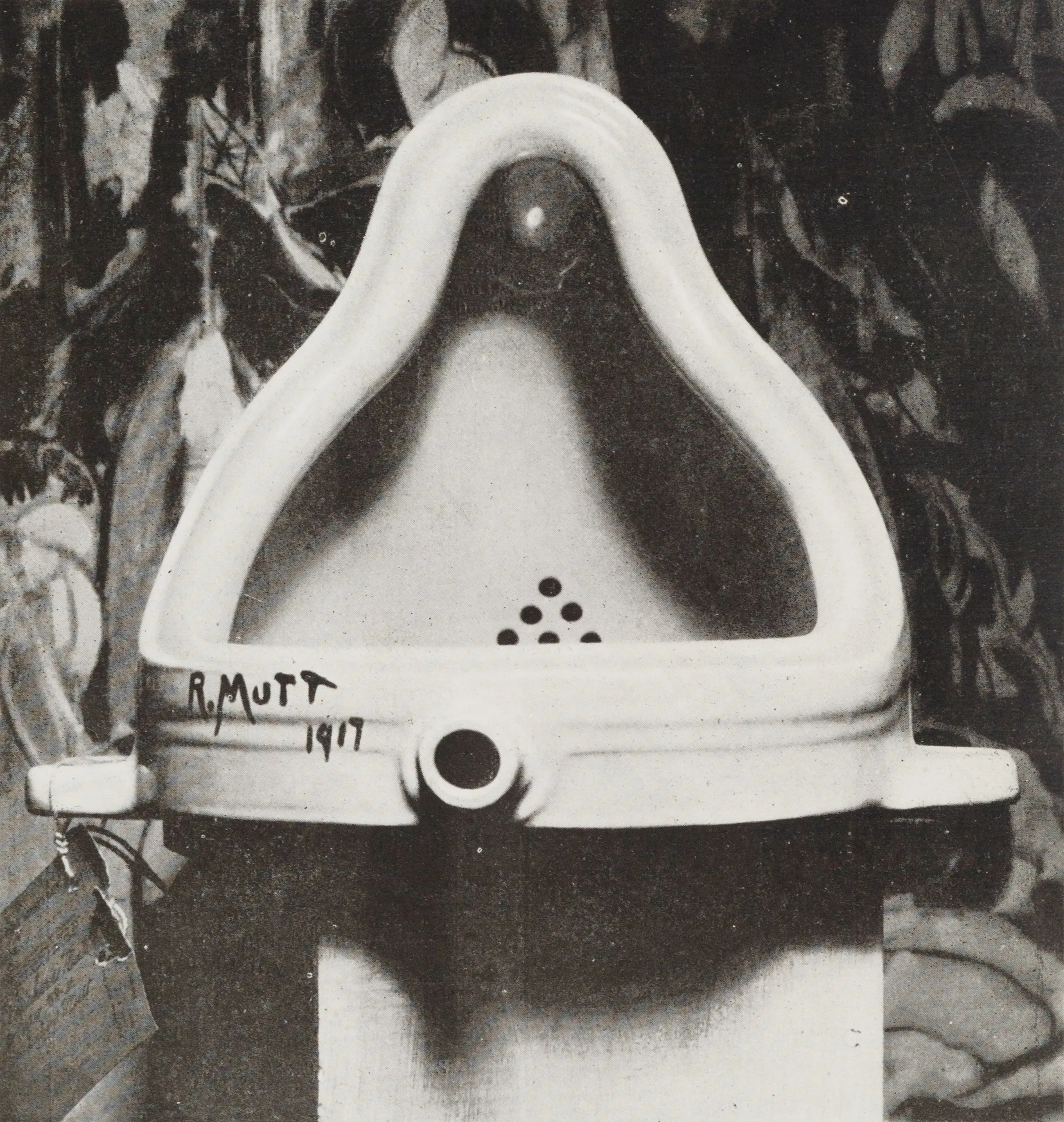
Marcel Duchamp, "Fountain" (1917), porcelain urinal. Photograph by Alfred Stieglitz. Duchamp's Dada readymade challenged every assumption about what art could be, paving the way for Surrealism's assault on rational thought. Image: Public domain, via Wikimedia Commons
Two Ways to Reach the Unconscious
Surrealist painters developed two distinct strategies for accessing unconscious imagery, and understanding this split is essential for making sense of the movement's visual diversity.
Automatism: Letting the Hand Lead
The first approach, automatism, involved suppressing conscious control and letting the hand move freely across the canvas. The idea came from Freud's technique of free association, where patients say whatever comes to mind without censoring themselves. In visual art, automatism produced abstract or semi-abstract works: swirling forms, biomorphic shapes, and spontaneous marks that emerged without premeditation.
André Masson was the leading practitioner of automatic drawing. He would enter a trance-like state, sometimes going without food or sleep, and let his pen wander across the paper. The resulting drawings are tangled webs of lines from which figures, animals, and landscapes emerge like shapes in clouds. Joan Miró also used automatism as a starting point, though he refined his automatic marks into the playful, colorful compositions of biomorphic shapes and symbols that became his signature style.
Automatism had an enormous influence on Abstract Expressionism. Jackson Pollock's drip paintings, with their emphasis on spontaneous gesture and the physical act of painting, owe a direct debt to Surrealist automatism. Pollock was exposed to the Surrealists' techniques through his connections with Peggy Guggenheim's gallery and the several Surrealist artists who had fled to New York during World War II. The line from Masson's automatic drawings to Pollock's all-over canvases is direct and historically documented.
Veristic Surrealism: Painting Dreams with Photographic Precision
The second approach, veristic Surrealism, took the opposite tactic. Instead of abandoning representational skill, veristic Surrealists painted impossible scenes with hyper-realistic precision. The logic was straightforward: dream imagery is most disturbing when it looks completely real. A melting clock is more unsettling when every detail of its surface is rendered with jeweler's accuracy than when it is a vague, abstract smear. The gap between convincing technique and impossible subject matter is what produces the specific unease that the best Surrealist paintings generate.
Salvador Dalí and René Magritte are the two giants of this approach, though their work could hardly be more different in tone and intent.
Dalí: The Paranoiac-Critical Method
Dalí joined the Surrealist group in Paris in 1929 and quickly became its most visible member. He developed what he called the paranoiac-critical method, a technique of self-induced hallucination in which he would stare at an object until it transformed in his perception into something else. He then painted what he saw with the precision of a naturalist documenting a specimen. The method produced the double images that fill his paintings: a face that is also a fruit bowl, a landscape that conceals a reclining figure, a skull assembled from the bodies of several women viewed from a specific distance.
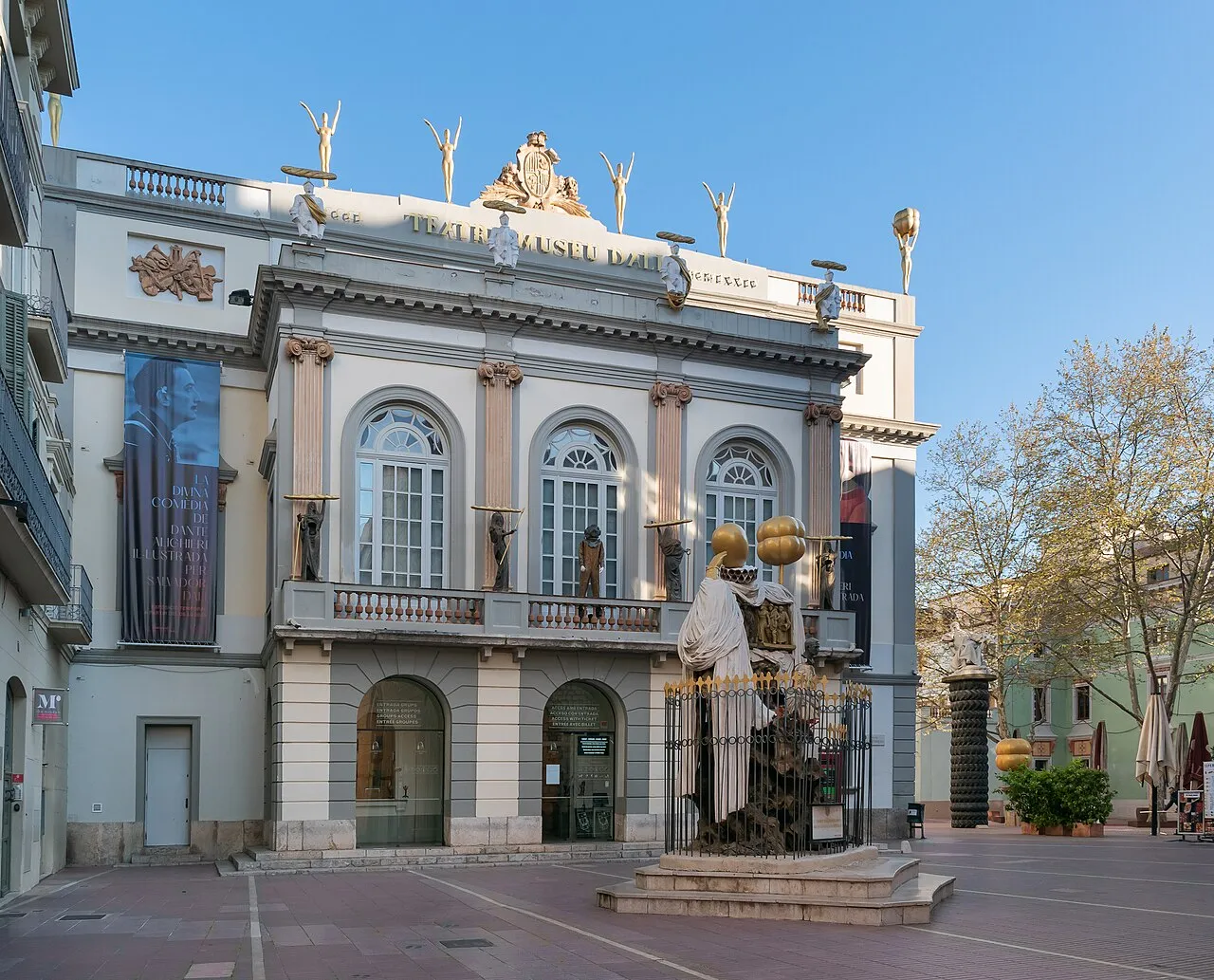
The Dalí Theatre-Museum in Figueres, Spain, designed by Dalí himself. Image: Public domain, via Wikimedia Commons
"The Persistence of Memory" (1931) measures just 24 by 33 centimeters, slightly larger than a sheet of printer paper, yet it contains one of the most recognized images in art history. Three soft watches drape and melt across a barren coastal landscape based on the cliffs of Cap de Creus near Dalí's home. A fourth watch is covered in ants. A fleshy, amorphous form on the ground is, on close inspection, a distorted self-portrait. The surface is painted with the meticulous finish of a 17th-century Dutch still life. Dalí claimed the melting watches were inspired by watching Camembert cheese soften in the sun, which may or may not be true. What is true is that the painting captures something about how time behaves in dreams that no philosophical exposition can match. The work hangs in the Museum of Modern Art in New York, where MoMA's collection notes describe it as exploring the collapse of our sense of time.
Magritte: The Philosopher in a Bowler Hat
If Dalí was Surrealism's showman, René Magritte was its philosopher. Born in Lessines, Belgium, in 1898, Magritte lived a deliberately ordinary life. He wore a bowler hat, lived in a modest Brussels suburb, and painted in his dining room. His paintings, however, are anything but ordinary. They are visual puzzles that question the relationship between images, words, and reality itself.
"The Treachery of Images" (1929) shows a meticulously painted pipe above the words "Ceci n'est pas une pipe." The statement is literally true: it is not a pipe, it is a painting of a pipe. You cannot fill it with tobacco or smoke it. But the image is so convincing that the denial feels absurd. Magritte forces you to confront the gap between representation and reality, between the thing and the image of the thing. This seemingly simple painting anticipates decades of philosophical inquiry, from Michel Foucault's essay on the painting to contemporary debates about digital images and deepfakes. The question Magritte posed in 1929 has not become less relevant. It has become more relevant.
"The Son of Man" (1964) shows a man in a dark overcoat and bowler hat standing before a low wall with the sea and cloudy sky behind him. A bright green apple hovers in front of his face, obscuring everything except the edges of his eyes. Magritte said: "Everything we see hides another thing. We always want to see what is hidden by what we see." The painting is about the fundamental human desire to see what is concealed, and the frustration of never quite being able to.
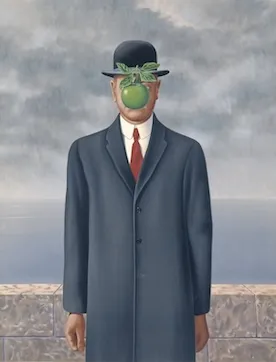
René Magritte, "The Son of Man" (1964), oil on canvas, 116 × 89 cm. Private collection. Image: Fair use, via Wikimedia Commons
Other Essential Surrealist Artists
While Dalí and Magritte are the most famous names, Surrealism was a broad movement with many important contributors whose work has been increasingly recognized in recent decades.
Max Ernst (1891-1976) was one of Surrealism's most inventive technicians. He developed frottage, rubbing textured surfaces with pencil to create random patterns, grattage, scraping wet paint off canvas laid over textured surfaces, and decalcomania, pressing paint between surfaces to create unpredictable textures. These techniques produced haunting, otherworldly landscapes that look like alien forests and petrified oceans. His painting "Europe After the Rain II" (1940-1942) is a devastating vision of a war-ravaged continent rendered through these experimental methods.
Leonora Carrington (1917-2011) created a deeply personal mythological world populated by hybrid creatures, alchemical symbols, and Celtic legends. Born in Britain, she moved to Mexico in the 1940s and lived there until her death. Her paintings combine the precision of medieval manuscript illumination with the dreamlike logic of fairy tales. Works like "The Inn of the Dawn Horse" (1937-1938) and "The Giantess" (1947) are among the most visually rich and narratively complex paintings in the Surrealist canon. Carrington's work has been increasingly recognized as central to the movement rather than peripheral, a re-evaluation that has been driven partly by the major retrospective at Tate Liverpool in 2015 and the growing scholarly attention to women in the Surrealist movement.
Remedios Varo (1908-1963), also based in Mexico, created intricate, jewel-like paintings of women navigating fantastical architectural spaces. Her work combines scientific imagery, laboratories, astronomical instruments, mechanical devices, with mystical and alchemical symbolism. Paintings like "Still Life Reviving" (1963) and "Creation of the Birds" (1957) have a quality of magical realism that feels both ancient and futuristic.
Surrealist Techniques Worth Knowing
The Surrealists were tireless experimenters who invented or adapted numerous techniques to bypass conscious control. Automatism involved drawing or painting without conscious direction, allowing the hand to move freely. Frottage, invented by Ernst, placed paper over a textured surface and rubbed with pencil to create random patterns. Decalcomania pressed paint between two surfaces and peeled them apart to create unpredictable textures. The Exquisite Corpse was a collaborative drawing game where each participant added to a figure without seeing what the others had drawn, producing bizarre composite creatures. The paranoiac-critical method was Dalí's technique of self-induced hallucination. Found object assemblage combined unrelated everyday objects to create new meanings, exemplified by Meret Oppenheim's fur-covered teacup, "Object" (1936), which is now in the collection of the Museum of Modern Art.
Why Surrealism Still Works on Us
Surrealism's influence extends far beyond gallery walls. The movement fundamentally shaped how we think about creativity, the unconscious, and the relationship between images and meaning.
In advertising, Surrealist imagery is everywhere. The idea that an unexpected, irrational image grabs attention more effectively than a logical one is pure Surrealist thinking, and it has been the foundation of visual marketing for decades. In film, Surrealism's DNA runs through the work of David Lynch, Luis Buñuel (who collaborated with Dalí on "Un Chien Andalou" in 1929), Terry Gilliam, and Guillermo del Toro. Any film that uses dream logic, irrational juxtaposition, or the uncanny is drawing on Surrealist principles.
In contemporary art, Surrealism's emphasis on the unconscious, the body, and the irrational continues to resonate. Artists like Kara Walker, Matthew Barney, and Wangechi Mutu create work that would be unthinkable without Surrealism's precedent. Magritte's "This is not a pipe" is essentially a one-painting course in semiotics, and it anticipated the postmodern fascination with the gap between images and reality that defines much contemporary modern and contemporary art.
Final Thoughts
Surrealism asked a question that remains as provocative today as it was in 1924: what happens when you stop trying to make sense and start listening to the part of your mind that dreams? The answers the Surrealists found, melting clocks, floating apples, fur-lined teacups, impossible landscapes painted with photographic precision, changed not just art but the entire visual culture of the modern world.
The next time you encounter an image that makes no logical sense but somehow feels deeply true, you are experiencing the Surrealist legacy. To explore more art movements, read our guide to Impressionism, or discover the evolution of art styles from Realism to Contemporary. And if you want to understand how art speaks to your emotions on a deeper level, explore how art communicates emotion without words.


