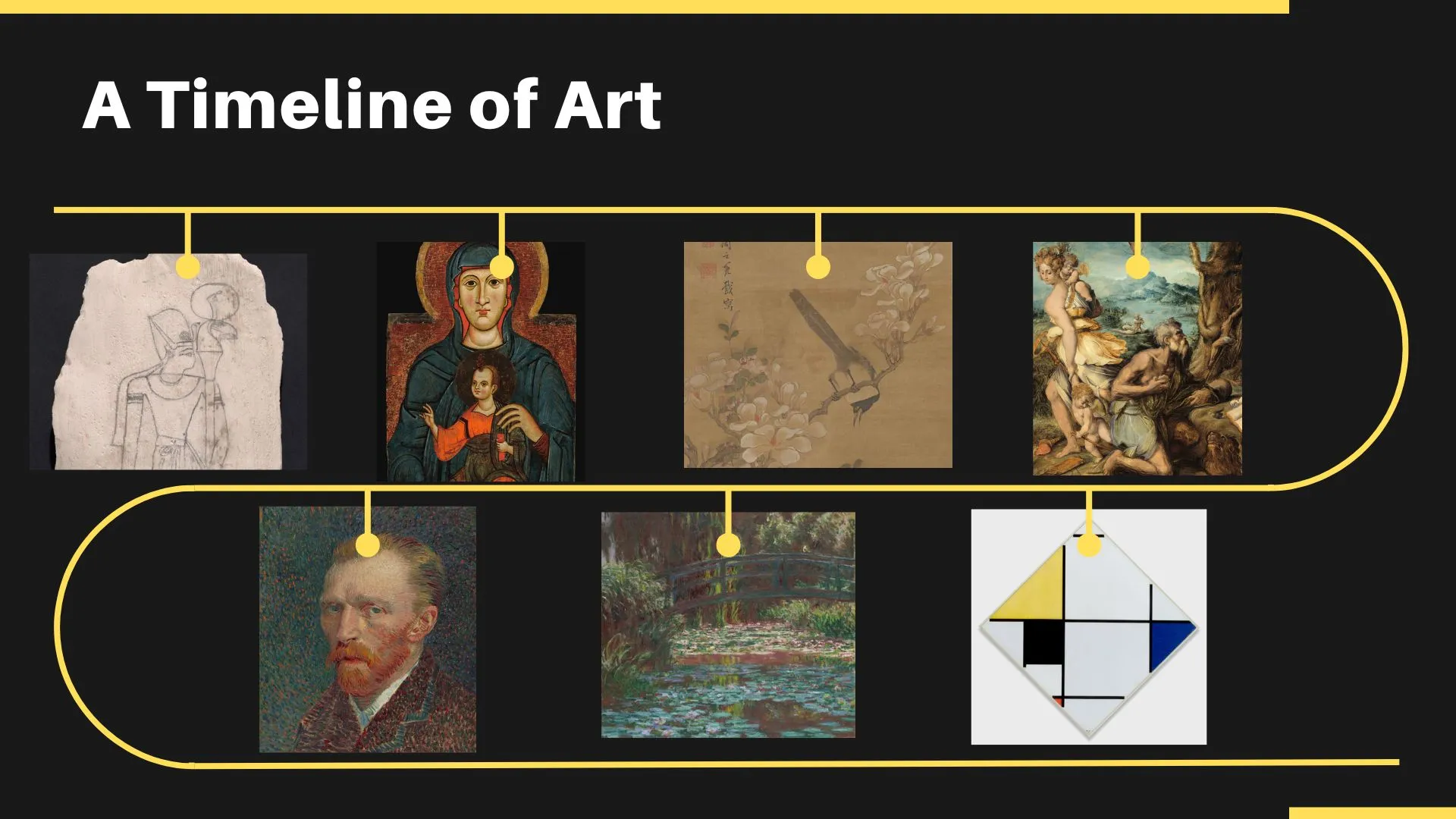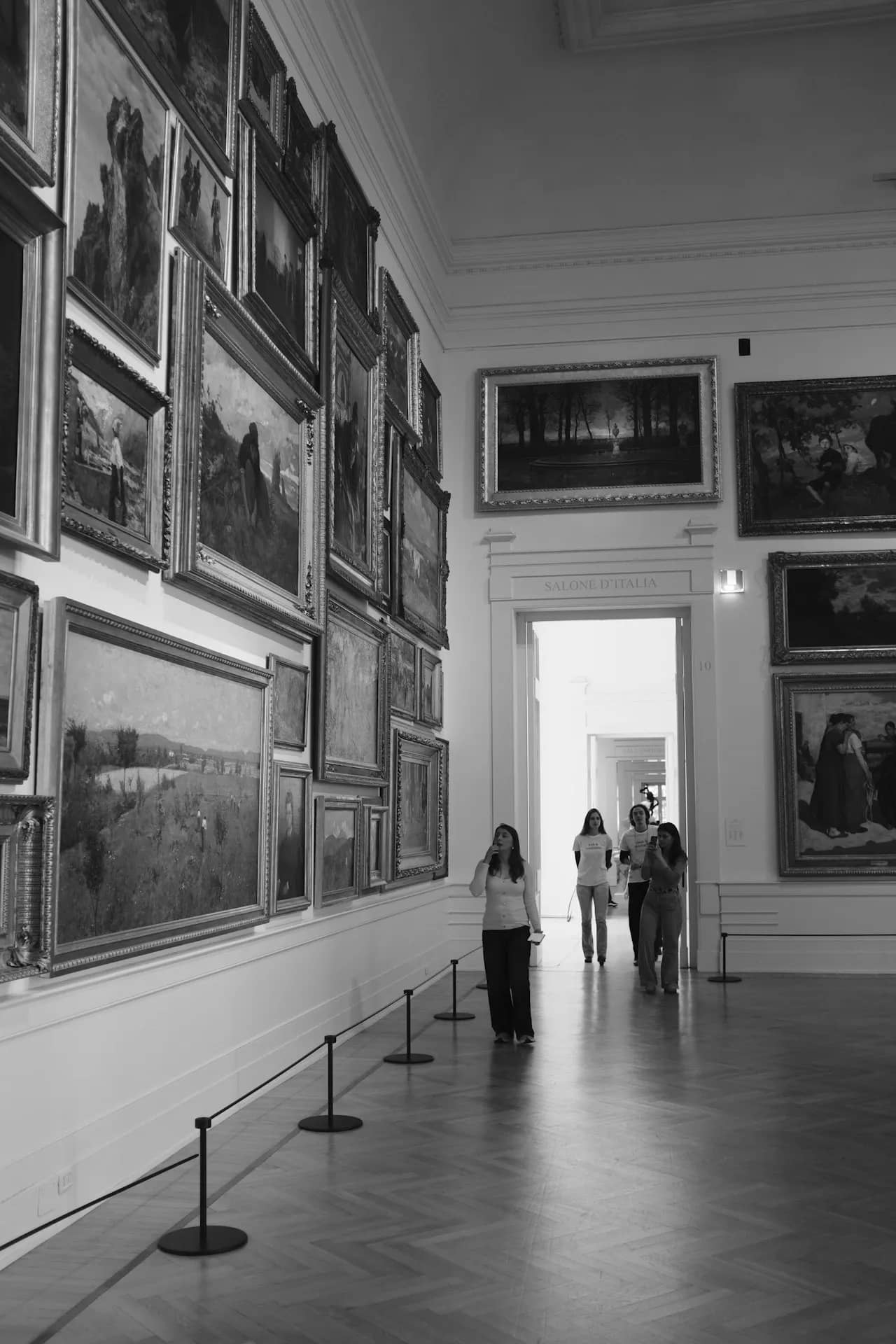
Most people can name two or three art movements. Impressionism, probably. Renaissance if they paid attention in school. Surrealism if they have seen a Dalí poster. But ask what any of those movements actually believed, what specific problem they were trying to solve, or how one led to the next, and the answers get thin. That gap is not a minor inconvenience. It means that most people walk through museums reading labels rather than understanding what they are looking at.
Art history is not a random sequence of styles. It is a continuous argument, spanning thousands of years, about what art is for, what reality looks like, and what human beings most need to express at any given moment. Each movement is a response to the one before it, or a rejection of it, or a development of something it left unfinished. Understanding the argument changes how you see every painting, sculpture, and installation you encounter. This guide maps that argument from ancient Egypt to 2026, with links to deeper coverage of every period.
Ancient Art: Rules That Lasted Three Thousand Years
Ancient Egyptian art (c. 3100-30 BCE) is one of the most distinctive visual languages ever created, and it barely changed over three millennia. Egyptian figures are shown in a composite view: head in profile, eye facing forward, torso facing the viewer, legs in profile again. This is not a failure of observation. Egyptian artists were skilled draftsmen who could observe accurately when they wanted to. The composite view was a deliberate choice: Egyptian art was not trying to show how things looked from one position at one moment. It was trying to show what things essentially were, in the most clear and permanent form possible. That ambition produced an art of extraordinary consistency. Our full exploration of Ancient Egyptian Art: Rules, Symbolism, and 3,000 Years of Consistency covers this tradition in depth.
Greek and Roman art moved in the opposite direction, toward naturalism: idealized human figures based on anatomical observation, mathematical proportion, and the idea that physical beauty was an expression of divine order. This classical tradition would be revived, contested, and reworked repeatedly over the following two thousand years.
Byzantine Art: The Sacred Image (c. 330-1453 CE)
When the Roman Emperor Constantine converted to Christianity and moved his capital to Constantinople in 330 CE, Western art underwent a fundamental transformation. Naturalistic classical figures gave way to flat, hierarchically organized images where spiritual authority was expressed through formal convention rather than physical resemblance. Gold backgrounds placed sacred figures outside ordinary time and space. Rigid frontal poses and elongated proportions signified holiness rather than humanity. Byzantine icons are immediately recognizable more than a thousand years after they were made, which is exactly what the system was designed to produce. The guide to Byzantine Art: Gold, Icons, and the Sacred Image covers this tradition and its lasting influence.
The Renaissance: When Art Rediscovered the Human (c. 1300-1600)
The Renaissance began in Florence in the 14th century as artists, scholars, and patrons rediscovered classical Greek and Roman art and philosophy. The technical innovations were specific and transformative. Filippo Brunelleschi's demonstration of linear perspective in the early 1400s gave painters a mathematical system for representing three-dimensional space on a flat surface for the first time in Western art. Figures began to inhabit convincing space. The human body returned to the center of art as a subject of beauty and dignity in its own right, not as a spiritual symbol.
The Renaissance produced some of the most recognized objects in Western culture: Leonardo da Vinci's Mona Lisa and The Last Supper, Michelangelo's David and the Sistine Chapel ceiling, Raphael's School of Athens. These were not isolated achievements but products of a cultural moment when patrons, artists, and scholars collaborated with shared purpose. The deep guide to Renaissance Art: Perspective, Humanism, and the Birth of Modern Art covers the full period. Spotlights on Leonardo da Vinci and Michelangelo explore its two defining practitioners.
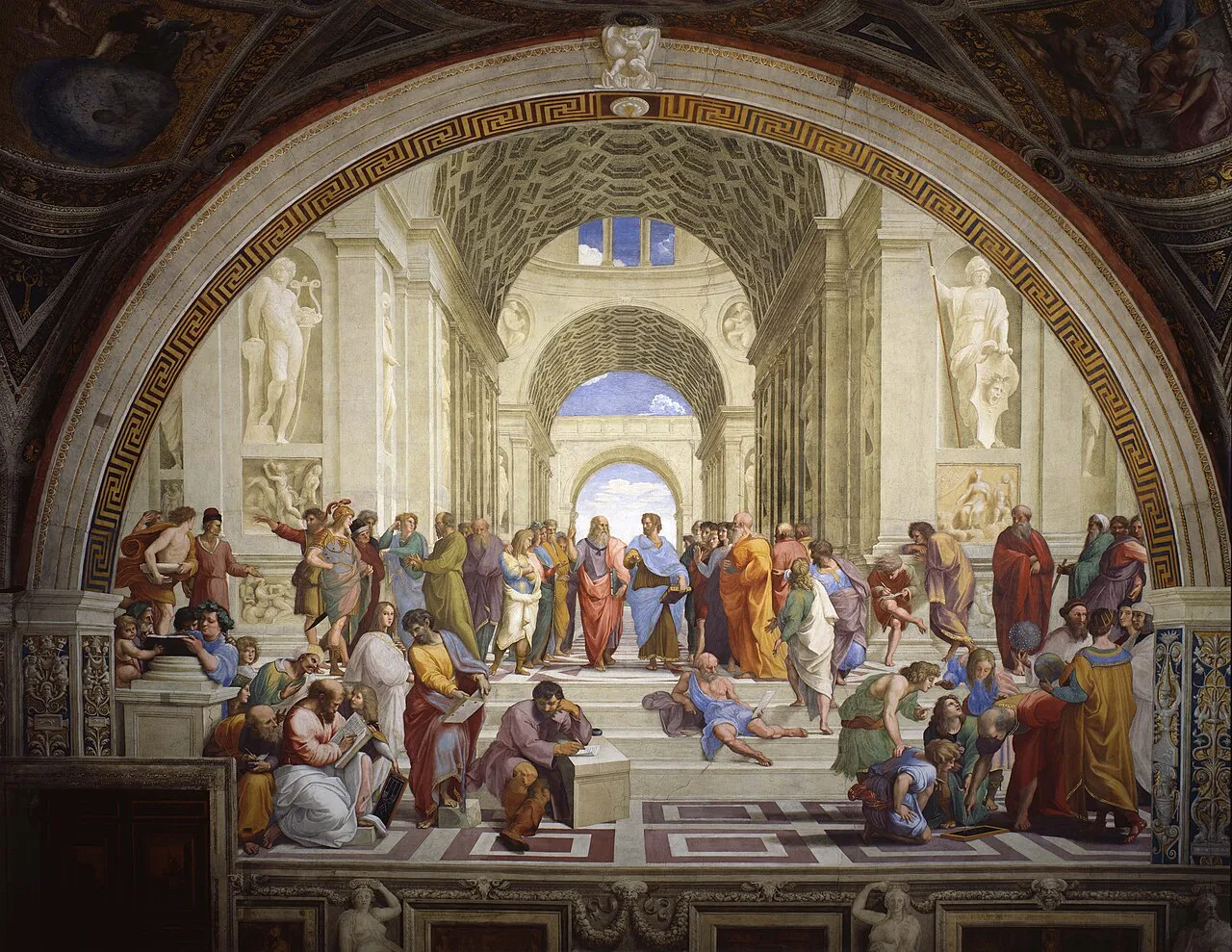
Raphael, "The School of Athens" (1509-11), fresco, 500 x 770 cm. Apostolic Palace, Vatican City. Renaissance humanism in its most ambitious visual form: the great thinkers of antiquity gathered in architectural space, with Plato and Aristotle at the center in dialogue. Image: Public domain, via Wikimedia Commons
The Baroque: Drama, Light, and Emotional Force (c. 1600-1750)
The Baroque emerged partly as a response to the Protestant Reformation. The Catholic Church wanted images that moved ordinary people emotionally, that made sacred stories feel immediate and urgent rather than ideally remote. Caravaggio showed exactly how to do it: figures pulled from the streets of Rome, scenes lit by a single concentrated light source against near-black backgrounds, physical emotions rendered with a directness that no earlier painting had attempted. The result was art of real dramatic power, and it spread rapidly.
The Baroque took different forms in different contexts. In Catholic Italy and Spain: Caravaggio, Velázquez, Bernini. In Protestant Netherlands: Rembrandt and Vermeer, working not for the Church but for a prosperous merchant class that wanted portraits, domestic scenes, and still lifes. The guide to Baroque Art: Drama, Light, and the Power of the Catholic Church covers the full period, with individual spotlights on Rembrandt, Vermeer, and Artemisia Gentileschi.
Romanticism: Emotion, Nature, and Individual Vision (c. 1780-1850)
Romanticism emerged as a reaction against the rationalism of the Enlightenment and the industrial transformation of daily life. Where the Enlightenment championed reason and classical clarity, Romanticism championed individual imagination, intense emotion, and the power of nature as something approaching a spiritual force. Caspar David Friedrich painted landscapes where small human figures confront vast mountains, mists, and seas that dwarf any human claim to significance. The sublime was the point: the feeling of being overwhelmed by something greater than yourself.
In France, Eugène Delacroix brought this intensity to historical and political subjects at an enormous scale. In England, J.M.W. Turner dissolved landscape into pure light and atmosphere with a freedom that anticipated Impressionism by three decades. The full story is in Romanticism: Emotion, Nature, and the Revolt Against Reason.
Impressionism: The Revolution of Light (c. 1860-1890)
Impressionism is where modern art history conventionally begins, and the conventional placement is correct. In April 1874, a group of Paris painters organized their first independent exhibition, deliberately bypassing the official Salon. Monet, Renoir, Degas, Pissarro, Morisot, and Sisley painted outdoors in natural light, capturing the changing effects of atmosphere with short, broken brushstrokes of pure color. Their paintings looked rough and unfinished to academic eyes because they were rejecting the conventions those eyes expected.
What Impressionism proposed was more radical than a stylistic choice. It said that the painter's direct observation of the visible world, right now, in this specific light, at this specific moment, was a worthy and sufficient artistic subject. That proposition opened every door that followed. The complete guide to Impressionism: Monet, Light, and Breaking Academic Rules covers the movement in depth. The spotlight on Claude Monet explores its defining practitioner.
Post-Impressionism: Four Artists, Four Completely Different Answers (c. 1886-1910)
Post-Impressionism is not a movement. It is a convenience label for four exceptional painters who each took the Impressionist breakthrough in a different direction. Vincent van Gogh kept the broken brushwork but charged it with emotional intensity, using color and form to express psychological states rather than observed light. Paul Cézanne pursued the underlying geometric structure of nature, simplifying forms toward cylinders, spheres, and cones in a way that directly inspired Cubism. Paul Gauguin rejected European civilization and sought a different visual language in Tahitian culture. Georges Seurat developed Divisionism, a systematic scientific application of color theory in tiny dots of pure pigment.
These four are the direct ancestors of virtually every major 20th-century movement, which makes them the most important painters to understand after the Impressionists themselves. The spotlight on Vincent van Gogh and the profile of Paul Cézanne explore the two most consequential figures.
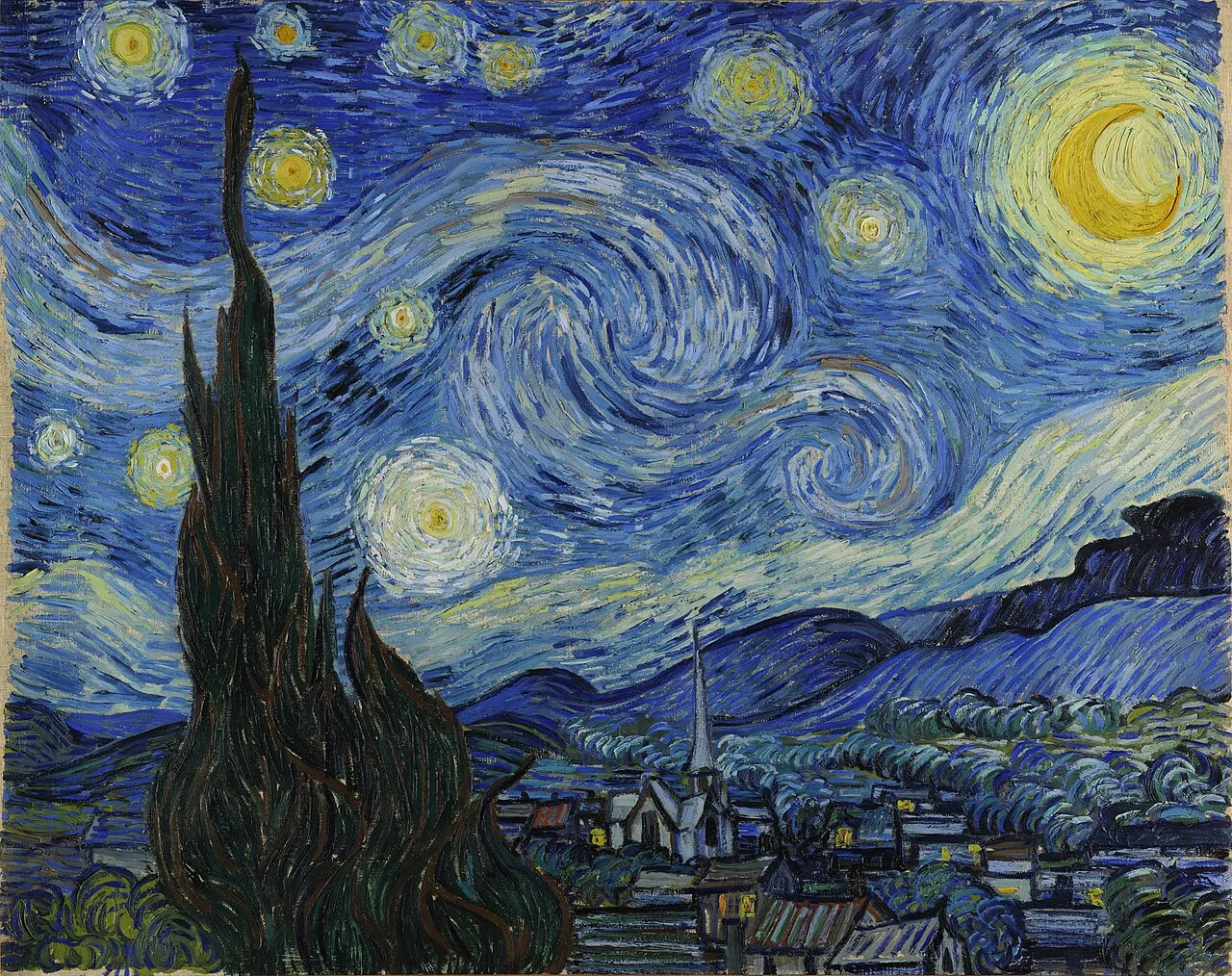
Vincent van Gogh, "The Starry Night" (1889), oil on canvas, 73.7 x 92.1 cm. Museum of Modern Art, New York. The swirling energy of the sky is not stylistic decoration. Van Gogh was painting what anxiety and awe feel like, not what a night sky looks like. Image: Public domain, via Wikimedia Commons
The Early 20th Century: Three Movements, Three Radical Breaks (c. 1900-1930)
Fauvism (c. 1905-1910), led by Matisse and Derain, liberated color from any obligation to describe what things actually looked like. Paint became pure chromatic energy. A face could be green and orange. A forest could be red. The result was the most freely expressive use of color European painting had seen. Expressionism in Germany and Austria (c. 1905-1925) used distorted form and harsh color to express inner psychological states. Edvard Munch's "The Scream" (1893) is the visual image that defines the emotional territory.
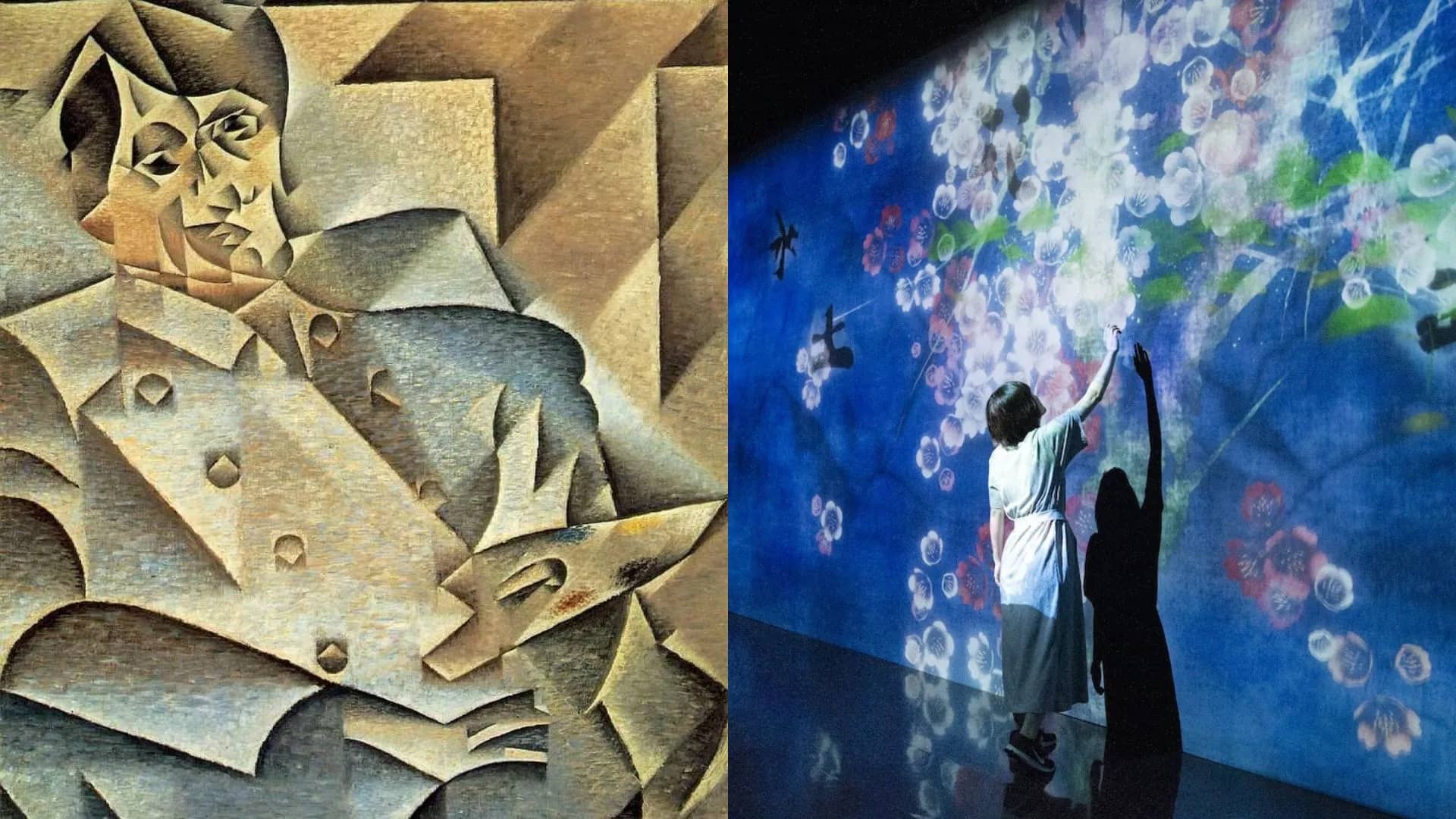
Cubism (c. 1907-1914), developed by Picasso and Braque, was the most intellectually radical break from the Western tradition since the Renaissance. It rejected single-point perspective and showed objects simultaneously from multiple viewpoints, building a more complete description of reality by abandoning optical naturalism altogether. This freed painting from any obligation to look like the visible world. According to MoMA's Cubism learning resources, the movement is now understood as the single most transformative shift in Western pictorial art between the Renaissance and abstraction. The full guide to Cubism: Picasso, Braque, and Seeing All Sides at Once and the spotlight on Pablo Picasso go deeper.
Bauhaus, Surrealism, and Between the Wars (c. 1919-1939)
The Bauhaus school in Germany (1919-1933) set out to unify fine art, craft, and industrial design under a single educational framework. Its faculty included Kandinsky, Klee, Itten, Moholy-Nagy, and Mies van der Rohe. The Nazis forced it to close in 1933, but its influence spread as its faculty emigrated to the US, UK, and elsewhere. Contemporary graphic design, architecture, typography, and product design are all Bauhaus descendants. The guide to The Bauhaus Movement: Where Art Met Design and Function covers this institution and its legacy.
Surrealism (founded in Paris in 1924 by André Breton) turned inward toward the unconscious, drawing on Freudian psychology to explore dreams, desire, and irrational imagery. Salvador Dalí, René Magritte, Max Ernst, and Joan Miró each developed a distinct visual language for this territory. The guide to Surrealism and the Subconscious and the spotlight on Salvador Dalí cover both the movement and its most recognizable figure.
Abstract Expressionism and Post-War Art (c. 1945-1970)
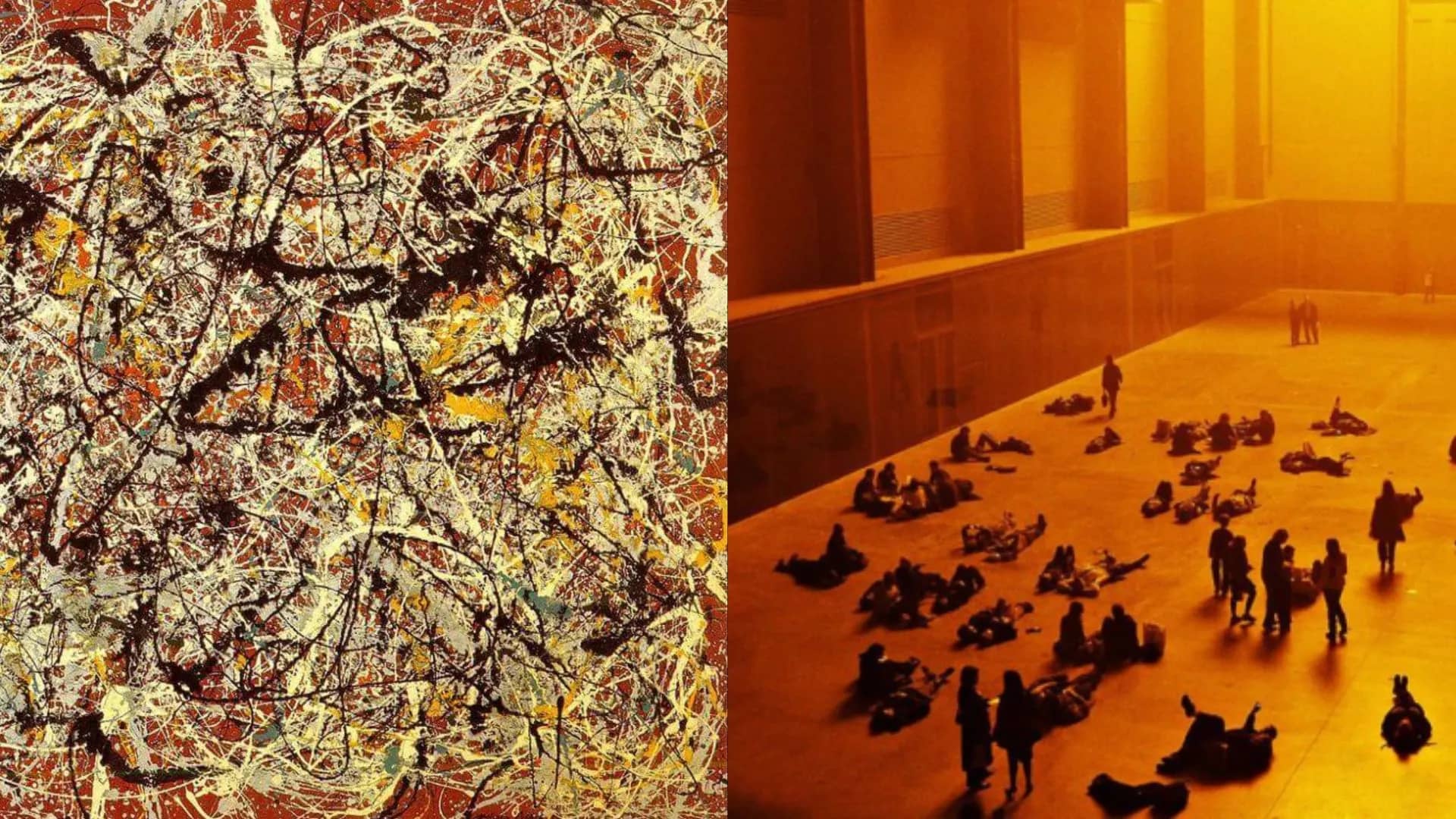
After World War II, the center of the art world shifted from Paris to New York. Abstract Expressionism was the first American movement to have global influence. Jackson Pollock dripping paint onto canvases laid on the floor. Mark Rothko floating luminous color fields at a scale large enough to fill your peripheral vision. Willem de Kooning attacking the canvas with gestural intensity. The movement split into two camps: action painting (Pollock, de Kooning), which emphasized the physical act of making, and color field painting (Rothko, Barnett Newman), which used large areas of pure color for emotional and near-spiritual effect.
The complete guide to Abstract Expressionism: When Art Became About the Act of Painting examines this movement. The spotlight on Wassily Kandinsky shows the earlier European roots of pure abstraction.
Pop Art, Minimalism, and Conceptual Art (c. 1955-1980)
Pop Art emerged in Britain and America in the late 1950s and 1960s, turning mass consumer culture into art. Andy Warhol's soup cans and Marilyn Monroe silkscreens, Roy Lichtenstein's comic-strip paintings, Richard Hamilton's collages: all asked what art was worth when it looked like a product, and what a product was worth when treated as art. The guide to Pop Art: History, Traits, Artists, and Modern Takes and the spotlight on Andy Warhol explore the movement and its most famous practitioner.
Minimalism stripped art to its irreducible formal elements: industrial materials, geometric forms, no representation, no personal expression. Donald Judd, Dan Flavin, and Carl Andre produced work that asked viewers to confront the physical reality of an object rather than any represented content. Conceptual Art went further, arguing that the idea behind a work was the work itself, making the physical object optional. Joseph Kosuth's "One and Three Chairs" (1965) is the definitive example. The guide to Conceptual Art: When the Idea Is the Artwork covers this territory.
Contemporary Art: No Single Story (1980-Present)
Contemporary art since 1980 operates without a single dominant movement or ideology, which is itself characteristic. Neo-Expressionism in the 1980s (Basquiat, Schnabel, Anselm Kiefer) returned to painterly gesture and personal imagery. The YBAs (Young British Artists) of the 1990s, led by Damien Hirst and Tracey Emin, made work that provoked controversy through shock, irony, and conceptual audacity. Street art moved from urban surfaces into galleries and auction houses in the 2000s and 2010s. Digital art, generative art, and AI-generated imagery have opened new territory in the 2020s.
Artists like Yayoi Kusama, Kara Walker, Ai Weiwei, and Olafur Eliasson continue to expand what a work of art can be and where it can appear. The guides to Digital Art: The Modern Creative Frontier and NFT Art Explained cover the emerging digital territory. The spotlight on Yayoi Kusama shows one clear vision of where art is going.
How to Use This Timeline
The movements described here are not sealed compartments. Artists moved between them, borrowed from them, and reacted against them continuously. Picasso drew on African art while inventing Cubism. The Surrealists drew on Freudian psychology and on Dada. The Abstract Expressionists responded directly to Surrealism's emphasis on the unconscious. Contemporary artists quote, appropriate, and remix the entire history. Understanding the connections between movements is far more useful than memorizing the movements as separate categories.
Use this timeline as a reference you return to. When you encounter an unfamiliar movement in a museum or article, come back here to place it in context, then follow the links to go deeper. The broader sweep of how styles evolved across all periods is traced in The Evolution of Art Styles: From Realism to Contemporary. For practical tools to understand what you are looking at in any period, see How to Look at Art for Beginners. Which movement do you find yourself returning to most often? Share it in the comments.