
On October 5, 2018, at Sotheby's auction house in London, a framed painting by Banksy sold for £1.04 million. The moment the auctioneer's hammer fell, a hidden shredder built into the frame activated, and the canvas began sliding through the mechanism, emerging in strips. The audience gasped. Sotheby's staff scrambled. The half-shredded painting, later renamed "Love is in the Bin," resold in 2021 for £18.5 million, making it one of the most expensive works by a living British artist. It was the most Banksy thing imaginable: a prank that exposed the absurdity of the art market while simultaneously making him richer.
No other artist in the world has pulled off a career like this. Banksy is simultaneously the most famous and the least verifiable figure in contemporary art. He makes work without permission on public property, refuses interviews, and has protected his identity so fiercely that a 2026 Reuters investigation running to thousands of words and years of reporting was needed to piece together the basic facts of who he is. That investigation concluded he was born Robin Gunningham in Bristol in 1973, that he later legally changed his name, and that a musician from the trip-hop group Massive Attack has been a close collaborator and enabler. Banksy's lawyers denied the claims. The mystery, as intended, continues.
His stenciled images have been reproduced on T-shirts and phone cases worldwide, yet the originals were made illegally on walls he does not own. His work has sold for tens of millions at Christie's and Sotheby's, yet he gives most of it away for free. This guide explores his rise, his most significant works, his political approach, and the contradictions that make him genuinely hard to dismiss.
Origins: Bristol, Graffiti, and the Stencil
Banksy emerged from the Bristol graffiti scene of the early 1990s, a subculture connected to the city's music world. Trip-hop pioneers Massive Attack and Tricky were developing their sound in the same city at the same time, and Robert Del Naja of Massive Attack, himself a graffiti writer under the tag "3D," is now confirmed by the Reuters investigation to have been a key collaborator in Banksy's operations. Early in his career, Banksy sprayed freehand, but he was reportedly too slow and the risk of arrest too high. He switched to stencils.
The stencil technique changed everything. A design is cut at home or in a studio, carried rolled up in a tube, and pressed against a wall. The paint goes on in seconds. You are gone before anyone notices. The technical constraint also produced an aesthetic: Banksy's work is graphic, high-contrast, and instantly legible from a distance. Figures read clearly in a single glance, which is exactly what street art needs if it is going to reach people who did not go to a gallery to see it.
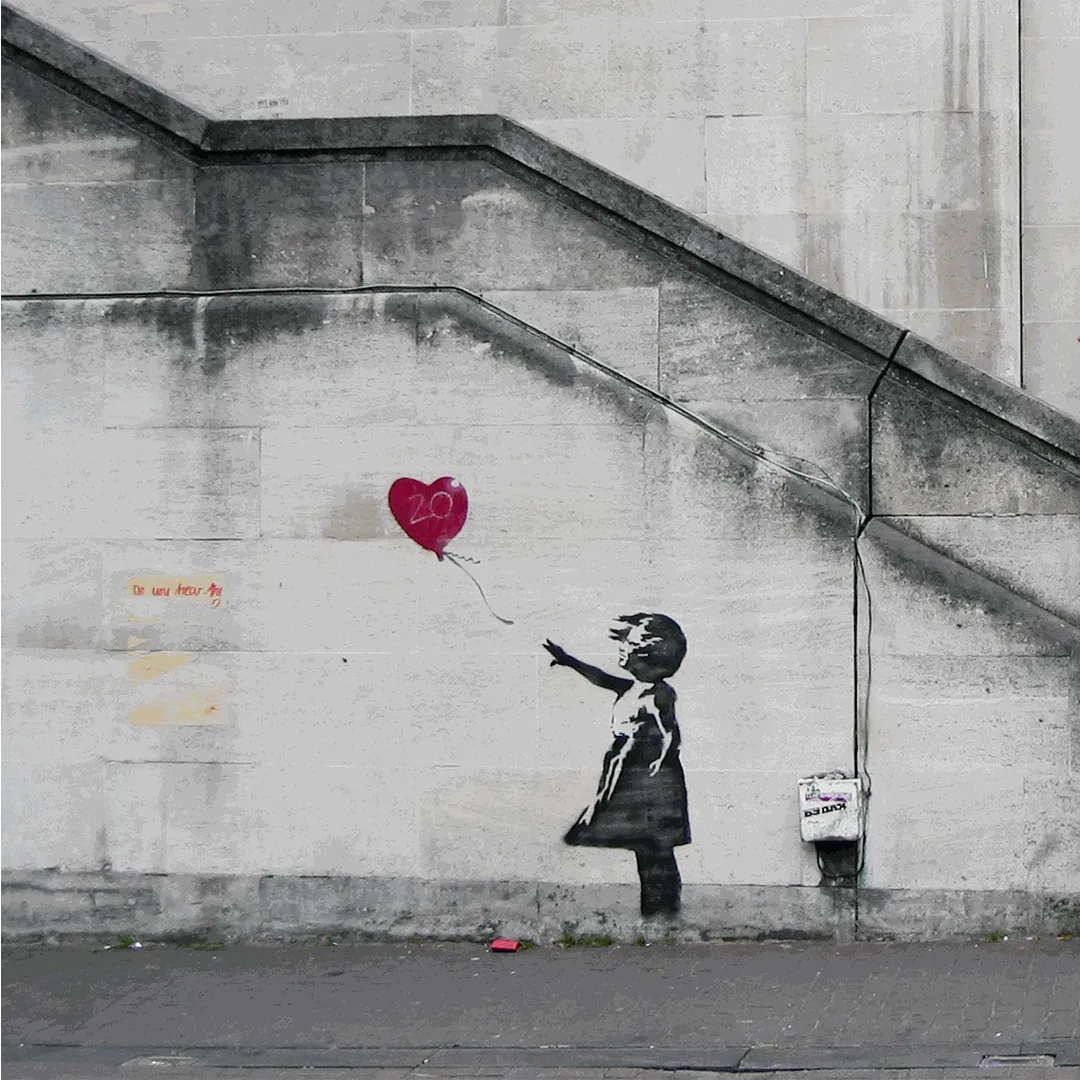
Banksy, "Girl with Balloon" (2002), stencil and spray paint, South Bank, London. One of Banksy's most widely reproduced images. Photo: Mustard
By the early 2000s, Banksy's work had spread from Bristol to London, New York, Palestine, and beyond. Each piece appeared without announcement, was confirmed afterward on his website or social media, and generated press coverage that no advertising budget could buy. It was a perfect model: the illegal act creates the story, the story creates the audience, and the audience creates the value.
The Works That Defined His Career
Girl with Balloon (2002)
Originally stenciled on a wall on London's South Bank, "Girl with Balloon" shows a small girl reaching toward a red heart-shaped balloon that floats just beyond her grasp. It is his most recognizable image and has been voted Britain's most loved artwork in multiple polls, including a 2005 BBC survey of the public's favorite works. The image works because it says nothing specific. It can be about innocence, loss, hope, or grief, and the viewer decides which. That openness is harder to achieve than it looks.
Kissing Coppers (2004)
Painted on a pub wall in Brighton, this stencil showed two male police officers in full uniform locked in a passionate kiss. It was a provocation about LGBTQ+ rights, a satire of authority, and a strangely tender image simultaneously. The pub later sold it to an American collector. The Brighton wall is now bare.
The Walled Off Hotel (2017)
Banksy opened a fully functional hotel in Bethlehem, Palestine, directly adjacent to the Israeli West Bank barrier wall. Billed as having "the worst view of any hotel in the world," each room features Banksy artworks looking directly onto the concrete separation wall. It remains open, and it is the only permanent physical institution Banksy has created. The hotel functions as a gallery, a museum of the wall's history, and a functioning place to sleep, all at once.
Dismaland (2015)
Built inside a derelict seaside lido in Weston-super-Mare, England, Dismaland was a dystopian theme park featuring over fifty artists and running for five weeks. Over 150,000 people attended. The centerpiece was a crumbling Cinderella castle. Other attractions included a crashed pumpkin carriage with a dead princess inside, a model migrant boat crossing, and a gift shop selling items for people who had given up. After it closed, Banksy sent the building materials to the Calais refugee camp to build shelters.
Shredding at Sotheby's (2018)
The self-shredding painting was installed in the frame years before the auction. Banksy waited. When "Girl with Balloon" sold for £1.04 million, the shredder activated. The stunt perfectly captured his main argument: that the art market converts subversive work into luxury commodity, stripping it of its point in the process. That the half-destroyed painting then sold for eighteen times more only confirmed the argument. The art market shrugged and paid up.
Political Art and Social Commentary
Banksy's politics are consistent and explicit. War, surveillance, consumerism, immigration, and the hypocrisy of institutional power appear in almost everything he makes. What makes the work more than propaganda is the humor. His "Napalm Girl" image takes the famous photograph of a burned Vietnamese child and adds Mickey Mouse and Ronald McDonald as her escorts. The outrage and the absurdity arrive at the same moment.
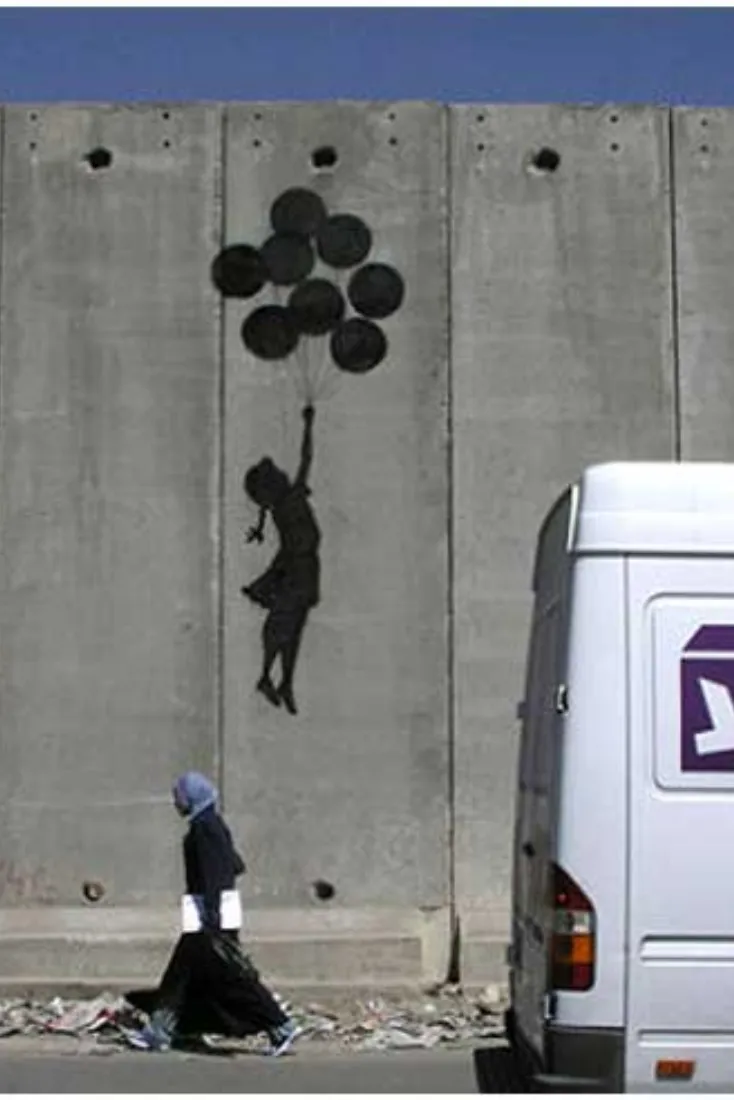
A Banksy artwork on the Israeli West Bank barrier wall in Bethlehem. Banksy has returned to the Palestinian territories multiple times, using the separation wall itself as the canvas. Image: Newtfire
His Steve Jobs portrait at the Calais refugee camp makes its point in a single sentence of caption: the biological father of the man who built the world's most valuable technology company was a Syrian immigrant. His 2020 "Game Changer" painting, showing a child playing with a nurse doll instead of superhero figures, was donated to a hospital during the COVID-19 pandemic and later sold by the hospital at Christie's for £16.8 million. In 2025, he painted an unauthorized mural at the Royal Courts of Justice in London showing a judge raising a gavel over a prostrate protester, and it was removed within days.
His most recent major work, as of mid-2026, appeared overnight in Waterloo Place, central London, in April 2026: a bronze-colored statue of a suited man striding forward off a plinth, his face entirely obscured by the flag he is carrying. Westminster Council initially said it was "excited" by the addition. The work is a few hundred meters from Downing Street, and the meaning is not subtle.
The Anonymity Paradox
The Reuters investigation published in March 2026 is the most serious attempt yet to pin down Banksy's identity. It built a case from a 2000 arrest record in New York, where a handwritten confession contained the name Robin Gunningham, from photographs, from travel records, and from an interview with former manager Steve Lazarides, who confirmed the name and that a legal name change followed their split in 2008. Banksy's lawyers contested the findings. The artist said nothing publicly.
The anonymity serves multiple purposes at once. It is legal protection: street art is criminal damage in most jurisdictions, and a named artist could be prosecuted or sued. It keeps attention on the work rather than the person. It generates the media cycle that keeps Banksy prominent between pieces. And it is, itself, an argument: about whether an artist's name should determine the value and meaning of their work, or whether the work can stand entirely on its own.
The contradiction that defines his career is that his critique of the art market has made him one of its most valuable participants. He paints on walls illegally; the walls become tourist destinations. He mocks auction houses; the auction houses sell his work for record prices. He never gives interviews; the silence generates more coverage than most artists get by talking constantly. These are not failures of consistency. They are the work.
Is Banksy Good Art?
This is a real debate, and it is worth engaging honestly. Critics including Jonathan Jones at The Guardian have argued that Banksy's stencils are essentially sophisticated illustration, that the conceptual content is carried by captions and context rather than by anything in the formal construction of the image, and that the shock value substitutes for genuine visual complexity. There is something to this. His work does not reward the same sustained looking that a Caravaggio or a Kentridge does.
But measuring Banksy against painting traditions he is explicitly rejecting is probably the wrong test. His work operates in public space, on a brief encounter, against distraction. Within those constraints, his ability to land a complex political argument in an image a passing stranger absorbs in three seconds is a genuine skill, and not a common one. He has moved street art from the margin of vandalism to the center of contemporary culture more effectively than any other single figure. The debate about what makes art good is exactly the kind of question his career keeps forcing open, which may be his most durable contribution.
Final Thoughts
Banksy has been making work for over thirty years and shows no sign of slowing down. In 2024, he produced an entire series of animal stencils across London in under a week. In 2025, he painted the Royal Courts of Justice. In April 2026, a crane appeared in Waterloo Place in the middle of the night and a statue was installed before dawn. His lawyers deny his identity. His Instagram has 13.8 million followers. His work sells for millions and is given away for free on walls that belong to other people.
His best pieces work because they collapse the distance between a complicated idea and the person encountering it on a wall. They make you laugh and then make you feel slightly uncomfortable about having laughed. That discomfort is the art. Want to explore the broader history of political and public art? Our guide to street art and urban creativity covers the tradition Banksy emerged from and transformed. For how art communicates without words, read our piece on how art communicates emotion. What is your take on Banksy's latest work? Share it in the comments.


