
In 1962, Andy Warhol exhibited thirty-two canvases showing Campbell's Soup cans at the Ferus Gallery in Los Angeles, one for each variety the company then produced. He arranged them like products on a supermarket shelf. The gallery next door reportedly displayed actual cans of Campbell's Soup in its window with a sign reading "Get the real thing for 29 cents." Some visitors thought the exhibition was brilliant. Many found it infuriating. That strong reaction, the sense that something important was being challenged, was exactly what Warhol was after.
His central question was one of the most unsettling in modern art: if an artist makes a work that is indistinguishable in subject, and very nearly in appearance, from a commercial product, what exactly is the difference between art and not-art? His answer, delivered with characteristic ambiguity, was that maybe there was not much of a difference, and maybe that was interesting rather than depressing. Mass production had created a visual world in which the same images appeared everywhere simultaneously: movie stars on magazine covers, product logos on every surface, news photographs of disasters repeated across every newspaper. Warhol did not lament this. He painted it. And in doing so, he produced one of the most accurate documents of twentieth-century American culture ever made by anyone in any medium.
This profile covers Warhol's early career as a commercial illustrator in New York, his explosion into the fine art world in the early 1960s, his method at The Factory, the 1968 shooting that changed him, and the late work that returned to the religious imagery of his childhood.
Pittsburgh to Manhattan: The Commercial Art Years
Andrew Warhola was born on August 6, 1928, in Pittsburgh, Pennsylvania, the third son of Carpatho-Rusyn immigrants from what is now Slovakia. His father Andrej worked in a coal mine and died of tuberculosis when Andy was thirteen. His mother Julia, who had emigrated to join her husband, was a deeply religious woman who would later live with Warhol in New York for twenty years. She was also an accomplished folk artist whose drawings were closer to professional quality than most people realize, and her hand is visible in some of Warhol's early commercial illustrations.
Warhol graduated from the Carnegie Institute of Technology in Pittsburgh in 1949 with a degree in pictorial design and moved immediately to New York. Within two years, he was the most successful commercial illustrator in the city, known for his shoe illustrations for I. Miller and his editorial work for Glamour, Harper's Bazaar, and Vogue. His commercial illustration work was genuinely inventive: he developed a technique of ink blotting that created a distinctive quality of slightly uneven, slightly unexpected line that set his work apart from the smooth precision of mainstream commercial art. The blotted line technique, which involved drawing in ink, pressing a sheet of absorbent paper against the wet drawing to lift the ink, then pressing that sheet onto the final surface, produced results that looked both handmade and mechanical at the same time. This tension between hand and machine would define his entire career.
The commercial work earned him enough money to live well and begin collecting art. But it was not what he wanted. Throughout the 1950s, he made repeated attempts to break into the gallery world with paintings and drawings, and was consistently rejected. The fine art world and the commercial art world were, at that time, understood to be fundamentally different, and the idea of a successful commercial illustrator crossing over was not taken seriously. Warhol was determined to cross that line, and when he did, he crossed it in a way that made the distinction permanently problematic.
The Soup Cans and the Invention of Pop
Warhol's breakthrough came in 1961 and 1962 when he began making paintings based on commercial products and mass-media images: Dollar Bills, Before and After (a before-and-after advertisement for a nose job), Coca-Cola bottles, and the Campbell's Soup Cans. The technique he settled on was silkscreen printing, which allowed him to transfer photographic images mechanically to canvas with slight variations in each print. The slight variations, the small differences in ink coverage, registration, and color, were where Warhol's hand was present, but they were subtle enough to make each image feel both mechanically produced and manually unique at the same time.
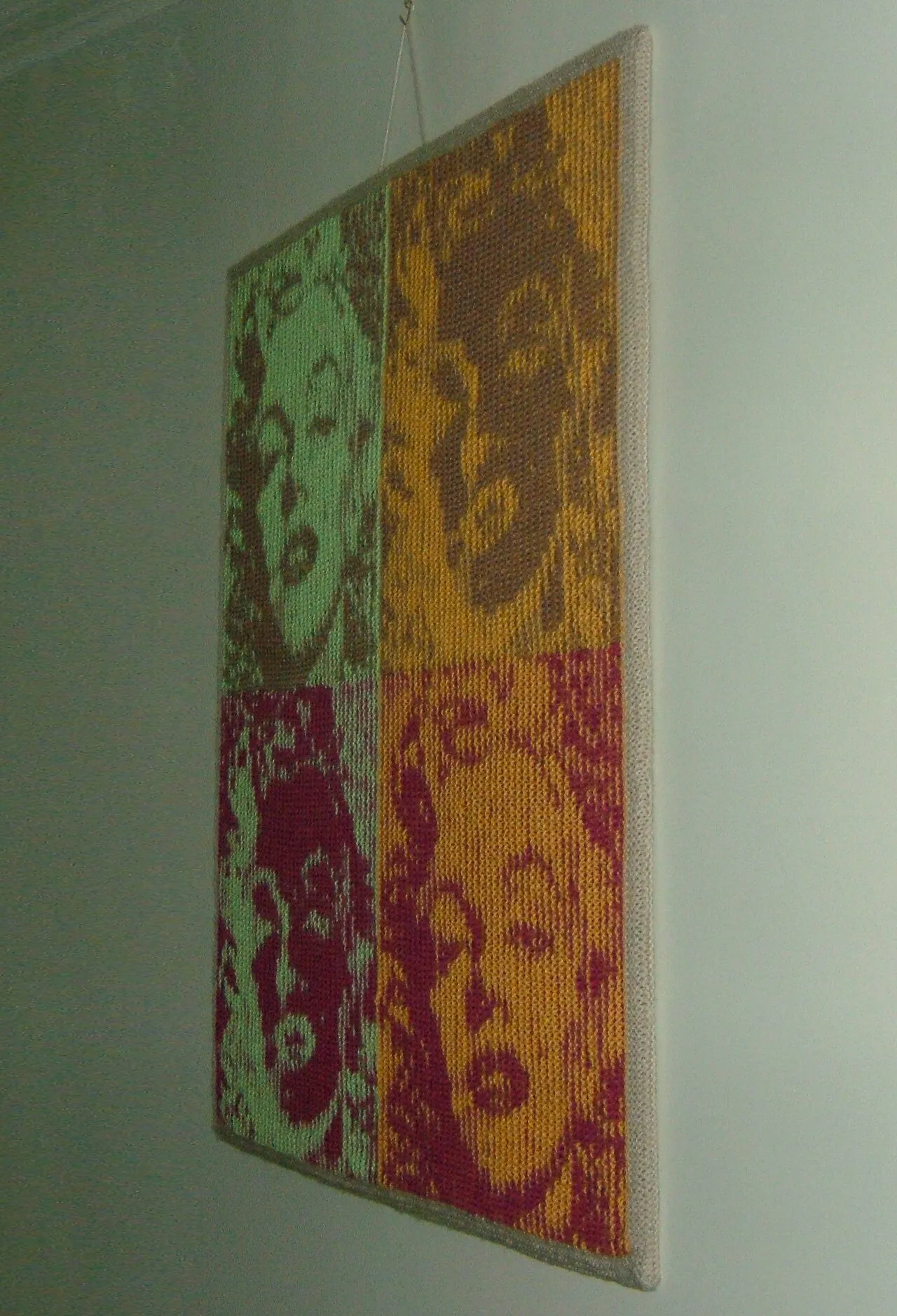
The silkscreen method also allowed production at scale. Warhol began making dozens of versions of the same image, often in different color combinations. The Marilyn Monroe series, begun immediately after Monroe's death in August 1962, showed her face repeated in color combinations ranging from brilliant gold to purple-black. The "Marilyns" were not a portrait or a tribute in any conventional sense. They were an investigation of what celebrity meant in an age of mass reproduction: the reduction of a person to an image, the image to a logo, the logo to an infinite series of slightly varying copies. The same face, repeated, each time slightly different, each time recognizably the same. The work was describing a condition that did not yet have a name in 1962 but that anyone alive in 2026 recognizes immediately.
Andy Warhol, "Gold Marilyn Monroe" (1962), silkscreen ink on synthetic polymer paint on canvas, 211.4 x 144.7 cm. Museum of Modern Art, New York. The Byzantine-icon quality of a single face on a gold ground is almost certainly intentional. Image via Wikipedia
Warhol's understanding of celebrity culture was decades ahead of its time. His series on Elvis Presley, Mao Zedong, and Mick Jagger treated fame as the dominant visual fact of modern life, a point of focus that commanded attention the way religious icons had commanded attention in earlier centuries. The gold background of "Gold Marilyn Monroe" is not accidental: it directly references the gold backgrounds of Byzantine icons, which Warhol would have seen in the Orthodox churches of his childhood in Pittsburgh's Rusyn community. The analogy between religious veneration and celebrity worship was one of his consistent themes, and it was not entirely metaphorical. The exploration of Pop Art's ideas runs throughout his entire career.
The Factory: Art as Social Experiment
In 1963, Warhol moved his studio to a large loft on East 47th Street in Manhattan that his associates nicknamed "The Factory," a reference both to the industrial scale of its art production and to its role as a social gathering point for New York's bohemian underground. The Factory became one of the defining social scenes of 1960s New York: a space where artists, musicians, drag queens, socialites, street people, and celebrities mixed with an openness that was genuinely novel for the time. Warhol produced paintings in large quantities, made experimental films (over sixty between 1963 and 1968), managed the rock band The Velvet Underground, and produced a magazine called Interview.
He cultivated the persona of the passive, affectless observer, giving empty one-word answers to journalists and projecting a blank, non-committal face that frustrated those who wanted a conventional artist. "If you want to know all about Andy Warhol, just look at the surface of my paintings and films and me," he said. "There I am. There's nothing behind it." This performance of blankness was itself a kind of artwork, and a sophisticated one. By refusing to explain or justify his choices, by declining to provide the interpretive narrative that critics and audiences expected, Warhol forced viewers to confront the images on their own terms. Whether a Campbell's Soup Can was art was a question viewers had to answer for themselves, and the fact that the question was so difficult to answer was, in Warhol's view, the most interesting thing about it.
After the Shooting and the Late Work
On June 3, 1968, Valerie Solanas, a radical feminist writer who had appeared in one of Warhol's films, shot Warhol in his studio. He was clinically dead for several minutes and required extensive surgery to survive. He wore a surgical corset for the rest of his life. The shooting profoundly changed him: he became more private, more security-conscious, and in some accounts more spiritually focused, attending mass regularly at a Catholic church near his home without publicizing it. The Factory became a more closed, professional operation.
His later career, from the late 1970s through his death in 1987, included the "Shadows" series (1978-79), enormous abstract canvases that look like paintings of shadows without identifiable sources; the "Oxidation Paintings" made by having people urinate on copper metallic paint to create chemical reactions; the "Myths" series showing American cultural icons; and the monumental "Last Supper" series of 1986-87, made in the last months of his life, which returned directly to the religious imagery that had interested him since childhood. The "Last Supper" paintings, shown at the Milan Triennale in 1986 and at the Dia Art Foundation in New York in 1987, are among the largest works he ever made. They reproduce Leonardo's composition in silkscreen, overlaid with commercial logos and price tags, collapsing the distance between sacred image and brand identity that his entire career had been investigating. Warhol died on February 22, 1987, in New York, following complications from gallbladder surgery, at age 58.
What the Work Still Does
Andy Warhol's legacy is impossible to contain in a single assessment. He is simultaneously the most commercially successful artist in history, the figure who most thoroughly questioned the distinction between commercial and fine art, and the artist who most accurately anticipated the visual culture of social media and celebrity spectacle that now surrounds us. The logic of his work, that fame is a kind of replication, that consumer culture is the dominant environment of modern consciousness, and that art's job might be to hold a mirror to that environment rather than to escape it, has become so thoroughly the dominant logic of contemporary culture that his paintings can seem obvious now.
They are not. Stand in front of the Marilyns or the soup cans and they still raise the questions they were designed to raise: about what we value, what we reproduce, what we elevate to the status of icons, and what that elevation says about us. Those questions have not been answered. They have only become more pressing. The Museum of Modern Art's Warhol page provides a good overview of his work across media. For a deeper exploration of the movement Warhol defined, read the full guide to Pop Art: History, Traits, Artists, and Modern Takes. For a look at how printmaking became the technical basis of Warhol's method, explore Printmaking 101: Linocut, Etching, and Screen Printing. Does Warhol's work feel more relevant to you now than it would have a decade ago? Share your thoughts below.


