
In 1982, a twenty-one-year-old artist with no formal training painted canvases in the basement of a SoHo gallery that sold for tens of thousands of dollars apiece. Within a year, Jean-Michel Basquiat was exhibiting at documenta 7 in Kassel as one of the youngest artists ever included in that event. Within two years, he was on the cover of the New York Times Magazine. Within six years, he was dead of a heroin overdose at age twenty-seven. In the decades since, his paintings have sold for over $100 million at auction. In 2024 alone, his work appeared in major exhibitions at Gagosian Paris, the Louisiana Museum of Modern Art in Denmark, and a solo show at Nahmad Contemporary in New York. His prices and his cultural presence continue to rise simultaneously, which is unusual and says something significant about what the work is actually doing.
Basquiat's canvases swarm with scrawled words, crossed-out phrases, skeletal figures, crowned heads, anatomical diagrams, and references ranging from Charlie Parker to Leonardo da Vinci to sugar plantations. The surfaces are dense, layered, and urgent. They demand attention not through polish but through intensity. Every painting feels like a mind working at full speed, connecting ideas faster than any single canvas can hold. The work looks raw. It is not naive. Understanding the difference is the key to understanding Basquiat.
This article covers Basquiat's origins, his artistic methods, his major themes, and the legacy that has made him one of the most important American artists of the late 20th century.
From SAMO to Soho: Basquiat's Origins
Jean-Michel Basquiat was born on December 22, 1960, in Brooklyn, New York, to a Haitian-American father, Gerard Basquiat, and a Puerto Rican-American mother, Matilde Andrades. He was trilingual (English, French, Spanish) and precociously intelligent. His mother, who suffered from mental illness and was frequently institutionalized, took young Jean-Michel to museums regularly. By age eleven, he was a junior member of the Brooklyn Museum, and his early exposure to art history left a permanent mark on his work.
At age seven, Basquiat was hit by a car while playing in the street. During his recovery, his mother gave him a copy of Gray's Anatomy. Its detailed illustrations of the human body became a lifelong visual reference. Skeletons, organs, and anatomical diagrams appear throughout his paintings, often alongside words and symbols that transform them from scientific illustrations into statements about vulnerability, mortality, and what it means to be a Black body in America under observation, under threat, under the medical gaze.
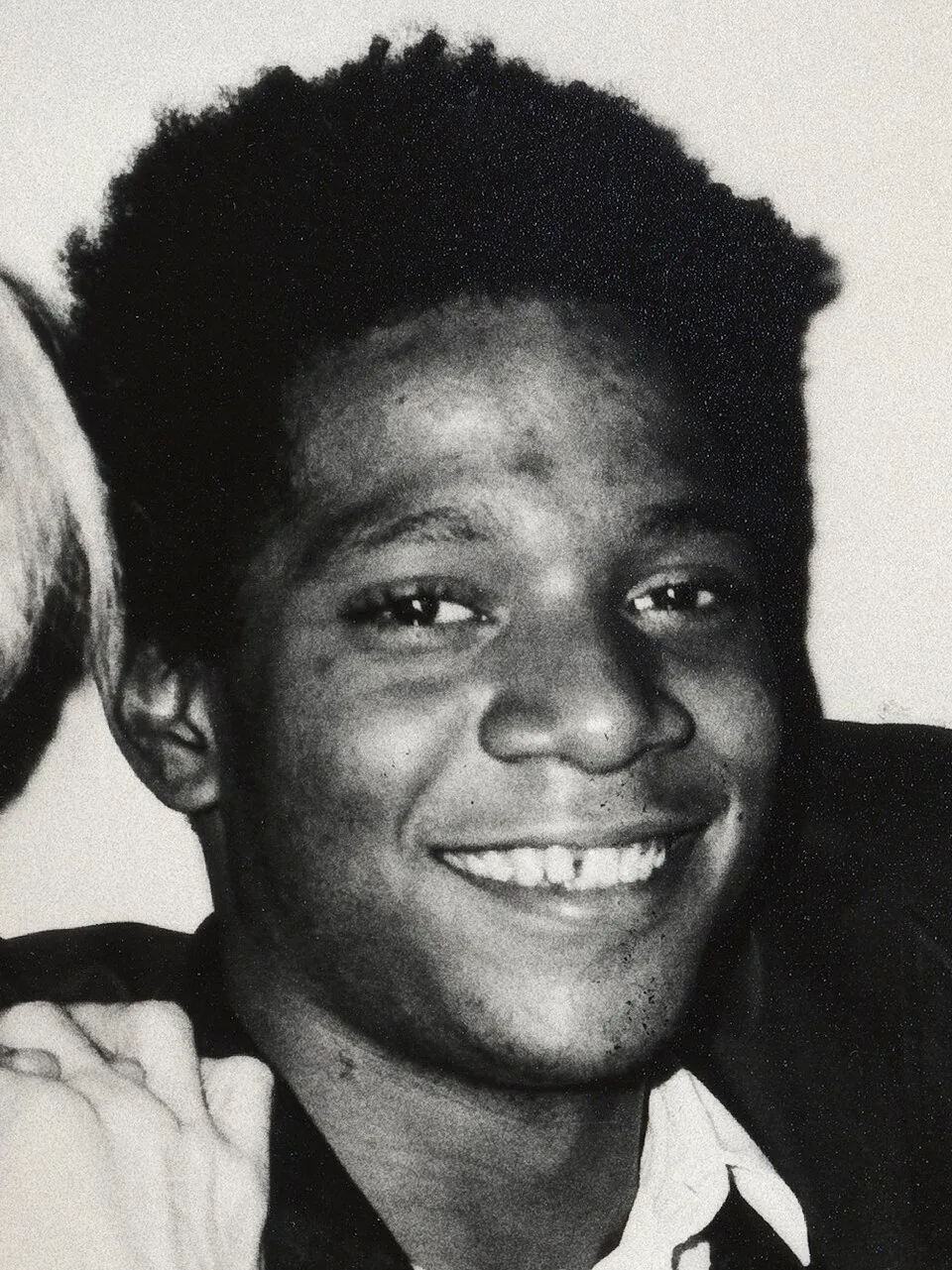
Jean-Michel Basquiat photographed during his brief but extraordinarily productive career. Image: Fair use, via Wikimedia Commons
Basquiat dropped out of high school at seventeen and left home. He survived by selling hand-painted postcards and T-shirts, sleeping on friends' couches and occasionally in cardboard boxes in Tompkins Square Park. With his friend Al Diaz, he began spray-painting cryptic, poetic phrases across Lower Manhattan under the tag SAMO© (short for "Same Old Shit"). Messages like "SAMO© AS AN END TO MINDWASH RELIGION, NOWHERE POLITICS, AND BOGUS PHILOSOPHY" appeared throughout SoHo and the East Village. The tags were genuinely witty and strange in a way that attracted attention from the downtown art scene, which was looking for exactly that quality.
The SAMO project ended in 1980 with the message "SAMO© IS DEAD," and Basquiat pivoted from street art to painting. The transition was fast. By 1981, he was included in the watershed "New York/New Wave" exhibition at P.S.1. By 1982, he was a gallery sensation exhibiting at his first solo show at Annina Nosei Gallery and at documenta 7. By 1983, at twenty-two, he was the youngest artist ever included in the Whitney Biennial.
Basquiat's Artistic Method
Basquiat worked with ferocious speed and on multiple canvases simultaneously. His studio, often a rented loft with expensive suits hanging next to paint-spattered canvases, was a chaos of art materials, records, books, and television screens. He painted while listening to jazz, watching cartoons, and reading encyclopedias, absorbing and recombining information at a pace that impressed everyone who witnessed it. The resulting paintings look spontaneous. They are the product of years of accumulated visual and intellectual research.
Materials and Surface
Basquiat worked on canvas, wood, doors, window frames, football helmets, and whatever else was at hand. He used oil stick (a kind of solid oil paint in crayon form), acrylic paint, spray paint, and collage. His surfaces are layered and worked — paint applied, scraped back, written over, painted again. The resulting textures feel archaeological, as if each painting contains multiple paintings fighting for visibility.
Text and Image
Words are as important as images in Basquiat's paintings. He scrawled, stenciled, and collaged words across his canvases — sometimes legible, sometimes crossed out, sometimes repeated obsessively. The crossed-out words are a signature gesture. "I cross out words so you will see them more," he explained. "The fact that they are obscured makes you want to read them." This technique gives his texts a quality of erasure and presence simultaneously — words that refuse to be silenced even as they are struck through.
Sources and References
Basquiat drew from an extraordinarily wide range of sources:
Anatomy and medicine — Gray's Anatomy, Leonardo da Vinci's anatomical drawings, medical diagrams
African and Caribbean culture — Haitian Vodou symbols, African masks, Afro-Caribbean history
Jazz and music — Charlie Parker, Dizzy Gillespie, Thelonious Monk, hip-hop
Art history — Cy Twombly, Robert Rauschenberg, Andy Warhol, Jean Dubuffet
Boxing and sports — Muhammad Ali, Sugar Ray Robinson, Joe Louis
History of slavery and colonialism — Sugar plantations, slave ships, Black historical figures
This density of reference gives Basquiat's paintings their characteristic intellectual complexity. They are not naive or spontaneous in the way they first appear — they are deeply researched, culturally layered, and deliberately constructed to look raw.
Major Themes
Race, Power, and Black Identity
Race is the engine of Basquiat's art. As a young Black man catapulted into the overwhelmingly white art world, he was acutely aware of the dynamics of power, tokenism, and exploitation. His paintings frequently depict Black figures — athletes, musicians, historical figures, and anonymous individuals — with crowns on their heads. The three-pointed crown became his most recognizable symbol, signifying royalty, divinity, and the assertion of Black dignity in a culture that systematically denied it.
Paintings like "Irony of Negro Policeman" (1981) address racism with a specific, biting precision. The painting shows a Black policeman rendered in a style that echoes both African mask traditions and medieval icon painting, the figure of institutional authority reduced to a symbol of complicity. "Crowns (Peso Neto)" (1981), which sold at Sotheby's in 2024 with an estimate of $35 to $45 million, uses the crown motif Basquiat developed from his earliest work to elevate and simultaneously interrogate the Black figure as king, saint, and commodity. Basquiat's treatment of race was never didactic. He layered references, let contradictions stand, and trusted viewers to do the work.
Mortality and the Body
Skulls, skeletons, exposed organs, and anatomical diagrams fill Basquiat's canvases. The body is always present — but it is rarely whole. It is dissected, X-rayed, broken open, and laid bare. This anatomical obsession connects to race (the Black body under surveillance, under threat, under the medical gaze) and to mortality (Basquiat seemed to know his time was short). His famous painting "Riding with Death" (1988), completed shortly before his death, shows a skeletal rider on a skeletal horse — a stark, stripped-down image of mortality that is among the most powerful works of the 1980s.
Heroes and Anti-Heroes
Basquiat's canvases are populated by heroes — but they are overwhelmingly Black heroes who had been excluded from mainstream art historical narratives. Charlie Parker, Miles Davis, Sugar Ray Robinson, Jack Johnson, and Toussaint Louverture all appear, crowned and celebrated. By placing these figures in the context of large-scale gallery painting — a format traditionally reserved for European kings, saints, and mythological figures — Basquiat was making a pointed statement about whose stories deserve monumental treatment.
Basquiat and Warhol
Basquiat met Andy Warhol in 1982, and the two began a close personal and professional partnership. Between 1984 and 1985, they produced approximately 160 collaborative paintings, with Warhol typically silk-screening commercial logos and images onto canvases that Basquiat then painted over, through, and around. The resulting works are more interesting than most critics acknowledged at the time. The tension between Warhol's flat commercial surface and Basquiat's urgent painterly overlay created exactly the kind of high/low collision that both artists were independently interested in.
The collaboration was also fraught. Critics accused Basquiat of riding Warhol's name, and Basquiat resented the implication that he needed Warhol's validation. When the collaborative paintings received harsh reviews in their 1985 exhibition, the relationship cooled. Warhol died in February 1987. Basquiat was devastated, and his own death from a heroin overdose followed seventeen months later, on August 12, 1988. He was twenty-seven years old.
Legacy and Market
Basquiat's posthumous reputation has grown consistently. His painting "Untitled" (1982), a large skull-like head against a vivid blue ground, sold for $110.5 million at Sotheby's in 2017, the most expensive American artwork sold at auction at that time. In 2024, the Gagosian Gallery in Paris mounted "Venus," pairing an early Basquiat painting from his acclaimed Modena series with an Imperial Roman sculpture of Venus loaned from the Torlonia Collection. The juxtaposition was not arbitrary: Basquiat had spent his career positioning Black figures within the Western tradition's historical frames. Placing his painting alongside Roman antiquity made the argument explicit.
The Louisiana Museum of Modern Art presented "Basquiat: Headstrong" in 2024 and 2025, the first solo museum presentation of Basquiat in Scandinavia, focused on the artist's obsessive depictions of the human head. It documented something that broader retrospectives sometimes miss: the head, for Basquiat, was the site where intelligence, identity, race, and mortality converged. It was the most politically loaded part of the body.

Exhibition view of Basquiat's work at the "King Pleasure" exhibition organized by the Basquiat family estate, showcasing his distinctive visual vocabulary of crowns, words, and figures. Image: Adjaye Associates
How to Look at a Basquiat Painting
Basquiat's work can feel overwhelming at first. Here are strategies for engaging with it:
Read the words — Text is not decoration. Read everything, including crossed-out words. Look for repeated words or phrases. They are clues to the painting's themes.
Identify the figures — Look for heads, bodies, crowns, and skeletal forms. Basquiat's figures are often simplified but always recognizable.
Look for lists and diagrams — Basquiat frequently included lists, labels, and quasi-scientific diagrams. These organize the painting's ideas and connect to his research interests.
Notice what is crossed out — Erasure is assertion. The struck-through words and painted-over images tell you what Basquiat wanted you to struggle to see.
Consider the title — When Basquiat titled his paintings (many are "Untitled"), the titles often provide essential context or ironic commentary.
Final Thoughts
Basquiat produced a significant body of work in roughly eight years, from his first canvases in 1980 to his death in 1988. The paintings endure because they speak to things that have not changed: racial inequality, the art world's tendency to commodify the artists it claims to celebrate, the tension between creative energy and commercial success, and the confrontation with mortality that runs through his work from the Gray's Anatomy drawings forward.
What is easy to miss, especially in reproduction, is how technically smart the paintings are. The chaotic surface is designed. The crossed-out words are calculated. The density of reference is controlled. Basquiat was not pouring unmediated feeling onto canvas. He was constructing an argument about race and culture and history that happens to look like it was made in a fever. That gap between the apparent spontaneity and the actual intelligence is where the paintings live.
For more on art that challenges convention, read about Kara Walker's approach to race and history, or explore what makes art good as a framework for thinking about work that resists easy judgment. What is the Basquiat painting that stays with you? Let us know in the comments.


