
In the summer of 1950, photographer Hans Namuth set up his camera in Jackson Pollock's barn studio in Springs, Long Island, and captured something the art world had never seen. Pollock stood over a massive canvas laid flat on the floor, swinging house paint from sticks, trowels, and hardened brushes in looping arcs. He worked from all four sides. He walked into the canvas. He never touched it with a conventional brush. The resulting photographs became famous, but the paintings themselves were even more startling: no center, no focal point, no recognizable image, just fields of interlaced marks that recorded every movement of the artist's body over the period of making.
Abstract Expressionism was the first major art movement to originate in the United States rather than Europe. It emerged in New York City in the late 1940s and dominated American art through the 1950s, encompassing styles as different as Pollock's poured paint webs and Mark Rothko's hovering rectangles of color. What held the movement together was a shared conviction: a painting does not need to represent anything outside itself. The act of making it, the emotions embedded in that process, and the viewer's direct physical experience of color, scale, and surface are enough.
This guide covers what the movement actually looked like, why it developed when and where it did, who its key figures were, and how to approach these paintings in museums without feeling lost.
What Abstract Expressionism Is
The name was coined by critic Robert Coates in 1946. It combines abstraction, meaning no recognizable subject, and expressionism, meaning art driven by inner emotion rather than external observation. The artists generally disliked the label. Rothko insisted he was not an abstractionist at all. But the term stuck, and it covers a range of practices that are genuinely related in their historical moment and their underlying convictions even when the paintings look nothing alike.
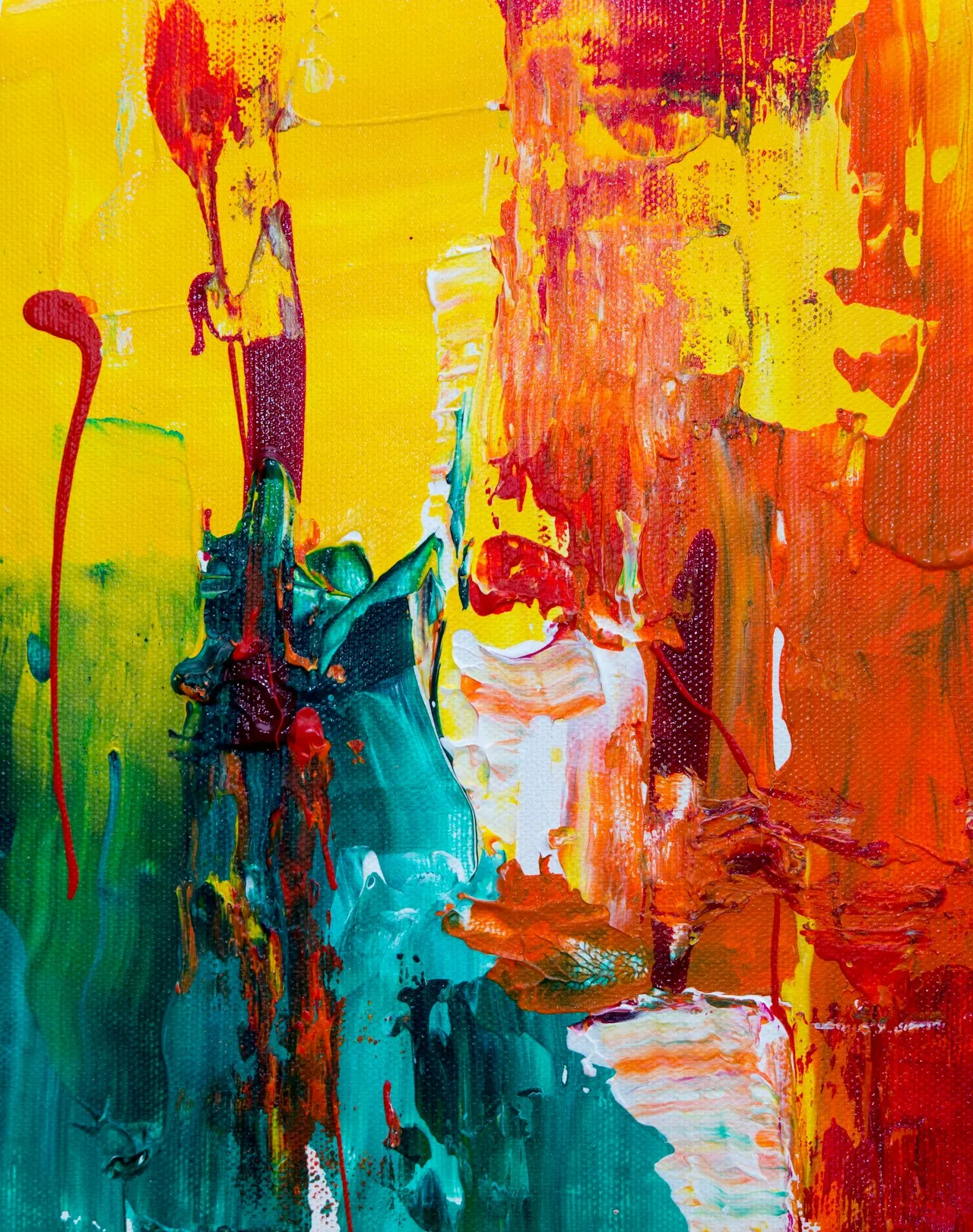
Art critics have traditionally divided the movement into two broad tendencies. Action Painting, associated with Pollock, Willem de Kooning, and Franz Kline, emphasizes the physical act of painting. The canvas records energetic gestures: drips, slashes, sweeping brushstrokes that make the creative process visible in the finished work. Color Field Painting, associated with Rothko, Barnett Newman, and Clyfford Still, uses large areas of flat or softly modulated color designed to envelop the viewer in a meditative, emotional experience rather than to show the evidence of making.
Across both tendencies, these artists shared certain convictions: paintings should be monumental in scale, should communicate at the level of feeling rather than narrative, and should be free from any obligation to depict the visible world. They believed painting could reach directly into emotion through color, form, gesture, and texture.
Why New York, Why Now
Abstract Expressionism did not arrive from nowhere. It grew from specific historical conditions that brought the most advanced European art into direct contact with American artists at a moment when those artists had very specific things they needed to express.
The European Exiles
The rise of fascism in the 1930s and 1940s drove many of Europe's leading artists and intellectuals to the United States. Piet Mondrian, Max Ernst, André Breton, Marcel Duchamp, and Fernand Léger all settled in New York. Their presence gave American artists direct access to the most advanced European movements, including Surrealism, Cubism, and geometric abstraction, that had previously been available only through books and occasional exhibitions.
Surrealism proved especially influential. The Surrealist technique of automatism, allowing the hand to move freely without conscious control to access unconscious imagery, gave the Abstract Expressionists a method for getting past the deliberate, planned image-making that representational painting requires. Pollock's drip technique is essentially automatism at maximum scale and physical intensity. He trained as a painter under Regionalist Thomas Hart Benton, underwent Jungian psychoanalysis, and absorbed the Surrealists' interest in unconscious process, and all three fed into the revolutionary method he developed between 1947 and 1950.
Postwar Anxiety and the Collapse of Certainty
World War II and the Holocaust shattered faith in progress, reason, and the idea that Western civilization was fundamentally advancing toward something better. Artists who had lived through the Depression and the war felt that traditional representational painting was inadequate to express what had happened and what it meant. Existentialist philosophy, particularly Jean-Paul Sartre's and Albert Camus's ideas about individual authenticity in a universe without inherent meaning, resonated deeply with the New York painters. If life has no fixed meaning, each person has to create meaning through their own choices and actions. For these artists, painting became that act.
Jackson Pollock's studio barn in Springs, Long Island. The paint-splattered floor is itself a record of Pollock's action painting process. Photo by Guenther, 2007. Image: CC BY-SA 3.0, via Wikimedia Commons
The Key Figures
Jackson Pollock (1912-1956)
Pollock's "drip paintings," made between 1947 and 1950, abandoned the easel entirely. Working on unstretched canvas spread across the studio floor, he used gravity and bodily movement to distribute paint in complex, layered webs. Paintings like "Number 1A, 1948" and "Autumn Rhythm (Number 30)" are enormous, some over seventeen feet wide, and they have no up, down, or center. They immerse you in a field of interlaced gestures that records every movement of the artist's body during the period of making.
The science of what Pollock actually produced has become a subject of genuine research. Physics professor Richard Taylor at the University of Oregon has studied the fractal structure of Pollock's poured paintings since the 1990s, finding that they exhibit statistical properties of natural fractal patterns. A 2025 study published in Frontiers in Physics further analyzed the fractal and lacunarity characteristics of poured paintings, confirming that Pollock's works are measurably distinct from those produced by other artists using similar pouring techniques. The physical control he exercised over the poured paint, even in his most apparently chaotic compositions, was real and specific to him.
Pollock died in a car crash at age forty-four in 1956. His alcoholism had ended his productive drip painting period years earlier, in 1950, and the work he made after that is generally considered weaker. The concentration of major work in a three-year window makes his achievement more remarkable, not less.
Mark Rothko (1903-1970)
Beginning around 1949, Rothko developed his signature format: large canvases with two or three soft-edged rectangles of color stacked vertically, hovering against a colored ground. The paintings are not illustrations of emotions. Rothko insisted they are emotions, made directly visible through color relationships that he spent months calibrating. He mixed his paints himself, working with very thin, layered washes that created subtle variations across large areas of color.
A 2025 study in the Journal of Cultural Heritage applied computational color analysis to Rothko's paintings using K-means clustering and Delta E metrics. The research found that what appears to be a simple field of color contains subtle gradients and hue variations that the human eye processes as depth and atmosphere rather than as flat paint, which explains why standing in front of a large Rothko feels different from looking at a reproduction. The paintings use color transitions too subtle for photographs to capture.
Rothko wanted viewers to stand close to his large canvases and be surrounded by the color field. "I paint very large pictures," he said. "The reason I paint them is precisely because I want to be very intimate and human." The Rothko Chapel in Houston, fourteen dark paintings in a non-denominational chapel completed after his death in 1971, is the ultimate realization of this vision.
Willem de Kooning (1904-1997)
De Kooning maintained a tense relationship with representation throughout his career, never fully abandoning it the way Pollock did. His "Woman" series (1950-1953) features ferocious, grinning female figures rendered with violent, slashing brushwork that builds up, is scraped away, and is rebuilt repeatedly across the canvas surface. The paintings shocked the art world, partly because of their apparent aggression and partly because they reintroduced recognizable imagery at a moment when pure abstraction was considered the more advanced position. De Kooning did not care about the more advanced position. He cared about what the paint could do.
Franz Kline (1910-1962)
Kline's enormous black-and-white paintings look like magnified calligraphic brushstrokes, architecturally powerful and structurally decisive. "Mahoning" (1956) suggests steel girders and bridges without depicting them. His apparently spontaneous compositions were carefully planned through small preparatory sketches that he sometimes projected onto the large canvas to establish proportions. The spontaneity is real but it is also rehearsed, which is characteristic of how action painting actually works at its most controlled.
Clyfford Still, "1957-D No. 1" (1957), oil on canvas. Albright-Knox Art Gallery, Buffalo. Still's massive canvases with their ragged, flame-like color fields were a major influence on Color Field painting. Image: Public domain / Fair use, via Wikimedia Commons
What the Movement Changed
Abstract Expressionism's significance goes beyond the paintings. The movement shifted the center of the art world from Paris to New York, a change that held for decades. It established the idea that American culture could lead rather than follow. And it raised questions about what art is and what it is for that are still being asked.
Scale became content. Before Abstract Expressionism, large-format paintings were for historical or religious subjects. Pollock and Rothko proved that abstraction could be monumental, and that immersive scale could be the primary experience a painting offers, not just a formal choice in service of subject matter.
Process became subject. Action painters made the act of creation visible in the finished work. This idea, that how a painting is made matters as much as what it shows, influenced performance art, conceptual art, and every subsequent movement that foregrounds process over product. It is also the reason those Namuth photographs were so important: they made the process legible in a way the paintings alone could not.
The movement opened the door to everything that followed, from Pop Art's critique of Abstract Expressionism's self-seriousness to Minimalism's reduction of the physical object to its essential properties to digital art and beyond.
How to Engage With These Paintings in a Museum
The most common reaction people have to Abstract Expressionism is impatience. "My kid could paint that" is the dismissal you hear most often. It is worth understanding what that reaction is actually responding to, which is the removal of the skill markers that most people use to evaluate painting. Without recognizable imagery, accurate drawing, or perspective, the usual cues for technical assessment are gone. What is left is color, scale, surface, and the physical traces of the making. You have to develop a different set of perceptual habits to engage with it.
Stand close to a Pollock until it fills your peripheral vision. Your eyes will start moving involuntarily along the looping gestures, following the paint trajectories. Stand close to a Rothko and notice that the color fields are not flat: there are subtle variations, edges that are harder or softer, areas where the underpainting comes through. Step back from both and notice how your physical response changes. Notice what color does to your body at large scale. These physical responses are what these paintings are for. For more practical strategies for museum looking, read the guide to how to visit an art museum.
Where to See the Work
The Museum of Modern Art in New York holds major works by Pollock, Rothko, de Kooning, Kline, and Newman, and the arrangement of their galleries gives you the actual experience of scale that reproductions cannot convey. The Rothko Chapel in Houston is worth a separate visit: fourteen dark paintings in an octagonal, non-denominational space that Rothko designed in collaboration with the architects. The Clyfford Still Museum in Denver, opened in 2011, holds the largest single-artist collection of Abstract Expressionist work in existence, with 94% of Still's output in one purpose-built building.
Ready to explore more of art history's major movements? Read about how Impressionism broke academic rules, or discover the evolution of art styles from Realism to Contemporary. What do you make of Abstract Expressionism? Does it move you or frustrate you? Share in the comments below.


