Only thirty-four to thirty-six paintings are definitively attributed to Johannes Vermeer. No other major artist in the Western tradition produced so small an output while achieving such consistently extraordinary quality. We do not know why he painted so few works. Whether he was slow, meticulous, frequently ill, occupied with his art dealing business, or simply uninterested in volume is unknown. We know very little about his life beyond the bare facts of birth, marriage, fifteen children, and death in debt at forty-three. What we have is the paintings, and in the paintings is more than enough to make him one of the most admired artists who ever worked.
In 2023, the Rijksmuseum mounted "Vermeer," the largest Vermeer retrospective ever assembled: twenty-eight of the thirty-six accepted works brought together for the first time in Amsterdam. It was the most oversubscribed exhibition in the museum's history, with tickets sold out globally within days of going on sale. Half a million people visited. The demand is not nostalgia or tourism. It is the recognition that Vermeer's paintings do something in person that no reproduction can replicate: they show you what it looks like when a window admits morning light into a room, and they show it with a quality of observation that feels less like painting and more like looking through a lens at something that actually happened.
This profile covers Vermeer's life in Delft, his technique, and the major paintings that have made him the most quietly compelling figure of the Dutch Golden Age.
Delft: A Life of Limited Documents and Extraordinary Art
Johannes Vermeer was baptized on October 31, 1632, in Delft, in the Dutch Republic. His father Reynier Jansz ran an inn and traded in art, which provided young Vermeer with some exposure to paintings from an early age. In 1653, at age twenty, Vermeer married Catharina Bolnes, converted to Catholicism (her family's faith), and was registered in the Delft painters' guild, the Guild of Saint Luke. He served as headman of the guild in 1662-63 and again in 1670-71, suggesting that he was respected within the local art community.
He and Catharina had fifteen children, of whom eleven survived to adulthood, an extraordinary number that the family housed largely in the home of Catharina's mother, Maria Thins, who appears to have financially supported the household. Vermeer's income from painting was supplemented by art dealing, though the records of his commercial activities are incomplete. He died in December 1675, at age 43, leaving his wife and children in serious debt. The contemporary biographer Arnold Houbraken barely mentioned him. He was forgotten for nearly two centuries, rediscovered in the 1860s by the French critic Théophile Thoré, who spent years tracking down paintings and attributions, and has been considered one of the supreme masters of painting ever since.
The Technique of Perfect Light
What sets Vermeer apart from his contemporaries, including the other great masters of the Dutch Golden Age, is the quality of his light. He painted almost exclusively with a single window at the left side of his compositions, and his ability to render the specific quality of diffused window light falling on faces, fabrics, walls, and objects has not been equaled in the history of painting.
Scholars have debated for decades whether Vermeer used a camera obscura, an optical device that projects an image through a small aperture onto a flat surface, as an aid in composing his paintings. The evidence is suggestive but not conclusive. Certain features of his paintings are consistent with the optical characteristics of lenses and do not appear in the work of contemporaries who are not suspected of using optical aids. The out-of-focus "circles of confusion" visible in the highlighted bread in "The Milkmaid" (c.1657-58) are one frequently cited example. Tim Jenison's 2013 documentary Tim's Vermeer argued, through a lengthy practical experiment, that Vermeer used a specific mirror-and-lens arrangement to achieve his light effects, and the Rijksmuseum's research on this question presents the current state of scholarship carefully. Whether he used optical devices or not, his observation of light was accurate enough that contemporary cinematographers and photographers study his paintings to understand how light behaves in enclosed spaces.
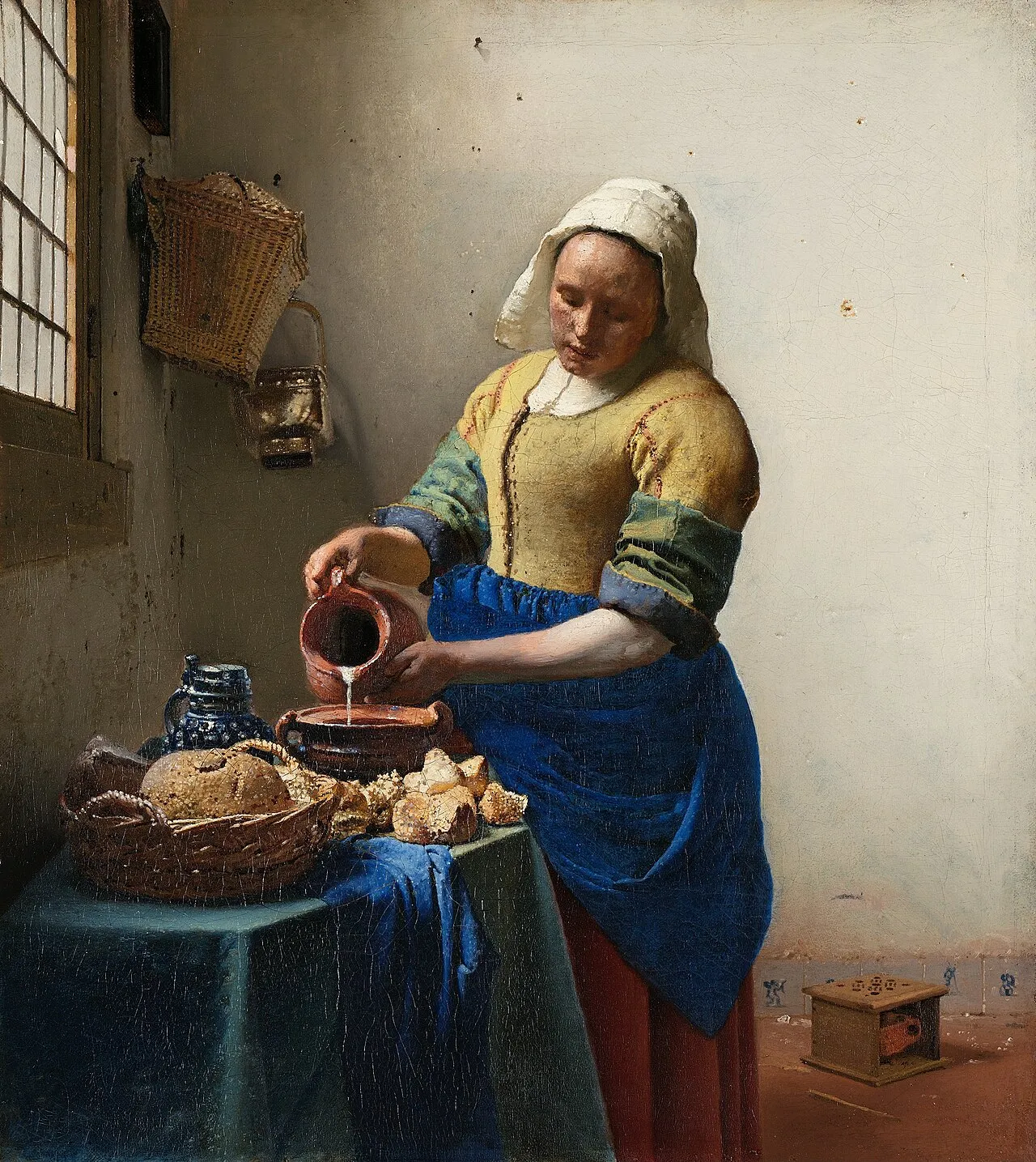
Johannes Vermeer, "The Milkmaid" (c.1657-58), oil on canvas, 45.5 x 41 cm. Rijksmuseum, Amsterdam. The concentrated weight of the figure, the precise rendering of textures, and the quality of the window light make this one of Vermeer's most admired works. Image: Public domain, via Wikimedia Commons
Vermeer worked from dark ground to light, building up translucent layers of paint through glazing. His flesh tones show a characteristic warm underlayer visible through cooler, more transparent surface layers, creating the luminous quality that makes his figures appear lit from within rather than illuminated from outside. He used expensive pigments consistently: the lead-based yellow that appears throughout his interiors, the lapis lazuli blue in the woman's dress in "Girl Reading a Letter at an Open Window" (c.1657-59), and the natural ultramarine that appears in multiple paintings at a cost that would have been significant. The expense of these materials, combined with his small output, is evidence that he was not painting for volume. He was painting for quality, and he was willing to pay for it. For a deeper look at how these layering techniques work, our guide to oil painting glazing and impasto covers the methods directly.
The Domestic Interior: Reading the Rooms
The great majority of Vermeer's paintings show women in domestic interiors: reading or writing letters, playing music, being fitted with jewelry, or simply standing in the light of a window. The rooms are recognizable across multiple paintings. The same tiled floor, the same yellow chair, the same maps on the wall appear again and again, confirming that he worked in a specific room, very likely in the house in Delft where he lived with his large family. He was not assembling idealized settings. He was painting the room he had available to him, and making it extraordinary through observation.
The subjects of these domestic scenes are deceptively simple. "Woman Holding a Balance" (c.1664) shows a woman at a table, a small balance scale in one hand, her gaze downward, a painting of the Last Judgment visible on the wall behind her. The balance, the judgment, and the woman's absorbed expression combine to create an image of moral weighing that operates at a completely different register from its apparent simplicity. The picture of the Last Judgment in the background is not decoration. It is an argument about the nature of the action in the foreground.
"The Love Letter" (c.1669-70) shows a woman receiving a letter from her maid in an interior seen through a doorway from another room, creating a sense of the viewer as a hidden observer of a private moment. "Officer and Laughing Girl" (c.1657) places a male figure in dark silhouette against a brightly lit woman, the spatial and tonal contrast implying a relationship that the painting refuses to explain. Vermeer understood composition as a tool for creating psychological complexity without narrative. His paintings do not tell stories. They present charged moments whose meaning the viewer must supply. That is not evasion. It is a specific and demanding kind of restraint.
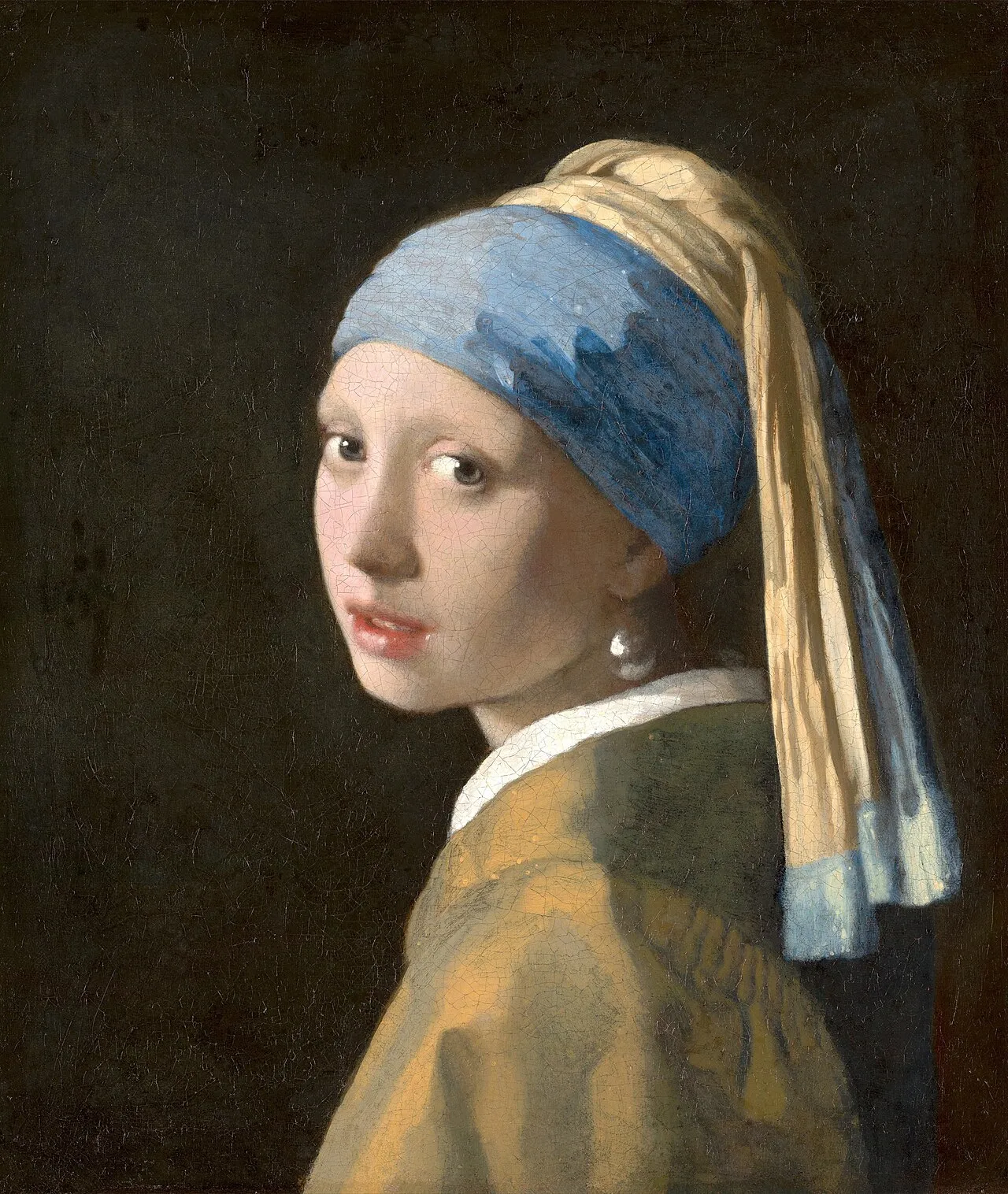
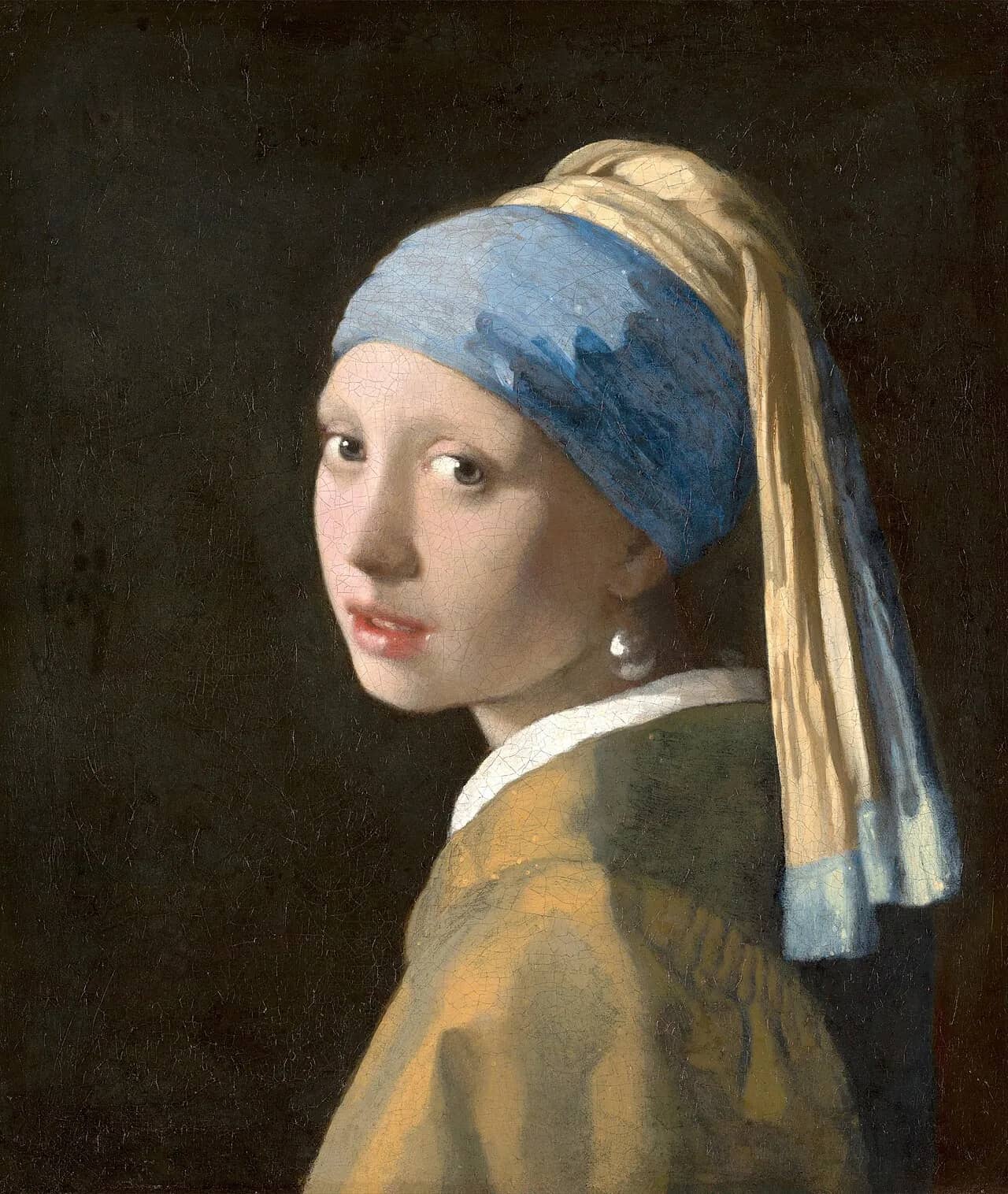
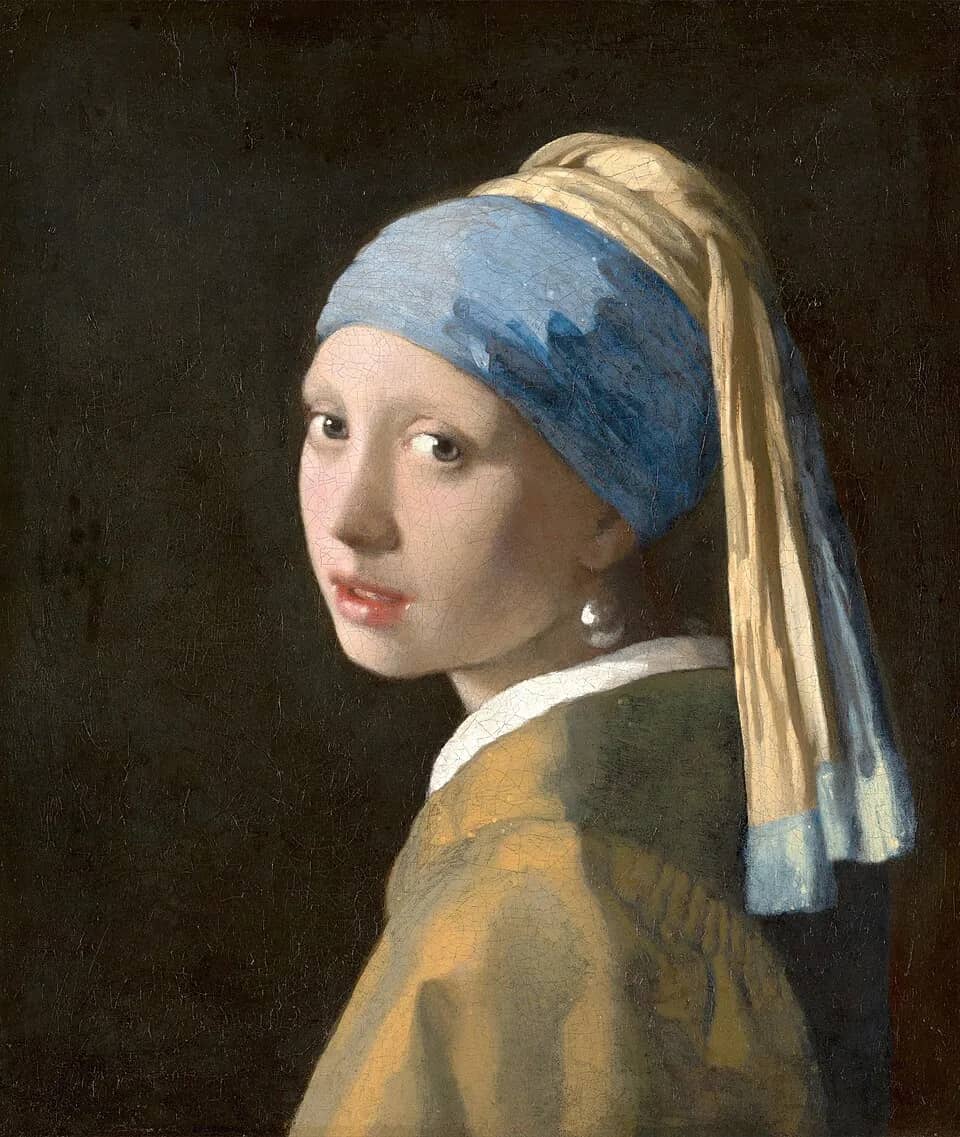
Johannes Vermeer, "Girl with a Pearl Earring" (c.1665), oil on canvas, 44.5 x 39 cm. Mauritshuis, The Hague. The identity of the subject remains unknown. The work has been described as a "tronie," a Dutch genre of character study rather than portrait. Image: Public domain, via Wikimedia Commons
The View of Delft and the Outdoor Exception
"View of Delft" (c.1660-61), at the Mauritshuis in The Hague alongside "Girl with a Pearl Earring," is the great exception in Vermeer's work: an outdoor scene, a townscape showing the city of Delft from across the water in morning light. Marcel Proust described it as "the most beautiful painting in the world," and the claim is not absurd. The painting shows Delft's rooflines, church towers, and quaysides reflected in still water, with figures on the near bank, the whole scene rendered with a luminous precision that again raises the camera obscura question. The small variations in cloud shadow across the buildings, the differentiation of textures in brick walls and tiled roofs, the reflections in the water: these are observed with a quality of attention that consistently startles contemporary photographers and painters who study it closely. The painting is currently at the Mauritshuis in The Hague, where it has been since 1822, and the Mauritshuis collection page provides detailed conservation notes.
Final Thoughts
Johannes Vermeer produced fewer paintings than almost any other major artist in history and left almost no written record of his methods or thinking. His silence is appropriate. The paintings are complete in themselves. They do not need explanation. They show you what it looks like when a window admits morning light into a room where someone is occupied with something small and ordinary and completely absorbed in it.
That quality of attention, the sense that Vermeer observed his subjects with a stillness and concentration that allowed him to see what ordinary looking overlooks, is what makes the work permanently compelling. In a culture of constant distraction, the ability to slow down and actually look at something, to see the light on a face reading a letter, to see the texture of a bread roll on a kitchen table, remains one of the most essential things art can offer. Vermeer offers it with more purity and more consistency than almost anyone. The 2023 Rijksmuseum retrospective confirmed what people had known privately for a long time: there is no painter quite like him.
For more on the Dutch Golden Age and the tradition Vermeer worked within, see our guide to Rembrandt and the Dutch Golden Age. For a deeper look at how great painters construct visual experience through compositional choices, read our guide to composition in art. Have you seen a Vermeer in person? Share what the experience was like in the comments.