In the autumn of 1908, Henri Matisse published a short essay called "Notes of a Painter." In it, he described his ambition: to make an art of balance, purity, and serenity, something like a good armchair in which a tired business man could rest after his exertions. Critics have sometimes used this quotation to portray Matisse as a decorator rather than a serious artist, content to make beautiful surfaces without deeper content. That reading misses the radicalism entirely. Matisse was not describing comfort as a trivial goal. He was arguing that joy, pleasure, and the pure experience of color were as valid artistic subjects as suffering, conflict, or moral instruction. In the 19th century, that was a genuinely subversive claim.
Matisse spent his career proving it. From the explosive colors of his Fauvist years to the monumental compositions of "The Dance" and "Music," through the sensuous interiors of his Nice period, to the extraordinary paper cutouts of his final decade, he pursued a single question with increasing focus: what is color capable of doing when freed from its conventional role of describing objects? The answer he arrived at, that color could structure space, create rhythm, express emotion, and produce a state of heightened visual pleasure that was its own justification, shaped the entire second half of the 20th century in art.
This profile traces Matisse's long career and the major works that defined each phase, from his breakthrough in Fauvism to the cut-paper masterpieces he made from his wheelchair in his late eighties.
A Late Start and a Radical Conversion
Henri-Émile-Benoît Matisse was born on December 31, 1869, in Le Cateau-Cambrésis, in northern France. His father was a grain merchant, and the family expectation was that Henri would study law. He did, working as a court administrator in Saint-Quentin while taking early morning drawing lessons at the local art school. At twenty, recovering from an appendectomy, his mother gave him a set of oil paints to help pass the time in bed. He started copying the painting manual that came with the set, and his life changed completely.
He described the experience as follows: "I feel a kind of paradise." He abandoned law, moved to Paris, and began serious art study. For six years, from 1891 to 1897, he studied at the École des Beaux-Arts under the painter Gustave Moreau, one of the finest teachers of his generation. Moreau was himself a Symbolist, interested in psychological depth and non-naturalistic color, and he pushed his students to look at everything, to copy in the Louvre, and to develop their own visual intelligence rather than imitating academic formulas. "I did not teach you painting, I opened doors," he told his students.
Through the late 1890s and early 1900s, Matisse experimented with Impressionism, Post-Impressionism, and particularly the Divisionist technique of Paul Signac, who encouraged him to use pure colors in separate touches to create optical mixing. The transition from this technique to Fauvism was not a sudden break but a gradual intensification. By the summer of 1905, painting in the intense southern light of Collioure with André Derain, Matisse had pushed his colors so far beyond any descriptive purpose that the resulting paintings looked, to contemporary viewers, like they were on fire.
Fauvism: Color as Pure Expression
The Salon d'Automne of 1905 exhibited works by Matisse, Derain, Maurice de Vlaminck, and several other painters whose use of color was so violent and non-naturalistic that the critic Louis Vauxcelles described them as "fauves," wild beasts. The name stuck. Matisse's "Woman with a Hat" (1905), showing his wife Amélie with a face in which green, orange, red, and violet stripes of paint describe shadows that no human face has ever actually displayed, was one of the most discussed and controversial paintings in the exhibition.
What Matisse was doing with color was not chaos. It was liberation. He freed color from its obligation to describe the appearance of surfaces under specific lighting conditions, what the Impressionists had done with brilliant technical precision, and asked instead what emotional or spatial effect a given color produced in the viewer. Red did not describe a red object; it created a particular kind of visual energy. Green in shadow was not the color of shadows in nature; it was the color that produced the right psychological response in the context of the painting. This understanding of color's independent expressive capacity is fundamental to the entire history of 20th-century art. You can read more about the principles underlying this approach in the guide to color theory in art appreciation.
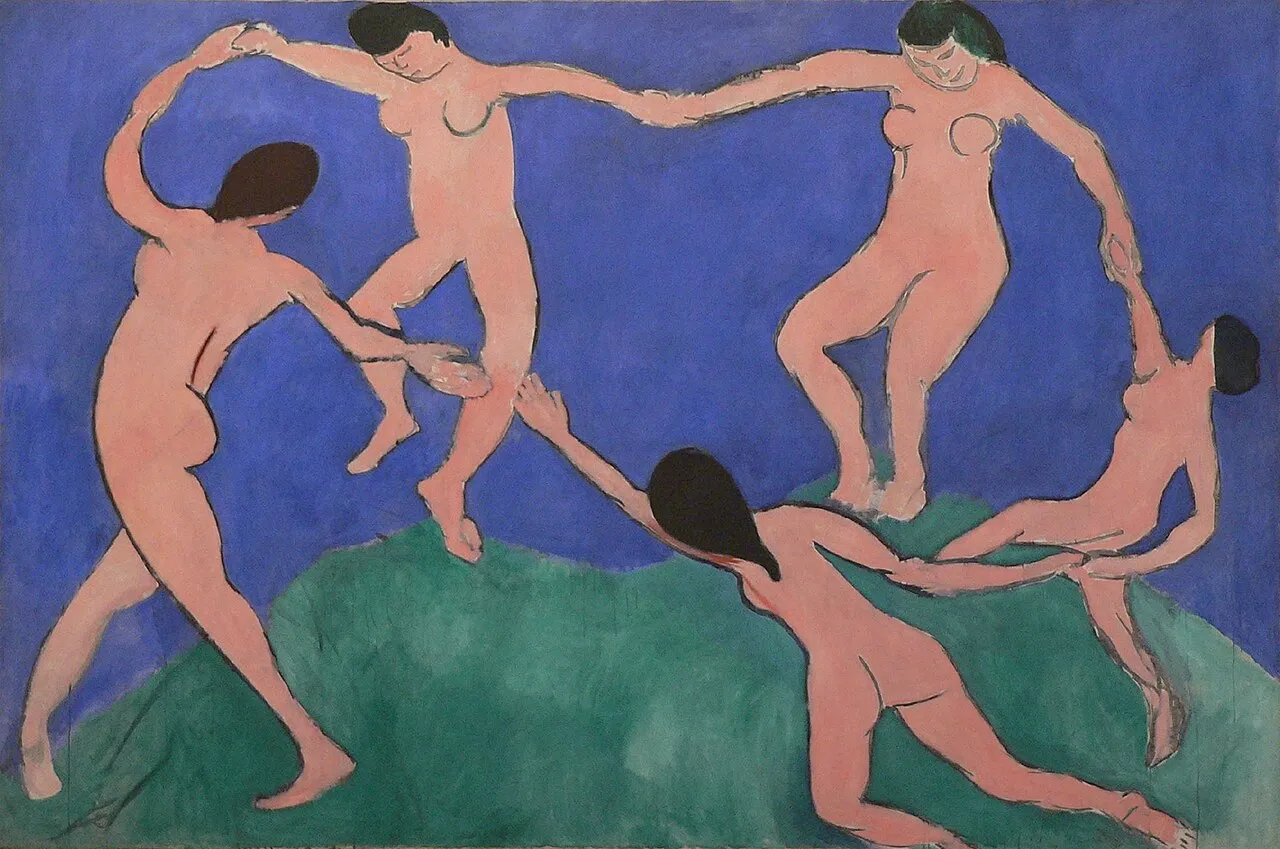
Henri Matisse, "The Dance I" (1909), oil on canvas, 259.7 x 390.1 cm. Museum of Modern Art, New York. This preparatory version preceded the final Dance now at the Hermitage, St. Petersburg. Image: Public domain, via Wikimedia Commons
The Great Compositions: The Dance and Music
In 1908, the Russian art collector Sergei Shchukin commissioned Matisse to produce two large decorative panels for his Moscow home. The result was "The Dance" and "Music" (both 1910), two of the most important paintings of the 20th century. "The Dance" shows five figures in a circle against a background of deep blue sky and vivid green ground. The figures are not anatomically correct. They are schematic, simplified, built from arcs and curves that echo the circular motion of the dance. The colors are primary and unmodified: orange-red figures, blue, green. There is no depth, no shadow, no spatial complexity. The painting works entirely through the rhythmic tension of the figures and the vibration of complementary colors.
"The Dance" was unlike anything that had been done before in painting on such a scale. It was not just a decorative composition. It was a demonstration that large-scale painting could achieve its effects through color and simplified form alone, without narrative content, without spatial illusionism, without any of the traditional tools of monumental art. The painting anticipated by several decades the direction that Abstract Expressionism and Color Field painting would take. According to the art historian John Elderfield, it is one of the works that most clearly defines where modern art was heading.
The Nice Period and the Odalisques
After the trauma of the First World War, during which he was refused military service due to his age but lived with the anxiety of having two sons at the front, Matisse relocated to Nice on the French Riviera in 1917. He returned there annually and eventually made it his primary home. The Nice period produced a long series of intimate interiors: richly patterned rooms with open windows, decorated screens and textiles, and female figures, often in odalisque poses, surrounded by the accumulated visual luxury of his studio.
These paintings have sometimes been criticized as retreating from the boldness of his pre-war work into sensuous decoration. The criticism is not entirely without basis, but it misses what Matisse was exploring: the relationship between the painted surface and pattern, the way an interior can be understood as a structure of overlapping decorative planes rather than an illusionistic depth. The odalisques are not merely comfortable subjects; they are pretexts for complex investigations of how the human figure relates to the decorative environment around it.
Throughout his career, Matisse collected textiles, carpets, and decorative objects from across the Islamic world, and their influence on his work is profound. The Moroccan trips of 1912 and 1913 intensified this interest, producing some of his most purely colorful and formally adventurous work.
The Cut-Outs: Drawing with Scissors
In 1941, Matisse underwent surgery for abdominal cancer and was left largely confined to his bed and wheelchair. He was 72 years old, and the surgery effectively ended his ability to paint at an easel. He began instead to work with cut paper, using scissors to cut shapes from sheets of paper pre-colored with gouache paint and arranging them into compositions on the wall of his apartment. He described the process as "drawing with scissors" and considered it the culmination of his entire career: a method that united color and form in a single act rather than applying one to the other sequentially.

Henri Matisse working on his paper cutouts in his apartment in Nice, 1952. In his final years, this became his primary medium, producing some of the most original work of his career. Image: Public domain, via Wikimedia Commons
The results included "Jazz" (1947), a book of twenty large plates showing circus performers, acrobats, and abstract shapes in vivid cutout color; "The Snail" (1953), a near-abstract composition of rectangular color shapes arranged in a loose spiral at the Tate Modern in London; and the designs for the Chapel of the Rosary at Vence, which Matisse considered his masterpiece and which he designed in its entirety: the architecture, the stained glass windows, the ceramic tile murals, the vestments, and the furniture. The chapel opened in 1951.
Final Thoughts
Henri Matisse died on November 3, 1954, in Nice, at age 84. He had spent sixty years pursuing a vision that was, in its own way, as demanding and as serious as anything produced by the artists who worked in modes of tragedy and darkness. The vision was that art's job was not to document suffering but to provide an experience that lifted the viewer beyond ordinary consciousness into a state of intensified perception. He called it "the condensation of sensations."
His influence on contemporary art is pervasive in ways that are easy to overlook because so much of modern graphic design, fashion, and visual culture has absorbed his lessons about color and pattern without attribution. The flat color fields of American Color Field painting in the 1950s and 1960s, the Pop Art use of bold color and simplified form, the decorative sensibility of much contemporary textile and wallpaper design: all carry the mark of Matisse's ideas. The joy he was pursuing was not frivolous. It was hard-won, technically demanding, and thoroughly modern.
To explore more about how color works as an expressive tool, read the full guide to Color Theory for Art Appreciation. For a broader look at how Matisse fits into the arc of 20th-century art, see The Evolution of Art Styles: From Realism to Contemporary. Which period of Matisse's work speaks most to you? Share your thoughts in the comments below.