
Rembrandt van Rijn painted himself more than eighty times. No artist before him had done anything like it, and the cumulative effect of those self-portraits, spanning forty years from confident young man to aged and financially ruined elder, constitutes something unprecedented in art: a visual autobiography, honestly recorded, unflinchingly observed. In the late self-portraits, painted when Rembrandt was in his sixties and facing bankruptcy and the deaths of most of the people he loved, you see a face mapped with failure and persisting with dignity. There is no flattery, no attempt to present himself better than he was. Just light, paint, and the face of a man who understood how to look at the truth.
That capacity for honest observation was Rembrandt's defining quality. He observed the way light fell on fabric, on aged skin, on polished armor, and on the faces of ordinary Amsterdam citizens with a precision and emotional intelligence that has never been surpassed. The technique he mastered was chiaroscuro: the dramatic contrast between light and shadow that had been developed by Caravaggio in Italy in the generation before him. But where Caravaggio used darkness as theater, Rembrandt used it as psychology. The shadow in a Rembrandt painting is not just the absence of light. It is the space where things are not yet known, where the sitter's interior life exists beyond what the surface reveals.
This profile covers Rembrandt's life in Amsterdam, his technique, his greatest works, and the financial collapse that turned his later life into a test of artistic character.
Early Life and Rise in Leiden and Amsterdam
Rembrandt Harmenszoon van Rijn was born on July 15, 1606, in Leiden, the Netherlands, the eighth of nine children of a prosperous miller. Leiden was a university city and an important intellectual center, and Rembrandt was enrolled at the Latin school and briefly at the University of Leiden. He left the university within a year to pursue painting, apprenticing first with a local painter named Jacob van Swanenburgh for about three years, then spending six crucial months in Amsterdam with Pieter Lastman, one of the leading history painters in the Netherlands. The decision to leave university for a painter's workshop was unusual for a family of their social standing, and it suggests that Rembrandt's talent was already obvious enough to override his father's expectations.
From Lastman, Rembrandt learned the dramatic use of light, the expressive possibilities of gesture and facial expression, and the conventions of history painting: large-scale works depicting scenes from the Bible, mythology, and ancient history. He absorbed these lessons quickly and was producing work that surpassed his teacher's within months. By his mid-twenties, working first in Leiden and then in Amsterdam from 1631, he was the most sought-after portrait painter in the city.
Amsterdam in the early 17th century was the richest commercial city in the world, the center of a global trading empire that stretched from Indonesia to Brazil. Its merchant class had money, ambition, and a desire to be recorded in paint. Rembrandt worked constantly, building a workshop, training students, and producing portraits, history paintings, etchings, and drawings at a prolific rate. In 1634, he married Saskia van Uylenburgh, the well-connected niece of his art dealer. They were genuinely happy together, as far as the historical record shows, and Rembrandt painted her repeatedly with obvious affection. The Rijksmuseum's Rembrandt collection provides the most comprehensive public overview of his work.
The Night Watch: A Commission That Changed Everything
"The Night Watch" (1642) is the painting that defines Rembrandt's reputation in the public mind, and it is also the painting that marks the beginning of his commercial decline. Commissioned by a guild of Amsterdam civic guards, it depicts a company of musketeers being led out on patrol by their captain, Frans Banninck Cocq, in black, and his lieutenant, Willem van Ruytenburch, in yellow. The painting is enormous: 363 by 437 centimeters, roughly 12 by 14 feet, and it contains over thirty-four figures.
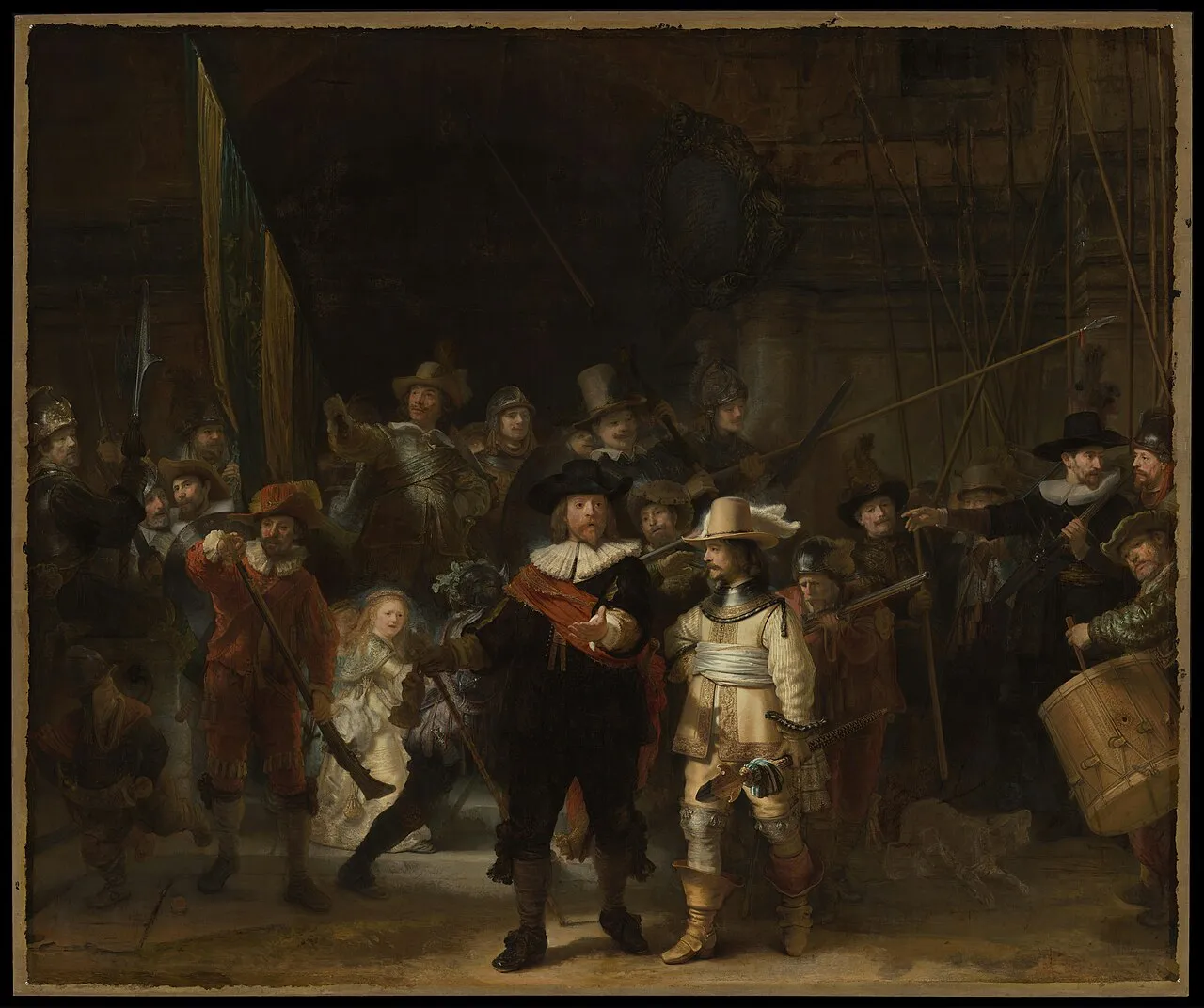
Rembrandt van Rijn, "The Night Watch" (1642), oil on canvas, 363 x 437 cm. Rijksmuseum, Amsterdam. The painting's original title was "Militia Company of District II under the Command of Captain Frans Banninck Cocq." Image: Public domain, via Wikimedia Commons
What made the painting controversial at the time was exactly what makes it extraordinary to us. Instead of arranging his subjects in the conventional row formation for group portraits, Rembrandt created a scene of dynamic movement, with figures stepping forward and backward in space, some brightly lit and fully visible, others partly obscured by shadow or by other figures. Several of the eighteen civic guards who paid for the painting found themselves marginalized, small, or largely in shadow. They reportedly complained. The painting is not what they commissioned. It is what Rembrandt needed to paint.
The dramatic use of light in "The Night Watch" exemplifies Rembrandt's approach to chiaroscuro. The young girl in yellow at the left of the composition is lit as if by a spotlight, her figure glowing against the dark background. The captain in black is defined more by his silhouette than by illumination. Light defines some figures with sharp precision and loses others entirely in darkness. This selective illumination is not just compositional technique. It creates a hierarchy of attention and a sense of psychological depth that flat, evenly lit group portraiture could never achieve. The Rijksmuseum's detailed analysis of the painting notes that the painting was not originally as dark as it appears today. Centuries of varnish and dirt had obscured the original colors, leading to the mistaken name "The Night Watch." The scene actually takes place in daylight.
Financial Ruin and the Late Masterworks
By the time "The Night Watch" was completed, Rembrandt's wife Saskia had died, leaving him a widower with a year-old son, Titus. His subsequent relationships, with his son's nurse Geertje Dircx and later with his housekeeper Hendrickje Stoffels, were socially complicated and caused problems with Amsterdam's Calvinist civic authorities. His spending, on houses, art collections, and curiosities, exceeded his income. In 1656, he was declared insolvent and forced to sell his house and his extraordinary collection of paintings, prints, costumes, and objects, which he had used as props and sources of inspiration throughout his career.
The financial catastrophe did not destroy his art. If anything, the late works, from the 1650s through his death in 1669, represent his deepest and most profound achievement. "The Anatomy Lesson of Dr. Nicolaes Tulp" (1632) and "The Night Watch" (1642) show Rembrandt in his commanding public mode. The late portraits, by contrast, are intimate, stripped of display, focused entirely on the interior life of the sitter. "The Jewish Bride" (c. 1667), showing a couple in an embrace of quiet tenderness, was described by Vincent van Gogh in a letter to his brother Theo as so moving that he would have given ten years of his life to sit in front of it for two weeks with only a crust of bread to eat. The National Gallery's page on the painting provides excellent context on its technique and provenance.
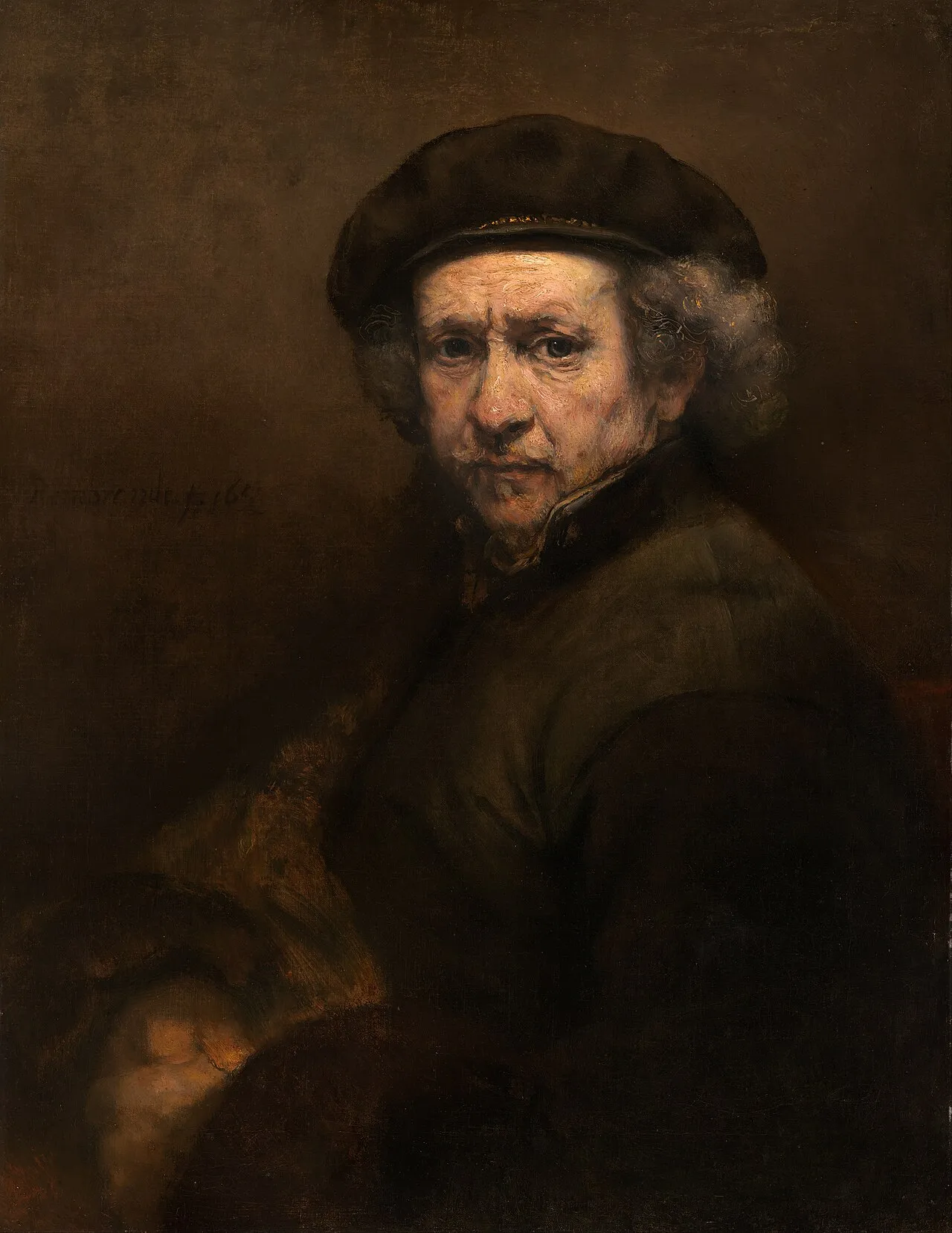
Rembrandt van Rijn, "Self-Portrait with Two Circles" (c.1665-1669), oil on canvas, 114.3 x 94 cm. Kenwood House, London. Painted in the final years of his life, this self-portrait is considered one of his most psychologically profound. Image: Public domain, via Wikimedia Commons
Rembrandt's Technique: The Magic of Impasto and Glaze
Rembrandt's technical approach evolved dramatically over his career, but two elements remained constant: the use of dark grounds and the combination of impasto and glaze. He typically began a painting on a dark or mid-tone ground, which allowed him to build up lights from darkness rather than filling in shadow over a white surface. This meant that the shadows in his paintings have actual depth: they recede into the painting surface rather than sitting on top of it.
For lights, he used impasto, applying thick, textured strokes of paint that project from the canvas and catch actual light from the room. Look at the pearls or the golden highlights in any Rembrandt portrait and you will see the paint built up into ridges that are physically dimensional. You can see this clearly in the portrait of Jan Six (1654), where the mayor's white collar is built up in thick ridges of lead white that catch the gallery light and appear to glow from within. For the darker areas, he used thin, transparent glazes of pigment that allowed the dark ground to show through, creating the luminous deep shadows that are his signature. This combination, thick impasto lights over thin transparent darks, is the technical basis of his distinctive visual effect. It is a technique described further in the guide to oil painting glazing and impasto.
Rembrandt also developed an extraordinary technique in etching, producing over 300 prints that are considered among the greatest in the history of the medium. His etching technique paralleled his painting approach: deep bitten lines creating rich dark areas, combined with fine hatching for subtle transitions and occasional bare plate highlights for the most luminous passages. He frequently combined etching with drypoint, which produces a softer, richer line by raising a burr of metal that holds extra ink. The result is prints with tonal range that rivals painting. The Rijksmuseum in Amsterdam holds the world's largest collection of his prints, and they are worth studying alongside the paintings as another dimension of his genius. For more on the etching process itself, see our guide to printmaking techniques.
Final Thoughts
Rembrandt died on October 4, 1669, in Amsterdam, at age 63. He had outlived his wife Saskia, his companion Hendrickje, and his son Titus, who died at age 27 just a year before his father. He died poor and was buried in a rented grave, his estate consisting of a few old clothes and painting tools.
Three and a half centuries later, his reputation has never wavered. Collectors still pay hundreds of millions for authenticated works. The Rijksmuseum's restoration of "The Night Watch," completed in 2021 in a glass enclosure so visitors could watch the process, attracted international attention and revealed details that had been hidden beneath centuries of varnish. New discoveries and reattributions still make news. His influence on every artist who has tried to use light to reveal psychological truth, from Vermeer to the Impressionists to Francis Bacon, is fundamental.
But perhaps the simplest measure of his greatness is this: the late self-portraits, painted by a ruined old man in an unfashionable style at a time when Amsterdam taste had moved on to something shinier, remain among the most psychologically honest things ever painted. That combination of technical mastery and personal courage is what makes Rembrandt irreplaceable.
For more on the techniques that made Rembrandt's work technically extraordinary, read the guide to oil painting: glazing, impasto, and why it takes months to dry. To understand how Rembrandt fits into the broader history of Western art, see the evolution of art styles from Realism to Contemporary. For how his approach to composition channels the viewer's attention, our guide to composition and visual balance covers the underlying principles. Which Rembrandt work has affected you most deeply? Share in the comments below.


