
Vincent van Gogh sold one painting during his lifetime. He spent ten years as an artist before his death at thirty-seven. In that decade, he produced roughly 2,100 artworks, including about 860 oil paintings, that reshaped the trajectory of Western art. You know the paintings. The swirling sky of "Starry Night," the blazing yellow of the "Sunflowers," the gnarled olive trees and wheat fields under southern French light. What you may not know is how deliberate the technique behind those paintings was. The thick, rhythmic brushstrokes that look like pure emotional release are the product of intense study, relentless experimentation, and a sophisticated understanding of color theory that Van Gogh developed through years of reading, writing, and painting.
The popular version of Van Gogh's story is the tragedy: the severed ear, the asylum, the suicide. Those biographical facts are real, and they matter. But they have overshadowed the work itself. When you stand in front of a Van Gogh painting in a museum, the first thing you notice is the surface. The paint is built up in thick ridges, sometimes a centimetre deep, catching real light and casting tiny shadows. You can identify a Van Gogh from across a gallery room by the texture alone. That texture is not the product of uncontrolled emotion. It is a technique called impasto, and Van Gogh developed it through years of careful practice and correspondence with other artists about materials and methods.
The Van Gogh Museum in Amsterdam, which holds the world's largest collection of his work, reported record visitor numbers in 2025 and has announced several new exhibitions for 2026, including "Van Gogh and the Roulins: Together Again at Last," which reunites the artist's portraits of the postman Joseph Roulin and his family. The museum's ongoing research into Van Gogh's materials and techniques has revealed new details about his pigments, his use of priming layers, and the chemical degradation of certain colors over time. This profile traces his artistic journey from dark Dutch beginnings through the explosion of color in France, examining the techniques and masterworks that made him one of the most important artists in history.
Before Art: Failed Careers and a Late Start
Vincent Willem van Gogh was born on March 30, 1853, in Groot-Zundert, a small village in the southern Netherlands. His father was a Protestant minister. Three of Vincent's uncles were art dealers, and his younger brother Theo would become one as well, eventually working at Boussod & Valadon in Paris. The art trade was in the family, but Vincent's path to making art was anything but direct.
Before becoming an artist, Van Gogh tried several careers and failed at all of them. He worked as an art dealer at Goupil & Cie in The Hague, London, and Paris from 1869 to 1876, but was dismissed for lack of enthusiasm for selling. He taught school in England. He attempted to become a minister like his father, studied theology in Amsterdam, and failed the entrance exams. He worked as a missionary in the Borinage, the coal-mining district of Belgium, where he lived in such extreme poverty alongside the miners that church authorities dismissed him for being too zealous. He gave away his clothes, slept on straw, and painted the miners because he could not help it.
It was during this period of personal crisis, around 1880, that Van Gogh decided to become an artist. He was twenty-seven years old. That is a late start by any standard, but what followed was one of the most intense and productive ten-year periods in the history of art. He began by drawing, studying anatomy and perspective with fierce determination. His early sketches of miners, peasants, and laborers show a raw talent for capturing human dignity in difficult circumstances.
The Dutch Period: Dark Earth and Working People
Van Gogh's earliest paintings, created between 1881 and 1885 while living in the Netherlands, look nothing like the vibrant works most people associate with his name. These are dark, somber pictures painted in earthy browns, deep greens, and muddy ochres. The subjects are peasants: people digging potatoes, weaving at looms, eating simple meals by lamplight. If you only know Van Gogh from "Starry Night," these paintings will surprise you. They look like they were made by a different person.
The masterpiece of this period is "The Potato Eaters" (1885), which shows five peasants sharing a meal of potatoes and coffee in a dimly lit room. Van Gogh deliberately made the figures rough and unglamorous. He wrote to Theo: "I have tried to emphasize that those people, eating their potatoes in the lamplight, have dug the earth with those very hands they put in the dish." The painting was influenced by the social realism of Jean-Francois Millet and the dark palette of Rembrandt. The Van Gogh Museum's catalogue entry for the painting notes that Van Gogh considered it his first real masterpiece and sent it to Theo in Paris, where it received mixed reactions from critics who found it ugly and technically crude.
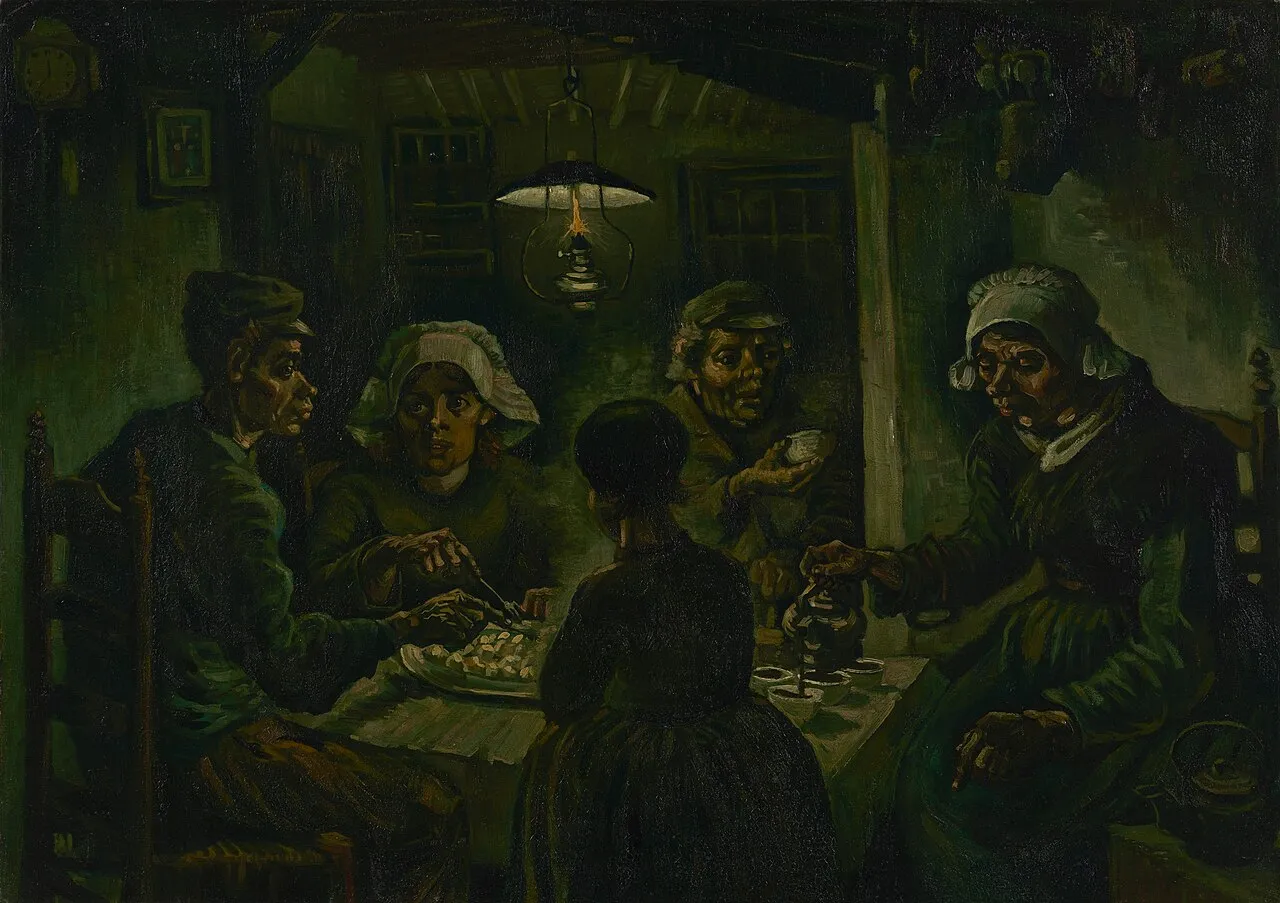
Vincent van Gogh, "The Potato Eaters" (1885), oil on canvas, 82 x 114 cm. Van Gogh Museum, Amsterdam. Van Gogh considered this his first real masterpiece. Image: Public domain, via Wikimedia Commons
While these early works lack the color fireworks of his later paintings, they reveal something essential about Van Gogh: his deep empathy for ordinary people and his willingness to sacrifice conventional beauty for emotional truth. These qualities would remain central to his art even as his palette exploded with color.
Paris: The Discovery of Color (1886 to 1888)
Everything changed when Van Gogh moved to Paris in February 1886 to live with his brother Theo. In Paris, Vincent encountered Impressionism for the first time, and it hit him like a thunderbolt. He studied the bright palettes of Monet and Renoir, the pointillist technique of Georges Seurat and Paul Signac, and the bold flat colors of Japanese woodblock prints, which were hugely fashionable in Paris at the time. Within months, his palette shifted dramatically. The dark Dutch browns gave way to vivid blues, yellows, greens, and oranges. He began experimenting with complementary color contrasts, placing red against green, orange against blue, to create maximum visual intensity.
Van Gogh also befriended several important artists during his two years in Paris, including Paul Gauguin, Emile Bernard, Henri de Toulouse-Lautrec, and Signac. These relationships pushed him to experiment further. But Paris also exhausted him. The city's pace, the drinking, the arguments. He needed somewhere quieter to develop his vision, and in February 1888 he boarded a train south to Arles.
Arles: Fifteen Months That Changed Art History
Van Gogh arrived in Arles, in Provence, to find snow on the ground. Within weeks the almond trees were blooming and the landscape was flooded with Mediterranean light. Van Gogh was electrified. Over the next fifteen months, he would produce some of the most recognized paintings in art history at a pace that borders on superhuman, sometimes completing a painting a day.
The Arles period gave us the "Sunflowers" series (1888), painted to decorate the Yellow House where Van Gogh hoped to establish an artists' colony with Gauguin. The sunflower paintings are exercises in yellow: chrome yellow, cadmium yellow, yellow ochre, set against backgrounds of pale blue or royal blue. Van Gogh applied the paint thickly, using impasto, so that the petals project physically from the canvas surface. If you see a "Sunflowers" painting in person at the National Gallery in London, you can see the paint ridges catching the gallery light. The flowers are not depicted. They are built.
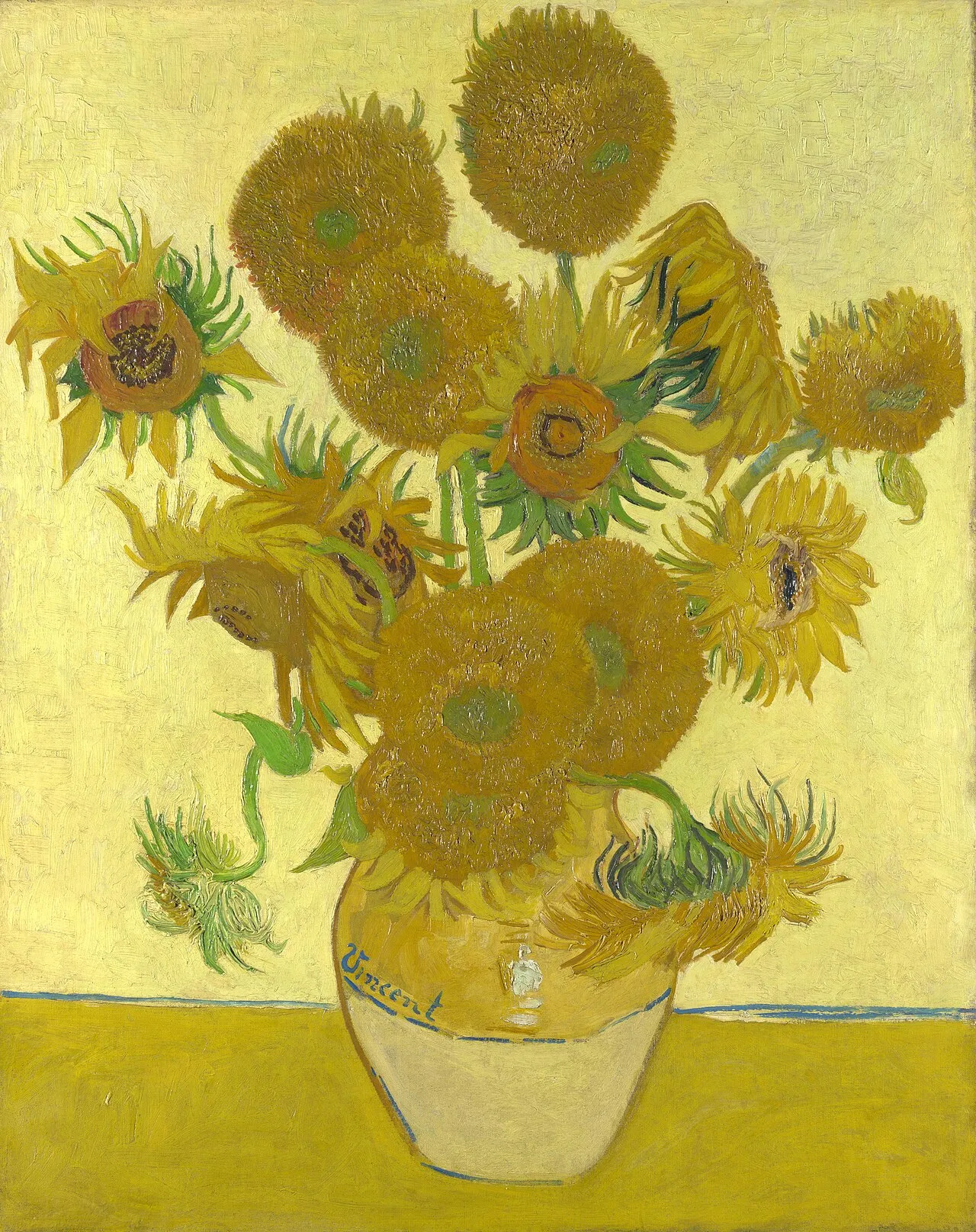
Vincent van Gogh, "Sunflowers" (1888), oil on canvas, 92.1 x 73 cm. National Gallery, London. One of several versions Van Gogh painted to decorate the Yellow House in Arles. Image: Public domain, via Wikimedia Commons
This period also produced "The Night Cafe" (1888), "Bedroom in Arles" (1888), "Starry Night Over the Rhone" (1888), and the portraits of the postman Joseph Roulin. In each of these works, Van Gogh pushed color beyond naturalistic description into the realm of pure emotion. The red and green of "The Night Cafe" are deliberately clashing. Van Gogh wrote that he wanted to express "the terrible passions of humanity" through color alone. He was not painting what the cafe looked like. He was painting what it felt like to be there.
How Van Gogh Actually Painted: Technique Breakdown
Van Gogh's painting technique evolved dramatically over his career, but several signature elements define his mature style, and they are worth understanding in detail because they are more deliberate than they look.
Impasto: Paint as Physical Object
Van Gogh applied paint thickly, often straight from the tube, building up ridges and textures that catch real light and create a three-dimensional surface. In "Starry Night," the swirling sky is built from thick ropes of paint that you can see in profile from the side of the canvas. The Van Gogh Museum's conservation team has measured paint thicknesses of up to 15 millimetres in some works. This impasto technique gives his paintings a physical presence that reproductions cannot capture. You really need to see them in person. A poster of "Starry Night" is a picture. The painting itself is a object.
Directional Brushwork: Everything Moves
Rather than dabbing paint randomly, Van Gogh used directional brushstrokes that follow the contours of forms. Grass flows in parallel curves. Skies swirl in concentric arcs. Tree bark follows the grain of the wood. This creates a sense of movement and energy. Everything in a Van Gogh painting seems to vibrate with life. The technique owes something to Japanese calligraphy, which Van Gogh admired deeply and collected extensively. He owned hundreds of Japanese woodblock prints and wrote to Theo that his work in the south of France was an attempt to find the equivalent of what Japanese artists found in their own landscape.
Color as Emotion, Not Description
Van Gogh used color not to describe what things look like but to express how they feel. He wrote extensively about color theory in his letters to Theo, discussing complementary contrasts, the emotional associations of specific hues, and the way colors interact when placed side by side. "Instead of trying to reproduce exactly what I see before my eyes," he wrote, "I use color more arbitrarily, in order to express myself more forcibly." This approach, using color for emotional expression rather than optical accuracy, would become the foundation of Expressionism and Fauvism in the early twentieth century. Henri Matisse, Ernst Ludwig Kirchner, and the entire German Expressionist movement owed an enormous debt to Van Gogh's color innovations.
The Asylum and "Starry Night" (1889 to 1890)
After the famous incident in which Van Gogh severed part of his own ear in December 1888, following a violent argument with Gauguin, his mental health deteriorated. In May 1889, he voluntarily entered the Saint-Paul-de-Mausole asylum in Saint-Remy-de-Provence. He would spend a year there, and despite severe episodes of illness, he continued to paint prolifically.
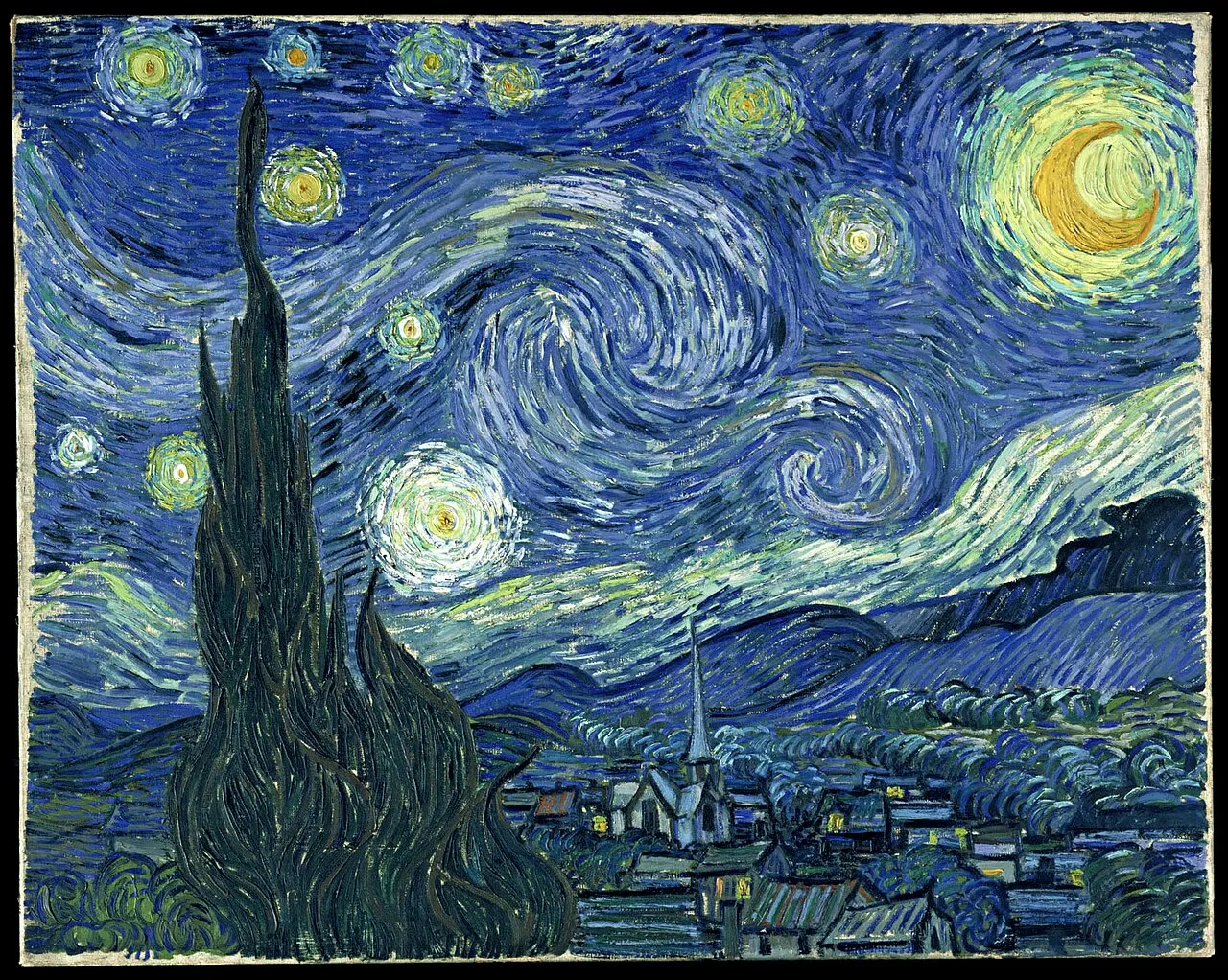
Vincent van Gogh, "The Starry Night" (1889), oil on canvas, 73.7 x 92.1 cm. Museum of Modern Art, New York. Painted from his window at the Saint-Paul-de-Mausole asylum in Saint-Remy-de-Provence. Image: Public domain, via Wikimedia Commons
The asylum period produced some of his greatest works, including "The Starry Night" (1889), painted from his bedroom window. The painting's swirling sky, with its enormous spiraling stars and crescent moon, is one of the most recognized images in all of art. Beneath the turbulent heavens, a quiet village sleeps peacefully, anchored by a dark cypress tree that flames upward like a green-black torch. The contrast between the cosmic drama above and the human calm below gives the painting its extraordinary emotional power. For a detailed analysis of this painting specifically, see our guide to The Starry Night.
Van Gogh left the asylum in May 1890 and moved to Auvers-sur-Oise, north of Paris, under the care of Dr. Paul Gachet. He painted furiously for seventy days, producing roughly one painting per day, before shooting himself in the chest on July 27, 1890. He died two days later, with Theo at his side. Theo himself would die six months later, at thirty-three, from complications of syphilis. The two brothers are buried side by side in Auvers-sur-Oise.
Van Gogh's Legacy: What He Changed
Van Gogh's influence on modern art is almost impossible to overstate. His expressive use of color directly inspired the Fauves, including Matisse, Derain, and Vlaminck, who pushed color even further from naturalism. His emotional intensity and visible brushwork laid the groundwork for Expressionism, from Edvard Munch's "The Scream" to the Abstract Expressionists of the 1950s. His willingness to distort form for emotional effect anticipated virtually every major movement of the twentieth century.
The Van Gogh Museum in Amsterdam holds over 200 paintings, 500 drawings, and more than 700 letters. His paintings regularly sell for tens of millions of dollars at auction. "Portrait of Dr. Gachet" sold for $82.5 million in 1990, setting a record that stood for over a decade. But Van Gogh's most lasting legacy might be the idea that art should be a direct expression of the artist's inner life. Before Van Gogh, most painters aimed to depict the external world as accurately or beautifully as possible. Van Gogh showed that a painting could be a window into the artist's soul, and that this emotional honesty could resonate with millions of people across cultures and centuries. For more on how art communicates emotion, see our guide to how art communicates emotion without words.
Final Thoughts
Vincent van Gogh transformed personal suffering into universal beauty. His thick, swirling brushstrokes, his blazing colors, and his unflinching emotional honesty created a new language for painting that spoke directly from the artist's nervous system to the viewer's. He proved that technical perfection matters less than authentic feeling, and that a painting's power comes not from what it depicts but from how deeply the artist means it.
To truly appreciate Van Gogh, visit a museum that holds his work and stand close enough to see the paint ridges catching the light. No reproduction can capture that physical presence. For more on the movement Van Gogh helped inspire, explore our guide to the evolution of art styles. For a deeper look at the techniques he used, our guide to oil painting covers impasto and other methods in detail. What is your favorite Van Gogh painting? Share in the comments below.


