
Stand in the upper gallery of Hagia Sophia in Istanbul and look at the Christ Pantocrator mosaic. The proportions are elongated. The flesh modeling is done with thin parallel lines rather than soft gradations. The background is solid gold. By the standards of Renaissance naturalism, nothing here is quite right. And yet the face is overwhelmingly present. The dark, slightly asymmetric eyes fix you with an authority that stops the usual habit of looking. This is a portrait of God, made by artists who were solving a problem that Western painting largely abandoned after the medieval period: how do you represent the infinite in a finite material?
Byzantine art spans roughly eleven centuries, from the founding of Constantinople in 330 AD to its fall to the Ottoman Turks in 1453. It was the visual culture of the Eastern Roman Empire, which outlasted its Western counterpart by nearly a thousand years. Unlike the Western Roman Empire, which collapsed and then slowly rebuilt a new visual tradition from scratch, the Byzantine Empire maintained continuous artistic production throughout, creating one of the most coherent and philosophically argued visual traditions in history. Understanding it requires setting aside the assumption that what it is not doing, which is creating convincing illusions of three-dimensional space, is what it should be doing.
What Made Byzantine Art Different
The first thing most Western viewers notice is what looks like a failure of naturalism. Figures seem flat. Perspectives are inconsistent. Faces follow formulas. Backgrounds are gold rather than depicted space. Compared to Renaissance painting or even ancient Roman wall painting, Byzantine art can look underdeveloped.
This assessment misunderstands the tradition entirely. Byzantine artists were not attempting to create convincing spatial illusions and failing. They were solving a completely different problem: how to represent sacred reality in a way that transcends the limitations of the visible world. Gold backgrounds are not a failure of perspective. They are a theological statement. The light in these images is not earthly light, which comes from a direction and creates shadows. It is divine light, which fills all space equally, from everywhere and nowhere simultaneously. The stylized figures are not badly drawn. They are drawn according to a system that prioritizes spiritual truth over physical likeness.
Byzantine art is one of the most programmatic traditions in art history, meaning that its visual conventions were carefully considered and justified on theological grounds. The artists and their patrons knew exactly what they were doing and why. Understanding those choices reveals a visual logic as sophisticated as anything in the Western canon.
The Mosaic Tradition
Byzantine art's most spectacular medium is mosaic: images assembled from thousands of small cubes of glass, stone, and precious materials set in mortar. Roman mosaics had used this technique for floor decoration, working primarily in stone and terracotta. Byzantine artists elevated it to a monumental wall and vault medium, and they introduced a decisive material: gold smalti, small glass cubes with a thin layer of gold leaf fused between two layers of glass.
Gold smalti are set at slightly varying angles to the wall surface, so that light reflecting off thousands of individually angled cubes creates a shimmer that no flat painted surface can produce. The effect in a candlelit Byzantine church is of a warm, breathing luminosity, as if the gold is generating light rather than reflecting it. This was intentional. As the Metropolitan Museum's Byzantine overview notes, every element of the decorative program had theological significance, from the placement of figures in the dome and apse to the materials themselves.
The Church of San Vitale in Ravenna, Italy, completed in 547 AD, gives the best surviving sense of a complete Byzantine mosaic program. The apse mosaics show the Emperor Justinian and Empress Theodora attending the liturgy, arranged in formal court procession, each figure holding offerings. The figures are flat and hieratic, but the color is brilliant, the gold background dazzling, and the overall effect is of a vision rather than a scene.
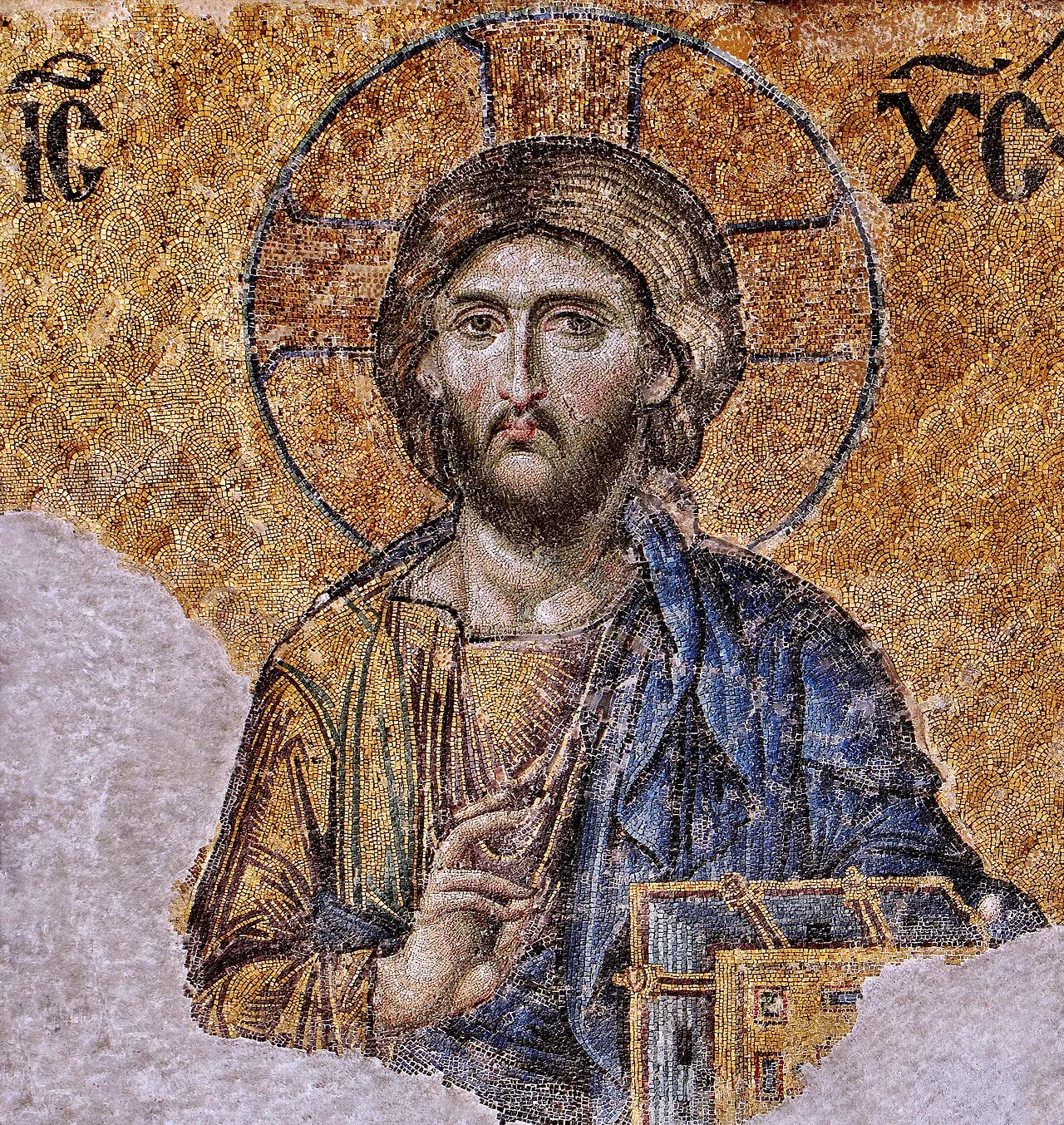
Christ Pantocrator (Ruler of All), mosaic from the upper gallery of Hagia Sophia, Istanbul (9th to 10th century). The gold background represents uncreated divine light, not a decorative choice but a theological one. Image: Public domain, via Wikimedia Commons
The Icon: Window to the Sacred
The most intimate form of Byzantine art is the icon, from the Greek word "eikon" meaning image. Icons are portable panel paintings of sacred figures, primarily Christ, the Virgin Mary, and the saints, painted on wood with egg tempera paint according to specific conventions, often with gilded backgrounds and elaborate frames of silver or gold.
In Orthodox Christianity, icons are not devotional aids in the way Western religious paintings are devotional aids. They are understood as actual presences. When you stand before an icon, you are in the presence of the person depicted. The icon is a window through which the sacred and the earthly make contact. Icons are kissed, carried in processions, credited with miraculous healings, and housed in specific honored locations in homes and churches. This theology of the sacred image has no equivalent in Western Catholic or Protestant tradition.
The oldest surviving icons are at the Monastery of Saint Catherine on Mount Sinai in Egypt, a monastery that has operated continuously since the 6th century. Its collection includes icons in the ancient encaustic technique, painting with hot wax, that survived the iconoclast period because Sinai was outside the reach of the iconoclast emperors. These ancient icons show Byzantine artists working simultaneously with classically influenced naturalism and the more stylized conventions that would dominate later Byzantine art.
Iconoclasm: When Images Became Forbidden
Between 726 and 843 AD, the Byzantine Empire went through two periods of iconoclasm, the systematic destruction of sacred images, ordered by imperial decree. The iconoclast emperors argued that sacred images were idols that violated the biblical prohibition against worshipping human-made objects. Thousands of icons were destroyed, and mosaics were whitewashed or replaced with crosses and geometric patterns.
The defenders of images, the iconophiles, responded with a sophisticated theological argument. The key thinker was John of Damascus (c. 676 to 749 AD), who argued that the Incarnation of Christ changed everything. Because God had taken human form in Jesus, it was not only permissible but necessary to represent that human form. To destroy the icon of Christ was to deny that God had truly become human, which was heresy. The icon was not an idol but a witness to the Incarnation.
This theological battle had enormous consequences for the development of Western art. The arguments that John of Damascus and later iconophile theologians developed to justify sacred imagery eventually formed the philosophical foundation for the entire Western tradition of religious painting. Renaissance painters depicting the life of Christ on panel were building on Byzantine theology, even when they had no awareness of it. The final defeat of iconoclasm in 843 AD, still celebrated in Orthodox churches as the Triumph of Orthodoxy, produced a renewed flowering of icon painting and mosaic that generated the greatest masterworks of Byzantine visual culture.
The Deesis Mosaic and the Late Byzantine Style
The Deesis mosaic in the upper gallery of Hagia Sophia (c. 1261) is widely considered the most beautiful single Byzantine work that survives. It shows Christ enthroned at the center, flanked by the Virgin Mary and John the Baptist, who turn toward him in intercession, pleading for the souls of humanity. Only three figures of what was originally a larger composition remain, but what survives is extraordinary.
What makes the Deesis exceptional within the Byzantine tradition is the degree of psychological presence in the faces. The gold smalti of the haloes and background contrast with a warm, almost Venetian naturalism of the flesh, built from thousands of tiny glass cubes in subtly varied tones. The Virgin's eyes are cast downward in an expression of sorrow and appeal that feels genuinely human. This is Byzantine art at its most emotionally direct, and it points toward what the Italian Renaissance would eventually become.
Art historians including Ernst Kitzinger have argued that the late Byzantine Paleologan Renaissance of the 13th and 14th centuries, which produced the Deesis and the extraordinary frescoes of the Chora Church in Istanbul, directly influenced the early Italian painters, Cimabue and Duccio among them, who laid the foundations for Renaissance painting. Byzantine artists and scholars moved to Italy following the fall of Constantinople in 1453, carrying with them techniques and theological frameworks that Italian painters absorbed and transformed.
Byzantine Art's Living Legacy
Byzantine art did not end in 1453. The Eastern Orthodox tradition it expressed continues to the present day in Russia, Greece, Romania, Serbia, Georgia, and many other countries. Russian icon painting developed its own distinctive traditions from the 15th century onward and produced masters like Andrei Rublev (c. 1360 to 1430 AD), whose "Trinity" icon (c. 1411) is considered by many Orthodox theologians to be the most perfect icon ever painted. Contemporary icon painters working in the Byzantine tradition operate in studios across the Orthodox world, producing work according to the same conventions that governed painters ten centuries ago.
For connections to the broader history of Western religious art, our guide to Renaissance art shows how the traditions Byzantine art helped initiate eventually transformed into something radically new. Our guide to Islamic geometric art covers a tradition that developed in direct dialogue with Byzantine visual culture across shared borders and centuries of contact.
Final Thoughts
Byzantine art answered one of the hardest questions any visual tradition faces: how do you show what cannot be seen? Its answer, developed through centuries of theological argument and artistic practice, was to use visible form as a transparent window onto invisible reality, to make the gold glow not like light reflected off a surface but like light emanating from a presence that is actually there. The result is an art that operates by different rules than Western naturalism and rewards viewers who are willing to learn those rules rather than measure the work against different ones.
The next time you encounter a Byzantine mosaic or icon, resist measuring it against Renaissance standards of naturalism. Ask instead what visual choices the artist made and why. What does the gold background mean? How is the face constructed stroke by stroke? What do the posture and gesture communicate? You will find an art that is not primitive or underdeveloped but precise, intentional, and philosophically rigorous. What aspect of Byzantine art surprises you most? Share your thoughts in the comments.


