
Every few months someone confidently uses "modern" and "contemporary" to mean the same thing in an art gallery, and every art historian in earshot winces quietly. The confusion is understandable. Both terms suggest newness, both cover art that broke from traditional academic painting, and both include work that looks nothing like a Renaissance portrait. But in art history, each word has a specific meaning that points to a different era, a different set of questions, and a very different relationship between the artist and the world.
Getting this distinction clear does not just make you sound more informed in galleries. It changes how you read individual works. Once you understand what problem each era was trying to solve, you stop asking "what does this mean?" in the abstract and start asking "what was this artist responding to?" That is a much more productive question.
Modern Art: Roughly 1860 to 1970
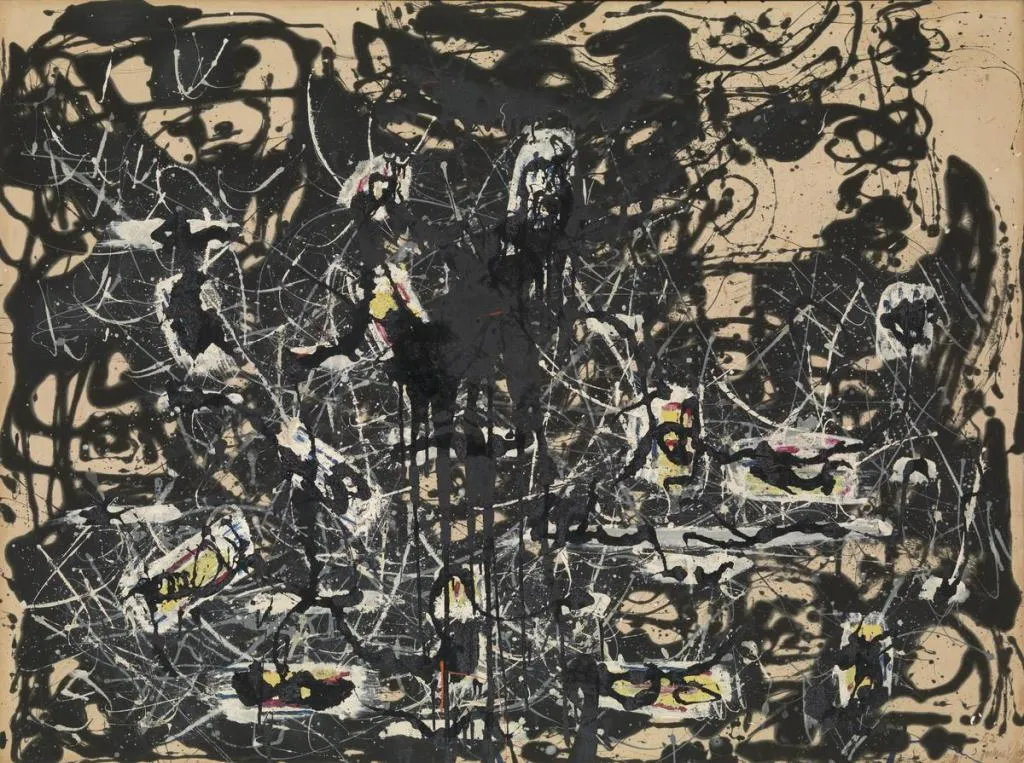
Yellow Islands by Jackson Pollock, 1952, Tate London. Abstract Expressionism represents one of Modern Art's terminal points — the furthest reach of painting as a self-referential medium.
The Modern Art period runs from the mid-19th century to around 1970, though the boundaries are genuinely blurry at both ends. It begins with artists like Courbet and Manet refusing the idealized subjects and polished surfaces of academic painting, and it accelerates through a sequence of movements — Impressionism, Post-Impressionism, Cubism, Fauvism, Surrealism, Abstract Expressionism — each one more willing than the last to abandon representation entirely.
The central question of Modern Art is formal: what can painting and sculpture do that they have never done before? Monet asks what happens when you paint the same haystack at different times of day and discover that light is the real subject. Picasso and Braque ask what happens when you show all sides of an object simultaneously. Mondrian asks whether a painting can be nothing but vertical and horizontal lines and rectangles of pure color and still be complete. Pollock asks whether the act of applying paint, rather than the image it produces, can be the work itself.
This is art that defines itself primarily against tradition. Modernist artists are in conversation with the history of Western art and they are arguing with it. Their work makes most sense in that context. When you look at Manet's "Olympia" (1863) at the Musée d'Orsay in Paris, the scandal of the painting, the flat painting style, the direct gaze of the nude model, the Black maidservant, only fully registers when you know the tradition of recumbent nude painting it was explicitly provoking.
According to the Museum of Modern Art's own definition, Modern Art is characterized by "a break with tradition, an emphasis on experimentation with new materials and techniques, and a focus on expressing inner experience." The key phrase there is "break with tradition." Modern Art knows what it is breaking from.
Contemporary Art: 1970 to the Present
Contemporary Art does not have the same unified project. It starts where Modern Art ends, roughly around 1970, and it includes everything being made right now. This is not just a longer time span — it is a fundamentally different relationship to the question of what art should do.
Where Modern Art asked formal questions about the nature of painting and sculpture, Contemporary Art tends to ask social, political, and philosophical ones. Who is represented in art and who is not? How does art function in a globalized market? What is the difference between art and commodity? How does digital technology change what images mean and who they belong to? These are not questions about whether to use impasto or whether color can carry emotion. They are questions about power, identity, and the world outside the studio.
Consider Kara Walker's large-scale silhouette installations, which address the history of American slavery with imagery that is simultaneously beautiful and disturbing. Or Ai Weiwei's "Sunflower Seeds" (2010), in which 100 million hand-crafted porcelain seeds filled the Turbine Hall at Tate Modern, a comment on mass production, individual labor, and Chinese political culture. These works are not primarily about what painting or sculpture can do. They are about what the world is doing and how art might respond to it.
Contemporary Art is also defined by its indifference to medium. Modern Art, even in its most experimental phases, was largely concerned with painting and sculpture. Contemporary Art uses video, performance, installation, digital processes, found objects, food, living organisms, and combinations of all of these. The Tate's definition notes that contemporary art is "generally used to describe art produced from the 1970s to the present day," and that it often "reflects and responds to contemporary society and culture."
The Clearest Way to Tell Them Apart
When you are standing in front of a work and trying to place it, ask yourself one question: is this work primarily in dialogue with art history, or primarily in dialogue with the world outside the gallery? If the answer is the former, you are probably looking at Modern Art. If the answer is the latter, you are probably looking at Contemporary Art.
Jackson Pollock's drip paintings are about what painting can be. They quote and argue against Abstract Expressionism's predecessors, particularly the gestural European painters Pollock studied. Damien Hirst's spot paintings, on the other hand, are not really about painting at all. They are about the art market, about production and authorship (Hirst had assistants paint most of them), about what makes an art object valuable, and about the relationship between art and pharmaceutical aesthetics. The subject is the contemporary art world itself.
The date of a work is a useful starting clue but not a reliable rule. Some artists working in the 1950s and 1960s, like Yves Klein or Joseph Beuys, were already asking Contemporary questions. Some artists working today, particularly in figurative painting, are still engaged in conversations that began in the Modern period. What matters more than the date is the nature of the conversation the work is having.
Why the Distinction Actually Matters
Understanding which era a work belongs to gives you the right frame for reading it. You would not evaluate a Monet haystack series by asking whether it makes a political statement about French agriculture. And you would not evaluate Ai Weiwei's "Sunflower Seeds" by asking whether its formal composition is as resolved as a Cubist painting. Both of those would be asking the wrong question.
The right question for Modern Art is usually: how does this advance or transform what art can do formally? The right question for Contemporary Art is usually: what is this saying about the world we are living in?
For more on the major movements within Modern Art and how they connect, the guide to art movements from ancient times to the present places each era in sequence. For a closer look at the Abstract Expressionist movement that represents Modern Art's most ambitious phase, the guide to Abstract Expressionism goes into detail on Pollock, Rothko, and their contemporaries.
Final Thoughts
Modern Art and Contemporary Art are not the same thing, and the difference is not pedantic. Modern Art is the story of how Western art dismantled its own traditions from the inside, movement by movement, over about a century. Contemporary Art is the story of what happened after that dismantling was complete, when artists stopped arguing primarily with art history and started arguing with everything else.
Both bodies of work reward careful attention. But they reward different kinds of attention. Next time you find yourself in front of something unfamiliar, ask first what conversation it is joining. The answer will tell you more than any label on the wall. What Contemporary work has surprised or challenged you recently? Share your thoughts in the comments.


