
In 1917, Marcel Duchamp placed a factory-made urinal on a gallery plinth, signed it "R. Mutt," and titled it "Fountain." The art establishment rejected it. Duchamp argued it was art. That argument, whether a mass-produced object could be art if an artist chose it, defined the final stretch of Modern Art and planted the seed for almost everything in Contemporary Art that followed. Understanding what distinguishes these two eras means understanding what was at stake in arguments like that one.
This guide lays out the key differences between Modern and Contemporary Art across six dimensions: timeline, dominant questions, materials and methods, major artists, relationship to politics, and how each era positions the viewer. By the end, you should be able to walk into any museum and know immediately which conversation the work in front of you is joining.
Timeline: When Each Era Begins and Ends
Modern Art runs from approximately 1860 to 1970. The starting point is usually placed at Courbet's Realism and Manet's challenge to academic painting in the 1860s. The end point varies by the historian you ask, but most place it somewhere between the decline of Abstract Expressionism in the late 1950s and the emergence of Conceptual Art and Pop Art in the 1960s.
Contemporary Art begins where Modern Art ends, roughly 1970, and it extends to the present. The boundary between the two is not a sharp line. Some artists working in the 1960s, particularly Yves Klein, Joseph Beuys, and the Fluxus group, were already asking Contemporary questions. Some figurative painters working today remain engaged in conversations that began in the Modern period. The dates are a framework, not a verdict.
What matters more than exact dates is the nature of the shift. Modern Art is a continuous sequence of movements, each reacting against the one before: Impressionism against academic Realism, Post-Impressionism against Impressionism, Cubism against both, and so on through Fauvism, Dada, Surrealism, and Abstract Expressionism. Contemporary Art does not have that kind of sequential logic. It is simultaneous, plural, and deliberately resistant to any single organizing principle.
The Central Questions Each Era Asked
The easiest way to understand the difference is to identify the central question each era was trying to answer.
Modern Art asked: what can art do that it has never done before? Every major Modern movement is a formal experiment. Impressionists ask what painting looks like if you prioritize the optical truth of light over the physical solidity of objects. Cubists ask what happens when you fracture a form and show its multiple facets simultaneously. Mondrian asks whether pure geometric abstraction, lines and rectangles in primary colors, can carry spiritual meaning. Abstract Expressionists ask whether the act of painting, the gesture itself, can be the subject of the work rather than a means to represent something else.
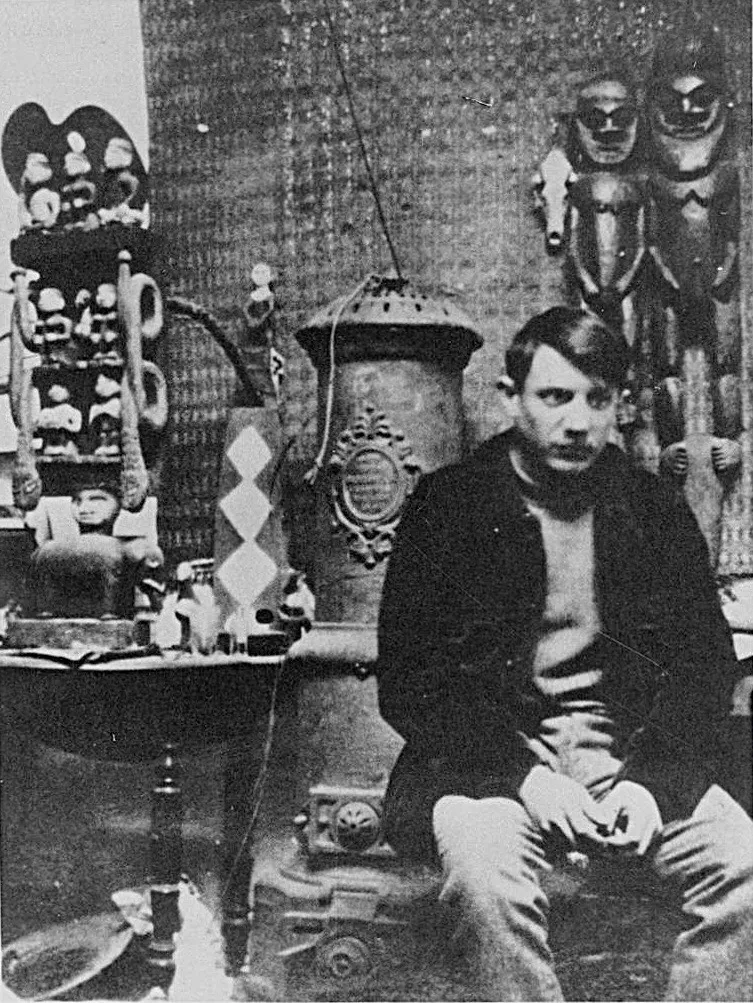
Pablo Picasso in his studio, 1908. Photograph by André Villers. Picasso's Cubist experiments asked whether a painting could represent an object from multiple viewpoints simultaneously — a purely formal question that defined Modern Art's ambitions.
Contemporary Art asks different questions. It tends to ask: who does art serve? Whose voices and histories have been left out of art history? How does art function within a global market? What happens to the meaning of images when they can be endlessly copied and circulated digitally? How does art address urgent issues like climate change, migration, race, and gender? These are not questions about what painting can do. They are questions about what art's responsibilities are to the world it inhabits.
Materials and Methods
Modern Art, for all its radicalism, stayed largely within the disciplines of painting and sculpture. There were exceptions: Duchamp's readymades, Kurt Schwitters's assemblages from found material, the Bauhaus integration of design and fine art. But the dominant media remained oil on canvas and carved or cast sculpture, even when what appeared on the canvas became completely abstract.
Contemporary Art is genuinely medium-agnostic. Since the 1970s, artists have worked with video and film, performance, installation, digital processes, photography, the internet, found objects, living organisms, light, sound, and combinations of all of these. There is no medium that is inherently more serious or valid than any other. This is not just stylistic variety. It reflects a philosophical position: the choice of material is itself a statement, and no material carries more inherent artistic authority than any other.
Bruce Nauman's neon light works from the late 1960s helped establish this principle. His text-based neon pieces, using commercial sign-making materials to produce philosophical and psychological statements, made the choice of cheap commercial materials part of the content. The gap between the banal medium and the serious message was the point.
Key Artists in Each Era
The Modern Canon
The Modern canon is centered in Western Europe and, from the 1940s onward, New York. Its defining figures include Claude Monet (Impressionism), Paul Cézanne (Post-Impressionism), Pablo Picasso and Georges Braque (Cubism), Henri Matisse (Fauvism), Wassily Kandinsky (early abstraction), Salvador Dalí (Surrealism), Jackson Pollock and Mark Rothko (Abstract Expressionism), and Donald Judd and Dan Flavin (Minimalism). Most of these artists were white and male, and the institutions that promoted them reflected those biases explicitly.
The Contemporary Expansion
Contemporary Art is geographically and demographically broader, though still marked by inequalities in market value and institutional access. Its defining figures include Joseph Beuys (performance and social sculpture), Bruce Nauman (conceptual and video work), Cindy Sherman (photography and identity), Jean-Michel Basquiat (neo-expressionist painting engaging race and urban culture), Kara Walker (historical silhouette installations), Ai Weiwei (politically engaged installation), Yayoi Kusama (obsessional pattern and installation), Wolfgang Tillmans (photography and queer culture), and Hito Steyerl (video essay and digital politics).
A mural in Lagos. Image Source: Cedar Creative Art. Contemporary Art's geographic scope extends well beyond Paris and New York. African, Asian, and Latin American art scenes have become increasingly central to global conversations.
Relationship to Politics and Society
Modern Art was not apolitical. The German Expressionists responded directly to the trauma of World War One. Picasso's Guernica (1937) is one of the most explicit political statements in 20th-century art. The Bauhaus was shut down by the Nazis in 1933. But Modern Art's political engagement was largely incidental to its formal project. The political content existed alongside the formal experiment, not in place of it.
In Contemporary Art, the political is often the whole point. Barbara Kruger's text-and-image works from the 1980s — "Your Body is a Battleground," "I Shop Therefore I Am" — are political arguments made in the visual language of advertising. Felix Gonzalez-Torres's candy piles, initially weighing the same as his partner who died of AIDS, make grief and political abandonment into a participatory experience. The politics is not added to the work. It is the work.

Visitors at the Taka Ishii Gallery, Tokyo, 2010. Photo: Maurizio Mucciola, Image Source: Tokyo Art Beat. Contemporary galleries worldwide now present work that explicitly engages political and social content as primary subject matter.
The Viewer's Role
In Modern Art, the viewer is primarily a witness. You stand before a Rothko color field and allow it to work on you. You look at Pollock's drip painting and try to follow its rhythms. The relationship is contemplative. The work has been made; you receive it.
Contemporary Art often demands more. Participatory and relational art, which became a recognized tendency in the 1990s through theorist Nicolas Bourriaud's concept of "relational aesthetics," makes the viewer's presence and action part of the work itself. Tino Sehgal creates situations that only exist when people interact with them; there is no object, only encounter. Yoko Ono's "Instruction Paintings" require viewers to complete the work. Olafur Eliasson's large-scale installations position you inside the work rather than in front of it. According to the Tate's overview of relational aesthetics, this shift reflects a broader move in contemporary practice toward social experience as artistic medium.
How to Tell Them Apart in Practice
When you are in front of an unfamiliar work, these two questions will usually orient you quickly. First: is this work primarily in formal dialogue with art history, asking what painting or sculpture can do? Or is it primarily in dialogue with the world outside the gallery, asking about society, identity, power, or technology? The former is the Modern impulse; the latter is the Contemporary one.
Second: does the work have a single correct medium and a single finished object? Modern Art almost always does. Or does it exist in time, space, multiple formats, or only through participation? Contemporary Art often does.
For a complete chronological map of how art movements developed from ancient times through Modernism and into the present, the guide to art movements across history provides the full sequence. For a focused look at how to read and interpret works from either era once you understand which conversation they are joining, the guide to how to read a painting provides a practical framework.
Final Thoughts
Modern Art and Contemporary Art are two chapters of the same story, but they are very different chapters. Modern Art is the story of Western art dismantling its own traditions from the inside, one formal experiment at a time. Contemporary Art is what came after that dismantling, when the question of what art could formally do had been pushed to its limits and artists turned outward to ask what it should say about the world.
Both eras reward deep attention. But they reward it differently. The more you know about the formal questions Modernists were asking, the richer your experience of any Modernist work becomes. The more you understand the social and political context Contemporary artists are addressing, the more their work opens up. Neither is harder or more rewarding than the other. They are just different conversations, and both are worth joining. Which era do you find yourself drawn to? Share your thoughts in the comments.


