
One evening in 1908, Wassily Kandinsky walked into his studio in Munich and saw one of his own paintings leaning against the wall, turned on its side. He did not recognize it. In the unfamiliar orientation, the painting looked like something he had never seen before: an arrangement of colors and forms without any identifiable subject, glowing in the evening light. It was beautiful. It was overwhelming. And it was his own work, unrecognizable simply because it was sideways. That accidental viewing revealed something Kandinsky had been approaching for years. If the subject disappeared and the painting still communicated powerfully, then the subject was not what the painting was about. The painting was about color, form, line, and their relationships. The painting was doing what music does.
This story, which Kandinsky recounted in his memoir "Reminiscences" (1913), captures the insight that would drive the rest of his career. He wanted to create visual music: an art of pure sensation, organized according to principles analogous to musical composition, that could reach the viewer directly through the senses without passing through the intellect's need to identify and name things. What he went on to produce was not just a body of paintings but a complete theory of visual abstraction, still taught in art schools worldwide, and a teaching practice at the Bauhaus that shaped an entire generation of designers and artists. The Guggenheim Museum, which holds the world's most important collection of his work, describes him as a pioneer whose theories "provided the rationale for nonobjective art" and whose paintings "constitute one of the most important chapters in the history of modern art."
This profile traces his path from Moscow lawyer to the inventor of abstract art, through his Bauhaus years and into his final period in Paris.
From Law to Art: Moscow and Munich
Wassily Wassilyevich Kandinsky was born on December 16, 1866, in Moscow, into a wealthy merchant family. He showed musical ability from childhood, playing piano and cello, and studied law and economics at the University of Moscow. He was offered a professorship in law at Tartu University in 1896, a secure and prestigious position. He turned it down. That same year, two events had convinced him to pursue painting instead.
The first was attending a performance of Wagner's opera "Lohengrin" at the Bolshoi Theatre. Kandinsky experienced synesthesia, a neurological condition in which stimulation of one sensory pathway triggers another. He saw colors and forms in response to the music. The violins produced yellow, the cellos produced blue, the brass produced deep red. The second was seeing Monet's "Haystacks" series at an exhibition in Moscow. The paintings disturbed him because he could not immediately identify the subject. The color and form were communicating before his brain could name what was depicted. That experience suggested that painting could work the way music worked, reaching the emotions directly without needing a recognizable subject.
He moved to Munich, then one of Europe's leading art cities, and enrolled at art school. He was thirty years old, which was considered quite late to begin formal art training. He studied first with Anton Azbe, then at the Munich Academy under the painter Franz von Stuck. He was a diligent and technically competent student, though his work at this stage showed little of the direction his career would take. The transformation happened gradually over the next decade through a process of incremental abstraction that can be traced across hundreds of paintings and studies. For more on the movement that influenced his early development, see our guide to Impressionism.
The Breakthrough: Compositions, Improvisations, and Impressions
By around 1910-1911, Kandinsky had developed a three-part classification for his abstract work that he used throughout his career. "Impressions" were paintings that retained some direct reference to an external visual source. "Improvisations" were largely spontaneous paintings expressing inner states. "Compositions" were the most worked and theorized paintings, analogous to the most formal kinds of musical composition, large-scale and carefully constructed. The musical terminology was not metaphorical. Kandinsky was a trained musician who believed painting could achieve the same direct emotional communication as music, without the intermediary of recognizable subject matter.
In 1911, Kandinsky published his theoretical work "Concerning the Spiritual in Art." The book laid out his ideas about color and form with systematic care. He argued that colors had specific emotional and spiritual associations. Yellow was earthly and aggressive, warm and irritating. Blue was heavenly and receding, deepening toward spirituality as it darkened. Red was warm and energetic, confident and vital. Combinations of colors produced effects analogous to musical chords. Forms also carried associations: circles were the most spiritual form, triangles were aggressive and dynamic, squares were stable and material. These ideas drew on his reading of Theosophy, Rudolf Steiner's Anthroposophy, and the general interest in spiritual and occult philosophies that characterized much of the European avant-garde around 1910. The full text of "Concerning the Spiritual in Art" is available online for anyone who wants to read the original argument.
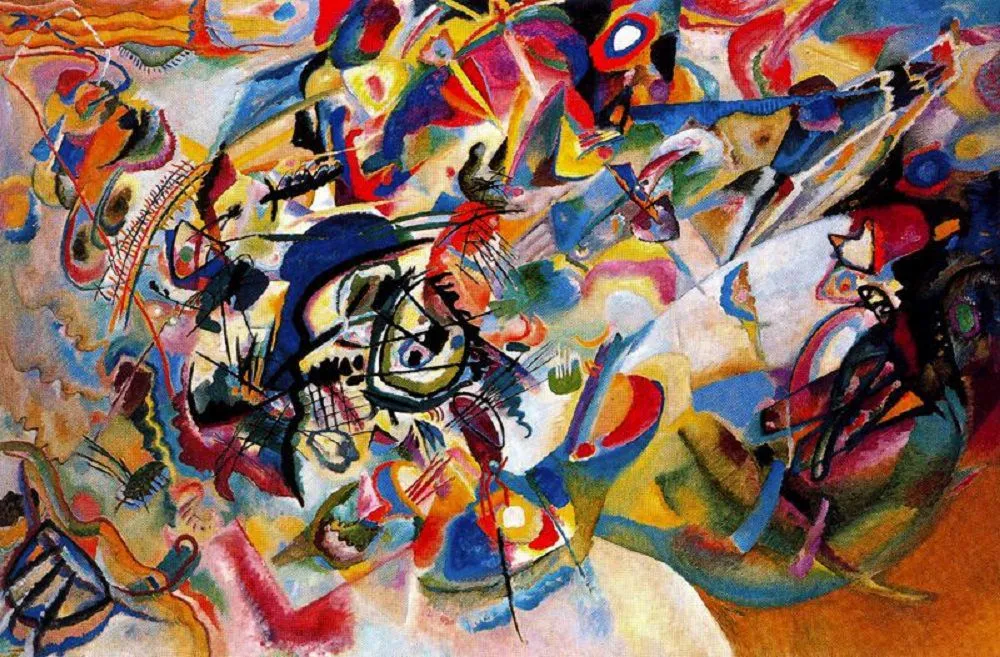
Wassily Kandinsky, "Composition VII" (1913), oil on canvas, 200 x 300 cm. Tretyakov Gallery, Moscow. Kandinsky considered this his most complex and important painting. It was completed in four days of frenzied work after months of preparation. Image: Public domain, via Wikimedia Commons
The paintings of this period, particularly the large-scale "Compositions" VII and VIII, show abstract forms of enormous energy and complexity. They are not random. They have compositional centers, spatial depth created through color relationships, rhythmic repetition of forms, and an overall structure that rewards extended looking. But they cannot be decoded in terms of represented subjects. This was revolutionary. Abstract painting, what art historians often call the most significant development in twentieth-century art, begins here. Understanding how Kandinsky's ideas relate to the broader history of abstract art connects directly to the movement explored in our guide to Abstract Expressionism.
The Bauhaus Years: Theory Meets Practice
After the upheaval of the Russian Revolution, during which Kandinsky returned to Moscow and worked in cultural administration, he left Russia in 1921 following ideological conflicts between his spiritual approach and the materialist doctrine of the Soviet state. Walter Gropius invited him to join the faculty of the Bauhaus in Weimar in 1922, where he would teach for the next decade.
The Bauhaus was an experiment in unifying fine art, craft, and design in a single educational institution, and its pedagogy was directly influenced by Kandinsky's theories. He taught the "Analytical Drawing" course and the "Color Theory" seminar, developing his ideas about the psychological and compositional properties of form and color into rigorous teaching materials. His Bauhaus book "Point and Line to Plane" (1926) systematized his analysis of visual elements with a precision that made his earlier mystical writings seem loose by comparison. The book remains a foundational text in design education. The Bauhaus archive provides extensive documentation of the school's pedagogy and faculty.
The Bauhaus years also changed his visual language. The looser, gestural forms of his pre-war work gave way to precise geometric shapes: circles, arcs, triangles, grids. "Composition VIII" (1923), the defining image of this period, is a complex arrangement of circles, lines, and angular forms in a shallow pictorial space. The painting looks more controlled, more analytical, and more machine-influenced than the earlier work. It reflects both Kandinsky's new intellectual environment, surrounded by architects and industrial designers, and his deepening interest in the precise psychological effects of specific geometric forms. The influence of this teaching practice on design education is described more fully in our guide to the Bauhaus movement.
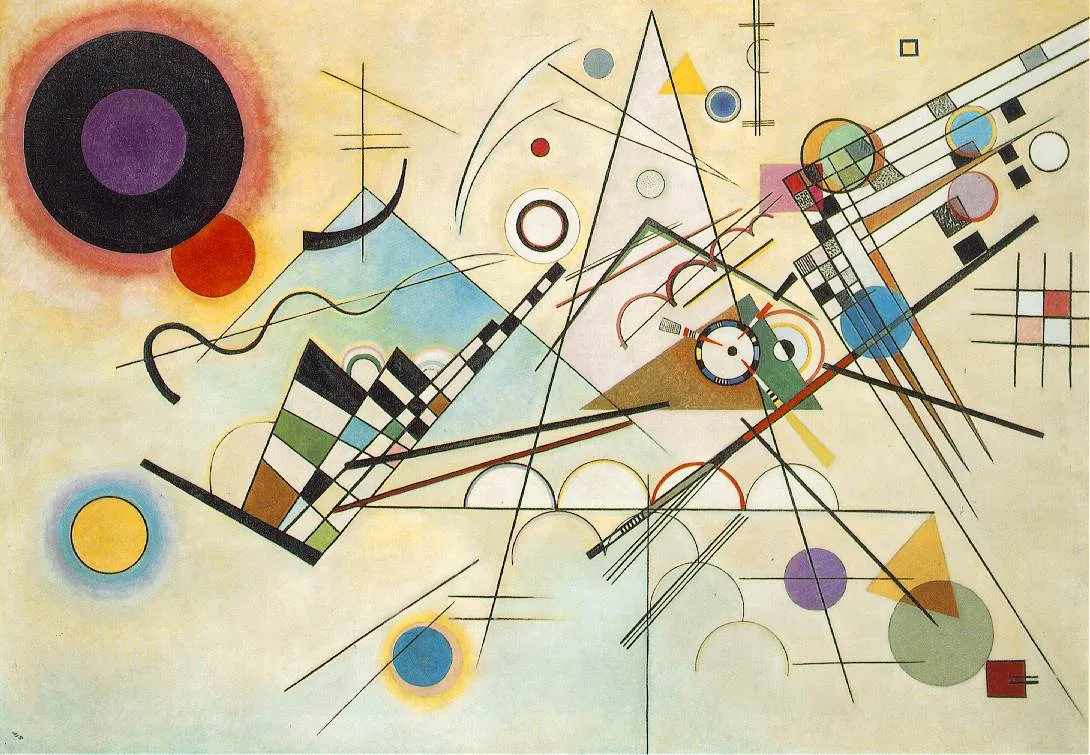
Wassily Kandinsky, "Composition VIII" (1923), oil on canvas, 140 x 201 cm. Solomon R. Guggenheim Museum, New York. Painted during his Bauhaus years, this work shows his shift from gestural to geometric abstraction. Image: Public domain, via Wikimedia Commons
Paris and the Late Works
When the Nazis came to power in Germany in 1933 and closed the Bauhaus, Kandinsky moved to Paris, settling in the suburb of Neuilly-sur-Seine where he would spend the rest of his life. The Paris years produced a third and final phase in his visual language. The geometric precision of the Bauhaus period gave way to a warmer, more organic imagery influenced by his growing interest in biomorphic forms, microscopic organisms, and the Surrealist interest in the subconscious. His later paintings show amoeba-like forms, hieroglyphic marks, and cellular shapes in warm, bright colors against black backgrounds, resembling nothing so much as a vivid inner world seen under magnification.
The Paris years were productive but relatively isolated. Kandinsky was in his seventies, a Russian emigre in occupied France during World War II, working in a style that neither the School of Paris nor the emerging American abstraction fully recognized as central. He died in Neuilly-sur-Seine on December 13, 1944, at age 77. His reputation was more secure in theory than in the art market at the time of his death, but the subsequent history of abstract art has confirmed exactly the central position he claimed for himself. For more on how abstract art developed after Kandinsky, see our guide to the evolution of art styles.
Final Thoughts
Kandinsky's achievement is unusual in art history in that it is simultaneously practical and theoretical. He did not just make abstract paintings. He explained why they worked, what their visual elements did, and how color and form could communicate without representational content. This theoretical framework, however much it has been revised and contested, provided the language in which much of twentieth-century art discussed itself. The Centre Pompidou in Paris holds a significant collection of his late work and has featured him in major retrospectives.
The Guggenheim Museum in New York, which holds the world's most important collection of his work, has continued to program Kandinsky exhibitions that draw substantial attendance. The paintings still work. The circles and triangles and cascading color forms of "Composition VIII" still produce something that resembles what Kandinsky described: a direct sensory communication that bypasses the need for a subject, reaching the viewer through the eye alone. That is what he was after, and after a century, it is still happening. For more on the school where Kandinsky taught, read our guide to the Bauhaus movement. To understand how his ideas evolved into the American movement that built on his work, explore Abstract Expressionism. How do you personally respond to abstract art that has no recognizable subject? Share your experience in the comments below.


