
When Masaccio painted "The Holy Trinity" on a wall of the Church of Santa Maria Novella in Florence around 1427, people reportedly thought a hole had been cut into the wall. They were not foolish. The fresco used Brunelleschi's newly codified system of linear perspective so accurately that the painted barrel vault receded into an illusory space that simply did not exist before in Western painting. Standing in front of it, you feel the pull of that depth still, almost six centuries later.
That moment is a good entry point into the Renaissance because it shows what was actually at stake: not just beauty, but a new relationship between the painted surface and the viewer's eye. Before this, Western European painting was largely symbolic and hierarchical. Figures floated against gold backgrounds, sized according to their spiritual importance rather than their position in space. After Masaccio and Brunelleschi, painters worked to make the flat canvas feel like a window onto a real, three-dimensional world. That shift drove everything that followed.
The Renaissance, from the French word for "rebirth," swept through Italy from the 14th century onward and spread across Europe over the next three hundred years. Fueled by the recovery of ancient Greek and Roman learning, advances in mathematics and anatomy, and the patronage of extraordinarily wealthy families and institutions, it produced Leonardo da Vinci, Michelangelo, Raphael, Botticelli, Donatello, and Jan van Eyck. Their innovations in composition, perspective, and color set the terms for Western art for the next five hundred years. Understanding what they actually did, and why it was so difficult, is the only way to understand why we still go to museums to look at these works.
What Made the Renaissance Possible
The Renaissance was not inevitable. It required a specific combination of intellectual conditions, economic support, and technical knowledge that happened to converge in 15th-century Italy.
The Recovery of Classical Knowledge
During the medieval period, much of ancient Greek and Roman scholarship was inaccessible to Western European scholars, though it had been preserved and extended by Islamic scholars. From the 14th century onward, Italian humanists began recovering and translating classical texts on philosophy, mathematics, architecture, and rhetoric. The works of Vitruvius on architecture, Pliny the Elder on painting and sculpture, and the Greek philosophers offered a radically different picture of what art could be.
The resulting intellectual movement, humanism, placed human experience and achievement at the center of inquiry. This did not mean abandoning Christianity. Most Renaissance artists remained devout, and most of their commissions were religious. But humanism meant that the human body, human emotion, and human reason were all things worth taking seriously as subjects of study and representation. The Florentine Neoplatonists under Marsilio Ficino argued that beauty itself was a form of divine truth, which gave artists philosophical permission to pursue visual perfection as a spiritual act. The Metropolitan Museum's overview of humanism in the Renaissance traces how this thinking reshaped artistic ambition across Italy.
The Patronage System
Renaissance art was expensive, and it needed money. The Medici in Florence, the Sforza in Milan, the Este in Ferrara, and the papacy in Rome all competed to attract the most talented artists and commission the most impressive works. This competition was not purely aesthetic: commissioning great art was a form of political and social power, a way of demonstrating that your city, your family, or your church stood at the center of civilized life.
For artists, the system created opportunity and constraint simultaneously. Lorenzo de' Medici supported Botticelli, Ghirlandaio, and the young Michelangelo, giving them the time and resources to develop ambitious work. But patrons also had specific demands about subject matter, scale, and iconography. The tension between artistic vision and patron expectation runs through countless Renaissance commissions, sometimes producing extraordinary results precisely because of the friction.
Technical Breakthroughs
Three technical developments made the visual ambitions of Renaissance painting achievable.
Linear perspective was systematized by the architect Filippo Brunelleschi around 1415. He demonstrated, using painted panels and mirrors, that all parallel lines in a scene converge to a single vanishing point on the horizon when viewed from a fixed position. Leon Battista Alberti codified the method in his treatise "De Pictura" (1435), which gave painters a practical mathematical tool for constructing convincing three-dimensional spaces. The system was not a discovery of how the eye works so much as a convention that painters agreed to adopt, and its adoption transformed the visual language of Western art.
Oil paint arrived in Italy from Flanders in the late 15th century. Tempera, the earlier medium, used egg yolk as a binder. It dried quickly, applied as opaque layers, and produced flat, matte surfaces. Oil paint, using linseed or walnut oil, dried slowly through oxidation rather than evaporation. This meant that a thick passage of lead white might feel dry to the touch in a week but remain wet underneath for months. More importantly for painters, the slow drying time allowed them to blend tones on the canvas, build up translucent glazes over underpaintings, and model forms with a subtlety that tempera could not match.
Anatomical study, pursued by Leonardo and others through dissection of human corpses, gave painters access to the body's internal structure. Leonardo's anatomical notebooks, now held by the Royal Collection Trust, show studies of muscle groups, bone structure, and the mechanics of movement that informed his painted figures with a physical specificity that simply had not existed before.
The Early Renaissance in Florence
Florence is where it started. Under Medici patronage from the early 15th century, the city became a laboratory where painters, sculptors, and architects competed and collaborated in ways that accelerated development at an extraordinary pace.
Masaccio (1401–1428) was the first painter to apply linear perspective systematically. His frescoes in the Brancacci Chapel in Florence, particularly "The Tribute Money" (c. 1425), show figures with genuine weight and volume, standing in space that recedes convincingly behind them. The figures' robes catch light from a consistent source. Their faces show individuated expressions. These seem like minimum requirements for painting now; in 1425 they were radical departures.
Donatello (c. 1386–1466) transformed sculpture on a parallel track. His bronze "David" from the 1440s was the first freestanding nude sculpture since antiquity, and it used contrapposto, the weight-shift pose in which the figure's hips and shoulders tilt in opposite directions to suggest relaxed naturalism, in a way that made the figure feel genuinely alive. His earlier relief carvings, including "The Feast of Herod" (1427) for the Siena Cathedral baptistry, used perspective recession in low relief to create the illusion of deep architectural space within a few centimeters of carved marble.
Sandro Botticelli (1445–1510) brought something different to the tradition: an almost elegiac lyricism that set him apart from the more analytical tendencies of his contemporaries. "The Birth of Venus" (c. 1484–1486) and "Primavera" (c. 1477–1482) drew on classical mythology for the Medici circle, but what makes them distinctive is the quality of longing in the figures, the sense that beauty is fleeting and slightly sorrowful. Botticelli never fully adopted the volumetric modeling that Masaccio had pioneered; his figures retain a linearity that reads as a deliberate choice rather than a technical limitation.
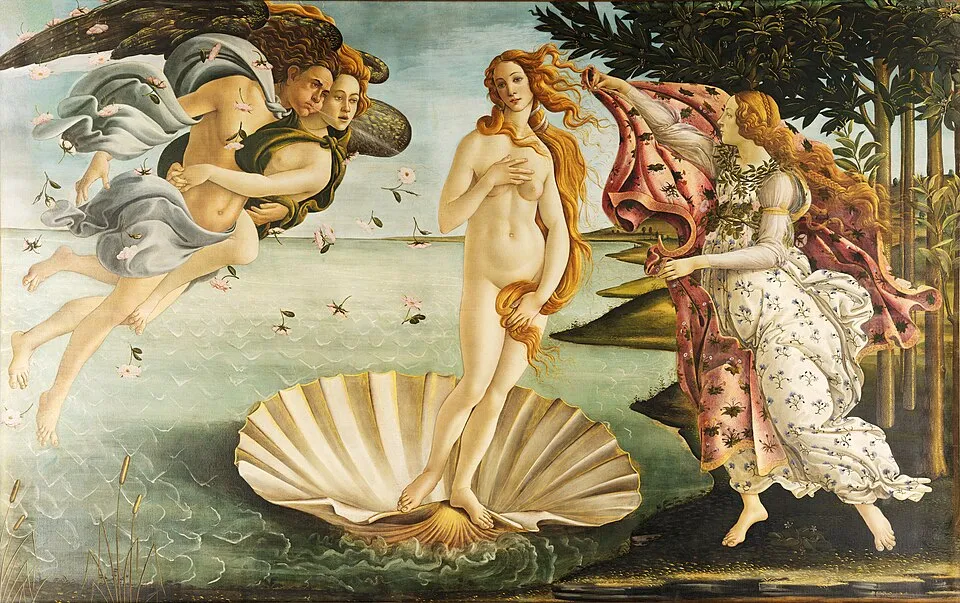
Sandro Botticelli, "The Birth of Venus" (c. 1484–1486), tempera on canvas, 172.5 × 278.9 cm. Uffizi Gallery, Florence. Commissioned for the Medici family, this painting drew directly on classical mythology. Image: Public domain, via Wikimedia Commons
The High Renaissance: Leonardo, Michelangelo, Raphael
The roughly forty years between 1490 and 1530, the period art historians call the High Renaissance, produced a concentration of achievement that has no parallel in the history of art. The reason is partly historical accident, partly the extraordinary richness of the patronage environment, and partly the fact that several artists of exceptional ability were working at the same time in the same relatively small geographic area, seeing and responding to each other's work.
Leonardo da Vinci (1452–1519)
Leonardo's most significant technical contribution to painting is sfumato, a method of blending tonal transitions so gradually that no hard edges remain. He achieved this by applying dozens of thin glazes of oil paint over an underpainting, building tone and color in layers so thin they are sometimes only a few micrometers thick. The Louvre's technical analysis of the Mona Lisa, published in research conducted by the Centre de recherche et de restauration des musées de France, found as many as thirty distinct layers of paint in some areas. The result is the atmospheric depth and the ambiguity of expression that makes the portrait so resistant to simple reading.
"The Last Supper" (1495–1498) in Milan shows Leonardo at his most compositionally ambitious. Each of the twelve apostles reacts to Christ's announcement that one will betray him, and Leonardo organized their responses into groups of three, with each group expressing a different psychological state: shock, denial, fear, anger. The figure of Judas leans back from the light, the only apostle whose face is partly in shadow. The whole scene is locked into a precise perspective system that places the vanishing point directly behind Christ's head.
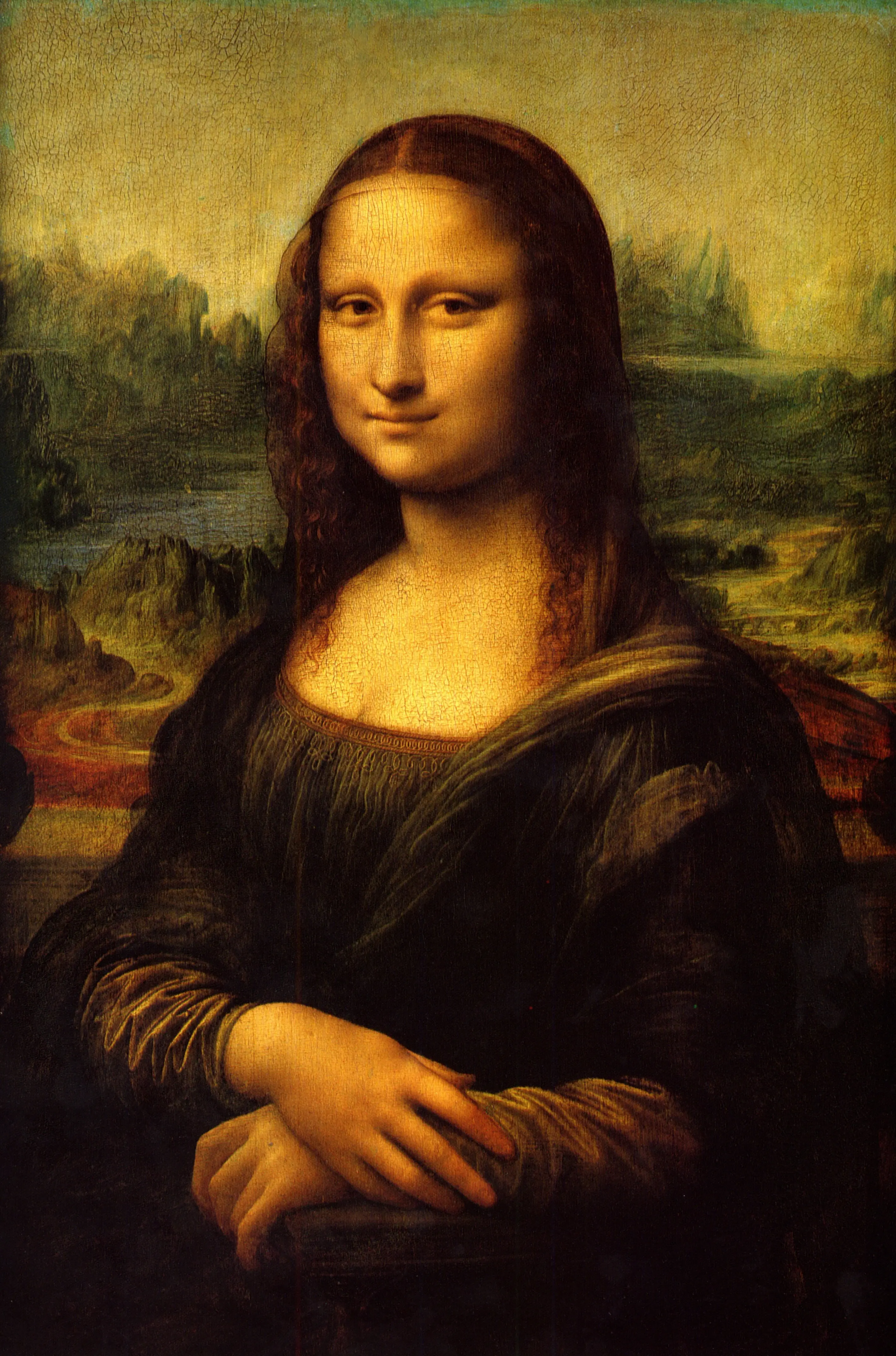
Leonardo da Vinci, "Mona Lisa" (c. 1503–1519), oil on poplar panel, 77 × 53 cm. Musée du Louvre, Paris. Technical analysis has identified up to thirty distinct paint layers in some areas, producing the painting's unmatched atmospheric depth. Image: Public domain, via Wikimedia Commons
Michelangelo Buonarroti (1475–1564)
Michelangelo thought of himself as a sculptor first and regarded painting as a lesser art. He accepted the Sistine Chapel ceiling commission reluctantly, having been essentially coerced by Pope Julius II, and he executed it almost entirely alone, lying on scaffolding over four years between 1508 and 1512. The ceiling contains over 300 figures, each one a study in the expressive possibilities of the human body in motion. The famous "Creation of Adam" is often reduced to the image of two hands almost touching, but that reading misses the compositional intelligence: God is surrounded by attendant figures gathered inside a shape that some scholars have identified as an anatomically accurate cross-section of the human brain, which would be consistent with Michelangelo's documented interest in anatomy.
His "David" (1501–1504) in the Galleria dell'Accademia is 5.17 meters tall and was carved from a single block of Carrara marble that had been quarried decades earlier and left abandoned because its proportions were awkward. Michelangelo used those awkward proportions deliberately: the figure's hands and head are slightly oversized, calibrated to look correct when viewed from below at street level in the position the statue was originally intended to occupy. Standing in the Accademia at floor level, the figure does not look distorted. The distortion is invisible because it was engineered to compensate for the viewing angle.
Raphael Sanzio (1483–1520)
Raphael died at 37, which makes the volume and quality of his surviving work difficult to account for. He absorbed what Leonardo and Michelangelo were doing with a speed that suggests unusually rapid processing of visual information, and he synthesized their innovations into a style of greater compositional clarity and emotional accessibility than either of his models.
"The School of Athens" (1509–1511) in the Vatican Stanze is the most complete demonstration of everything Renaissance painting had achieved. Fifty or more figures of Greek and Roman philosophers populate a magnificent barrel-vaulted hall whose architecture is rendered in perfect one-point perspective. Plato, bearing Leonardo's face, gestures upward. Aristotle gestures level, toward the earth. The figures are organized so that the eye moves continuously through the composition without ever getting stuck. It is, technically, a near-perfect painting, and it is still teaching painters things about compositional organization five centuries after it was made.
The Northern Renaissance
Italy did not have a monopoly on the Renaissance. Northern Europe developed parallel innovations that were in many ways more technically demanding, even if their philosophical orientation differed.
Jan van Eyck (c. 1390–1441) in Flanders perfected oil painting several decades before it became standard in Italy. His "Arnolfini Portrait" (1434) contains a level of material specificity that remains astonishing: the individual threads of the bed hangings, the grain of the floorboards, the reflections in the convex mirror on the back wall showing two additional figures including, apparently, van Eyck himself. He achieved this by building up extraordinarily thin, transparent glazes of oil paint over meticulous underdrawing, sometimes working with brushes of just a few hairs. The National Gallery's technical research on the Arnolfini Portrait has documented the complexity of his working method in detail.
Albrecht Dürer (1471–1528) in Nuremberg made two trips to Italy and brought back a deep understanding of Italian perspective theory and figure drawing, which he combined with the Northern tradition's meticulous attention to surface and texture. His woodcuts and engravings achieved tonal complexity that rivaled painting, and his self-portraits, particularly the 1500 panel in Munich where he depicts himself frontally in a Christ-like pose, were among the first Western paintings to treat the artist's own identity as a serious subject. That idea anticipates artists like Frida Kahlo by four centuries.
Why the Renaissance Keeps Mattering
The Renaissance established the categories through which Western art has been understood ever since, even by movements that rejected everything it stood for.
The concept of the artist as a named individual genius, rather than an anonymous craftsperson, is a Renaissance invention. Before the 15th century, most paintings and sculptures in Western Europe were unsigned and their makers largely unrecorded. The Renaissance created Vasari's "Lives of the Artists" (1550), biography as a genre applied to painters and sculptors, the idea that the artist's personality and life history are part of the meaning of the work. Every museum label with an artist's name is a direct descendant of this idea.
The commitment to representing the visible world accurately set a standard that later movements extended, questioned, and eventually dismantled. Impressionism, Expressionism, Cubism, and abstraction are all, in different ways, responses to the Renaissance project of visual realism. You cannot understand why Cézanne matters without understanding what he was pushing against.
Humanism, the belief that human beings are interesting and important and worth representing in detail, is not a small idea. It shaped Western ethics as well as Western aesthetics, and it is embedded in the assumptions we bring to art whether we know it or not.
Final Thoughts
Walking from the medieval rooms into the Renaissance galleries at the Uffizi, you watch a world change. The gold backgrounds disappear. The figures gain weight. Space opens up behind them. It is one of the most compressed demonstrations of intellectual and technical transformation available to direct experience, and it is still happening every day for anyone who chooses to walk through those rooms in sequence.
The Renaissance does not belong only to art history courses. It belongs to anyone who has ever found a painting convincing, been moved by a figure that seemed about to step out of the canvas, or felt that a portrait was looking back at them. Those responses are the product of techniques invented in Florence and Bruges and Rome between roughly 1400 and 1520. They are still working on you.
Ready to see how later artists built on and broke from these foundations? Explore how Impressionism broke academic rules, or learn how to look at art as a beginner. And if you want to understand the sculptural side of the Renaissance in greater depth, the guide to sculpture materials and techniques covers the marble and bronze work of Donatello, Michelangelo, and their successors.


