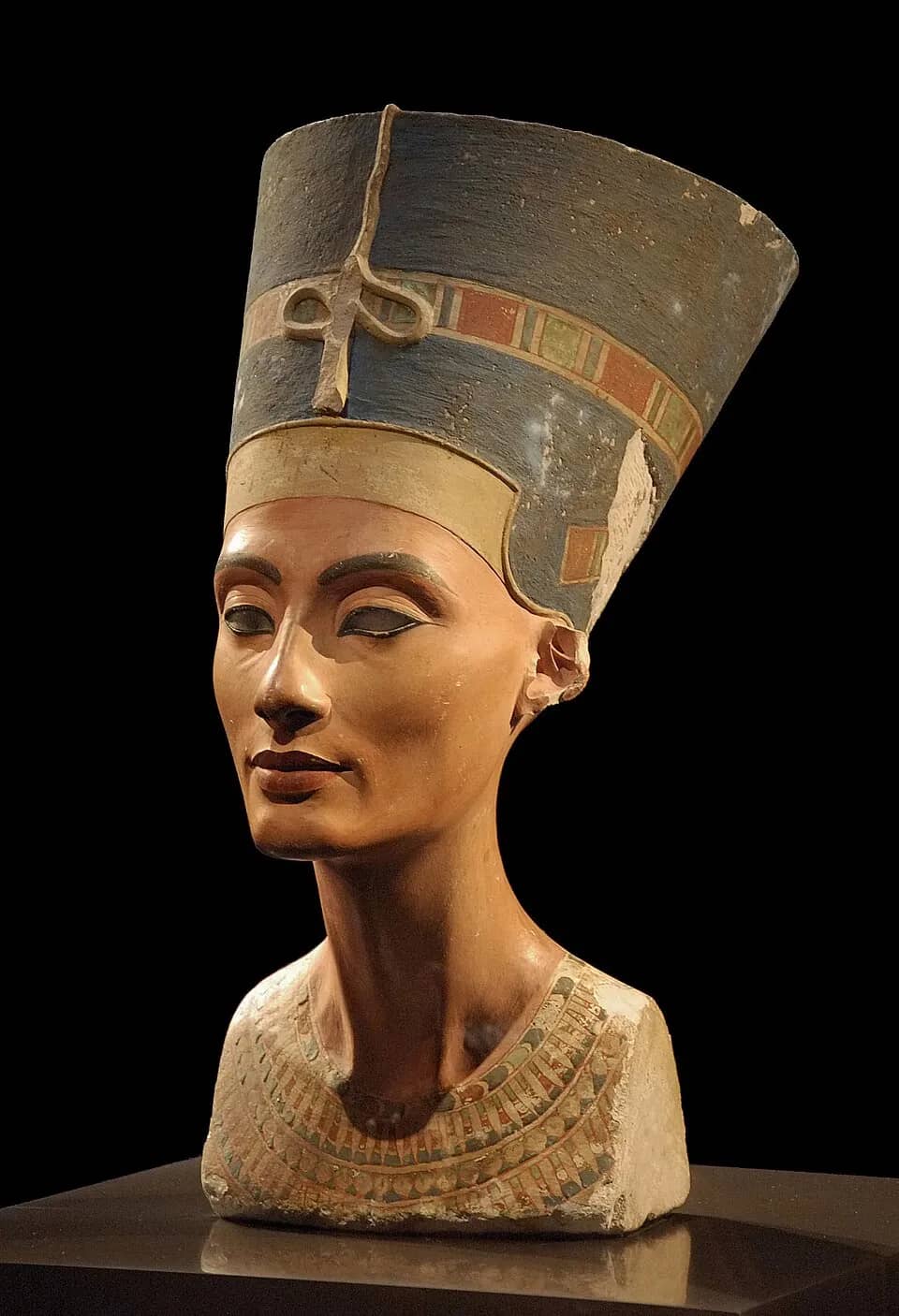
The Nefertiti Bust spent its first two thousand years in a sculptor's workshop in Amarna, Egypt, then sat unrecognized in the storage of an Egyptian merchant for nearly a decade after excavation, then traveled to Germany in 1912 wrapped in cloth by the archaeologist Ludwig Borchardt in a way that Egyptian authorities later argued was deliberate concealment. It has been at the Neues Museum in Berlin since 1913. Egypt has been requesting its return, formally and persistently, for over a century. Germany has declined each time.
The bust itself is 48 centimeters tall, made of limestone covered in painted stucco, with an inlaid crystal eye on the right and a blank socket on the left. The blue crown is painted with a precision that has not faded in 3,300 years. The sculptor's name was Thutmose, and we know this because his studio was found intact during excavation, with the bust still inside it alongside other unfinished works. It was, apparently, a master model used to train apprentices in the correct proportions of the queen's face.
Understanding what conventions governed that face, and why those same conventions persisted across three thousand years of Egyptian art, is one of the most useful things you can do before visiting any museum with an Egyptian collection. This guide covers the canon of proportions, the composite view, tomb painting, sculpture's religious function, the Amarna revolution and its reversal, and how to read what you are actually looking at when you encounter these works.
The Canon: Art as Law
Ancient Egyptian art operated according to a strict set of rules known as the canon of proportions. Every figure was drawn or sculpted according to a grid system that fixed the sizes of each body part relative to the others. The standing human figure was divided into eighteen equal units from the base to the hairline. The seated figure was divided into fifteen. Every artist in every period of Egyptian history used this same grid, which is why a figure painted in 2700 BC and a figure painted in 700 BC are immediately recognizable as belonging to the same tradition despite a 2,000-year gap between them.
This was not a limitation imposed on unwilling artists. It was built into the system because Egyptian art served specific religious, political, and cosmic functions, and deviation from established convention was not creativity but error. Egyptian art was not meant to express an individual artist's vision. It was meant to perform tasks: to house the soul of the deceased in a tomb painting, to display the power and divinity of the pharaoh in a temple relief, to provide eternal offerings to the gods. For art to perform these tasks correctly, it had to follow the prescribed rules. An incorrectly proportioned figure would fail in its function just as surely as an incorrectly inscribed ritual formula.
The Principle of Conceptual Representation
The most immediately distinctive feature of Egyptian figural art is what art historians call conceptual representation or the "composite view." Egyptian painters and relief sculptors did not draw figures as they appear from a single viewpoint. Instead, they drew each part of the figure from the angle at which it is most clearly visible and most completely identifiable.
The head is shown in profile, because the profile shows the most characteristic outline of a human face. The eye, however, is shown full-face, because the eye in profile is ambiguous (is the person looking toward or away?). The shoulders are shown from the front, because the frontal torso shows the broadest and most powerful view of the upper body. The hips and legs are shown in profile again, because movement and walking are clearest in profile. The feet are both shown from the inside, so that both have proper arches and toes.
To a viewer trained in Western naturalism, this looks like anatomical error. The figures seem to have their torsos twisted in impossible positions. But look at Egyptian figures long enough and you realize this is not error but system. Every part of the body is shown in its most legible and dignified form. The figure is not observed from a single viewpoint but assembled from multiple correct views. It is a picture of what a person is rather than what a person looks like from one position at one moment.
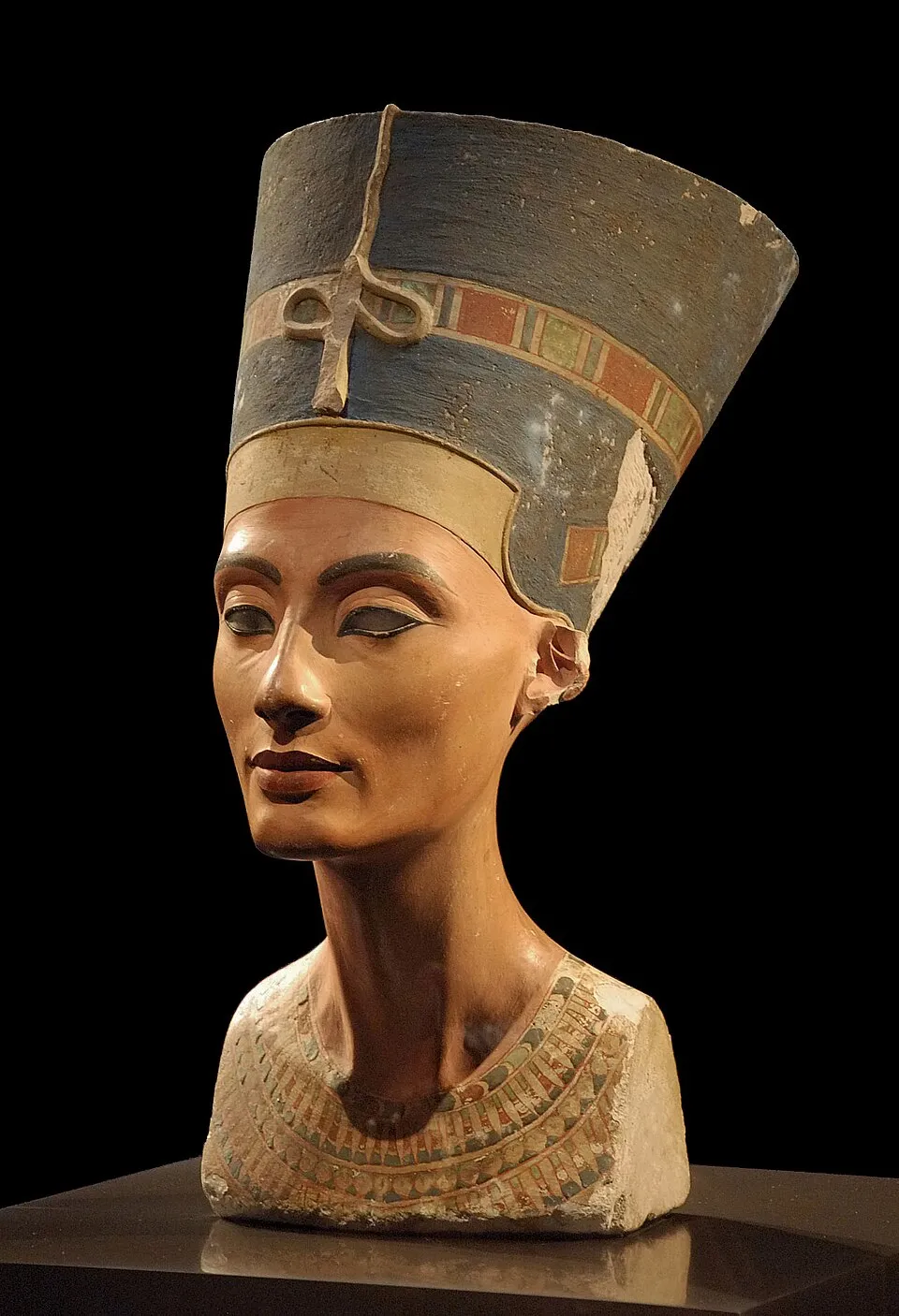
The Nefertiti Bust (c. 1345 BC), painted limestone with crystal and wax eye inlay, 48 cm tall. Attributed to the sculptor Thutmose, found at Amarna, Egypt. Neues Museum, Berlin. One of the most reproduced portraits from the ancient world, and the subject of ongoing repatriation negotiations between Germany and Egypt. Image: Public domain, via Wikimedia Commons
Tomb Painting: Art for Eternity
The most significant context for Egyptian pictorial art is the tomb. Egyptian religion held that the preservation of the physical body after death, and the provision of images and objects in the tomb, were essential to the deceased's eternal survival. A painted figure in a tomb was not a decoration or memorial. It was a functional object: if the physical body was destroyed, the soul (the ka) could take up residence in the painted image instead. This is why tomb paintings show the deceased engaged in feasting, hunting, farming, sailing, and receiving gifts, not because these things happened exactly this way, but because they need to continue happening forever, and the painted image makes that permanence possible.
The quality of painting and the accuracy of depiction directly affected the magical function. A poorly painted offering table was a poorly functioning one. This is why tomb workshops employed the best artists available and why the painting in major New Kingdom tombs is of extraordinary quality. The Tomb of Nakht in Luxor (c. 1400 BC) shows agricultural scenes with a freshness and movement that is remarkable within the conventional framework: geese grazing by the Nile, harvested grain being winnowed in the breeze, a musician playing the double flute. The color is still vivid after 3,400 years. The observation of natural detail within the strict conventional system is consistently surprising to modern visitors who expect rigid formula to produce rigid results. It does not.
Sculpture: The Eternal Body
Egyptian sculpture served primarily as a container for the soul rather than as representation for its own sake. Tomb statues were idealized rather than individualized: they showed the person at their best, in the prime of health, with the dignified bearing appropriate to their station. Individual portraits, like the Nefertiti Bust, are exceptions rather than the rule, products of the brief and revolutionary Amarna period when Akhenaten imposed a new religion and a new aesthetic that emphasized naturalness and family warmth over hieratic dignity.
The great royal statues, including the colossal seated figures of Ramesses II at Abu Simbel (c. 1264 BC) and the sphinx figures that lined the processional ways of major temples, were instruments of political theology: they displayed the pharaoh as a divine being whose presence alone sanctified the space around him. The seated pose, with hands on knees and the left foot slightly advanced, is one of the most persistent conventions in Egyptian sculpture, used from the Old Kingdom through the Late Period with only minor variations.
The Amarna Revolution and Its Reversal
The reign of the pharaoh Akhenaten (c. 1353 to 1336 BC) produced one of the most dramatic departures from Egyptian artistic convention in recorded history. Akhenaten imposed the worship of the Aten, the solar disk, as the sole divinity, closed the temples of other gods, and moved his court to a new city, Akhetaten, built from scratch in the desert. The art produced during his reign is strikingly different from anything before or after: figures are shown with elongated skulls, exaggerated lips, swelling hips, and a soft, boneless quality completely at odds with the dignified stiffness of traditional Egyptian royal imagery.
Whether the Amarna style reflects an actual physical condition, a religious ideology emphasizing the fertility and life-giving power of the sun, or a deliberately distinctive royal aesthetic remains debated among Egyptologists. A 2025 study in the Cambridge Archaeological Journal reviewed the pathology and artistic convention hypotheses and found no conclusive physical evidence for a medical condition in Akhenaten, pointing instead to deliberate ideological construction of a new royal identity. What is clear is that after Akhenaten's death, his successors systematically dismantled his religious reforms and largely erased his name from monuments. The Amarna style disappeared within a generation, demonstrating how thoroughly Egyptian art was an instrument of official ideology rather than individual expression.
The golden mask of Tutankhamun (c. 1323 BC), now at the Grand Egyptian Museum in Giza, represents the return to traditional forms executed with extraordinary technical refinement. Made of solid gold inlaid with lapis lazuli, carnelian, turquoise, and obsidian, with a striped nemes headdress and the crossed crook and flail of royal authority, it was found by Howard Carter in 1922 in the only substantially intact royal tomb ever discovered in the Valley of the Kings. The Grand Egyptian Museum, which opened fully in 2024 after a phased opening, now displays Tutankhamun's complete burial assemblage together for the first time since Carter excavated it, giving visitors the ability to see the full sequence of objects that surrounded the young king's mummy.
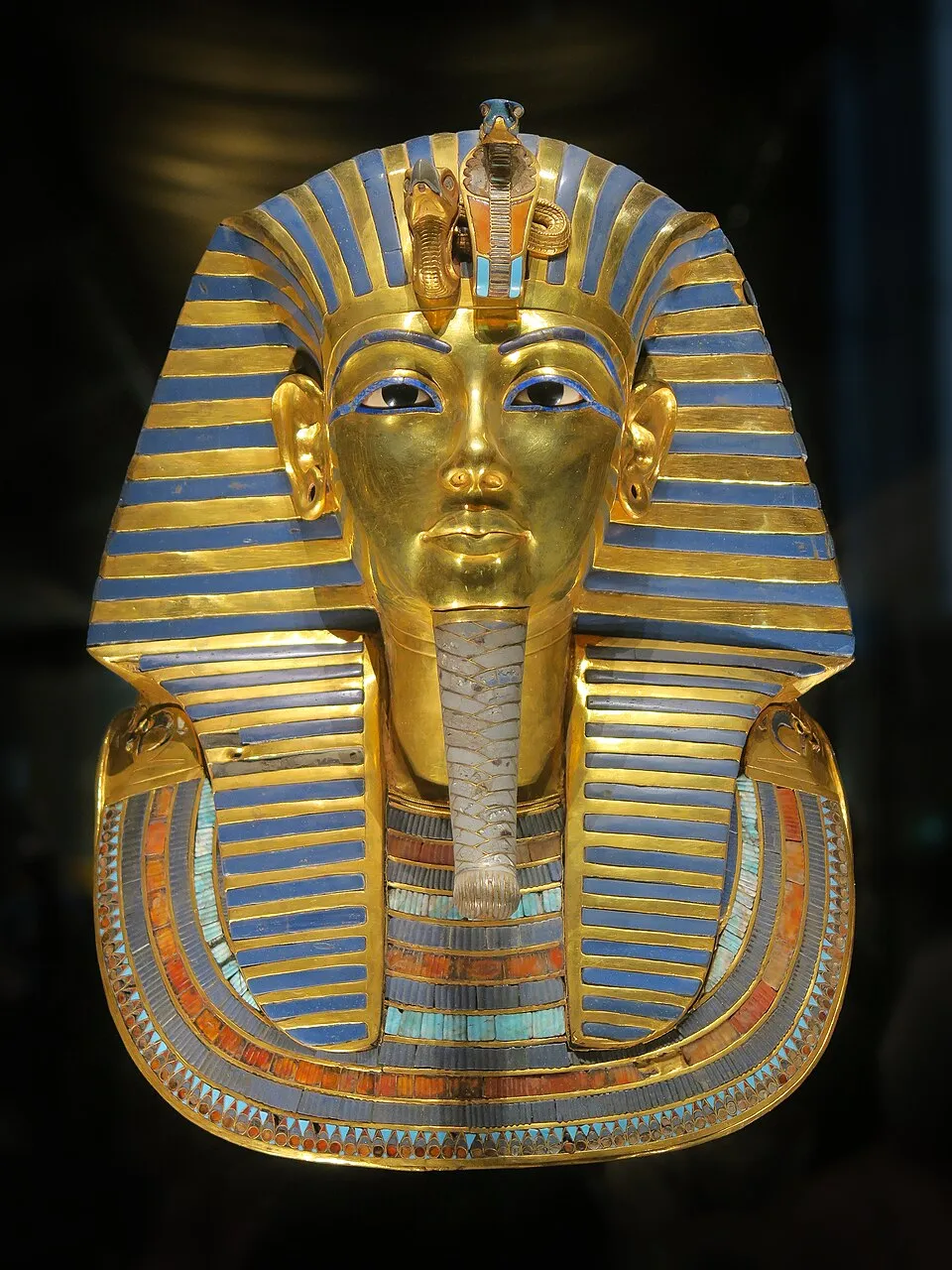
The golden death mask of Tutankhamun (c. 1323 BC), gold, lapis lazuli, carnelian, turquoise, and obsidian, 54 cm tall. Egyptian Museum, Cairo. The mask was designed to house the soul of the young pharaoh and ensure his identity in the afterlife. Found by Howard Carter in 1922 in the Valley of the Kings, Luxor. Image: Public domain, via Wikimedia Commons
How to Read Egyptian Art
Several practical approaches will help you engage more deeply with Egyptian art when you encounter it in a museum.
Read the scale hierarchy. In Egyptian composition, the most important figures are the largest. A pharaoh will be shown much larger than his attendants, who are larger than ordinary people. This size hierarchy is not failed perspective. It is social and cosmic order made visible.
Identify the registers. Egyptian wall paintings and reliefs are organized in horizontal bands called registers. Each register is a separate narrative or scene, read from left to right and from bottom to top. The arrangement communicates spatial depth, with lower registers representing what is nearer, without using Western perspective conventions.
Look for the cartouche. Royal names in hieroglyphs are enclosed in an oval frame called a cartouche. Finding the cartouche in a relief tells you which pharaoh or queen is depicted. In heavily vandalized monuments, where Akhenaten's successors removed his face and name, the missing cartouche is itself evidence of a historical event.
Engage with the composite view without fighting it. When you see a figure with a frontal eye on a profile head, resist the impulse to see it as error. Ask instead what information is being maximized by this combination of views. Each part is showing you the most complete version of itself. Together they give you more information than any single viewpoint could.
The Egyptian collection at the Metropolitan Museum of Art in New York is one of the finest outside Egypt, with outstanding examples from every major period including the reconstructed Temple of Dendur. The British Museum's Egyptian galleries hold the Rosetta Stone, which unlocked the hieroglyphic writing system in 1822, alongside major sculpture and papyri. The Grand Egyptian Museum in Giza, which opened fully in 2024, holds the complete Tutankhamun assemblage and is the largest archaeological museum in the world. For deeper context on how visual systems encode meaning differently across cultures, the guides to Byzantine art and Chinese landscape painting show how other traditions developed their own complete visual logics. What aspect of ancient Egyptian art would you most like to explore in depth? Leave a comment below.


