
In April 2025, the National Gallery of Victoria in Melbourne closed its Yayoi Kusama exhibition after selling 570,537 tickets. It was the highest attendance record for a visual art exhibition in Australian history, breaking the NGV's own record previously held by a Van Gogh show. The exhibition featured 200 artworks spanning almost nine decades of Kusama's career, from drawings she made as a nine-year-old to an Infinity Mirror Room created the previous year. Ten Infinity Rooms were on display, the most ever gathered in one place. The street trees outside the gallery were wrapped in pink and white polka dots.
That exhibition was not an isolated event. It was the first stop in a major international retrospective jointly organized by the Fondation Beyeler in Basel, the Museum Ludwig in Cologne, and the Stedelijk Museum in Amsterdam. The Beyeler presentation ran from October 2025 to January 2026, drawing over 300 works from across Europe and Asia. The Museum Ludwig in Cologne opened its version in March 2026 with more than 300 works and a newly commissioned Infinity Mirror Room, spreading beyond the museum's exhibition spaces onto the roof of the building, where painted bronze flowers appeared at the foot of Cologne Cathedral. The exhibition runs through August 2026. You can read more about it at the David Zwirner exhibition page.
Kusama is 96 years old. She has lived voluntarily in a psychiatric hospital in Tokyo since 1977, walking to her studio across the street every morning to work. She has produced paintings, sculptures, installations, films, novels, poetry, and fashion across a career spanning seven decades. She was a pioneering figure in Pop Art, Minimalism, and feminist art, often years ahead of male peers who received more credit. Her Infinity Mirror Rooms have made her the most popular living artist on the planet. But the Instagram-friendly spectacle of those rooms is only one part of a much larger and stranger story.
Early Life and the Origins of Obsession
Yayoi Kusama was born on March 22, 1929, in Matsumoto, a city in the mountainous Nagano prefecture of Japan. Her family ran a prosperous plant nursery and seed farm, and as a child she spent long hours among the flowers and fields that would later populate her art. Her childhood was not idyllic. Her parents' marriage was unhappy. Her father was frequently unfaithful, and her mother, embittered by his behavior, was often abusive toward young Yayoi. Her mother tore up her drawings.
More significantly, Kusama began experiencing vivid hallucinations as a young child. She described seeing fields of flowers that spoke to her, patterns of dots that spread across every surface and threatened to engulf her, and nets that expanded infinitely until they consumed the entire visual field. These visions became the foundation of her art. "One day I was looking at the red flower patterns of the tablecloth on a table," she later recalled, "and when I looked up I saw the same pattern covering the ceiling, the windows, and the walls, and finally all over the room, my body, and the universe."
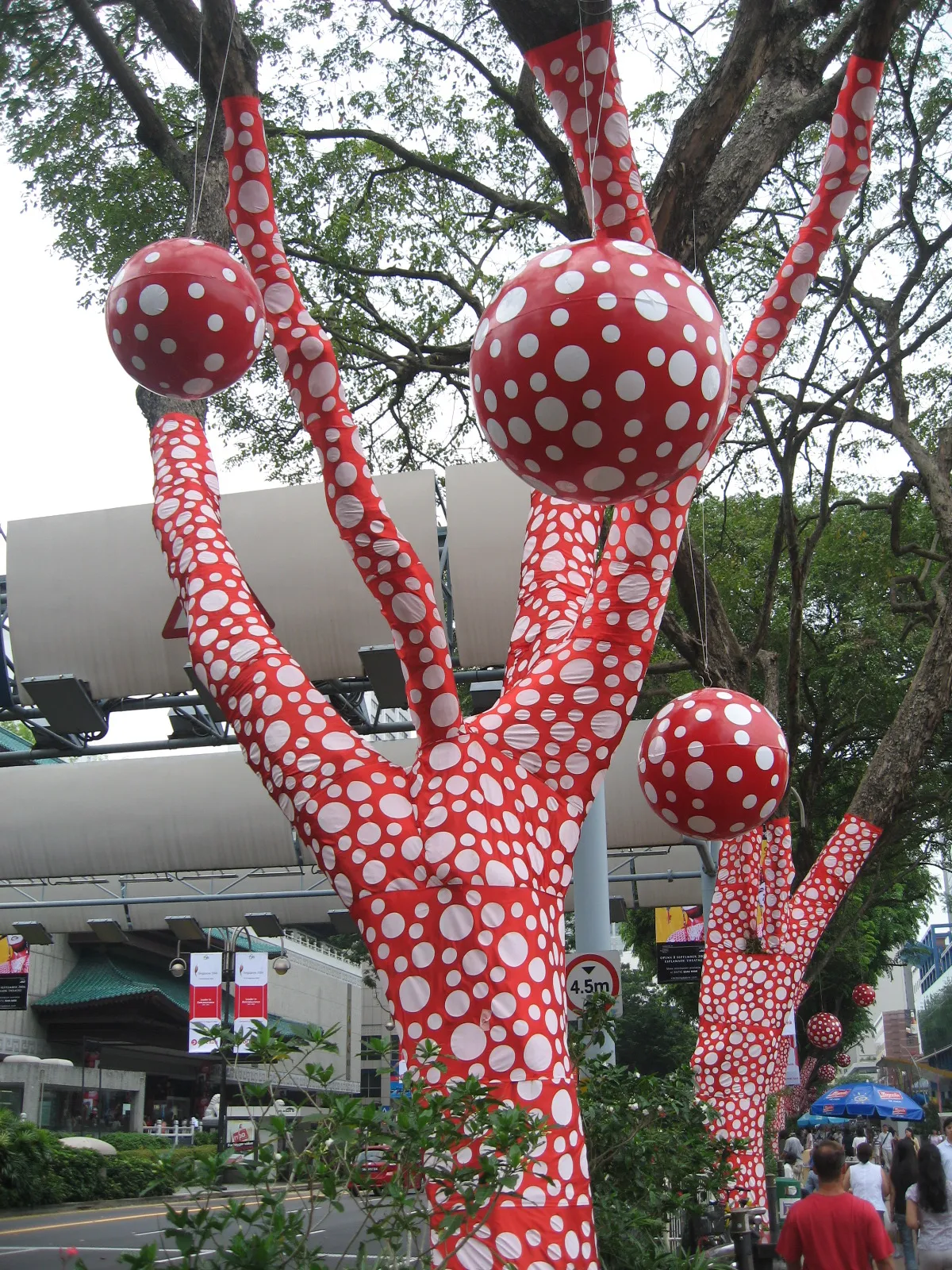
Yayoi Kusama, "Ascension of Polka Dots on the Trees" (2006), installation at the Singapore Biennale. Kusama's signature polka dots transform the natural environment, blurring the boundary between art and reality. Photo by Siyang Ng. Image: CC BY-SA 3.0, via Wikimedia Commons
Despite her family's opposition, Kusama studied traditional Japanese painting (Nihonga) at the Kyoto Municipal School of Arts and Crafts. She found the conservative art scene in Japan stifling and set her sights on the only place that seemed big enough for her ambitions: New York City.
The New York Years (1958-1973)
Kusama arrived in New York in 1958 with little money but enormous determination. She quickly immersed herself in the city's avant-garde art scene, befriending artists like Donald Judd (who became her romantic partner), Joseph Cornell, and Andy Warhol. The work she produced in New York during the 1960s was years ahead of its time.
Infinity Net Paintings
Her first major works in New York were the Infinity Net paintings: enormous canvases covered in thousands of tiny, hand-painted loops or arcs that extended to every edge with no focal point and no composition in the traditional sense. These monochrome paintings, some over thirty feet long, anticipated Minimalism by several years. They were directly inspired by her hallucinations, the infinite nets she saw spreading across her visual field, and the obsessive, repetitive process of painting them was itself a form of psychological self-treatment. The Museum Ludwig retrospective in 2026 traced this evolution from her earliest drawing (c. 1934, made when she was five) through to the most recent Infinity Net canvases, showing how consistent her visual language has remained across nearly a century of work.
Accumulation Sculptures and Soft Sculpture
By the early 1960s, Kusama began creating Accumulation sculptures: furniture and objects covered in hundreds of stuffed fabric protrusions that resemble phalluses. An armchair bristling with soft white tubes, a rowing boat overflowing with them, a pair of shoes sprouting them. These unsettling works addressed sexuality, obsession, and the erasure of the individual object under a mass of repetitive forms. They were among the earliest examples of soft sculpture, predating Claes Oldenburg's more famous soft objects. The Museum Ludwig exhibition in 2026 included her first-ever installation, "Aggregation: One Thousand Boats Show" (1963), which had not been displayed in decades.
Infinity Mirror Rooms
In 1965, Kusama created her first Infinity Mirror Room, "Phalli's Field," a room lined with mirrors and filled with hundreds of her stuffed fabric protrusions, creating an infinite multiplication of forms that overwhelmed the viewer's sense of space and self. This was the beginning of the immersive environments that would eventually make her world-famous. The mirrors transformed a finite room into a seemingly infinite space, externalizing Kusama's hallucinatory experience of boundless pattern and self-dissolution. The Beyeler retrospective in 2025 featured two new Infinity Rooms created specifically for the show: "Infinity Mirrored Room - Illusion Inside the Heart" (2025) and "Infinity Mirrored Room - The Hope of the Polka Dots Buried in Infinity Will Eternally Cover the Universe" (2025). She has now made more than 20 unique Infinity Rooms over six decades.
Happenings and Body Festivals
In the late 1960s, Kusama organized public "happenings," performance events where she painted polka dots on naked participants' bodies in public spaces, including Central Park and the Brooklyn Bridge. These events were equal parts art, protest, and spectacle. They challenged social norms around nudity, critiqued the Vietnam War, and expressed Kusama's philosophy of "self-obliteration," the dissolution of the individual ego into the infinite pattern of the cosmos. More on the performance art tradition she helped pioneer can be found in our guide to performance art and Marina Abramovic.
Return to Japan and Reinvention
Kusama returned to Japan in 1973, physically and emotionally exhausted. One of her closest friends, Joseph Cornell, had died. In 1977, she voluntarily admitted herself to the Seiwa Hospital for the Mentally Ill in Tokyo, where she has lived ever since. Far from retiring, she established a studio near the hospital and began one of the most productive phases of her career.
Throughout the 1980s and 1990s, Kusama produced large-scale paintings, sculptures, and environmental installations while also writing surrealist novels and poetry. Her reputation, which had faded in the 1970s, was revived by a major retrospective at the Center for International Contemporary Arts in New York in 1989 and her representation of Japan at the Venice Biennale in 1993, where her mirror room "Mirror Room (Pumpkin)" drew enormous attention. Her first institutional retrospective in Japan had been at the Kitakyushu Municipal Museum of Art in 1987.
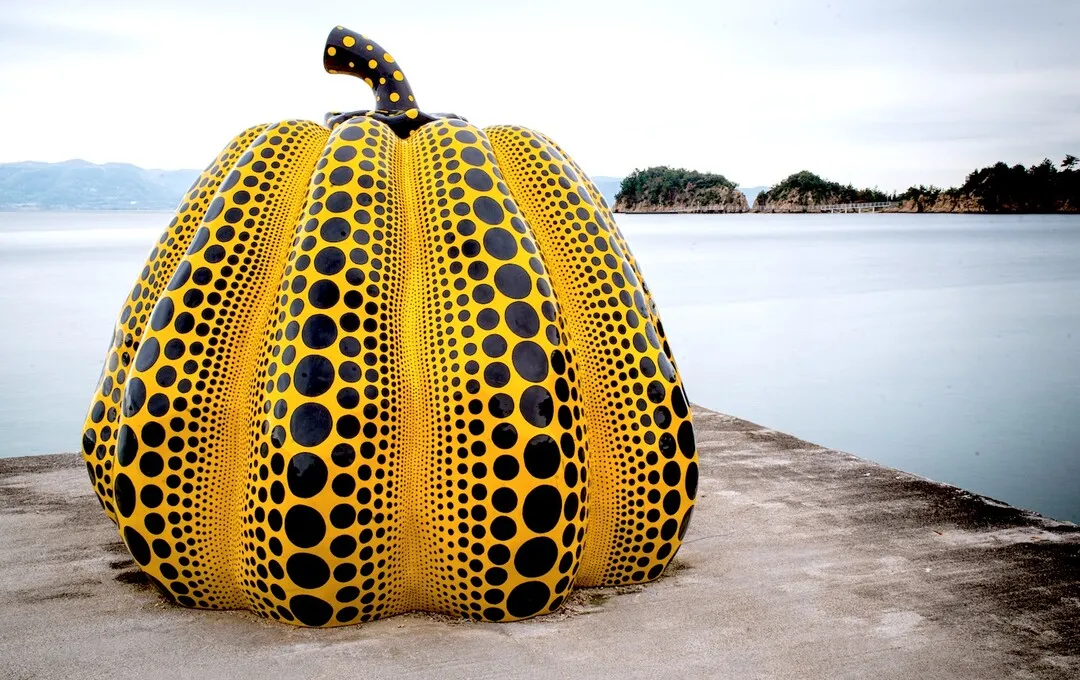
Yayoi Kusama, yellow pumpkin sculpture on Naoshima island, Japan. The pumpkin is one of Kusama's most beloved motifs, representing both humility and cosmic wonder. Image: via Sayart.net
Key Themes in Kusama's Art
Infinity and Self-Obliteration
The central concept in Kusama's work is the dissolution of boundaries between self and other, object and environment, finite and infinite. Her polka dots, nets, and mirror rooms all serve this theme. "A polka dot has the form of the sun, which is a symbol of the energy of the whole world and our living life," she has said, "and also the form of the moon, which is calm. Round, soft, colorful, senseless and unknowing. Polka dots become movement. Polka dots are a way to infinity."
Obsession and Repetition
Kusama's compulsive repetition of dots, nets, and accumulations is both a symptom of her mental condition and a deliberate artistic strategy. The act of painting thousands of identical marks is meditative and therapeutic. It quiets the hallucinations by giving them form. It is also conceptually powerful: through infinite repetition, individual marks lose their identity and merge into a larger pattern, just as individual humans dissolve into the vastness of the universe. The curators of the 2025-2026 retrospective wrote that Kusama's practice reveals "a profound interconnectedness between the self and the cosmos, the microcosm and the macrocosm."
The Cosmic and the Personal
Kusama's work oscillates between the intimate and the cosmic. A polka dot is a simple, childlike form. An Infinity Room evokes the endless expanse of space. Her pumpkins are humble vegetables that she transforms into objects of wonder. This tension between the ordinary and the transcendent gives her art its emotional power and wide appeal. For more on how artists use repetition and pattern to create emotional impact, see our guide to how art communicates emotion without words.
Why Kusama Matters
Kusama's significance extends across multiple dimensions of art history. She was a pioneer of immersive art. Her Infinity Mirror Rooms, created from the 1960s onward, are precursors to today's immersive art experiences. Every immersive installation, from teamLab's digital environments to Meow Wolf's experiential spaces, owes something to Kusama's vision of art as total environment. Our guide to installation art covers this broader movement.
Her work connects Abstract Expressionism, Pop Art, and Minimalism. She was doing "soft sculpture" before Oldenburg, "accumulations" before Warhol's multiples, and "environments" before the term was widely used. You can explore those movements in our guides to Pop Art and Minimalism.
As a Japanese woman in the male-dominated New York art world of the 1960s, Kusama fought against double marginalization. Her body-painting happenings, which foregrounded the female body on her own terms, were ahead of the feminist art movement by several years. And her openness about her mental illness, and her demonstration that extraordinary creativity can coexist with psychological struggle, has been inspiring for millions. She shows that art can communicate experiences that words cannot capture.
Where to Experience Kusama's Work
Kusama's Infinity Mirror Rooms are in permanent collections at several major museums. The Broad in Los Angeles holds "Infinity Mirrored Room - The Souls of Millions of Light Years Away." The Hirshhorn Museum in Washington, D.C. has multiple Kusama rooms in rotation. The Art Gallery of Ontario in Toronto has "INFINITY MIRRORED ROOM - LET'S SURVIVE FOREVER" on display until October 2026, featuring mirrored spheres suspended from the ceiling and arranged on the floor. The Yayoi Kusama Museum in Tokyo, a dedicated museum near her studio, is open by reservation only.
The major 2025-2026 retrospective traveled from the Fondation Beyeler in Basel (October 2025 to January 2026) to the Museum Ludwig in Cologne (March to August 2026), and will continue to the Stedelijk Museum in Amsterdam later in 2026. If you plan to visit any of these, check our museum visit guide for practical strategies, especially for popular exhibitions with timed entry.
Final Thoughts
Yayoi Kusama has spent over seventy years transforming her private hallucinations into public wonder. Her polka dots, infinity rooms, and pumpkin sculptures have become some of the most recognizable images in contemporary art, not through marketing or provocation, but through the sheer intensity and consistency of her vision. The 570,537 people who bought tickets to see her work in Melbourne, and the hundreds of thousands more who visited the Beyeler and Museum Ludwig retrospectives, are not wrong about what they experienced.
Her popularity with young audiences is sometimes dismissed as superficial, driven by Instagram photo opportunities rather than genuine engagement with the work. But Kusama herself would disagree. She wants people to experience self-obliteration, to feel their individual boundaries dissolve into something larger. If a sixty-second visit to an Infinity Room gives someone even a momentary sense of cosmic connection, her art has done its work.
Want to learn about other artists who challenged convention? Read about Frida Kahlo's self-portraits, or explore how street art redefined where art belongs. You might also be interested in how Kusama connected with the Japanese woodblock tradition in our guide to woodblock printing, where her Mount Fuji print was featured in a major 2025 Tokyo exhibition. The most powerful artists are often those who refuse to stay inside the lines the art world draws for them.


