
New York did not start as an art city. In 1900, Paris was the capital of the art world and New York was a commercial center with a few collectors and no serious art infrastructure. By 1960, New York was the capital. Abstract Expressionism, the first internationally significant American art movement, was a New York movement. Pop Art followed. Minimalism followed. The gallery system moved from 57th Street to SoHo to Chelsea. The museums — MoMA, the Met, the Guggenheim, the Whitney — built collections that rivaled anything in Europe. The art market, centered on New York auction houses, became a global industry. This guide covers how New York became the art capital: the Ashcan School, the Armory Show, Abstract Expressionism, the gallery system, the museums, and what the city's art scene looks like today.
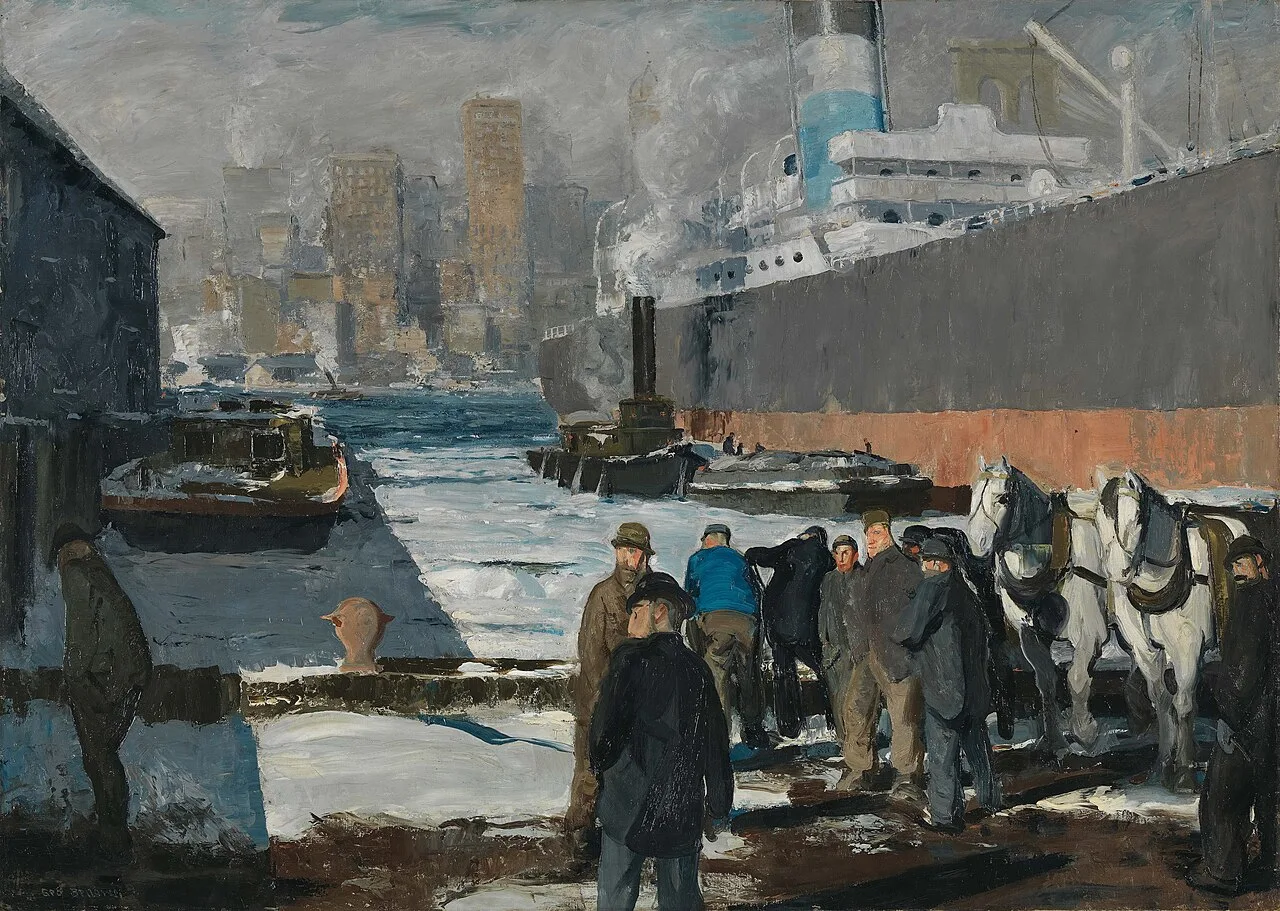
George Bellows, "Men of the Docks" (1912). Oil on canvas, 114.3 x 161.3 cm. National Gallery, London. Bellows painted the Brooklyn waterfront with the Manhattan skyline rising behind a group of day laborers waiting for work. The painting was sold to the National Gallery in London in 2014 for $25.5 million — the first American painting the National Gallery had ever purchased. Bellows was a student of Robert Henri, the unofficial leader of the Ashcan School. Image via Wikimedia Commons.
The Ashcan School and the Armory Show
The first distinctly New York art movement was the Ashcan School, a group of painters active in the first decade of the 20th century who painted the daily life of the city — its streets, its tenements, its docks, its boxing matches. Robert Henri was the leader. His students included George Bellows, Everett Shinn, John Sloan, and George Luks. They were called the Ashcan School because a critic dismissed their subject matter as fit for ash cans. The name stuck, and the painters adopted it.
The Ashcan School was not a formal movement. It was a loose group of artists who shared a commitment to painting the city as it actually was, not as an idealized landscape. They painted immigrants, workers, saloons, and street scenes. This was new. American art before the Ashcan School was mostly landscape (the Hudson River School) or portraiture. The Ashcan School made the city a subject. For more on the broader context of American art, see our guide to Georgia O'Keeffe and American modernism.
The 1913 Armory Show was the event that put New York on the international art map. Organized by the Association of American Painters and Sculptors, the Armory Show brought European modern art to the United States for the first time. It included works by Duchamp, Matisse, Picasso, Braque, and Brancusi. Duchamp's "Nude Descending a Staircase, No. 2" was the sensation — mocked by critics, admired by artists. The Armory Show showed American artists what was happening in Europe and set the terms for American modernism. It also showed that New York could host an exhibition of international significance, something that had previously been possible only in Paris.
Abstract Expressionism and the Shift
World War II changed everything. Paris was occupied. European artists fled to New York. The Surrealists — Breton, Ernst, Masson, Matta — arrived in New York in the early 1940s, and their presence had a direct impact on the younger American artists who would become the Abstract Expressionists. Jackson Pollock, Mark Rothko, Willem de Kooning, Franz Kline, and Barnett Newman were all working in New York in the 1940s. They absorbed the Surrealist interest in the unconscious and in automatic painting, but they pushed it further, into large-scale abstraction.
The key critic was Clement Greenberg, who wrote for Partisan Review and The Nation. Greenberg argued that Abstract Expressionism represented a genuine advance beyond European modernism — that American painting had become more advanced than French painting. This was a bold claim, and it was taken seriously because the work was strong enough to support it. Pollock's drip paintings, made between 1947 and 1950, were unlike anything being made in Europe. For more on the movement, see our guide to Abstract Expressionism.
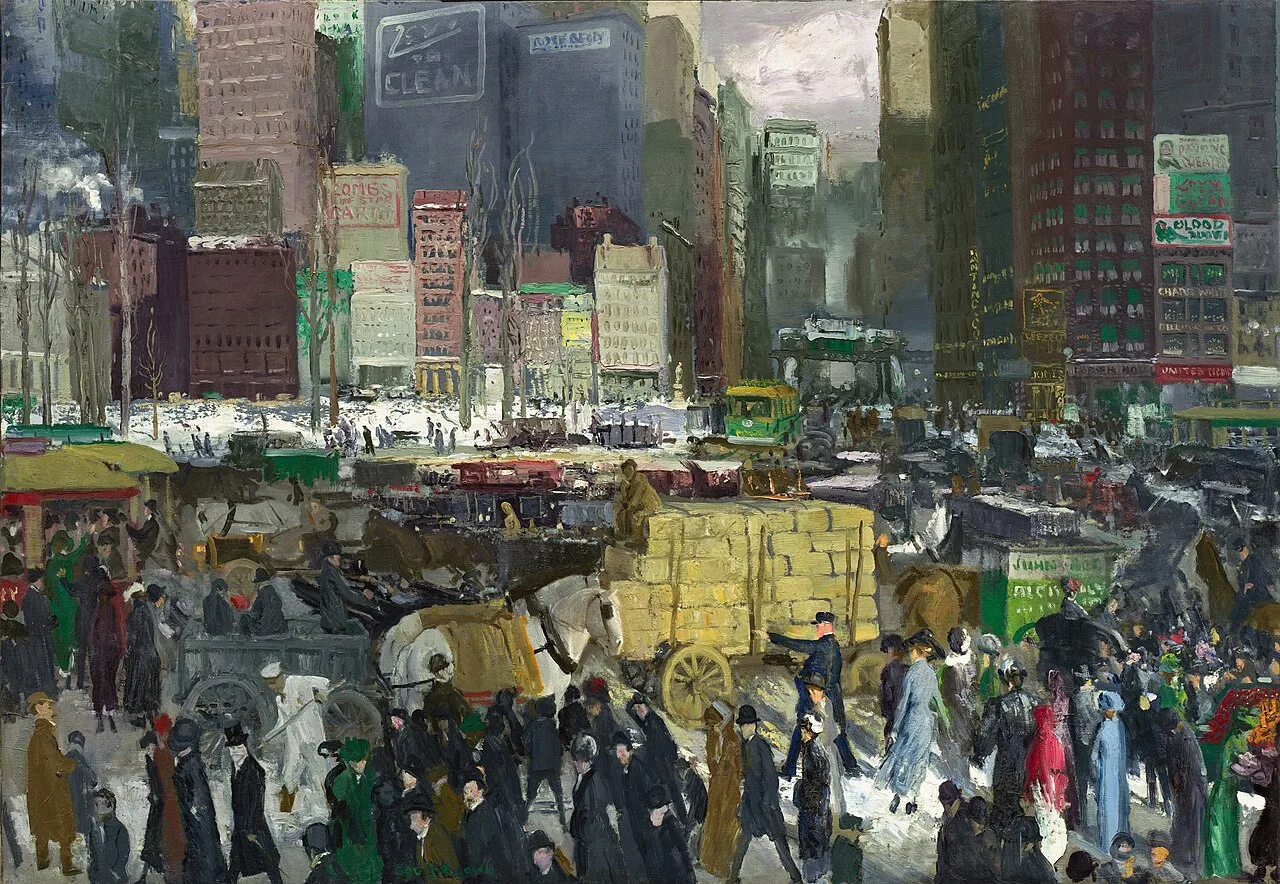
George Bellows, "New York" (1911). Oil on canvas. National Gallery of Art, Washington. Bellows painted the street life of New York with the same directness he brought to his boxing paintings. The canvas shows a busy intersection with pedestrians, horses, and storefronts — the raw material of the city that the Ashcan School made its subject. Image via Wikimedia Commons.
The Gallery System: 57th Street to SoHo to Chelsea
The gallery system in New York developed in three phases. In the 1940s and 1950s, galleries were clustered on 57th Street. Peggy Guggenheim's Art of This Century gallery, which opened in 1942, was the first to show the Abstract Expressionists. Betty Parsons, who took over the gallery after Guggenheim closed it, gave Pollock his first solo show. By the 1950s, galleries like Leo Castelli's were showing Jasper Johns, Robert Rauschenberg, and later Roy Lichtenstein and Andy Warhol.
In the 1970s and 1980s, galleries moved to SoHo, where the large loft spaces of former industrial buildings suited the scale of contemporary art. Castelli moved to Wooster Street. Mary Boone opened on West Broadway. SoHo became the art district. By the 1990s, rising rents pushed galleries out of SoHo and into Chelsea, where former garages and warehouses provided even larger spaces. By the 2000s, Chelsea had more than 300 galleries in a 20-block area. The gallery system in New York is the largest in the world, and it is the mechanism through which most contemporary art reaches the market. For more on how this system works, see our guide to how the art market works.
The Museums
New York's museums are what made it the art capital. The Metropolitan Museum of Art, founded in 1870, is the largest art museum in the Americas, with a collection spanning 5,000 years. The Museum of Modern Art, founded in 1929 by Abby Aldrich Rockefeller, Lillie Bliss, and Mary Quinn Sullivan, was the first museum dedicated to modern art. Its collection of late 19th and 20th century art is the most comprehensive in the world. The Guggenheim, founded in 1939 and housed since 1959 in Frank Lloyd Wright's spiral building, brought European modernism to New York. The Whitney Museum of American Art, founded in 1930, focused on American art and established the Whitney Biennial as the most important survey of contemporary American art.
The density of these institutions is what makes New York different. No other city has four museums of this scale dedicated to art. The Met has the depth. MoMA has the modern. The Guggenheim has the European modernist collection. The Whitney has the American contemporary. Together they form a complete picture of art history, and they attract more visitors than any other group of art museums in the world. For more on how to navigate a major museum, see our guide to how to enjoy a great museum.
The Auction Houses and the Market
New York is also the center of the art market. Christie's and Sotheby's, the two dominant auction houses, both hold their most important sales in New York. The May and November evening sales are the events that set the market. In 2017, Christie's New York sold Leonardo da Vinci's "Salvator Mundi" for $450.3 million — the highest price ever paid for a painting. The secondary market in New York is larger than the primary market in any other city. For more on how auction houses value art, see our guide to auction house valuation.
The art market in New York is not just auctions. It is galleries, private dealers, art advisors, insurance companies, shippers, framers, and conservators. The infrastructure of the art world — the services that make buying, selling, and owning art possible — is concentrated in New York more than in any other city. For more on the economics behind this, see our guide to the economics of the art world.
What New York Looks Like Today
The New York art world is larger and more diverse than it has ever been. The galleries are still in Chelsea, but they have also spread to the Lower East Side, to Brooklyn, and to Queens. The museums are still the Met, MoMA, the Guggenheim, and the Whitney, but they have been joined by smaller institutions like the New Museum, the Studio Museum in Harlem, and MoMA PS1 in Queens. The artist community is spread across Brooklyn — Bushwick, Gowanus, Red Hook — where loft rents are still affordable compared to Manhattan.
New York's position as the art capital is not uncontested. London, Hong Kong, and Basel all compete for market share. Berlin competes for artist community. But no other city has the combination of museums, galleries, auction houses, and artist community that New York has. For a broader look at how the art world is organized today, see our guide on following the art world.
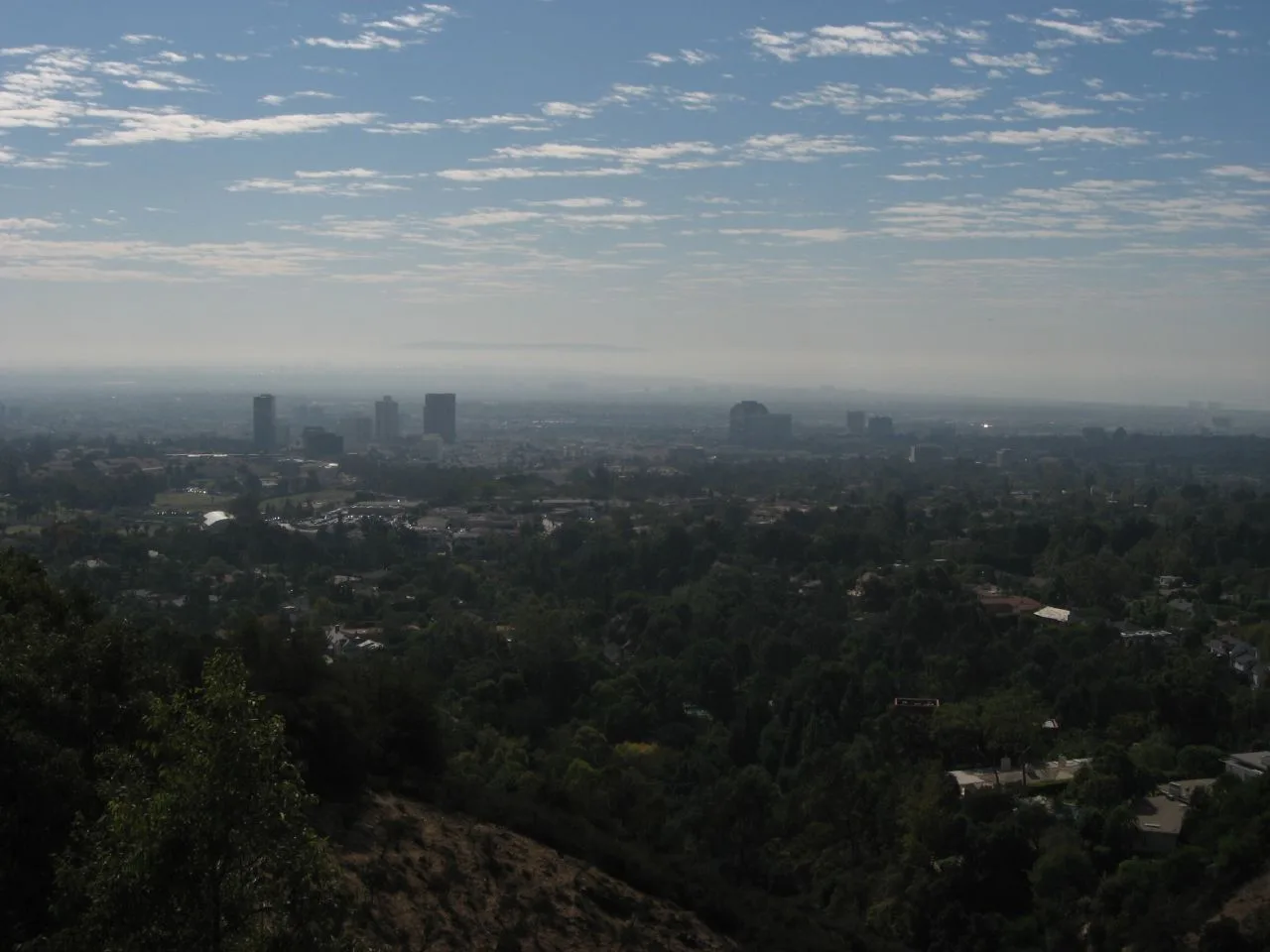
The Getty Center, Los Angeles. The view from the Getty Center, looking south past Santa Monica to the Palos Verdes Peninsula. The Getty Center, designed by Richard Meier and opened in 1997, sits atop a hill in the Santa Monica Mountains — a different kind of art institution from the dense urban museums of New York. Image via Wikimedia Commons.
Final Thoughts
New York became the art capital because it had the money, the museums, and the artists. The Ashcan School made the city a subject. The Armory Show brought European modernism. Abstract Expressionism made American art internationally significant. The galleries built the market. The museums built the audience. The auction houses built the prices. Each piece depended on the others, and together they created the infrastructure that still makes New York the center of the art world.
Start at MoMA for the history of modern art. Go to the Met for everything else. Walk through Chelsea to see the gallery system in action. Go to the Whitney for American contemporary art. Then take the L train to Bushwick to see where the artists actually work. For more on the movements that defined New York's rise, see our guides to Abstract Expressionism and Pop Art. For a wider view, see our guide to art movements from ancient to now.


