Most industries have a reasonably legible structure: manufacturer, distributor, retailer, consumer. The art market does not work like that. It has no standard pricing mechanism, no publicly accessible inventory, and no consistent rules about who pays what to whom. A painting can change hands for $500 at an open studio and for $500,000 at a blue-chip gallery, and both transactions can involve the same artist. Understanding this structure is not optional knowledge for working artists or serious collectors. It is the foundation on which every other art world decision is made.

A Sotheby's pre-auction exhibition at the Hong Kong Convention and Exhibition Centre. Auction houses set the publicly visible price records for artists whose work sells at auction, influencing how galleries price their living artists' new work. Image: CC BY-SA 3.0, via Wikimedia Commons
The global art market returned to growth in 2025, with total sales reaching an estimated $59.6 billion according to the Art Basel and UBS Global Art Market Report 2026. That is a 4 percent increase after two consecutive years of decline following the post-pandemic peak in 2022. The US maintained its position as the leading market at 44 percent of global sales by value. But these headline figures obscure the structure that actually determines how money moves through the system and who receives it. That structure is what this guide explains.
Primary vs. Secondary Market
The most important structural distinction in the art market is between the primary and secondary markets. The primary market is where new work is sold for the first time, typically by a gallery representing the artist. The secondary market is where work is resold after that first sale, either through auction houses, private dealers, or gallerists acting as resellers.
These two markets operate very differently. In the primary market, the gallery and artist agree on a split, the work is priced based on the artist's track record and the gallery's judgment, and the transaction is often private. In the secondary market, supply and demand are more visible since auction results are public, prices fluctuate based on current collector interest, and neither the original artist nor the original gallery typically receives any proceeds unless a resale royalty is legally required.
In the European Union and some other jurisdictions, artists have a statutory right called droit de suite or artist resale right, which entitles them to a percentage of the hammer price when their work is resold through an auction house or dealer. This rate is typically up to 4 percent for lower-value works and declines for higher values. In the United States, no federal resale royalty right exists, though advocacy for one has grown in recent years. For many artists, understanding this distinction has significant long-term financial implications, particularly as their secondary market becomes active.
Galleries: How They Work
The Gallery Commission
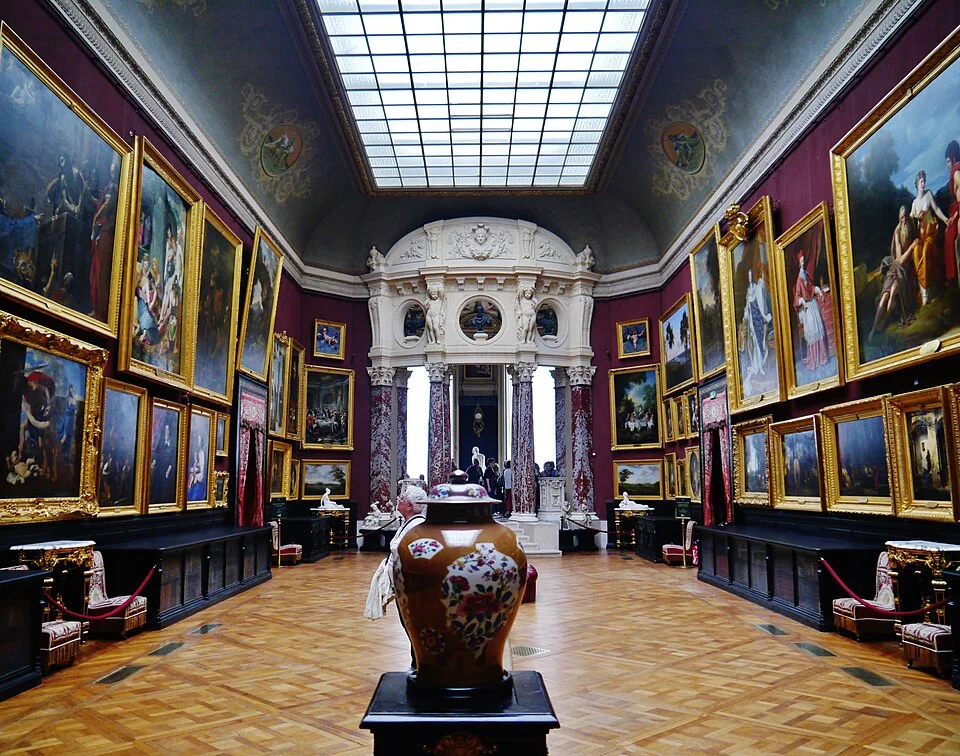
The Picture Gallery of Chantilly Palace, France. The gallery tradition that established the model for how art is displayed, sold, and valued, a tradition that today's commercial galleries extend. Image: CC BY-SA 3.0, via Wikimedia Commons
Commercial galleries are the central institution of the primary art market. They find artists, develop their careers, produce exhibitions, represent work at art fairs, handle sales, and maintain relationships with collectors. In return for these services, they take a commission on every sale, typically between 40 and 50 percent of the retail price.
This commission rate surprises many artists and collectors. It is high for a reason: running a commercial gallery is expensive. Rent in the kinds of districts where galleries operate, full-time staff, art fair booth fees that regularly exceed $50,000 to $100,000 per event at major fairs, shipping, insurance, and production costs all accumulate. Many commercial galleries, even well-known ones, operate on thin margins and are sustained by the financial success of a small number of top-selling artists. The 2026 Art Basel report noted that gallery restructuring was a significant trend in 2025, with a number of mid-tier galleries closing or consolidating as the market adjusted after two years of contraction.
The commission split means that if a gallery prices a painting at $10,000, the artist receives $5,000 before any costs they have absorbed themselves. This is the baseline. Artists whose work sells well often negotiate better splits over time, moving toward 60/40 in their favor. New artists typically accept 50/50 as the standard entry point.
Types of Gallery Representation
Not all gallery relationships are the same. Full representation means the gallery exclusively shows your work, takes you to fairs, and actively develops your collector base. Consignment means the gallery holds your work and takes a commission if it sells, with no deeper commitment. A group show invitation means a single exhibition, typically with no ongoing relationship implied.
Many artists work with multiple non-exclusive galleries in different geographic markets: one gallery in their home city, one in the country's major art capital, and potentially one internationally. Full exclusivity at a single gallery is more common for artists who have reached a level where a single gallery can serve all their markets and where the gallery is investing heavily enough in the artist's career that exclusivity is worth the tradeoff.
What Galleries Actually Do for Artists
Gallery representation is not simply about taking a cut of sales. A good gallery does substantial work that most artists cannot do themselves: identifying and cultivating collectors, placing work in important collections, submitting artists to museum acquisition committees, arranging loans to exhibitions, developing press relationships, and providing the institutional context that signals to the market that an artist's work is serious.
The gallery's network is often more valuable than its selling ability. A well-connected gallery director with strong relationships with museum curators, critics, and major collectors can accelerate an artist's career in ways that no amount of direct artist marketing can achieve. This is why artists with genuine gallery representation continue to value it even as online selling platforms have made direct sales more viable. For a deeper look at this from the gallery side, see our guide to what a gallerist actually does.
Dealers and Private Sales
Not all art sales go through galleries with a physical presence. Private dealers operate without a fixed gallery space, buying and selling work through their collector networks, often specializing in particular artists, periods, or media. Private dealers typically work on a margin basis, buying work at a lower price and reselling it at a higher one, rather than on commission. This means their financial interest is different from a gallery's.
The private dealer market is especially important for the secondary market in established work. A significant portion of transactions in major artists' markets, particularly at the highest price levels, happens through private treaty sales arranged by dealers rather than through auction. These transactions are entirely private and do not appear in public databases, which is one of the reasons the art market remains opaque even to participants within it.
Auction Houses
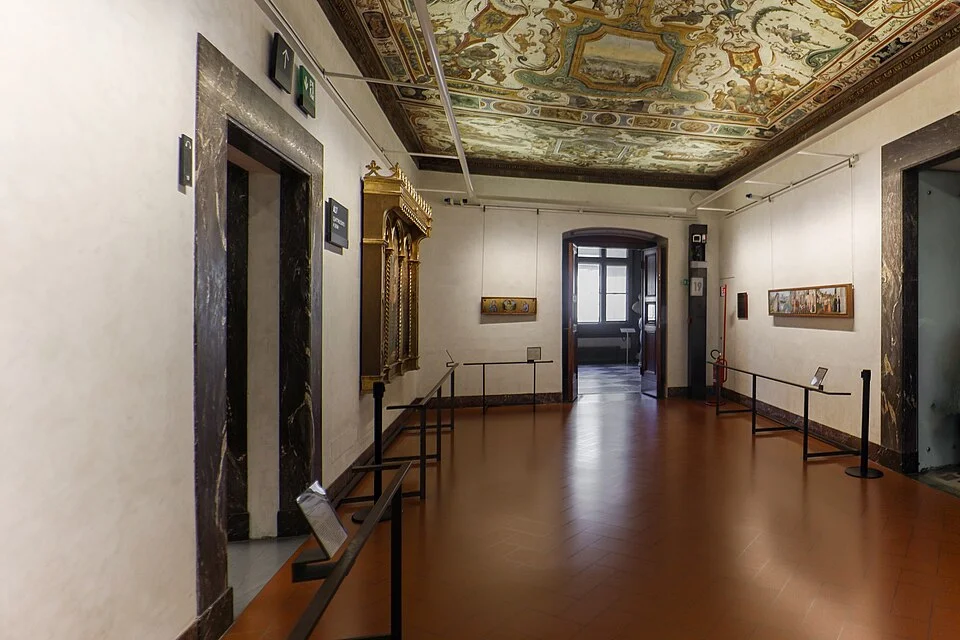
The Uffizi Gallery, Florence, Room A17 (Quattrocento a Siena). The institutional museum context that provides the art historical validation underpinning the market's pricing structure. Image: CC BY 4.0, via Wikimedia Commons
Auction houses operate primarily in the secondary market, though they occasionally handle primary-market sales for estates or in special circumstances. The major houses (Christie's, Sotheby's, Phillips, Bonhams) set the publicly visible price record for artists whose work sells at auction, which influences how galleries price their living artists' new work.
The relationship between the auction market and the gallery market is complicated and sometimes adversarial. When a work by a gallery-represented artist sells at auction for significantly less than the gallery's current retail price, it damages the artist's market. When it sells for significantly more, it creates upward pressure that galleries and artists can leverage. Public auction results remain one of the few genuinely transparent price signals in a market that is otherwise almost entirely opaque.
For a full explanation of how auctions work mechanically, including buyer's premiums, reserve prices, and the difference between estimates and hammer prices, see our guide to understanding art auctions.
Art Advisors
Art advisors work on behalf of collectors, and occasionally institutions, to identify, evaluate, and acquire art. They typically charge either a flat fee, an hourly rate, or a percentage of the purchase price, usually 5 to 15 percent. Unlike dealers, who are trying to sell specific inventory, advisors are theoretically acting in the buyer's interest. In practice, the line between advisor and dealer is sometimes blurry, and conflicts of interest are common in an industry without formal licensing or professional standards.
For collectors at the level where an advisor is relevant, typically spending $50,000 or more annually on art, a good advisor with genuine market knowledge and collector relationships is a significant asset. For collectors below that threshold, the advisor fee is rarely worth the cost. The more useful investment at earlier stages of collecting is education: reading the market, attending degree shows and gallery openings, and developing your own eye before delegating that function to someone else.
Online Platforms and the Changing Market
Since 2015, and dramatically accelerated by the COVID-19 period, online platforms have reshaped parts of the art market. The 2026 Art Basel report found that online art sales remained a significant component of the market in 2025, with dealers reporting that approximately a quarter of their sales were transacted online, down from the pandemic peak but substantially above pre-2020 levels.
Artsy, Saatchi Art, and Artfinder have created an accessible layer of the primary market that bypasses traditional gallery infrastructure for lower-to-mid price points. The online shift has benefited mid-career artists selling work in the $500 to $5,000 range more than it has affected the top of the market, where relationships and physical experience of the work remain primary. It has also created new transparency in pricing: when collectors can easily see an artist's online prices, the traditional gallery practice of different pricing for different collectors becomes harder to sustain.
For artists thinking about how to use online platforms as a sales channel alongside gallery representation, the guides on how to sell art online and how artists price their work cover the practical details of operating in this environment.
Final Thoughts
The art market's opacity is not accidental. It serves the interests of the most powerful participants at every stage: galleries that can maintain different prices for different buyers, auction houses that can manage estimates and reserve prices privately, dealers who profit from information asymmetry. As a working artist or a collector, your best protection against that opacity is knowledge of how the system works.
None of this means the art market is corrupt or that participation in it requires compromising your values. It means it is a market like others, with structures that reward those who understand them and disadvantage those who do not. The artists and collectors who navigate it most successfully are the ones who treat market knowledge as a legitimate part of their practice, not as something separate from the work itself.