
MoMA is the museum that defined modern art as a category. When it opened in 1929 in a rented six-room gallery at 730 Fifth Avenue, it had 40 visitors on its first day. Its first director, Alfred H. Barr Jr., was 27 years old. Barr's vision was radical: he treated modern art not as a fringe phenomenon but as a continuous historical development from Cezanne to the present. His 1936 chart "Cubism and Abstract Art" was a diagram showing how movements influenced each other, from Cezanne through Cubism, Futurism, Constructivism, Dada, and Surrealism to Abstract Expressionism. That chart became the template for how every art history textbook has been organized since.
MoMA moved to its current location at 11 West 53rd Street in 1939. The building has been expanded and rethought so many times, by Philip Johnson (1951, 1964), Cesar Pelli (1984), and Yoshio Taniguchi (2004), that it now fills an entire Midtown block. The 2019 renovation by Diller Scofidio + Renfro added 40% more gallery space and reorganized the collection chronologically across Floors 2, 4, and 5. In 2026, MoMA is hosting the first US retrospective of Marcel Duchamp's work in over 50 years, an event that alone justifies a trip to New York.
This guide covers the Floor 5 highlights (Starry Night, Demoiselles, Campbell's Soup Cans), the Alfred Barr vision, Floor 4 (Abstract Expressionism and Pop), Floor 2 (contemporary), the sculpture garden, the Duchamp retrospective, and practical tips.
Alfred Barr and the Invention of Modern Art History
Alfred H. Barr Jr. (1902-1981) was MoMA's founding director from 1929 to 1943. His approach was encyclopedic. He collected painting, sculpture, architecture, design, film, photography, and prints as equal parts of modern art. This was not how other museums worked. The Metropolitan Museum treated modern art as a minor annex to its historical collections. Barr treated it as a civilization with its own history, and he built the institutional framework to prove it.
The 1936 "Cubism and Abstract Art" chart is still how art history is taught. It shows a flowchart of influences: Cezanne at the top, branching into Cubism and Expressionism, which branch into Futurism, Constructivism, Dada, Surrealism, and eventually Abstract Expressionism. The chart has been criticized for oversimplifying the messy reality of how artists actually influenced each other, but its organizational logic was so clear and so useful that it became the default structure for art history education. Every "movements" chapter in every art textbook owes something to Barr's diagram.
Barr's acquisitions strategy was to buy works early and cheaply. "The Starry Night" was acquired in 1941 for what was then a modest sum. "Les Demoiselles d'Avignon" was donated to the museum in 1939, though Picasso had kept it in his studio for nearly 20 years before letting it go. Barr argued that a museum's job was not to judge quality but to organize and present. This approach made MoMA the arbiter of what counted as "modern art." If MoMA showed it, it was modern art. If MoMA ignored it, it was not. You can read more about this history on MoMA's official history page.
I would argue that MoMA's greatest contribution was not its collection but Barr's framework. The idea that modern art is a coherent historical narrative, not a random accumulation of avant-garde gestures, is what made modern art legible to the public. Without Barr, modern art might have remained a confusing pile of incompatible movements. Barr gave it a story.
Floor 5: The Greatest Hits
Start on Floor 5. This is where the permanent collection from the 1880s through the 1940s lives, and it contains the foundational works of modern art. The 2019 renovation reorganized these galleries chronologically, so walking through Floor 5 is like walking through Barr's chart made physical.
Van Gogh's "The Starry Night" (1889) is in Gallery 501. It is 73.7 x 92.1 cm, smaller than most people expect. Van Gogh painted it at the Saint-Paul-de-Mausole asylum in Saint-Remy, where he had committed himself after the ear-cutting incident. He wrote to his brother Theo: "This morning I saw the countryside from my window a long time before sunrise, with nothing but the morning star, which looked very big." The painting is not a direct observation of the sky. It is a composite of the view from his asylum window and his memory of the Dutch landscape. The swirls of the sky are not how stars look. They are how stars feel when you are in a state of extremity. By 11 AM the room is three deep with tour groups. Go at 10:30 AM when the museum opens.
Picasso's "Les Demoiselles d'Avignon" (1907) is in Gallery 502. It is 243.9 x 233.7 cm, painted when Picasso was 25. It shows five women in a brothel, their bodies angular and distorted, their faces influenced by African and Iberian masks. The painting was so radical that even Picasso's closest friends did not know what to make of it. He kept it hidden in his studio for nearly 20 years. It is traditionally presented as the beginning of Cubism, though it is more accurate to say it is the painting that made Cubism possible by destroying the conventions of Western representation that Cubism then rebuilt in a new form.
Matisse's "Dance" (1909) is in Gallery 508. It was commissioned by Sergei Shchukin for his Moscow mansion. Three versions exist; MoMA has the largest. The figures are flat, simplified, and painted in three colors: red, blue, and green. The painting looks like it was made quickly, but Matisse reworked it extensively. Monet's "Water Lilies" triptych is in Gallery 509. Each panel is roughly 2 meters tall. Monet painted these in his 70s with failing eyesight, and the surfaces are dense with layered paint that dissolves into pure color and light at a distance. For more on Van Gogh's life and work, see our guide on Van Gogh: turbulent brilliance and the myth of the tortured artist.
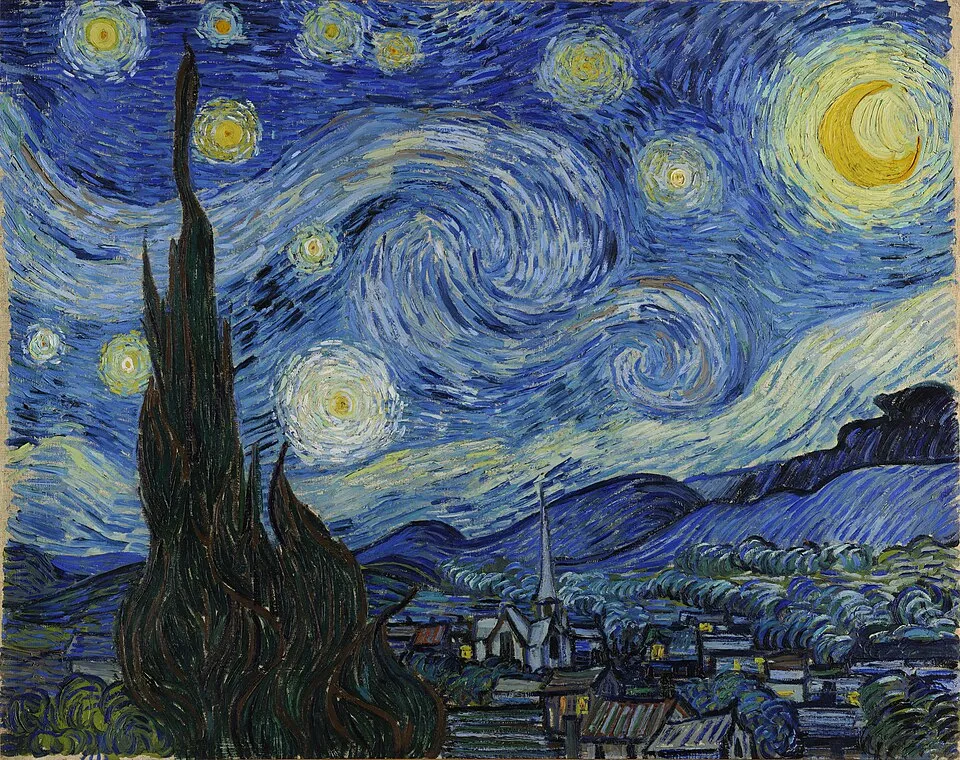
Vincent van Gogh, "The Starry Night" (1889). Oil on canvas, 73.7 x 92.1 cm. MoMA, Floor 5, Gallery 501. Wikimedia Commons.
Floor 4: Abstract Expressionism to Pop Art
Floor 4 covers the 1940s through the 1970s. The leap from Picasso to Pollock to Warhol makes visual sense when you walk it in order. This is the floor where the story of American art takes over from the story of European art, and the transition is one of the most dramatic in the museum.
Jackson Pollock's "One: Number 31, 1950" is in Gallery 417. It is 2.69 x 5.31 m, one of the largest drip paintings Pollock ever made. He laid the canvas on the floor of his studio in Springs, New York, and poured and flicked enamel paint onto it from sticks and brushes. You can see the physical evidence of his body movements in the paint: the arcs of his arm, the flicks of his wrist, the places where he stepped on the canvas. The painting is not a picture of anything. It is a record of an action. For more on this movement, see our guide on Abstract Expressionism: Pollock, Rothko, and American painting at its peak.
Mark Rothko's "No. 3" and "No. 5" are in Gallery 414. Rothko insisted that his paintings be hung low in dim light, and MoMA honors this request. The effect is that the paintings seem to glow from within. The colors are deep reds, oranges, and yellows that blur at the edges. Rothko wanted the viewer to stand close enough that the painting filled their field of vision. At the right distance, the rectangles stop being shapes and start being spaces you fall into.
Andy Warhol's "Campbell's Soup Cans" (1962) is on Floor 5 but belongs to the story that Floor 4 tells. It is 32 separate canvases, each 50.8 x 40.6 cm, one for each variety of soup that Campbell's sold at the time. Warhol originally exhibited them at the Ferus Gallery in Los Angeles, priced at $100 each. The gallery owner Irving Blum bought back the ones that had sold and acquired the full set for $1,000. MoMA acquired the complete set in 1996. The price is not public, but comparable Warhol works from the period have sold for tens of millions. Roy Lichtenstein's "Drowning Girl" (1963) is nearby: "I'd rather sink than call Brad for help." The Ben-Day dots are hand-painted, not printed, which is the detail that separates Lichtenstein from a commercial illustrator. For more on Picasso and the movement he launched, see our guide on Picasso: Cubism, controversy, and a century of influence.
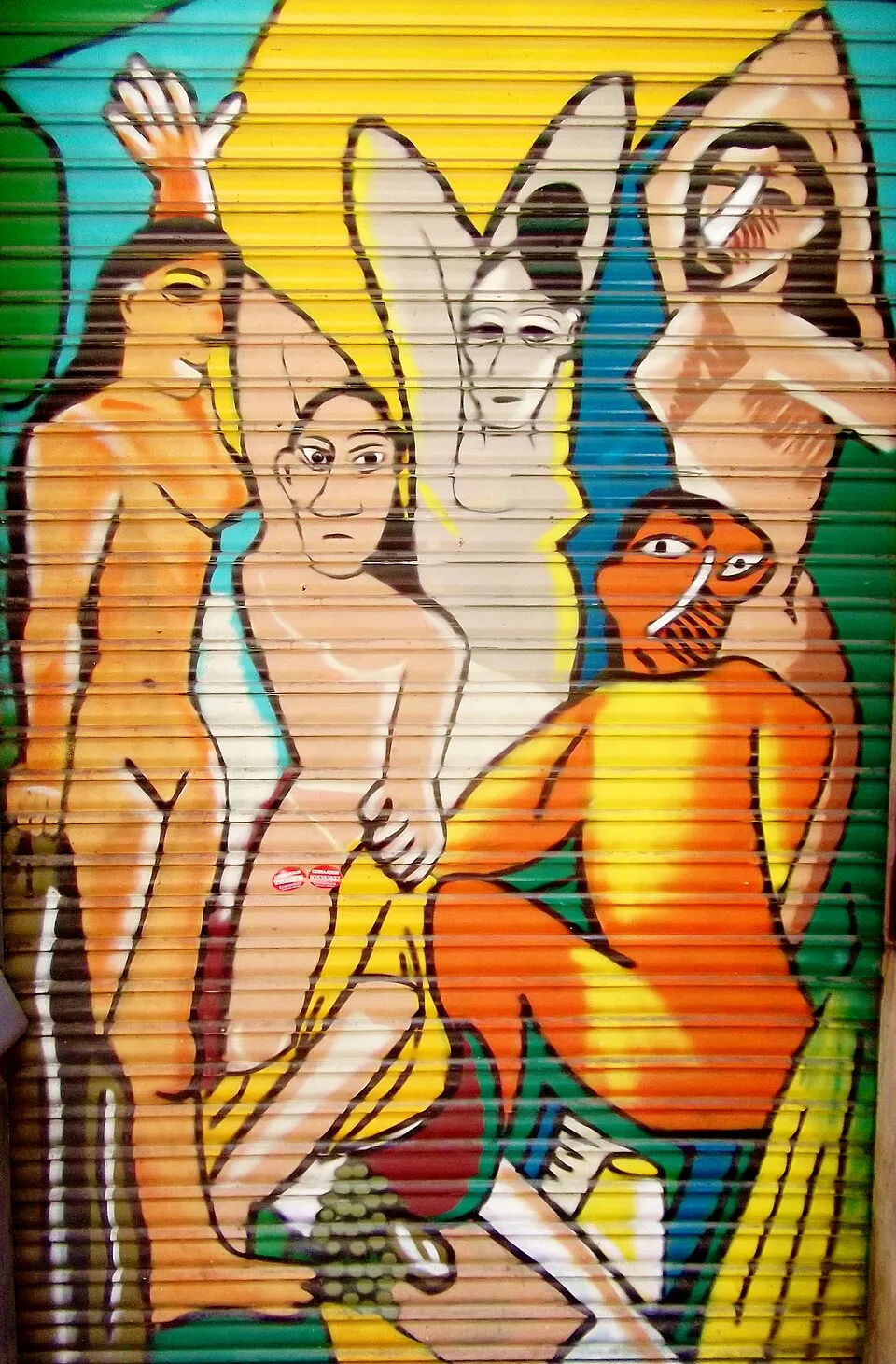
Pablo Picasso, "Les Demoiselles d'Avignon" (1907). Oil on canvas, 243.9 x 233.7 cm. MoMA, Floor 5, Gallery 502. Wikimedia Commons.
Floor 2 and the Sculpture Garden: What Most Visitors Miss
Floor 2 is contemporary art from the 1980s onward. Most visitors skip it. The rotating installations are often MoMA's most provocative work, and the galleries are emptier than Floors 4 and 5. If you have time for only one floor beyond the highlights, make it this one. The work here is what MoMA is betting will matter in 50 years, and some of it will.
The sculpture garden on the ground floor is free to enter, even without a museum ticket. Enter from 54th Street. It contains Picasso's "She-Goat" (1950), a bronze sculpture made from cast-off materials including a wicker basket and palm leaves, and Rodin's "Monument to Balzac" (1898), which was rejected by the literary society that commissioned it because they expected a dignified portrait and got a robed figure that looked like a standing stone. The garden is best in spring and autumn when the trees are in leaf or turning.
MoMA PS1 in Queens has been free for everyone since January 1, 2026, thanks to a gift from Sonya Yu that funds three years of free admission. It is the largest free museum in New York City. PS1 is a contemporary art space in a former public school building in Long Island City, 45 minutes from Midtown on the subway. Its 50th anniversary programming in 2026 includes "Greater New York" (April 16 to August 17, 2026), a quinquennial survey of artists living and working in New York. If you have an extra afternoon, go. You can find more information on the Art Visit Guide MoMA tickets page.
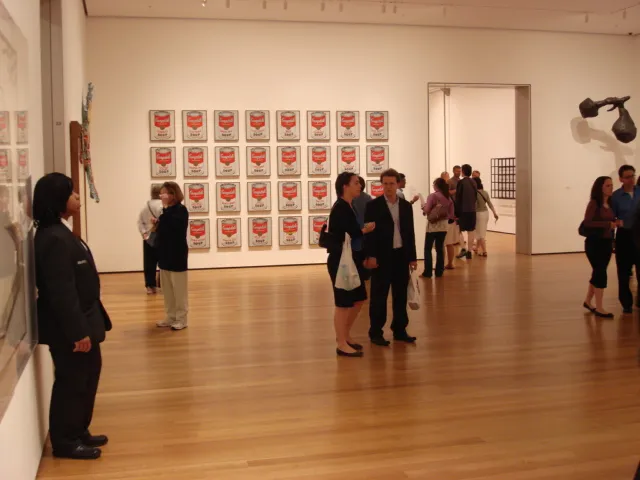
Andy Warhol, "Campbell's Soup Cans" (1962). Synthetic polymer paint on 32 canvases, each 50.8 x 40.6 cm. MoMA, Floor 5. Wikimedia Commons.
2026 Exhibition: Marcel Duchamp Retrospective
"Marcel Duchamp" runs from April 12 through August 22, 2026, in the Steven and Alexandra Cohen Center for Special Exhibitions on Floor 6. It is the first US retrospective of Duchamp's work since 1973, a gap of 53 years. The exhibition is organized by MoMA and the Philadelphia Museum of Art, with the collaboration of the Centre Pompidou. After MoMA, it travels to Philadelphia (October 10, 2026 to January 31, 2027) and then to the Grand Palais in Paris in spring 2027.
The exhibition presents approximately 300 works across all mediums from 1900 to 1968, organized chronologically. It includes "Nude Descending a Staircase, No. 2" (1912), the painting that caused a scandal at the 1913 Armory Show in New York; "The Bride Stripped Bare by Her Bachelors, Even" (The Large Glass, 1915-23), his magnum opus; the readymades including "Fountain" (1917), the upturned urinal signed "R. Mutt"; and "Etant donnes" (1946-66), his final major work, a diorama-like installation viewed through two peepholes in a wooden door.
Why it matters: Duchamp changed what art could be. The readymade, a mass-produced object presented as art without any modification by the artist, is the most influential idea in 20th-century art. Without Duchamp, there is no Warhol, no Conceptual Art, no Damien Hirst, no Jeff Koons. The exhibition's curators, Ann Temkin and Michelle Kuo, have emphasized that Duchamp was not just a provocateur but an inventor who expanded the media and disciplines available to artists. As Kuo told The Art Newspaper, Duchamp made art "multi-sensory" so that "it was famously not just a retinal pursuit for him, but something that could be olfactory or multi-dimensional or spatial or taking place over time." You can read more on the MoMA Marcel Duchamp exhibition page.
Practical Tips
Tickets are $28 online ($30 at the door). Seniors pay $20, students $15, and visitors under 16 are free. New York State residents get free admission on Fridays from 5:30 to 8:30 PM, but you must reserve online in advance. The Friday free hours are popular, so book early.
Hours are Monday through Thursday and weekends 10:30 AM to 5:30 PM. Fridays 10:30 AM to 8:30 PM. The quietest times are Tuesday and Wednesday mornings, 10:30 AM to 12 PM. Go to Floor 5 first. By noon the Starry Night room is packed.
Plan 2 to 3 hours for highlights (Floors 4 and 5). A full museum visit takes 4 to 5 hours. The sculpture garden is free, enter from 54th Street. For the Duchamp retrospective, allow at least 90 minutes. The show is large and dense, and the chronological organization means you need to walk the whole thing to understand the argument.
For more general advice on museum visits, see our guide on how to visit an art museum without getting overwhelmed. For the broader context of where modern art fits in the history of art, the complete guide to art movements covers the full timeline.
Final Thoughts
MoMA is where modern art lives, not just because it has the best collection, but because it invented the category. Alfred Barr's vision of modern art as a continuous historical development from Cezanne to the present is still the framework every art history textbook uses. Walking through MoMA is walking through that chart, made real.
Book at moma.org. Go on a Tuesday morning. Start on Floor 5. Leave time for the Duchamp retrospective and the sculpture garden. If you have an extra afternoon, take the subway to PS1 in Queens, which is now free for everyone. For a quick overview of art history before you go, try the art history cheat sheet, and for more on how to approach looking at art, see how to look at art for beginners. What is your favorite MoMA gallery? Share in the comments below.


