
The Metropolitan Museum of Art has 2 million objects spanning 5,000 years of human history, displayed across 190,000 square meters of gallery space. It is the largest art museum in the Americas. In fiscal year 2025, the Met welcomed 5.7 million visitors to its two locations, a 5% increase over the previous year. Unlike MoMA, which covers modern art, or the Louvre, which covers Western art, the Met covers everything: Egyptian temples, medieval armor, Renaissance paintings, African masks, Chinese calligraphy, American furniture, contemporary photography. The challenge is not finding something to see. It is deciding what to skip.
The Met was founded in 1870 by a group of American citizens, financiers, artists, and civic leaders who wanted to bring European-level culture to New York. It opened in a rented building at 681 Fifth Avenue in 1872. The current building on Fifth Avenue at 82nd Street, designed by Richard Morris Hunt, opened in 1902. The Met also operates The Cloisters in Fort Tryon Park, a dedicated medieval art branch housed in a reconstructed monastery.
This guide covers the building layout, the Egyptian collection (Temple of Dendur), European paintings (Vermeer, Rembrandt, Van Gogh), the American Wing, the Arms and Armor collection, what most visitors miss, and practical tips.
The Building and How to Navigate It
The Met is organized geographically and chronologically. The main building on Fifth Avenue has four floors. Floor 1 holds Egyptian art, Greek and Roman art, Near Eastern art, and medieval art. Floor 2 holds European sculpture and decorative arts, the American Wing, Arms and Armor, musical instruments, and ancient Near East. Floor 3 holds European paintings (1250-1800), Asian art, drawings and prints. Floor 4 holds European paintings (1800-present) and special exhibitions.
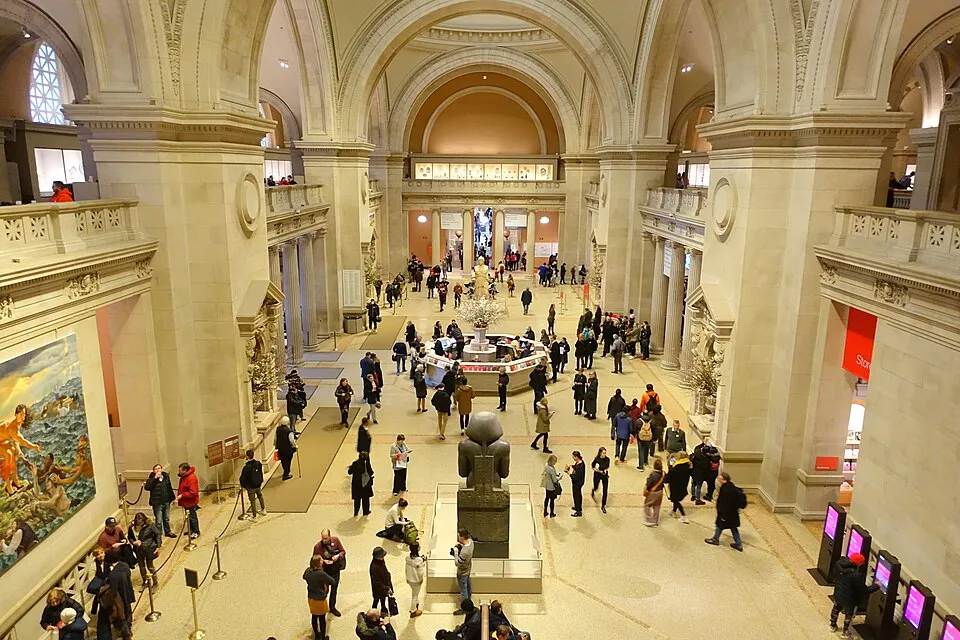
The Great Hall, Metropolitan Museum of Art. Designed by Richard Morris Hunt, opened 1902. Wikimedia Commons.
The Great Hall, designed by Richard Morris Hunt in 1902, is the entrance hall. Pick up a map here. The information desk can tell you what is open and what is being renovated. The strategy is simple: do not try to see the Met in one visit. Pick 3 or 4 areas and see them properly. The Met rewards repeated visits. Your ticket includes same-day admission to both The Met Fifth Avenue and The Met Cloisters, so you can split your day between the two locations. The Met's exhibitions page lists what is currently on view.
The Egyptian Collection and the Temple of Dendur
The Met's Egyptian collection is the largest outside Cairo, with 26,000 objects spanning 4,000 years. The centerpiece is the Temple of Dendur (c. 15 BCE), a complete Egyptian temple commissioned by Emperor Augustus. Egypt gave it to the United States in 1965 as thanks for American help in saving Nubian monuments from flooding by the Aswan Dam. It was installed in the Sackler Wing in 1978. The glass wall facing Central Park creates one of the most beautiful museum spaces in the world.
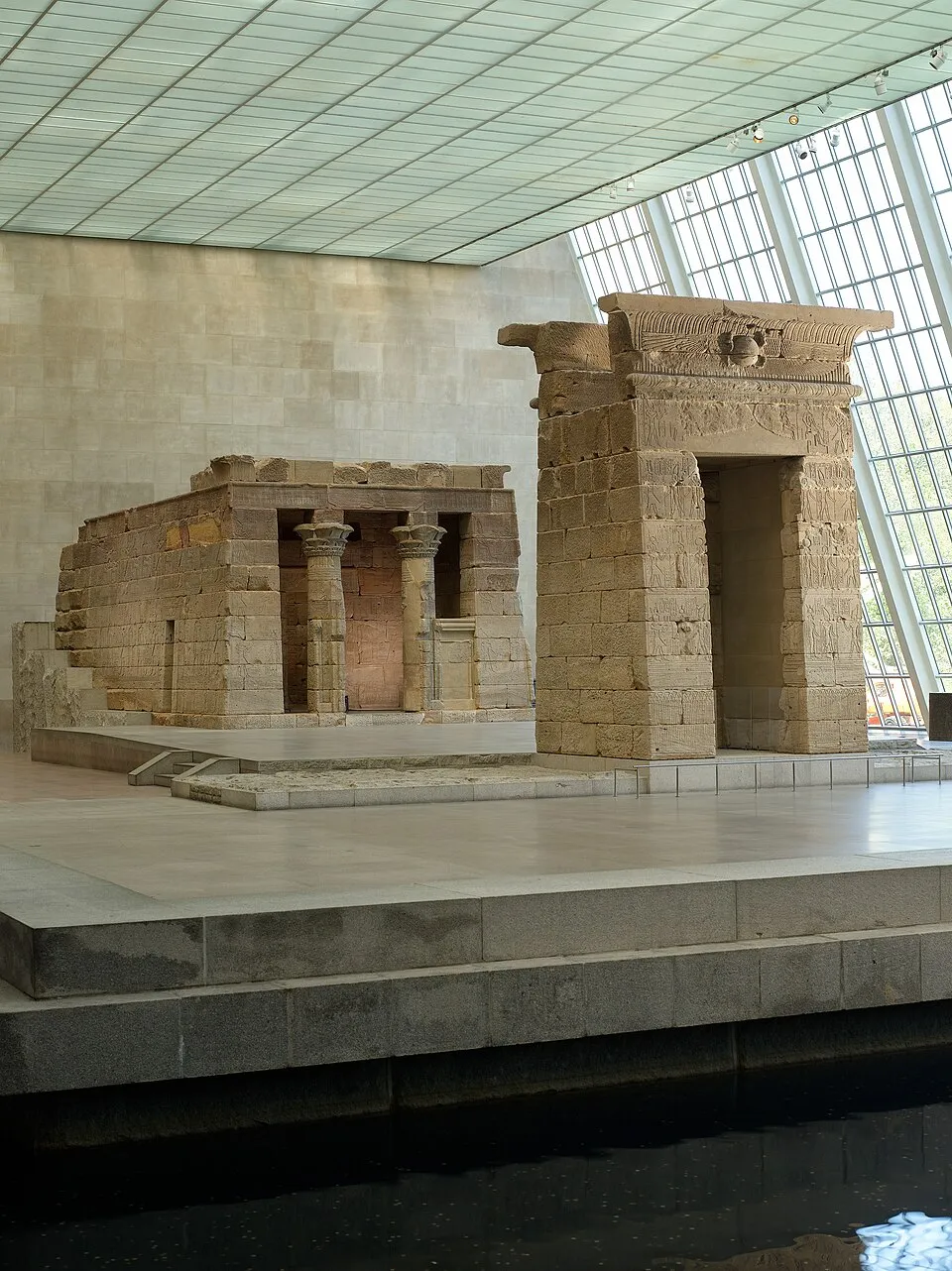
The Temple of Dendur (c. 15 BCE), commissioned by Emperor Augustus. Gift of Egypt to the United States, 1965. Installed in the Sackler Wing, 1978. Wikimedia Commons.
The Tomb of Perneb (c. 2380 BCE) is a complete Old Kingdom tomb chapel, reassembled in the museum. You can look through the false door into the burial shaft. The models from the tomb of Meketre (c. 1980 BCE) are 24 wooden models of daily life: baking, brewing, sailing, cattle counting. These are the most intimate glimpse into ancient Egyptian daily life in any museum. They are small, detailed, and easy to walk past. Do not walk past them.
The Michael C. Rockefeller Wing, which houses the Met's collections of art from sub-Saharan Africa, the Pacific Islands, and the Americas, reopened on May 31, 2025 after a major renovation. The reopening drew 33,700 visitors in a single day, the highest single-day attendance since 2017. The renovated wing presents these collections with new gallery architecture, improved lighting, and updated interpretive materials. For a quick orientation to the historical periods represented across the Met's collections, read our art history cheat sheet.
European Paintings: Vermeer, Rembrandt, Van Gogh
The Met's European paintings galleries on Floors 3 and 4 reopened on November 20, 2023, following a $150 million skylight renovation that began in 2018. It was the largest capital project in the museum's history. The 45 galleries are now arranged chronologically from 1300 to 1800, with more than 700 works on view. The new skylights cast diffuse natural light that changes with the seasons, which is how these paintings were meant to be seen. Before the 20th century, most paintings were created in natural light.
The rehang introduced new narratives. Works by women artists and artists of color are placed alongside canonical European masters, not segregated into side galleries. A self-portrait by the 18th-century French painter Marie Victoire Lemoine hangs next to one by the 20th-century Abstract Expressionist Elaine de Kooning. A 2014 Kerry James Marshall canvas, in which all the figures are Black, shares a gallery with an 1817 Jean Alaux painting. The curators are making an argument about continuity, not tokenism.
Vermeer's "Young Woman with a Water Pitcher" (c. 1662) is the most beloved Vermeer in the collection. "A Maid Asleep" (c. 1656-1657) is one of Vermeer's earliest surviving works. Rembrandt's "Aristotle with a Bust of Homer" (1653) measures 143.5 x 136.5 cm. It shows Rembrandt's self-portrait as Aristotle, contemplating a bust of Homer. Van Gogh's "Wheat Field with Cypresses" (1889) was painted at Saint-Rémy, the same asylum where he painted The Starry Night. The Met has 37 Monet paintings, the largest collection outside France. For more on Rembrandt's techniques, read our guide to Rembrandt and the human face.
The American Wing and the Stained Glass
The American Wing spans Floors 1 and 2 and is the most comprehensive collection of American art in the world. It includes painting, sculpture, furniture, silver, glass, and architecture. "Washington Crossing the Delaware" by Emanuel Leutze (1851) measures 378.5 x 647.7 cm and is the largest painting in the American Wing. It is historically inaccurate (the flag shown did not exist in 1776, the boat is too small) but it is an icon of American painting.
The Frank Lloyd Wright Room is a complete living room from the Francis Little house (1912-1914), reassembled in the museum. It is the most intimate Wright interior on public view. The Tiffany stained glass collection includes "Garden Landscape" (c. 1905) and "Autumn Landscape" (c. 1923), displayed in a darkened gallery where the windows are backlit. It is one of the most beautiful small spaces in the museum.
The Charles Engelhard Court is a sculpture garden on Floor 1 of the American Wing, with the facade of the Branch Bank of the United States (1822-1824) reconstructed as a backdrop. In fall 2026, the Met will present "Designing the Gilded Age: Drawings from the Studios of Louis C. Tiffany" (October 22, 2026 through February 7, 2027), the first major exhibition dedicated to the design drawings behind Tiffany Studios' stained-glass windows, lamps, and mosaics. The exhibition will reunite two major stained-glass windows with their original design drawings for the first time in nearly half a century. For more on how art reflects cultural identity, read our guide on art and society.
Arms and Armor: The Most Surprising Gallery
The Arms and Armor galleries (Floor 1, Gallery 370-380) are one of the most popular and most unexpected collections in the Met. Suits of armor from medieval Europe, Japan, and the Islamic world are displayed in a gallery designed like a medieval hall. The armor of Henry II of France (c. 1550) is a complete suit of ceremonial armor, 1.77 meters tall, decorated with gold and silver damascening. The Japanese armor collection includes 230 pieces, with samurai armor from the 14th through 17th centuries. The helmets are extraordinary: antlers, horns, and demon masks.
The Arms and Armor galleries demonstrate that the Met is not just a painting museum. It is a museum of human creativity in all materials: steel, leather, gold, silk, glass. The galleries are usually full of children, which is appropriate. This is the collection that converts people who think they do not like museums.
What Most Visitors Miss
The Cloisters is the Met's medieval branch in Fort Tryon Park, 40 minutes by subway from the main building. It is a reconstructed medieval monastery with the Unicorn Tapestries (c. 1495-1505), seven tapestries depicting the hunt of a unicorn. These are the finest medieval tapestries in the United States. Admission is included with your Met ticket on the same day. The Cloisters feels like time travel. The setting, on a hill above the Hudson River, is unlike any other museum space in New York.
The Robert Lehman Collection is a private collection donated to the Met, displayed in a gallery designed to look like a private home. It includes Renaissance bronzes, Venetian glass, and drawings by Dürer and Rembrandt. It is on Floor 1, behind the medieval galleries, and most visitors walk right past it.
The rooftop garden (open May through October) has outdoor sculpture installations with views over Central Park. It is the best view of the Manhattan skyline from above the tree line. The musical instrument collection (Floor 2, Gallery 680) has 5,000 instruments from every culture and period: Stradivari violins, ancient Egyptian flutes, Javanese gamelans.
Also worth noting: "Orientalism: Between Fact and Fantasy" opened June 12, 2026 and runs through February 28, 2027. It is the Met's first comprehensive exhibition on Orientalism, bringing together roughly 180 works from 12 Met departments. The show traces how European and Ottoman artists depicted the East, from Napoleon's 1798 Egyptian campaign to the work of Osman Hamdi Bey. And "A King's Carpet: Louis XIV and the Savonnerie" opens September 8, 2026, exploring the 20-year production of carpets commissioned for the Grande Galerie of the Louvre.
Practical Tips
Tickets cost $30 for adults, $22 for seniors, and $17 for students. Visitors under 12 enter free. New York State residents pay what you wish (must show ID). Students from New York, New Jersey, and Connecticut also pay what you wish. You can now reserve pay-what-you-wish tickets online from the Met's website, which speeds up entry. In FY2025, 42% of visitors used these expedited entry options.
Hours are Sunday through Tuesday and Thursday 10 AM to 5 PM, and Friday and Saturday 10 AM to 9 PM. The Met is closed Wednesdays, which is unusual among major museums. Your ticket includes same-day admission to both The Met Fifth Avenue and The Met Cloisters, so you can visit both in one day if you plan your time.
Plan 3 to 4 hours for highlights. A full day for a thorough visit. The Met has two locations: Fifth Avenue (main) and The Cloisters (medieval, in Fort Tryon Park). Save The Cloisters for a separate trip if you can. It deserves more than a rushed afternoon tag-on.
For strategies on pacing yourself through a museum this size, read our guide on how to visit an art museum without getting overwhelmed. For a broader timeline of the art movements represented in the Met's collection, see our complete guide to art movements.
Final Thoughts
The Met is not a museum you visit. It is a museum you inhabit. The 2 million objects span 5,000 years and every inhabited continent. The strategy is to accept that you cannot see it all, pick what matters to you, and come back. The same-day admission to both locations is the most generous policy of any major museum in the Americas.
Book at metmuseum.org. Go on a Friday or Saturday, when the museum is open until 9 PM. Start with the Temple of Dendur. Spend time in the European Paintings galleries, which look better now than they have in decades after the skylight renovation. Save The Cloisters for a separate day.
For more on how to get the most out of what you are seeing, read our guide on how to look at art for beginners and our overview of famous paintings explained.


