
"The global art market returned to growth in 2025, with sales increasing by 4% year-on-year in value to an estimated $59.6 billion," according to the Art Basel and UBS Global Art Market Report 2026. But "the global art market is still well shy of the $67.8bn it totalled in 2023, as well as its all-time peak of $68.2bn in 2014," as The Art Newspaper put it. The report, the 10th edition, authored by Dr. Clare McAndrew of Arts Economics, is "a benchmark report for the industry and provides the most comprehensive data-driven overview of the forces shaping today's market." The numbers tell a story of modest recovery. They also tell a story of structural inequality. Aggregate sales in both dealer and auction markets improved, with the dealer sector rising 2% year-on-year to $34.8 billion and public auction sales up 9% to $20.7 billion. Reported private sales declined 5% to just under $4.2 billion. Dealers' total operating costs rose by an estimated 5% on average in 2025, higher than the rate of inflation in most major art markets and higher than aggregate sales growth.
"80 percent of survey respondents said that President Donald Trump's tariffs and other cross-border trade barriers negatively impacted their business in 2025, while 20 percent reported no effect. (None reported a positive impact.)" The art market is $59.6 billion. But who makes money, and who doesn't? The answer is more unequal than the headline number suggests. This guide covers the global market size, the market structure, US dominance, dealer economics, the tariff impact, gender parity, and who actually profits. For more on what is current, see our guide to contemporary art trends.
Art Basel. "The global art market returned to growth in 2025, with sales increasing by 4% year-on-year in value to an estimated $59.6 billion" (Art Basel). "The 10th edition of the Art Basel and UBS Global Art Market Report 2026, authored by Dr. Clare McAndrew of Arts Economics, analyzes the global art market in 2025" (Art Basel). Image via Wikimedia Commons
The Global Market: $59.6 Billion and Below the Peak
"The global art market returned to growth in 2025, with sales increasing by 4% year-on-year in value to an estimated $59.6 billion." This uptick was largely driven by high-end sales, with a 9% increase in the combined value of auction turnover above $10 million. The recovery is real, but it is incomplete. The market is still well shy of the $67.8 billion it totalled in 2023, and below its all-time peak of $68.2 billion in 2014. The 2025 number sits roughly 9% below the 2023 level and below its level a decade earlier. A four percent gain after two years of contraction is a turning point, not a triumph.
The structure of the market shapes who profits. The dealer sector rose 2% year-on-year to $34.8 billion. Public auction sales rose 9% to $20.7 billion. Reported private sales declined 5% to just under $4.2 billion. The auction sector accounted for around 42% of total sales by value, up 1% in share year-on-year, while dealers and galleries accounted for 58%. Auctions grew faster than dealers in 2025, which means the public, top-end of the market is where the momentum is. For more on how that top-end is priced, see our guide to auction houses and valuation.
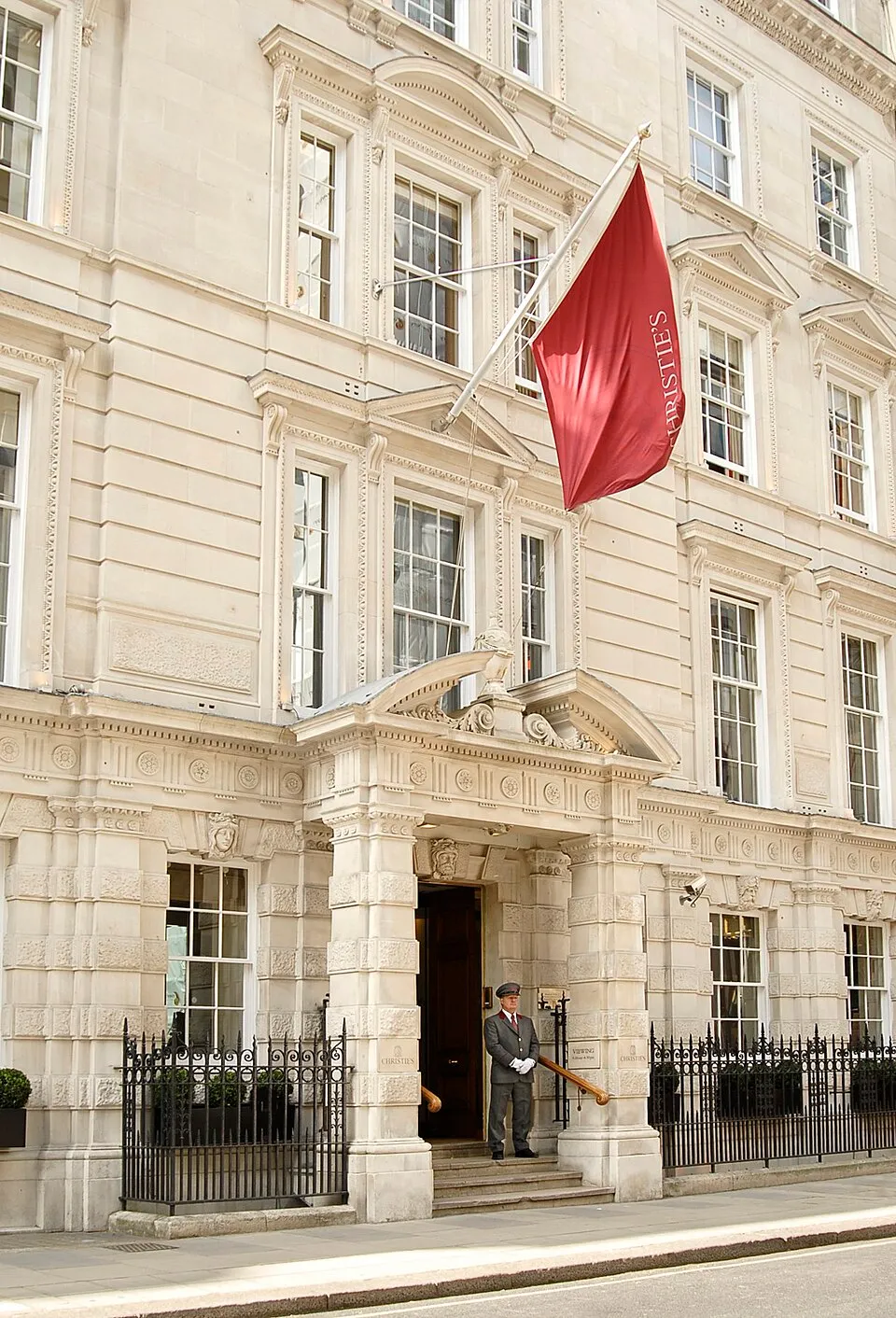
Auction house sale room. "Public auction sales up by 9% to $20.7 billion. Reported private sales declined by 5% to just under $4.2 billion" (Art Basel). "The auction sector accounted for around 42% of total sales by value, up by 1% in share year-on-year, while dealers and galleries accounted for 58%" (Art Basel). Image via Wikimedia Commons
The US Dominance: 44% of the Global Market
The US accounts for 44% of global sales by value, up 1% year-on-year, according to UBS. US sales grew 5% year-on-year to $26 billion in 2025, marking a return to growth following two years of decline. The US accounted for 78% of the global market for works sold above $10 million. All of the top 10 most expensive lots sold globally in 2025 were auctioned in New York City. The concentration at the top is staggering. When you talk about the high-end art market, you are largely talking about New York.
The UK accounts for 18% of the global market, unchanged year-on-year. China's market share decreased 1% to 14%, maintaining its position as the world's third-largest art market. Hong Kong, a freeport with a more international profile, saw aggregate sales decline 6% year-on-year, while the more domestically focused mainland saw a 5% rise. The US, UK, and China together account for 76% of the global market. The remaining 24% is spread across Europe, Asia, and the rest of the world. The art market is not a single market. It is three markets, plus everyone else.
Dealer Economics: The Middle Market Squeeze
The dealer sector rose 2% year-on-year to $34.8 billion. Nearly half of dealers, 42%, reported an increase in sales in 2025, up 7% year-on-year, while 33% reported a decline and 25% had stable sales. But dealers' total operating costs rose by an estimated 5% on average in 2025, higher than the rate of inflation in most major art markets and higher than aggregate sales growth. Costs are rising faster than sales. That is the core problem for the dealer sector.
The squeeze is concentrated in the middle. Dealers with turnovers of $250,000 to $500,000, and of $500,000 to $1 million, reported lower profitability than last year. Dealers with both lower and higher turnovers reported increased profitability. The share reporting lower profitability declined to 38%, down 5% year-on-year, while 33% reported higher profitability and 29% maintained similar levels. The dealer market is polarized. The top end, galleries with turnover above $10 million, and the bottom end, small galleries with turnover below $250,000, are profitable. The middle is squeezed.
The costs tell you why. Payroll, rent, and art fairs remained dealers' biggest expenses. For primary market galleries, payroll and rent each accounted for 21% of annual costs. Art fair booths accounted for 15%, but related expenses like travel, shipping, and accommodations added another 17%. Fairs account for roughly a third of dealers' total spending. Twenty-nine percent said they are cutting back on fairs, down slightly from 31% in 2024 but well above 19% in 2023. When a third of your budget goes to fairs, and you are cutting back, the model is under pressure. For more on the people who help navigate this, see our guide to art advisors.
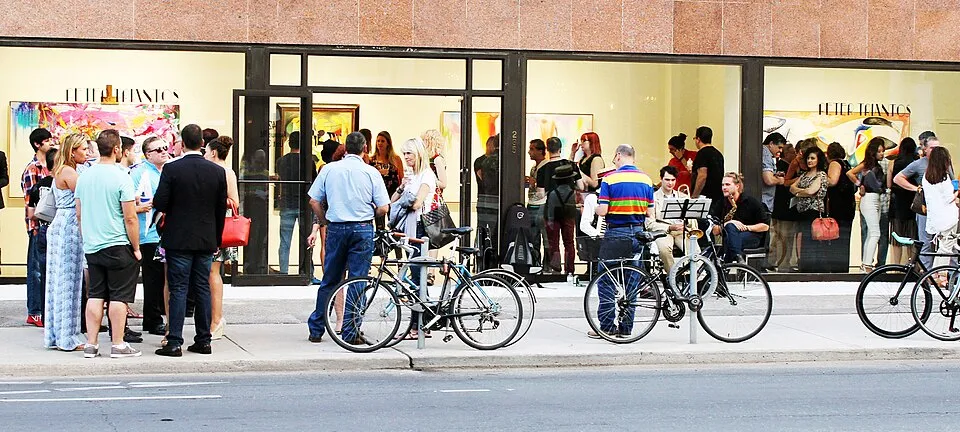
Gallery exhibition. "Dealers' total operating costs rose by an estimated 5% on average in 2025, higher than the rate of inflation in most major art markets and higher than aggregate sales growth, indicating persistent financial challenges" (Art Basel). "Payroll, rent, and art fairs remained dealers' biggest expenses" (The Art Newspaper). Image via Wikimedia Commons
The Tariff Impact: 80% Negatively Affected
"80 percent of survey respondents said that President Donald Trump's tariffs and other cross-border trade barriers negatively impacted their business in 2025, while 20 percent reported no effect. (None reported a positive impact.)" 56% of dealers said that tariffs had a negative impact on business, while 72% identified higher ancillary costs as the biggest knock-on effect. The tariffs did not need to apply directly to fine art to do damage. As McAndrew told The Art Newspaper, "although much of fine art was exempt from the tariffs, shipping delays, increased logistical costs and reduced consumer confidence all discourage people from going through the hassle of cross-border transacting, which the art market is heavily reliant on."
The shift is visible in the data. Complications with cross-border trade have led many collectors to acquire more in their home markets, with all dealer segments in 2025 reporting a greater share of local buyers. This was particularly pronounced among the smallest dealers, whose share of local buyers rose 9% to 71% of sales to private collectors. The art market is inherently international. Tariffs and trade barriers do not just increase costs. They fragment the market, pushing collectors toward domestic purchases and undermining the global circulation that the art market depends on. For more on the cultural forces at work, see our guide to art and society.
Gender Parity: Progress and Gaps
Female artists accounted for 45% of dealer representation in 2025, an increase of 4% year-on-year, with primary market galleries reaching parity on average. Female artist representation strengthened in 2025, reaching parity, 50% of represented artists, among primary market galleries, and 45% across all dealers, up from 41% in 2024 and 35% in 2018. The trajectory is positive. Representation has grown from 35% to 45% in seven years.
But representation is not sales. Works by female artists accounted for 37% of sales by value. Women represent 50% of artists in primary galleries but account for only 37% of sales by value. The gap is even wider at the top of the market, where the most expensive lots at auction are overwhelmingly by male artists. Parity in the gallery has not translated to parity in the market. The rosters have changed faster than the prices. For more on building the knowledge to engage with this work, see our guide to art for beginners.
Who Makes Money, and Who Doesn't
Who makes money? Auction houses, with public auction sales up 9%. Top-tier galleries, with turnover above $10 million and a 3% increase. The US market, with a 44% share and $26 billion. New York, where all of the top 10 lots in 2025 were sold. Blue-chip artists, Picasso, Warhol, Monet, who make up roughly 20% of the Artprice100. High-end collectors, buying above $10 million.
Who doesn't? Middle-market galleries, with $250,000 to $1 million turnover and declining profitability. Small galleries facing rising costs. Artists without gallery representation. Collectors in tariff-affected regions. Hong Kong, where sales declined 6%.
The art market is not one market. It is a pyramid. At the top, a small number of artists, galleries, auction houses, and collectors handle the majority of the value. At the bottom, thousands of artists, galleries, and collectors operate on thin margins. The $59.6 billion headline obscures this inequality. Most of the money is concentrated at the top. The longer-term shift may rebalance things. Paul Donovan of UBS points to "the Great Wealth Transfer, with more than USD 83 trillion set to pass between generations in the coming decades. As wealth increasingly moves into the hands of women and younger collectors, family dynamics, collecting motivations, and philanthropic priorities are evolving, reshaping collecting patterns and long-term engagement with the art market." For more on building the knowledge to participate, see our guide to teaching yourself art history.
Final Thoughts
The global art market returned to growth in 2025, with sales increasing 4% year-on-year to an estimated $59.6 billion, still well shy of the $67.8 billion it totalled in 2023 and the all-time peak of $68.2 billion in 2014. The dealer sector rose 2% to $34.8 billion. Public auction sales rose 9% to $20.7 billion. Private sales declined 5% to just under $4.2 billion. The US accounts for 44% of global sales by value, $26 billion, and 78% of the market for works sold above $10 million. All of the top 10 most expensive lots in 2025 were auctioned in New York City. The UK holds 18%. China holds 14%. Dealers' total operating costs rose 5% on average. 80 percent of respondents said Trump's tariffs negatively impacted their business. None reported a positive impact. Fairs account for roughly a third of dealers' total spending, and 29% are cutting back. Female artists account for 45% of dealer representation, with primary market galleries reaching parity, but only 37% of sales by value, up from 41% in 2024 and 35% in 2018. The Great Wealth Transfer, with more than $83 trillion set to pass between generations, is reshaping who buys.
Read the Art Basel and UBS Global Art Market Report 2026. It is free to download from artbasel.com. Look at the data for your segment. Are you a collector, a dealer, an artist, a student? The report tells you where the money is and where it isn't. If you are buying art, understand that the market is polarized: the top end is strong, the middle is squeezed, the bottom is surviving. If you are selling art, understand that costs are rising faster than sales for most dealers, and that tariffs are fragmenting an inherently international market. If you are an artist, understand that gallery representation is reaching gender parity, but sales by value are not. The art market is $59.6 billion. The headline number is not the story. The story is in the structure: who makes money, who doesn't, and why. For more on the works that drive the top of that market, see our guide to famous paintings.


