
Georgia O'Keeffe painted a flower so large it filled a four-foot canvas. Not a bouquet, not a garden scene — a single jimsonweed blossom, magnified until its white petals became rolling landscapes and its pale green center became a luminous cave. "Nobody sees a flower really," O'Keeffe explained. "It is so small. We haven't time, and to see takes time, like to have a friend takes time." So she made her flowers impossible to ignore, scaling them up until the petals swallowed your field of vision and you had no choice but to actually look.
O'Keeffe was the defining figure of American modernism — an artist who forged a visual language entirely her own, independent of the European avant-garde movements that dominated the early 20th century. While her contemporaries looked to Paris for inspiration, O'Keeffe looked at the American landscape: the skyscrapers of New York, the vast desert of New Mexico, the bleached animal bones she collected on long walks through the badlands. She stripped these subjects down to their essential forms and colors, creating paintings that hover between representation and abstraction, between the specific and the universal.
This article explores O'Keeffe's life, her artistic development, her most important works, and the legacy that has made her one of America's most celebrated artists.
Early Life and Artistic Formation
Georgia Totto O'Keeffe was born on November 15, 1887, on a wheat farm near Sun Prairie, Wisconsin. She knew she wanted to be an artist by age twelve and received early training at the School of the Art Institute of Chicago and the Art Students League in New York. But she grew frustrated with the academic tradition of copying European masters and briefly abandoned art altogether, working as a commercial illustrator and art teacher in Texas and South Carolina.
The turning point came in 1912 when O'Keeffe encountered the ideas of Arthur Wesley Dow, an art educator who taught that the purpose of art was not to imitate nature but to express ideas through harmonious arrangements of line, color, and shape. Dow's approach, influenced by Japanese aesthetics, gave O'Keeffe permission to move away from representation toward something more personal and abstract.
In 1915, O'Keeffe began producing a series of abstract charcoal drawings that were unlike anything being made in America at the time. A friend sent them to Alfred Stieglitz, the influential photographer and gallery owner in New York. Stieglitz was stunned. "At last, a woman on paper!" he reportedly exclaimed, and exhibited the drawings at his gallery, 291, without O'Keeffe's initial knowledge. This began one of the most consequential relationships in American art history.
O'Keeffe and Stieglitz: Art and Partnership
Stieglitz and O'Keeffe began a correspondence that evolved into a romantic relationship. She moved to New York in 1918, and they married in 1924. Stieglitz championed O'Keeffe's work relentlessly, organizing annual exhibitions and photographing her obsessively — he made over 300 portraits of her over two decades, including many nudes that became famous (and sometimes controversial) in their own right.
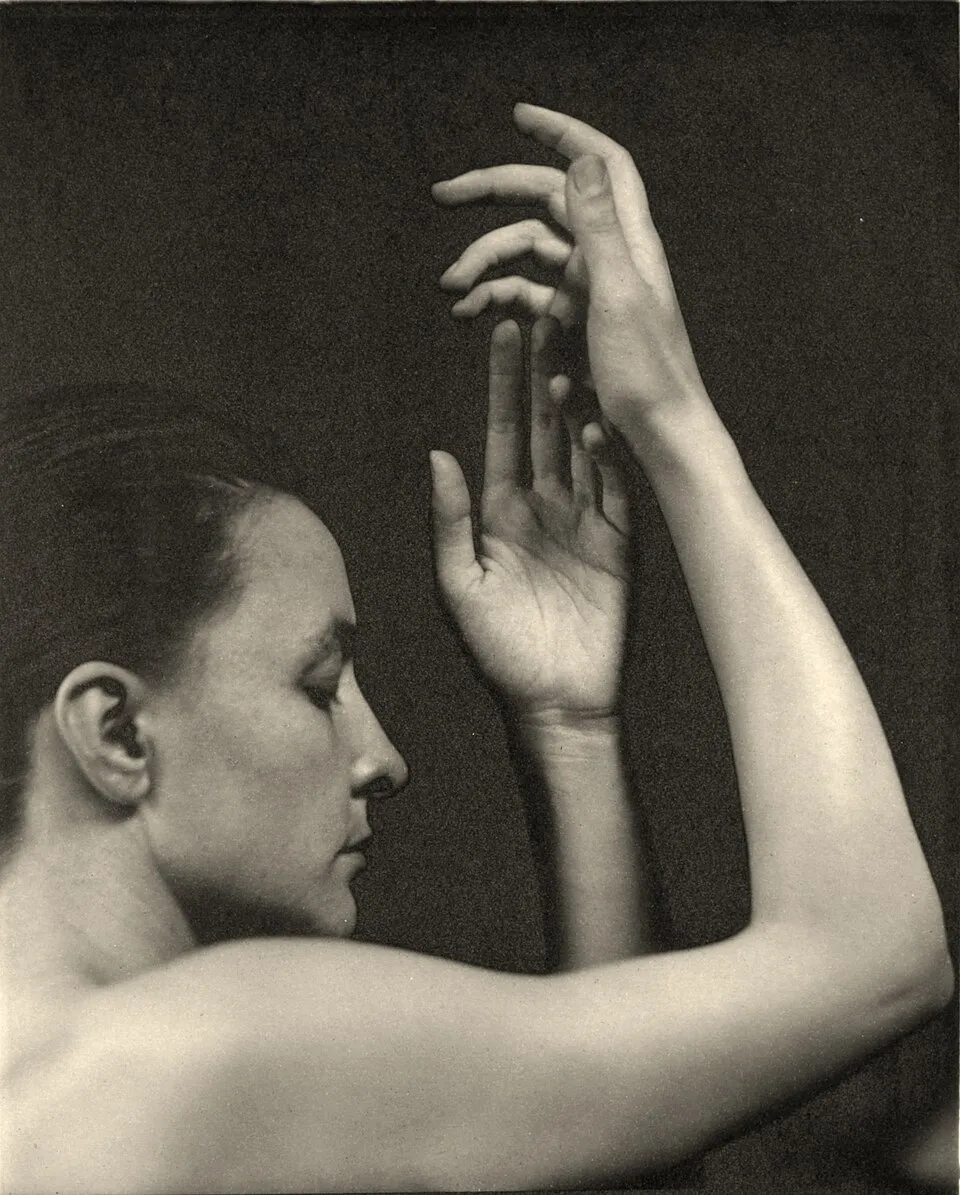
Alfred Stieglitz, portrait of Georgia O'Keeffe (1918), gelatin silver print. The Art Institute of Chicago. Stieglitz's extensive photographic portraits of O'Keeffe helped establish her as a modern icon. Image: Public domain, via Wikimedia Commons
The relationship was both productive and complicated. Stieglitz gave O'Keeffe a platform and financial stability, but he also shaped how her work was received. His emphasis on her gender — and the Freudian interpretations that critics applied to her flower paintings — infuriated O'Keeffe throughout her life. "When people read erotic symbols into my paintings, they're really talking about their own affairs," she said bluntly.
The Flower Paintings
O'Keeffe began her large-scale flower paintings in the mid-1920s, and they remain her most famous works. Paintings like "Jimson Weed/White Flower No. 1" (1932), "Black Iris" (1926), "Red Canna" (c. 1924), and "Oriental Poppies" (1927) present single blooms at enormous scale, filling canvases up to four feet across.
The magnification serves several purposes. First, it forces viewers to really look at something they normally glance past. Second, it transforms the familiar into the abstract — at such scale, a flower's petals become sweeping curves, its center becomes a deep recession, and its colors become autonomous fields of sensation. Third, it creates an immersive experience that anticipates the large-scale work of later abstract painters. Standing in front of a four-foot O'Keeffe flower is not unlike standing in front of a Rothko — you are enveloped by color and form.
O'Keeffe was adamant that her flowers were not sexual symbols, despite decades of Freudian interpretation. "I hate flowers — I paint them because they're cheaper than models and they don't move," she said with characteristic dry humor. More seriously, she insisted that her paintings were about seeing itself — about the act of paying close attention to the physical world and translating that attention into form and color.
New York and the Urban Landscape
During the 1920s, while living with Stieglitz in New York, O'Keeffe also painted the city. Works like "Radiator Building — Night, New York" (1927) and "City Night" (1926) depict Manhattan's skyscrapers as soaring, geometric forms — dark towers silhouetted against glowing night skies. These paintings are less well-known than the flowers, but they demonstrate O'Keeffe's ability to find abstract beauty in any subject. She treated skyscrapers the same way she treated flowers — isolating them, simplifying their forms, and magnifying their visual impact.
New Mexico: The Landscape That Defined Her
In 1929, O'Keeffe made her first trip to northern New Mexico, and the landscape transformed her art. The vast desert, the bleached animal bones, the dramatic mesas and canyons, the intense light — everything about the Southwest resonated with her aesthetic vision. She returned every summer, and after Stieglitz's death in 1946, she moved to New Mexico permanently, dividing her time between a house in Abiquiú and a ranch at Ghost Ranch.
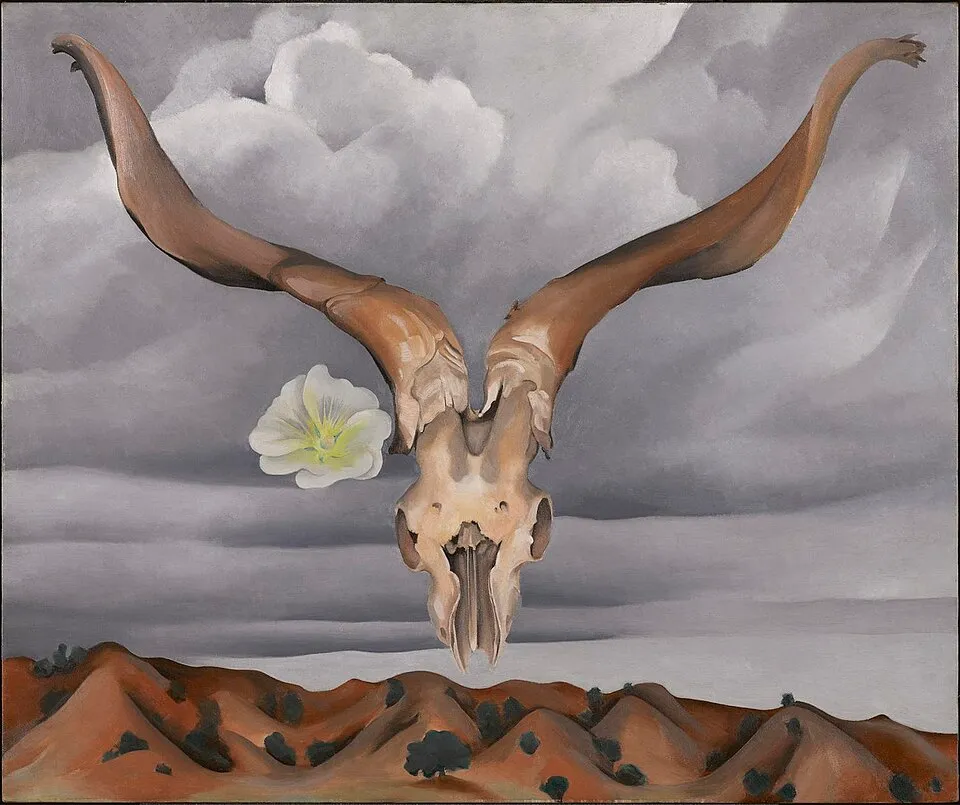
Georgia O'Keeffe, "Ram's Head White Hollyhock and Little Hills" (1935), oil on canvas. Brooklyn Museum. O'Keeffe combined desert bones, flowers, and landscapes into dreamlike compositions that define the American Southwest in the public imagination. Image: Fair use, via Wikimedia Commons
The New Mexico paintings include several interrelated series:
Bones — O'Keeffe collected sun-bleached animal skulls and pelvic bones from the desert floor and painted them against blue skies, distant hills, and fabric backgrounds. "Cow's Skull: Red, White, and Blue" (1931) became an unofficial symbol of the American West. She insisted the bones were not about death but about the enduring beauty of form: "To me they are as beautiful as anything I know."
Landscapes — The mesas, canyons, and desert hills around Ghost Ranch and Abiquiú appear in hundreds of paintings, rendered in sweeping curves and luminous, saturated colors. "Red Hills and Bones" (1941) and "From the Faraway, Nearby" (1937) capture the dramatic scale and intense light of the landscape.
Sky and clouds — In the 1960s, inspired by frequent air travel, O'Keeffe painted her "Sky Above Clouds" series — enormous canvases depicting cloud formations seen from above, stretching to a distant horizon. "Sky Above Clouds IV" (1965), at 8 × 24 feet, is her largest painting and one of the great achievements of American art.
O'Keeffe's Artistic Legacy
O'Keeffe's influence on American art and culture is immense and multifaceted:
Independence from European movements — While many American modernists followed Cubism, Surrealism, or other European trends, O'Keeffe developed a distinctly American visual language rooted in the American landscape. She proved that American art did not need to imitate Paris to be world-class.
Women in art — O'Keeffe was the first woman to receive a major retrospective at the Museum of Modern Art (1946) and became a powerful symbol of female artistic achievement. She achieved this not by making "women's art" but by insisting that her gender was irrelevant to her work — a position that was itself radical in its time.
Bridging representation and abstraction — O'Keeffe's paintings hover in a productive space between depicting recognizable subjects and creating pure abstract compositions. This approach influenced generations of artists who wanted to maintain a connection to the visible world while exploring the expressive possibilities of form and color.
Cultural icon of the Southwest — O'Keeffe's paintings, her aesthetic sensibility (clean lines, natural materials, earth tones), and her independent lifestyle in the desert made her an icon of Southwest culture. The style she embodied — austere, elegant, rooted in landscape — continues to influence design, fashion, and architecture.
Where to See O'Keeffe's Work
The Georgia O'Keeffe Museum in Santa Fe, New Mexico, holds the world's largest collection of her work. Major paintings are also in the collections of the Art Institute of Chicago, the Metropolitan Museum of Art, the Museum of Modern Art, the Whitney Museum of American Art, the Brooklyn Museum, and the National Gallery of Art in Washington, D.C. Her home and studio at Ghost Ranch can be visited by guided tour.
Final Thoughts
Georgia O'Keeffe lived to ninety-eight years old, painting until failing eyesight forced her to stop in the early 1970s (she then turned to pottery and, with an assistant's help, watercolor). Over a career spanning more than six decades, she created a body of work that is instantly recognizable, deeply American, and genuinely original. Her flowers are not just flowers — they are lessons in attention. Her bones are not symbols of death — they are celebrations of form. Her landscapes are not postcards — they are meditations on the relationship between the human eye and the vast, indifferent beauty of the natural world.
"I found I could say things with color and shapes that I couldn't say any other way — things I had no words for," O'Keeffe said. That ability to communicate through pure visual means, without relying on narrative or symbolism, connects her to the deepest purpose of why art matters.
Explore more artist profiles: read about Van Gogh's emotional brushwork, or discover David Hockney's vibrant vision.


