
Los Angeles was not supposed to be an art city. It was supposed to be a movie town. For most of the 20th century, the art world treated LA as a cultural backwater — a place where the film industry was, but not where serious art was made. That perception changed in the 1960s, when a group of Los Angeles artists began making work that could not have been made anywhere else. Ed Ruscha's paintings of gas stations and Hollywood signs, Robert Irwin's light installations, James Turrell's perceptual environments, and the Finish Fetish school of Craig Kauffman and John McCracken — this was art that came from the specific qualities of Los Angeles: its light, its space, its car culture, its surfaces. This guide covers how Los Angeles became a global art city: the Ferus Gallery, the Light and Space movement, CalArts and the conceptual art scene, the Getty Center, and the gallery districts that define the city today.
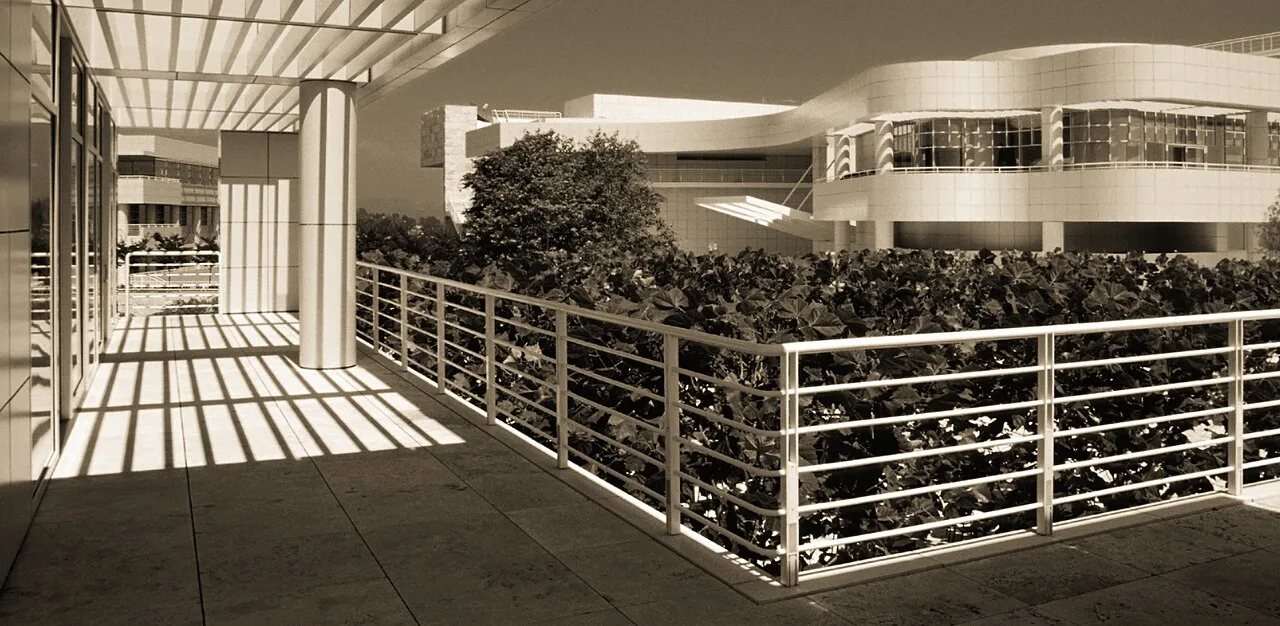
The Getty Center, Los Angeles, designed by Richard Meier. Opened in 1997, the Getty Center sits atop a hill in the Santa Monica Mountains and houses the J. Paul Getty Museum, the Getty Research Institute, the Getty Conservation Institute, and the Getty Foundation. The campus is built from white travertine and is organized around two competing grids that align with the natural ridges of the site. The Central Garden was designed by Robert Irwin, the Los Angeles artist who helped define the Light and Space movement. Image via Wikimedia Commons.
Ferus Gallery and the 1960s Scene
Ferus Gallery, founded in 1957 by Walter Hopps and Ed Kienholz on La Cienega Boulevard, was the gallery that started the Los Angeles art scene. Ferus gave Ed Ruscha his first solo show in 1963. It showed Craig Kauffman, John McCracken, Larry Bell, and Robert Irwin — the artists who would later be grouped under the labels "Light and Space" and "Finish Fetish." Ferus also showed New York artists like Andy Warhol and Roy Litchenstein, bringing East Coast Pop Art to Los Angeles. The gallery closed in 1966, but its impact was lasting. It proved that a Los Angeles gallery could show work of international significance.
Ed Ruscha is the defining artist of the Los Angeles scene. His paintings of the Hollywood sign, gas stations, and the Twentysix Gasoline Stations book (1963) are deadpan records of the Los Angeles landscape. Ruscha painted the city as it actually was — strip malls, parking lots, signs — with a detachment that was new. He was not celebrating or criticizing. He was recording. For more on the broader context of American art in this period, see our guide to American modernism.
Light and Space
The Light and Space movement is the art movement that could only have come from Los Angeles. The qualities of Los Angeles light — bright, flat, even, and relentless — and the availability of new industrial materials — fiberglass, polyester resin, acrylic — produced a kind of art that was about perception itself. Robert Irwin made scrim installations that dissolved the boundaries of the gallery. James Turrell made rooms where the light was the artwork. Larry Bell made glass cubes that interacted with ambient light. Craig Kauffman made vacuum-formed plastic panels with translucent surfaces. John McCracken made polished resin planks that sat on the floor and leaned against the wall, reflecting the room.
The Light and Space artists were not a formal group. They were a loose collection of artists working in Los Angeles in the 1960s and 1970s who shared an interest in perception, light, and surface. What connected them was not a manifesto but a set of material conditions: the light of Los Angeles, the aerospace and surfboard industries that provided new materials, and the distance from New York, which allowed them to develop without the pressure of the New York art world. For more on how art can challenge perception, see our guide to why abstract art makes people uncomfortable.
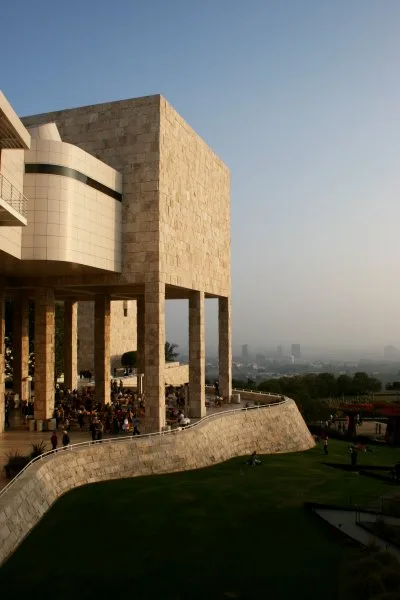
The Getty Center, Los Angeles. View from the Restaurant Building to the Museum Entrance Hall and the East Building. The Getty Center's architecture, by Richard Meier, is characterized by white travertine surfaces, strong contrasts of light and shadow, and a layout that exploits the natural topography of the site. Image via Wikimedia Commons.
CalArts and Conceptual Art
The California Institute of the Arts (CalArts), founded by Walt Disney in 1961 and opened in Valencia in 1971, became the most important art school on the West Coast. CalArts was designed to be different from traditional art schools. It had no departments — students could move freely between film, art, music, and theater. The faculty included John Baldessari, who taught there from 1970 to 1988 and whose conceptual art practice shaped a generation of Los Angeles artists. Baldessari's students included Cindy Sherman, David Salle, and Eric Fischl — though they are more associated with New York, their formation was partly Californian.
The CalArts approach was conceptual. Baldessari's own work — photographs with painted dots over faces, text-and-image combinations, appropriated film stills — was about the relationship between images and meaning, not about craft or medium. This conceptual approach spread through the Los Angeles art world in the 1970s and 1980s, producing artists like Mike Kelley, Paul McCarthy, and Diana Thater, whose work was more aligned with the international conceptual art scene than with the Light and Space movement. For more on this broader context, see our guide to postmodernism in art.
The Getty Center and the Museums
The Getty Center, opened in 1997, was the moment when Los Angeles's museum infrastructure caught up with its artist community. The Getty Center cost $1.3 billion to build, making it the most expensive art institution ever constructed. It houses the J. Paul Getty Museum's collection of European paintings, drawings, manuscripts, sculpture, and decorative arts, as well as photographs from the 1830s to the present. The architecture, by Richard Meier, and the Central Garden, by Robert Irwin, are themselves major works of art. The Getty Center draws 1.8 million visitors annually.
The Los Angeles County Museum of Art (LACMA), founded in 1961, is the largest art museum in the western United States. Its collection spans ancient to contemporary, with particular strength in Latin American art, Korean art, and contemporary art. LACMA's campus on Wilshire Boulevard includes buildings by William Pereira, Bruce Goff, and Renzo Piano, and the museum has recently undergone a controversial rebuilding by Peter Zumthor. The Museum of Contemporary Art (MOCA), founded in 1979, was the first museum in Los Angeles dedicated to contemporary art. The Broad, opened in 2015, houses Eli Broad's collection of postwar and contemporary art in a building by Diller Scofidio + Renfro. The Hammer Museum, originally founded by Armand Hammer, has become one of the most important venues for emerging Los Angeles artists under the direction of Ann Philbin.
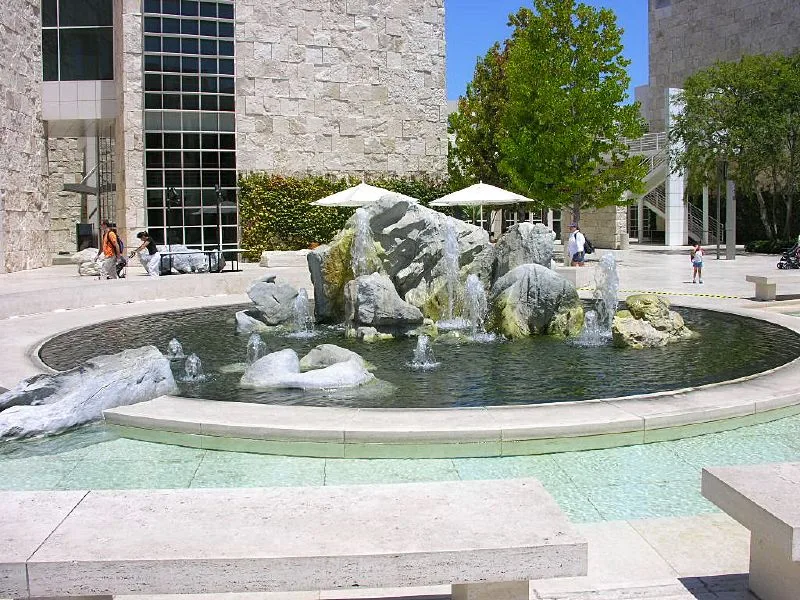
The central courtyard fountain at the Getty Center, Los Angeles. The fountain is part of the Central Garden designed by Robert Irwin, the Light and Space artist. Irwin's garden — with its stream, azalea maze, and bougainvillea arbors — is a living artwork that changes with the seasons. Irwin's statement, "Always changing, never twice the same," is carved into the plaza floor. Image via Wikimedia Commons.
The Gallery Scene: Venice to Culver City
The Los Angeles gallery scene has moved several times. In the 1970s and 1980s, galleries were in Venice Beach, where Ed Ruscha and other artists had studios. In the 1990s and 2000s, galleries moved to Culver City, where former industrial spaces provided the large rooms that contemporary art requires. Culver City became the Chelsea of Los Angeles, with galleries like Blum & Poe, Roberts & Tilton, and Various Small Fires lining La Cienega Boulevard and Washington Boulevard. More recently, galleries have opened in Hollywood, in the Arts District downtown, and in Mid-Wilshire near LACMA.
The Los Angeles gallery scene is smaller than New York's, but it has grown significantly in the last two decades. The Frieze Los Angeles art fair, launched in 2019, brought international collectors and galleries to the city and confirmed Los Angeles's status as a global art capital. For more on how galleries function, see our guide to how the art market works.
What Makes Los Angeles Different
Los Angeles is different from New York, Paris, and Berlin because it is a city of sprawl, not density. The art scene is spread across the city — museums in Mid-Wilshire and Brentwood, galleries in Culver City and Hollywood, studios in Vernon and the Arts District. There is no single art district that you can walk through. The city's car culture, which shapes everything else, shapes the art scene too. You drive to the galleries. You drive to the museums. You drive to the studios. This is not a disadvantage. It means that each part of the art scene has room to breathe, and the distances between them create a different kind of art experience — one that is more deliberate, more spread out, and more attuned to the specific qualities of the city.
The other thing that makes Los Angeles different is the relationship between the art world and the film industry. Many Los Angeles artists have worked in film — Ed Ruscha worked as a layout designer, John Baldessari made films, Paul McCarthy's work references Hollywood. The film industry provides a pool of technical expertise, materials, and fabrication skills that artists in other cities do not have access to. For more on the intersection of art and visual culture, see our guide to Pop Art.
Final Thoughts
Los Angeles became a global art city because a group of artists in the 1960s made work that came from the specific qualities of the city — its light, its space, its surfaces, its car culture. The Ferus Gallery gave them a venue. CalArts gave them a school. The Getty Center, LACMA, MOCA, and the Broad gave them museums. The galleries in Culver City and Hollywood gave them a market. The result is an art scene that is unlike any other, and that has produced some of the most distinctive art of the last 60 years.
Start at the Getty Center for the architecture, the garden, and the European collection. Go to LACMA for the breadth. Go to the Broad for postwar and contemporary. Go to MOCA for Los Angeles art. Then drive to Culver City to see the galleries. For more on the movements that shaped the Los Angeles scene, see our guides to abstract art and postmodernism. For a wider view, see our guide to modern vs contemporary art.


