Cleveland Museum of Art Open Access: The Most Tech-Forward Museum API Available
The Cleveland Museum of Art (CMA) launched its open access initiative in January 2019, making it one of the earliest major US museums to release collection images under Creative Commons Zero (CC0). Five years later, the API has been downloaded 47 million times, and images of collection objects have been viewed over 300 million times on Wikimedia platforms. In July 2026, the museum is launching ArtLens Reimagined, its third and most ambitious digital gallery iteration, featuring AI-powered interactives trained exclusively on the museum's public domain collection.
What sets Cleveland apart from other open access museums is not the collection size (37,000-plus CC0 images is smaller than the Met's 492,000) but the technical infrastructure. The API is well-documented, updated daily through an automated process, and includes features that no other museum open access program offers.
The API: Version 4.0.3
The CMA Open Access API is at version 4.0.3 as of July 2026. It provides access to data on more than 64,000 artwork records in the collection, with image assets for over 37,000 works released under CC0. The API is free for both commercial and noncommercial use.
Recent updates in 2026 include:
- Added_to_oa filters (v4.0.2, February 2026): New advanced search filters allow you to query artworks added to open access before or after a specific date. This currently works for 2026 onward, with efforts underway to reconstruct historical add dates.
- ArtLens and Early Education descriptions (v4.0.3, July 2026): New fields for didactic content used in the ArtLens app and the "Little Learners" program.
- Daily automated updates: The API syncs with the museum's central collection content management system every night by 5 AM, meaning any cataloging changes appear in the API within 24 hours.
The entire dataset is also available as JSON or CSV downloads from the museum's GitHub repository, which is useful for data scientists who want the complete collection without making API calls.
ArtLens Reimagined: AI Meets Open Access
Launching July 28, 2026, ArtLens Reimagined is the museum's most ambitious digital project. It uses AI trained exclusively on the museum's public domain artworks to create new interactive experiences:
- Art Morph: A generative AI tool that transforms everyday materials into artworks inspired by the open access collection. Users rearrange items and the AI dynamically creates new compositions based on public domain works.
- Community Mural: A collaborative digital mural where AI helps cut out specific elements of artworks (plants, hats, people) so users can collage them together with less manual effort.
The redesigned ArtLens app (iOS and Android) launches alongside the gallery with a unified codebase, accessibility features for blind and low-vision visitors, and a fall 2026 feature that lets visitors point their phone camera at any artwork to instantly access information, images, audio, and video.
For developers and digital artists, ArtLens demonstrates what becomes possible when a museum commits to both open access licensing and serious technical infrastructure. The AI tools are trained on CC0 content, which means the generated compositions carry no copyright restrictions.
The Collection Strengths
Asian Art
Asian art is the CMA's most celebrated holding, widely regarded as one of the finest collections in the United States. The collection covers Chinese bronzes, ceramics, jade, and painting from the Neolithic period onward; Japanese painting, sculpture, ceramics, lacquerware, and metalwork from the Heian period through the modern era; Indian and Southeast Asian sculpture with major Hindu and Buddhist works; and Korean ceramics.
The Japanese painting collection is particularly strong, with major works in every format including hanging scrolls, folding screens, and albums. For artists studying Japanese artistic traditions, the high-resolution CC0 images allow detailed examination of brushwork, composition, and materials.
Medieval European Art
The medieval collection covers early Christian through late Gothic, with major works in painting, sculpture, ivory, enamel, metalwork, and textiles. The Byzantine art holdings are among the most important in the US, with mosaics, ivories, enamels, and manuscript illumination. The Romanesque and Gothic sculpture collection includes significant architectural sculpture from medieval churches and cathedrals.
American Art
The American collection spans colonial through 20th-century work. Hudson River School paintings by Thomas Cole, Frederic Church, and Albert Bierstadt are a highlight. The American modernism holdings include works by Georgia O'Keeffe, Charles Sheeler, and Stuart Davis, documenting the development of American modernism into Abstract Expressionism.
3D Models on Sketchfab
The CMA extends its open access policy to three-dimensional scans of public domain artworks. These 3D models are hosted on Sketchfab and can be downloaded directly. For 3D artists, game developers, and AR/VR creators, this is a resource that most museum open access programs do not offer. The models include sculptures, decorative objects, and architectural fragments.
How It Compares
Compared to the Art Institute of Chicago, which offers 50,000-plus CC0 images, the CMA has fewer images (37,000+) but a more frequently updated API and 3D model support. The AIC has stronger Impressionist holdings; Cleveland has stronger Asian and medieval collections.
Compared to the Metropolitan Museum, which offers 492,000-plus open access images, the CMA has a much smaller collection but a more developer-friendly API with better documentation and daily updates.
Compared to Artvee, the CMA offers higher resolution images, API access, 3D models, and richer metadata. Artvee wins on browsing experience for non-technical users.
Practical Uses for Artists and Developers
Painters studying Asian or medieval art traditions can download high-resolution images to examine specific techniques. The Asian painting collection is particularly valuable for studying brushwork, composition, and material handling.
3D artists and game developers can download Sketchfab models for reference, study, or direct use in projects. The CC0 license means no attribution or licensing fees.
Developers can build applications using the well-documented API. The daily updates and GitHub data dumps make it easy to keep local databases in sync.
Data scientists can use the API and datasets for machine learning projects, data visualization, or digital humanities research. The museum's own ArtLens AI tools demonstrate what becomes possible with CC0 training data.
Designers working with Asian or medieval decorative traditions can source patterns, motifs, and color combinations from the collection.
Insider Tips
- Use the
cc0 filter in the API to return only open access images. Use copyrighted to see metadata for works still under copyright (images not included).
- The
added_to_oa_after filter lets you track newly added open access works. Set it to 20260101 to see everything added in 2026.
- 3D models are not in the API directly. Browse them on the museum's Sketchfab page.
- The Live Virtual Dashboards show real-time usage statistics for the open access collection, updated daily. Useful for understanding which works are most popular.
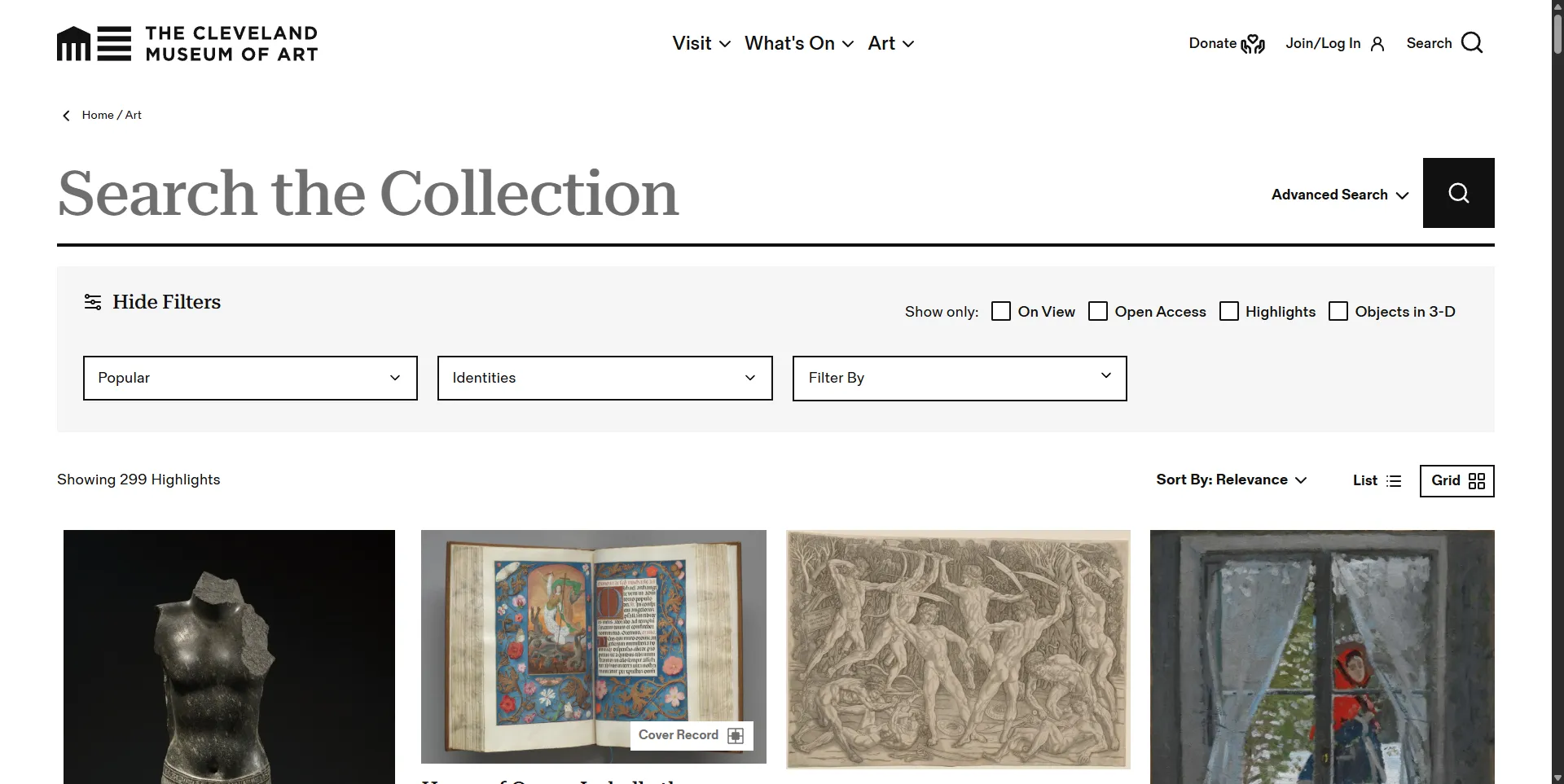
- The museum's website launched a new version in January 2024 with improved collection search that makes it easy to identify which works are open access.
Final Verdict: Who Is This Actually For?
The Cleveland Museum of Art Open Access program is the best choice for developers, data scientists, and digital artists who need a well-documented API, 3D models, and daily-updated collection data. The ArtLens Reimagined launch in July 2026 makes it the most technically innovative museum open access program available.
If you need the largest possible collection of CC0 art images, go to the Met. If you need the finest Impressionist collection, go to the Art Institute of Chicago. But if you need API reliability, 3D models, and a museum actively building AI tools on top of its open access collection, Cleveland is the right choice.
Visit the CMA open access page to start browsing, read the API documentation, or explore the GitHub repository for complete datasets.