
In 1825, a young English immigrant named Thomas Cole took a steamboat up the Hudson River to the Catskill Mountains. He painted what he saw: steep cliffs, dense forests, and a river bending through a valley that looked nothing like anything in European painting. He exhibited the paintings in a New York shop window, and within three years he was the most talked-about artist in America. The movement he started, the Hudson River School, would dominate American painting for 50 years.
The Hudson River School was the first distinctly American art movement. It arose in the 1820s, just as the United States was expanding westward and defining its national identity. The painters depicted American wilderness as a divine revelation, evidence that God had blessed the continent and intended it for American settlement. The connection to Romanticism is direct: both movements treated nature as a source of spiritual truth, and both preferred the sublime to the beautiful.
This guide covers Cole's founding role, Church's expansion to South America, Bierstadt's Western landscapes, the Luminist offshoot, and the movement's complicated relationship with Indigenous displacement and Manifest Destiny.
Thomas Cole and the Founding
Thomas Cole (1801 to 1848) was born in England and emigrated to Ohio as a teenager. He trained as an engraver, moved to New York in 1825, and took that steamboat up the Hudson the same year. The 1825 Catskill paintings were exhibited at William Coleman's shop window, where they were bought by John Trumbull, Asher B. Durand, and William Dunlap, all of whom promoted him aggressively. The speed of Cole's rise is remarkable. He went from unknown to celebrated in less than three years.
Cole's vision of American landscape was double-edged. He saw it as a new Eden, untouched by European history, but also as fragile. His "Course of Empire" series (1833 to 1836) warned that all civilizations rise and fall. The series follows a single city from pastoral origins through conquest, destruction, and desolation. The third painting, "Destruction" (1836), shows a vast city being sacked, with burning buildings, collapsing statues, and soldiers slaughtering civilians. It is 100 by 161.3 centimeters and is now at the New-York Historical Society. Cole was painting a warning about the American project, not a celebration of it.
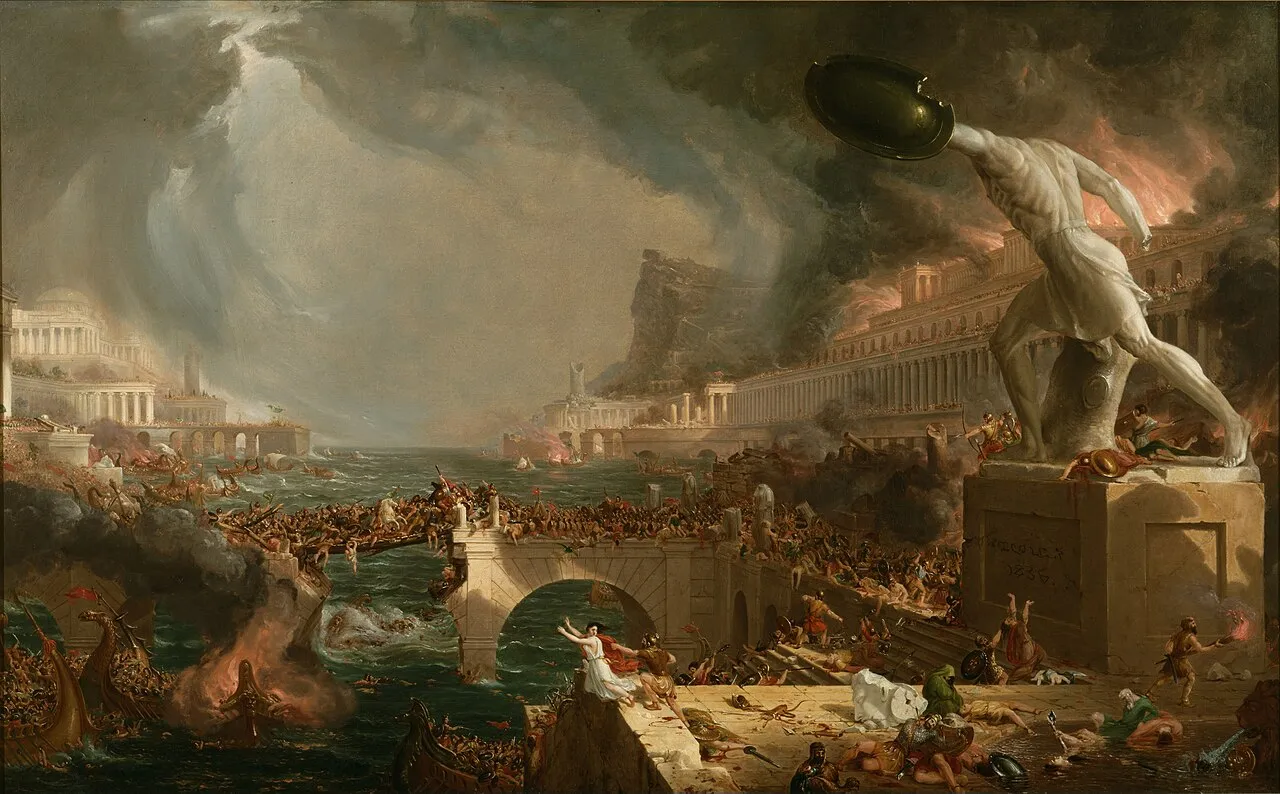
Thomas Cole, "The Course of Empire: Destruction" (1836). Oil on canvas, 100 x 161.3 cm. New-York Historical Society. Image: Public domain, via Wikimedia Commons
"The Oxbow" (1836), formally titled "View from Mount Holyoke, Northampton, Massachusetts, after a Thunderstorm," is 130.8 by 193 centimeters and is now at the Metropolitan Museum of Art. The composition is split. The left side shows dark, stormy wilderness. The right side shows settled farmland under a clearing sky. Cole paints himself in the foreground, looking at the viewer. The Met's label notes the painting "emphasizes the encroachment of Euro-American settlement into a supposed untamed wilderness." The painting is both a celebration and a question: what happens when the wilderness becomes farmland?
2025 marked the COLE 200 commemoration, celebrating 200 years since Cole's first public display of Hudson River Valley landscapes in New York City. In 2026, the Thomas Cole National Historic Site in Catskill, NY, is continuing the celebration with two exhibitions. "Thomas Cole: An American Visionary" opened April 25 in the new Richard T. Sharp Gallery, featuring a section exploring the artistic exchange between Cole and his student Frederic Church, including an original 19th-century landscape painting by Church on loan. "Circles of Influence: Thomas Cole and the American Landscape Movement" opens June 20, bringing together works by Cole, Church, Asher B. Durand, Jasper Francis Cropsey, Albert Bierstadt, Susie Barstow, and Mary Josephine Walters. As the Thomas Cole National Historic Site explains, the 2026 programming is part of the broader America 250 commemoration, positioning Cole as the artist who gave the young nation its visual identity.
Frederic Church and the Sublime
Frederic Edwin Church (1826 to 1900) was Cole's only student. He studied with Cole from 1844 to 1846 in Catskill, and after Cole's death in 1848, he took over as the leading figure of the Hudson River School. Church's ambition was bigger canvases, wider landscapes, and more scientific detail than his teacher. Where Cole painted the Catskills, Church painted the Andes, the Arctic, and the Middle East.
"The Heart of the Andes" (1859) is 168 by 302.9 centimeters, and it is the painting that made Church famous. He traveled to Ecuador and Colombia in 1853 and 1857, and the painting is a composite of South American topography: Mount Chimborazo, a jungle waterfall, a plain with a church and a cross. Over 12,000 people paid 25 cents each to see it in New York. Church's exhibition strategy was as innovative as his painting. He showed single paintings in darkened rooms with special lighting, charging admission. The model made him one of the best-known and wealthiest American artists of the 19th century.
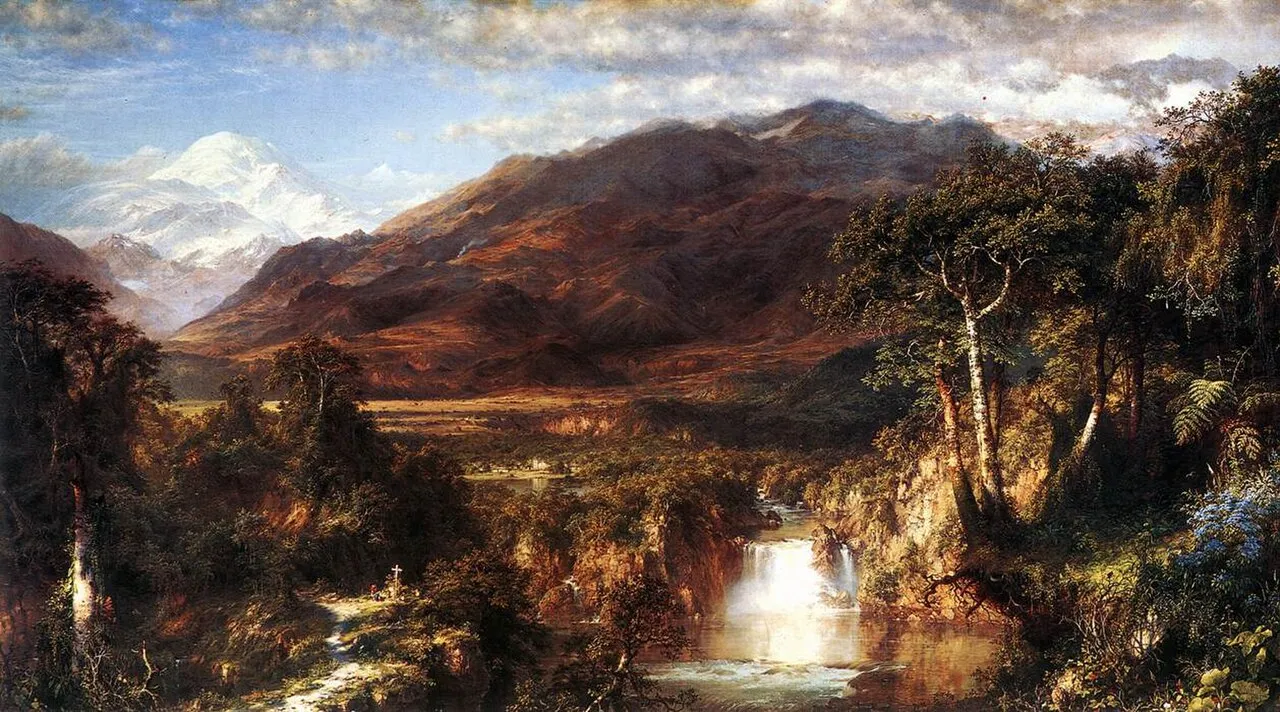
Frederic Edwin Church, "The Heart of the Andes" (1859). Oil on canvas, 168 x 302.9 cm. Metropolitan Museum of Art, New York. Image: Public domain, via Wikimedia Commons
2026 marks the Frederic Church bicentennial, organized as FREDERIC CHURCH 200 by The Olana Partnership. The flagship exhibition, "Frederic Church: Global Artist," runs from May 17 to October 25, 2026, at Olana State Historic Site, Church's home across the Hudson River from the Thomas Cole Site. Co-curated by Elizabeth Kornhauser (Curator Emerita at the Metropolitan Museum of Art), Tim Barringer (Yale University), and Jennifer Raab (Yale University), the exhibition unites drawings and oil sketches from Church's global travels with his large exhibition paintings. As the Olana State Historic Site describes, the show examines Church as a global artist whose work was shaped by travel to South America, the Arctic, Europe, the Middle East, and Mexico. The Hudson River Skywalk, a pedestrian walkway connecting the Thomas Cole Site with Olana across the Hudson River, offers a way to visit both sites on foot.
Albert Bierstadt and the West
Albert Bierstadt (1830 to 1902) was German-born, trained in Dusseldorf, and returned to America in 1859. That same year, he joined a government survey expedition heading west, becoming the first major artist to accompany a survey team. The journey produced a body of work that would define how Americans imagined the Western landscape for decades.
"Among the Sierra Nevada, California" (1868) is 183 by 305 centimeters. The painting depicts a pristine Sierra lake with deer at the water's edge, snow-capped peaks, and dramatic clouds. No human settlement. No Indigenous presence. The landscape is empty, waiting. Bierstadt's paintings were enormously popular with the public, but critics accused him of exaggerating the scale and drama. His paintings were called "theatrical" and "operatic," and the criticism was not entirely wrong. Bierstadt did exaggerate. He compressed distances, heightened contrasts, and enlarged mountains. But the exaggeration was the point. These paintings were not documentation. They were argument.
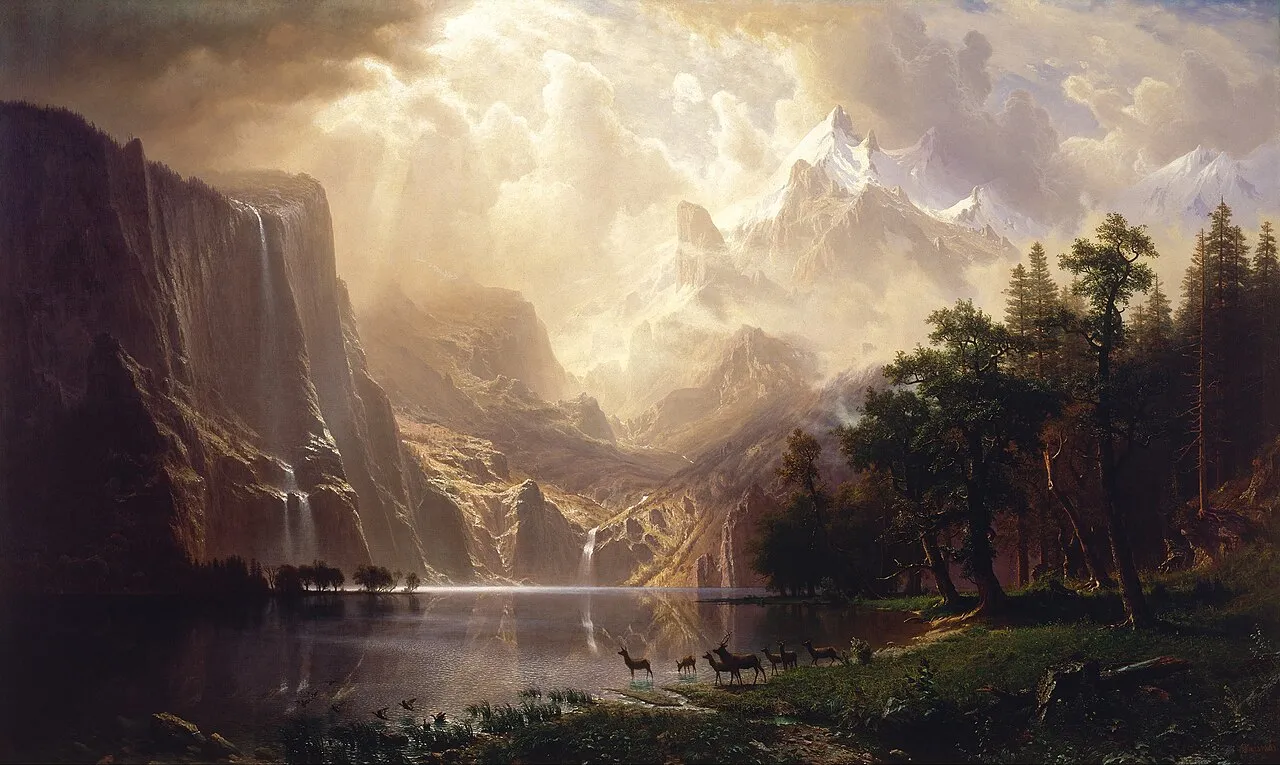
Albert Bierstadt, "Among the Sierra Nevada, California" (1868). Oil on canvas, 183 x 305 cm. Smithsonian American Art Museum, Washington. Image: Public domain, via Wikimedia Commons
The political function of Bierstadt's paintings was to present the West as a vast, empty, beautiful wilderness. This required ignoring the Indigenous populations who lived there and the wars being fought to remove them. The paintings made American expansion look like a discovery rather than a conquest. For more on how landscape painting has been used to make political claims, see our post on landscape painting traditions and our guide to how to look at art.
Luminism and the Quiet Offshoot
Luminism is a related but distinct tendency within American landscape painting. It is less dramatic than Church or Bierstadt, more focused on calm water, smooth surfaces, and still light. The key figures are Fitz Henry Lane, Martin Johnson Heade, and John Frederick Kensett.
Luminism's difference is immediately visible. No towering mountains, no dramatic storms, no sublime terror. Instead: quiet harbors, flat horizons, and light that seems to come from inside the painting. The surfaces of Luminist paintings are so smooth that brushmarks are nearly invisible. The effect is meditative rather than overwhelming.
The connection to Transcendentalism is clear. Luminist stillness echoes Thoreau's observation of Walden Pond. The divine is found in quiet attention, not in spectacle. This is a different kind of spiritual claim than Church's sublime, and it belongs to the same American moment that produced Emerson and Thoreau. For more on how art engages with spiritual experience, see our post on art and religion.
The Indigenous Question
The Hudson River School painters depicted a continent that was not empty. The landscapes they painted were the homelands of Indigenous nations: Mohican, Mohawk, Iroquois, Shoshone, and many others. These nations were being forcibly removed during the exact decades these paintings were made. The Indian Removal Act was signed in 1830, the same decade Cole was painting the Catskills. The Trail of Tears happened in 1838. Bierstadt's Western paintings were made during the Plains Wars.
Cole's "Indians Viewing Landscape" (c. 1840) is a small painting showing Native figures in the landscape. The 2024 to 2025 exhibition "Native Prospects: Indigeneity and Landscape" at the Thomas Cole National Historic Site juxtaposed Cole's paintings with works by contemporary Indigenous artists including Teresa Baker, Brandon Lazore, and Kay WalkingStick. As the Thomas Cole National Historic Site's Native Prospects page explains, the exhibition argued that Cole's approach to landscape was not identical to later painters who erased Indigenous presence entirely. He included Native figures, even if he did not fully understand their relationship to the land.
The Hudson River School's beauty is real, but it is beauty with a political function. The paintings made American expansion look like divine providence rather than conquest. Admiring the paintings while acknowledging this function is not contradiction. It is honesty. The 2026 "Circles of Influence" exhibition at the Thomas Cole Site, which includes women painters like Susie Barstow and Mary Josephine Walters alongside the canonical male artists, is part of the same project of expanding the narrative. For more on how governments have used visual culture for political ends, see our guide to art and politics.
Final Thoughts
The Hudson River School lasted roughly 50 years, from about 1825 to 1875, and produced the first American paintings that rivaled European art in scale and ambition. Its vision of American wilderness as divine revelation shaped how Americans saw their own country, and how they justified taking it.
The 2026 bicentennial of Frederic Church's birth, combined with the ongoing America 250 commemoration, has produced the most extensive programming in the history of the Thomas Cole National Historic Site and Olana State Historic Site. The two sites face each other across the Hudson River, connected by the Hudson River Skywalk, and visiting both in a single day gives you a physical sense of the relationship between Cole and Church that no book can match.
Visit the Thomas Cole National Historic Site in Catskill, NY, and Olana, Frederic Church's home across the river. The Cole Site is open May through December. Olana is open year-round. "Thomas Cole: An American Visionary" runs through December 2026, and "Frederic Church: Global Artist" runs from May 17 to October 25, 2026. For the broader context of where the Hudson River School sits in art history, see our art movements timeline and our art history cheat sheet.


