MFA Boston Open Access: The Best Japanese Art Collection Outside Japan, Free to Download
The MFA Boston holds over 4,000 Japanese paintings and more than 30,000 ukiyo-e prints, one of the largest such collections in the world. William Sturgis Bigelow, a 19th-century Bostonian who lived in Japan and served as an MFA trustee, donated the majority of these works. Today, all of them are available under Creative Commons Zero (CC0), free for any use without attribution.
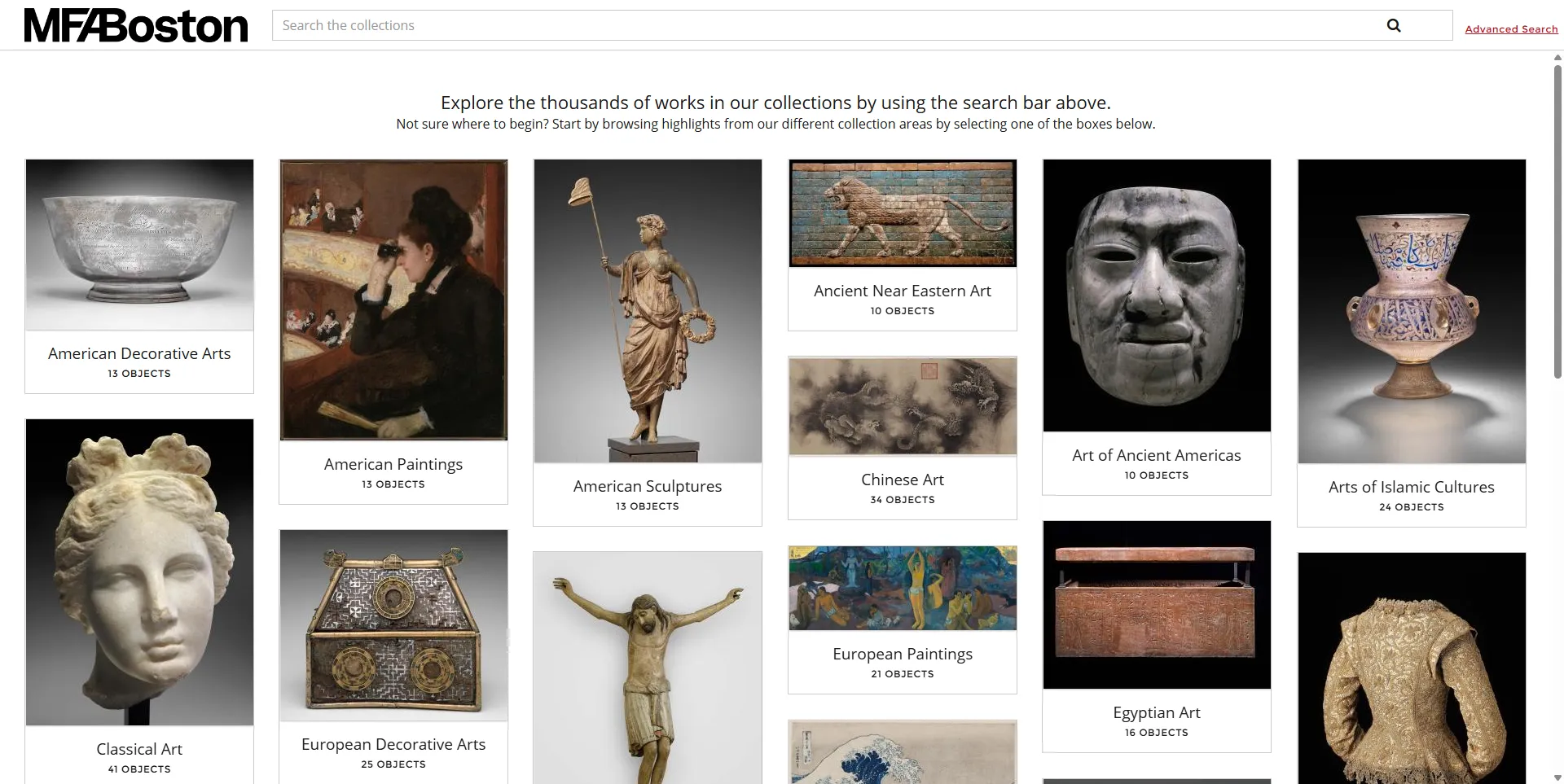
The Museum of Fine Arts Boston was founded in 1870, the same year as the Met. Its collection encompasses about 500,000 works of art, with nearly 440,000 object records available on its collections website. The open access program provides over 500,000 high-resolution images under CC0, covering American art, Asian art, ancient Egyptian art, European painting, and decorative arts.
The Japanese Collection: Why the MFA Matters
In 1890, the MFA became the first museum in America to establish a Japanese collection and appoint a curator specialising in Japanese art. Its Asian Conservation Studio is one of only five such studios in the United States and is the oldest outside Asia.
The collection includes the eighth-century Hokkedo hon mandara, one of the earliest extant landscape paintings in East Asia. The 1189 image of Miroku is the earliest dated work by the master sculptor Kaikei. The mid-13th-century Ban Dainagon ekotoba chronicles the burning of the Sanjo Palace in vivid detail. These are not minor works. They are foundational objects in the history of Japanese art.
Ukiyo-e prints number over 30,000, including works by Katsushika Hokusai, Utagawa Hiroshige, and other masters of the floating world tradition. For printmakers and illustrators studying woodblock printing techniques, this is the most accessible collection of its kind. The high-resolution scans show the registration marks, carved details, and pigment characteristics that define ukiyo-e as a medium.
Japanese ceramics, lacquerware, swords, and Noh robes round out the collection with objects that document Japanese material culture from the 8th century through the present day. The Art of Japan gallery, reinstalled in January 2013, features over 130 objects organised into five sections: Art of the Rulers, Art of the Town, Mingei (Folk Art), new acquisitions, and contemporary work.
American Art: Sargent and the Colonial Tradition
The MFA's American collection is one of the finest in the United States, covering the colonial period through the 20th century.
John Singer Sargent is represented by an extraordinary group of works, from his society portraits to his watercolours to his monumental decorative paintings for the Boston Public Library. The Sargent collection at the MFA is one of the most important in the world. The high-resolution images allow detailed study of his fluid brushwork, his approach to capturing fabric and light, and the specific techniques that made him the most sought-after portraitist of his era.
Colonial and federal period works include major portraits by John Singleton Copley and Gilbert Stuart. The Copley collection is particularly valuable for studying the transition from American colonial to American federal portraiture, showing how painting technique and compositional conventions evolved alongside the new nation.
American decorative arts include silver, furniture, and ceramics from the colonial period through the 20th century. The silver collection is one of the most important in the United States, documenting the development of American silversmithing from the colonial period through the Arts and Crafts movement.
Ancient Egyptian Art: The Old Kingdom Sculpture
The MFA holds one of the most important ancient Egyptian art collections in the United States, covering the Predynastic period through the Roman period. The Old Kingdom sculpture is the standout, with major works from the pyramid age that show ancient Egyptian sculptors at the height of their tradition.
The collection includes significant objects from the Giza plateau, acquired through joint archaeological expeditions with Harvard University in the early 20th century. For artists studying ancient Egyptian visual conventions, the high-resolution images show the specific approaches to proportion, idealisation, and material treatment that define this tradition.
The Search Experience
The MFA's collections search provides filtering by artist, period, medium, culture, classification, and gallery location. The "On View" filter lets you find objects currently displayed in the museum, useful if you are planning a visit. The gallery number search lets you find all objects in a specific gallery, which is helpful for understanding the curatorial organisation of the collection.
One limitation: the MFA's API is not publicly documented in the same way as the Met's keyless API or the Harvard Art Museums API. The collections website is the primary access point for most users. If you need programmatic access, you will need to contact the museum directly.
Another quirk: exhibitions often feature artworks on loan from other institutions. Only objects owned by the MFA appear on the website. If you saw a painting in a special exhibition and cannot find it online, it was likely on loan.
MFA Boston vs. Other Open Access Programs
Compared to the Met Open Access, the MFA has a comparable number of images (500,000 vs 492,000+) but a stronger Japanese collection. The Met has a better API, broader global coverage, and more consistent image quality. The MFA has the edge for Japanese art specifically and for American colonial and federal period material.
Compared to the Harvard Art Museums, both are in the Boston area and both offer CC0 images. Harvard has a better API with colour extraction and IIIF support. The MFA has a larger collection and stronger Japanese, Egyptian, and American holdings. Harvard has the unique German Expressionism and Byzantine specialisations.
Compared to the Getty Open Content, the MFA offers far more images (500,000 vs 88,000) and broader cultural coverage. The Getty has a stronger photography collection and more consistent metadata.
Insider Tips
Search by gallery number. If you are planning a museum visit, use the gallery number filter to preview what is on display in specific galleries. This helps you plan your route through the museum.
Use the "On View" filter for current displays. Not every object in the collection is on display at any given time. The "On View" filter shows only objects currently in the galleries.
Check provenance information. The MFA provides detailed provenance for most objects, documenting ownership history. For researchers studying the history of collecting, this information is valuable.
Look for the download button on each object page. High-resolution images are available for download directly from the object page. No registration or login is required.
Explore the Japanese collection first. If you are new to the MFA's collection, start with the Japanese holdings. This is where the MFA outperforms every other American museum, and the quality and depth of the collection will surprise you.
Who Is This For?
MFA Boston Open Access is for artists and researchers focused on Japanese art, American colonial and federal period art, or ancient Egyptian art. It is for printmakers studying ukiyo-e woodblock printing techniques. It is for designers who need high-quality decorative arts reference from the American or Japanese traditions.
It is not for you if you need a well-documented public API (use the Met or Harvard), if you need European painting (the National Gallery of Art or Getty are stronger), or if you need photography (the Getty has a better collection).
Getting Started
Browse the MFA Boston collections and use the filters to narrow by culture, classification, or gallery. Download any CC0 image directly from the object page. No registration, no attribution required. For Japanese art specifically, search by classification "Paintings" or "Prints" and filter by culture "Japanese" to access the strongest part of the collection.