
In the early 1980s, a group of American painters made work that the critical establishment had been insisting was impossible: large, gestural, figurative paintings that asserted the continued relevance of painting as a medium at the precise moment when the most sophisticated voices in art criticism were declaring it finished. The movement was called Neo-Expressionism in Germany and Bad Painting or Neo-Geo in the United States, but its American wing had a character of its own. These painters were not interested in expressiveness for its own sake. They were interested in painting as a vehicle for examining what it meant to live inside a culture saturated with images from every source and every era simultaneously.
David Salle, born in Norman, Oklahoma, in 1952, was the most intellectually consistent and formally inventive of the American Neo-Expressionist generation. His paintings from the early 1980s onward layer multiple images on the same canvas in ways that deny the viewer any conventional path through the composition. A figure drawn from pornography sits alongside a fragment of art history. A piece of furniture is painted in one style while a figure in the same painting is rendered in another. Text appears and disappears. The images belong to different registers of visual culture and different moments in history, and their co-presence on the same canvas refuses to resolve into a single statement about any of them.
Training and Context
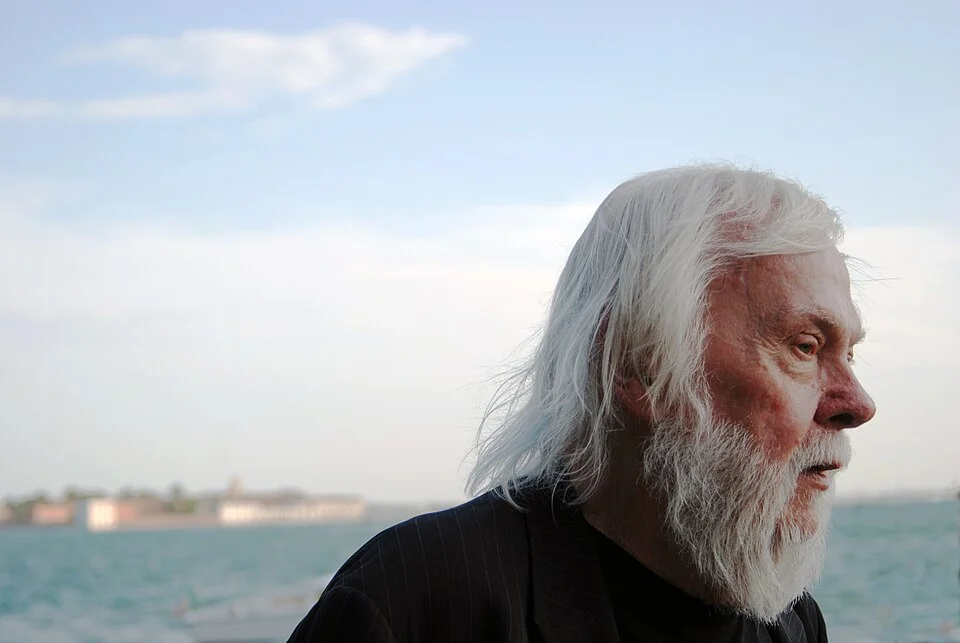
John Baldessari (2009), the conceptual artist who taught Salle at CalArts and whose influence is visible throughout Salle's work. Image: CC BY 3.0, via Wikimedia Commons
Salle studied at the California Institute of the Arts in Valencia under John Baldessari, one of the central figures of conceptual art in the 1970s and one of the most important art teachers of the past 50 years. Baldessari's influence is visible throughout Salle's work: the use of found imagery, the interrogation of art's visual language, the willingness to treat painting as a medium for examining image culture rather than simply producing more images. But where Baldessari's practice tended toward photographic and text-based work, Salle redirected these conceptual investigations back into the medium of oil paint.
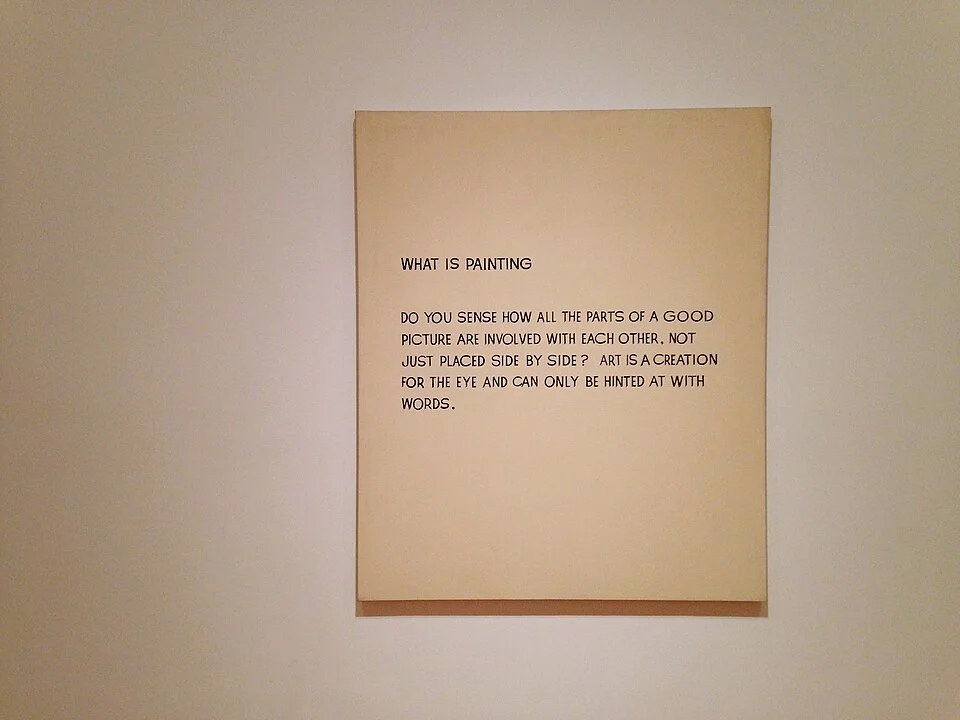
John Baldessari, What Is Painting (1966-68). The conceptual investigation of image and language that shaped Salle's approach to painting. Image: CC BY 2.0, via Wikimedia Commons
He moved to New York in 1975 and became embedded in the downtown art scene of the late 1970s, a scene that also included Julian Schnabel, Jean-Michel Basquiat, Keith Haring, and Cindy Sherman. The conversations and competitive energies of this community, combined with the explosive growth of the art market in the early 1980s, provided both the intellectual context and the economic fuel for the generation's rapid rise to prominence. As the art historian Hal Foster documented in his 1996 book "The Return of the Real," this period saw a contested negotiation between the claims of postmodern theory and the market's appetite for painting as a collectible commodity.
The Paintings: Structure and Method
A characteristic Salle painting from the early 1980s consists of two or more panels, or a single large canvas divided into distinct zones, each containing images in different styles and from different sources. The images are drawn from a combination of high and low visual culture: art history (Manet, Poussin, genre painting), pornography, advertising, comic books, pattern and ornament, and direct observation. They are painted in styles that correspond to their source material: a figure borrowed from a pornographic photograph might be rendered in a thin, washed-out gray that mimics the photographic source, while a fragment of painted pattern in the same work is rendered in dense, saturated color.
The juxtaposition of these elements is the work's central activity. Salle is not interested in creating unified visual compositions in which all the elements contribute to a single effect. He is interested in the confrontation between incompatible visual languages and cultural registers. The viewer cannot settle on a stable interpretation because the painting refuses to organize itself into one. This refusal is not a failure of organization but the work's primary aesthetic principle.
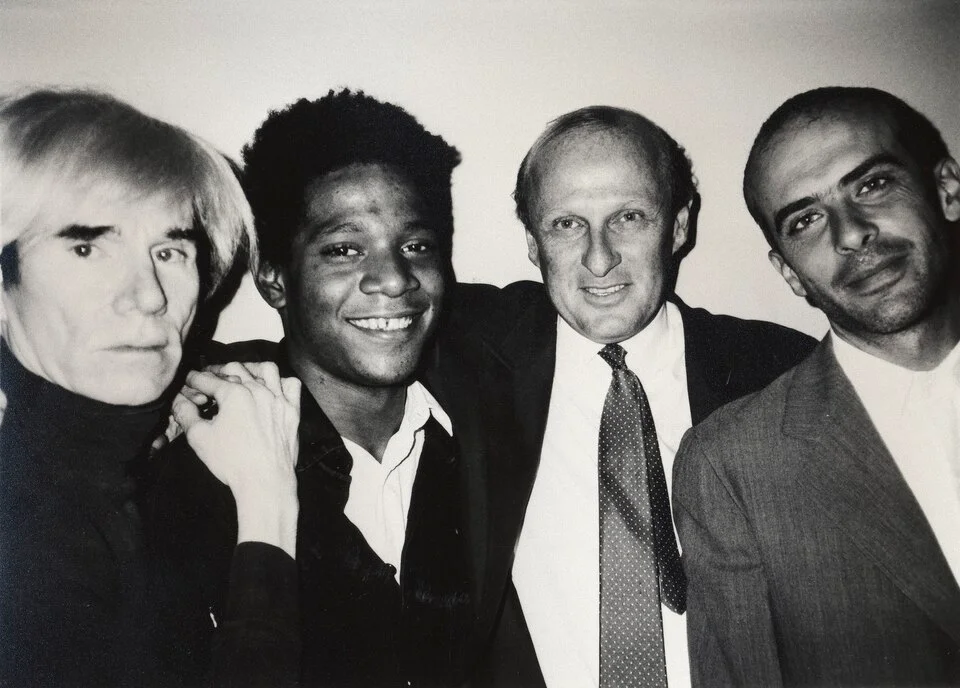
Andy Warhol, Jean-Michel Basquiat, Bruno Bischofberger, and Francesco Clemente, New York, 1984. The downtown art scene that Salle was part of, where Neo-Expressionism and the Pictures Generation converged. Image: public domain, via Wikimedia Commons
The critical framework most often applied to Salle's work is postmodern, with its emphasis on pastiche, quotation, and the loss of a unified subject position from which meaning can be generated. His paintings are read as symptoms of a culture so saturated with images from so many different sources and registers that the attempt to create a unified visual statement is either impossible or naive. The paintings embody this condition rather than proposing a solution to it. The art critic Robert Hughes, who was often skeptical of 1980s art market inflation, acknowledged in his 1990 book "Nothing if Not Critical" that Salle's paintings achieved something real: a genuinely uncomfortable confrontation with the conditions under which images circulate in contemporary culture.
The Controversy: The Female Body
A significant portion of the criticism directed at Salle's work concerns his use of images of women drawn from pornographic and erotic sources. The female figures in his paintings are often nude, often in sexually available poses, rendered in the flat, impersonal style that mimics photographic sources. These images coexist with the other visual materials in the paintings without any evident comment on or critique of the sources from which they come.
Feminist critics, including Rosalind Krauss and Laura Mulvey, argued that the paintings' apparent neutrality toward their pornographic sources was not the sophisticated postmodern stance its defenders claimed but simply a recycling of the objectifying gaze that postmodern theory was supposed to be analyzing and disrupting. Salle's defenders responded that the paintings' refusal to endorse or condemn their sources was itself a statement about a culture in which critique and complicity are inseparable. The debate has not been resolved and continues to frame how the work is discussed in graduate seminars and catalog essays alike.
What is worth noting is that Salle has engaged with this criticism directly in interviews and lectures, arguing that the flatness of his treatment of erotic imagery is precisely the point: these are not images of desire but images of the representation of desire, and the difference is what the painting is about. Whether you find that argument persuasive will depend on where you think painting's responsibility to its subject matter lies.
The 1990s and After
The art market collapse of the late 1980s substantially reduced the commercial and critical visibility of the Neo-Expressionist generation, and Salle's reputation contracted along with the market. He continued to paint throughout the 1990s and 2000s, and his work in this period shows a gradual evolution toward more complex compositional structures and a greater range of source materials. The "Tapestry" series from the 2000s uses large-scale printed photographic images as grounds on which painted figures and objects are overlaid, extending the layering logic of the early works into new formal territory.
His critical rehabilitation has been ongoing since the mid-2000s, as scholars and curators have begun to reassess the 1980s generation with the distance that time provides. The retrospective at the Louisiana Museum of Modern Art in Denmark in 2019 offered the most comprehensive survey of his career to that point and demonstrated that the most searching of his early paintings remain compelling objects that cannot be reduced to their moment of origin. Salle himself has been increasingly articulate in print about his intentions, publishing essays and catalog texts that situate his work within a longer history of painting and quotation stretching back through Manet to Velazquez.
His 2016 book "How to See: Looking, Talking, and Thinking About Art" received considerable attention for its accessible and opinionated account of how visual art works and how it should be talked about. It is worth reading alongside his paintings as a guide to what he thinks he is doing and why.
Why It Matters Now
Salle made paintings in the 1980s that were simultaneously celebrated and attacked as the most acute symptom of their cultural moment. They remain some of the most formally interesting and conceptually searching objects produced by the American art world in the late 20th century. Their refusal to resolve, their insistence on holding incompatible visual materials in unresolved tension, looks more prescient now, in an era of algorithmic image overload and social media feeds that deliver pornography, political speeches, memes, and Renaissance paintings in the same scroll, than it did when they were made.
Standing in front of a large Salle canvas, you feel the same cognitive dissonance that characterizes contemporary media consumption: everything is present, nothing is hierarchized, and the demand to make sense of it all falls entirely on you. Whether that is a limitation or an achievement is a question that painting in 2026 is still trying to answer.
For the broader Neo-Expressionist context, the guide to Neo-Expressionism provides essential background. For the conceptual tradition he emerged from, the guide to conceptual art covers the Baldessari lineage that shaped his thinking. And for the broader postmodern moment in which his work was produced, our guide to postmodernism in art places it in context. The MoMA's collection records on Salle provide access to several key works and their documentation.


