
Paris did not become the art capital of the world by accident. It became the art capital because it built the infrastructure that made art a profession, a market, and a public event. The Salon, the Ecole des Beaux-Arts, the Louvre as a public museum, the gallery system, the critic-journalist — these institutions were either invented in Paris or perfected there. Between 1850 and 1940, every major modern art movement either began in Paris or had to prove itself there. Impressionism, Cubism, Dadaism, Surrealism, Fauvism — all Parisian. Picasso moved to Paris in 1904. Van Gogh moved to Paris in 1886. Mondrian moved to Paris in 1912. Chagall moved to Paris in 1910. They did not move there for the light or the food. They moved there because Paris was where art happened.
This guide covers how Paris became the art capital: the Salon system and the Ecole des Beaux-Arts, the Impressionist break with the Salon, the Cubist revolution, the gallery system that replaced the Salon, the museums that preserved and displayed the work, and what remains of Paris's art dominance today. For a broader overview of the movements mentioned here, see our complete guide to art movements.
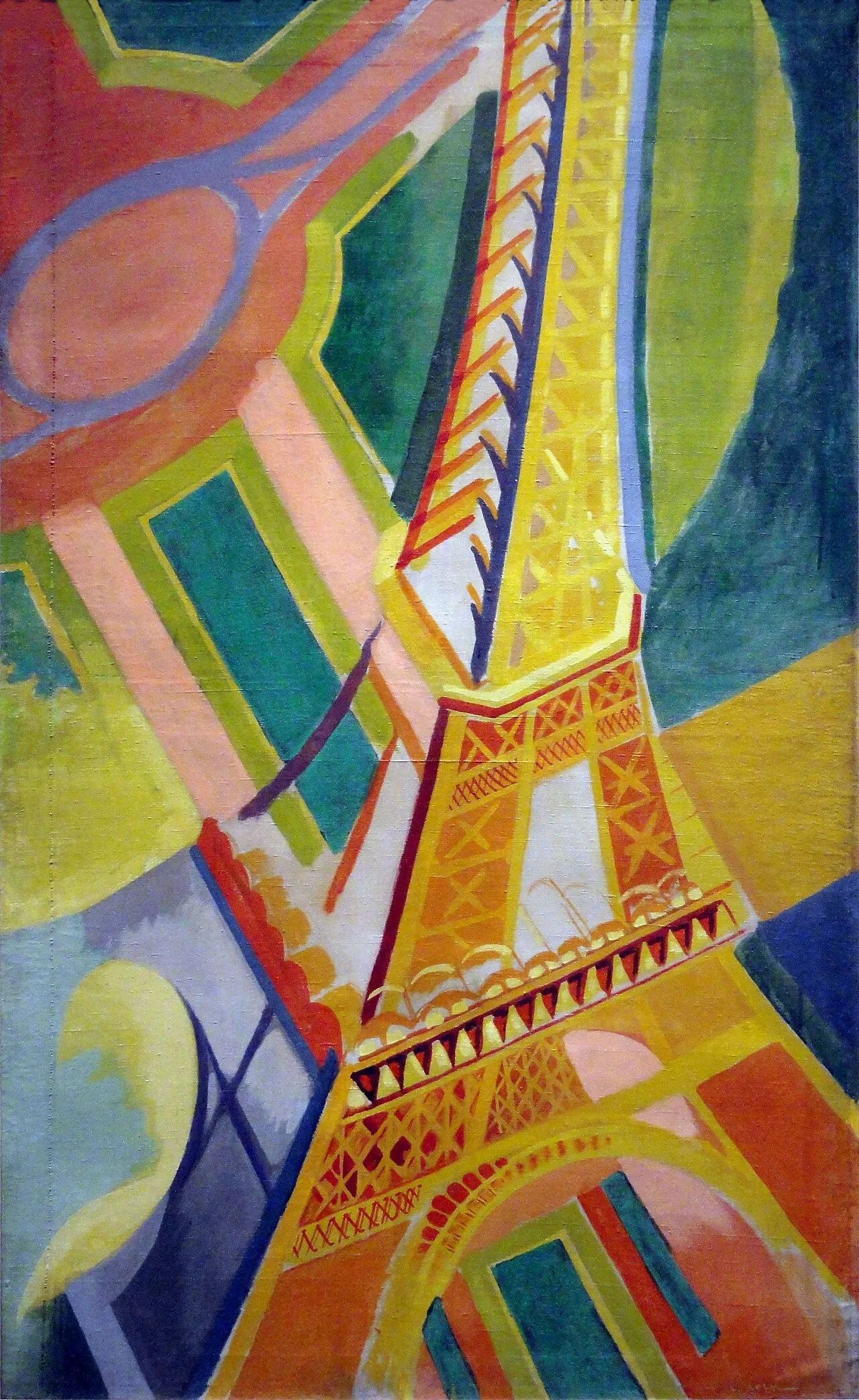
Robert Delaunay, "Eiffel Tower" (1926). Oil on canvas, 169 x 86 cm. Musee d'Art Moderne de la Ville de Paris. Delaunay painted the Eiffel Tower repeatedly, treating it as the emblem of modernity itself. The tower, completed in 1889 for the World's Fair, was the tallest structure in the world and became the visual shorthand for Paris as a city of the future. Image via Wikimedia Commons.
The Salon and the Ecole des Beaux-Arts
The Salon was the engine. Founded in 1667 as the exhibition of the Academie royale de peinture et de sculpture, the Salon became, by the 19th century, the most important art exhibition in the world. It was held annually or biennially in Paris, and it was the single event that could make or break an artist's career. The Salon jury decided what was shown and what was rejected. Being accepted meant your work was seen by tens of thousands of visitors, reviewed by critics, and potentially purchased by the state. Being rejected meant obscurity.
The Ecole des Beaux-Arts, founded in 1816, was the other pillar. It was the most prestigious art school in Europe, and its curriculum — drawing from casts, then from life, then from antiquity — set the standard for what "proper" art training looked like. The Ecole taught a hierarchy of genres: history painting at the top, then portraiture, then genre painting, then landscape, then still life. This hierarchy shaped what the Salon rewarded and what it did not. For more on how this system broke down, see our guide to Impressionism and the breaking of academic rules.
The combination of the Salon and the Ecole created a closed system. The state funded the schools, the schools trained the artists, the Salon exhibited the work, and the state purchased what it liked. This system produced enormous technical skill but also enormous conservatism. The artists who broke from it — Manet, Monet, Degas, Renoir, Pissarro, Morisot, Cezanne — did so because the Salon would not show what they were painting. The break is the origin of modern art.
The Impressionist Break
In 1863, the Salon jury rejected more than half of the submitted works. Emperor Napoleon III, responding to the outcry, authorized a "Salon des Refuses" — an exhibition of the rejected works. Manet's "Le Dejeuner sur l'herbe" and "Olympia" were shown there, and the public reaction was hostile. But the Salon des Refuses proved that there was an audience for art outside the official system.
The Impressionists took the lesson further. Between 1874 and 1886, they organized eight independent exhibitions, bypassing the Salon entirely. The first exhibition, in 1874, included Monet, Renoir, Degas, Morisot, Pissarro, Cezanne, and Sisley. It was at this exhibition that the critic Louis Leroy coined the term "Impressionists" as an insult, after Monet's "Impression, Sunrise." The name stuck. For more on the women who were part of this movement, see our guide to women of Impressionism.
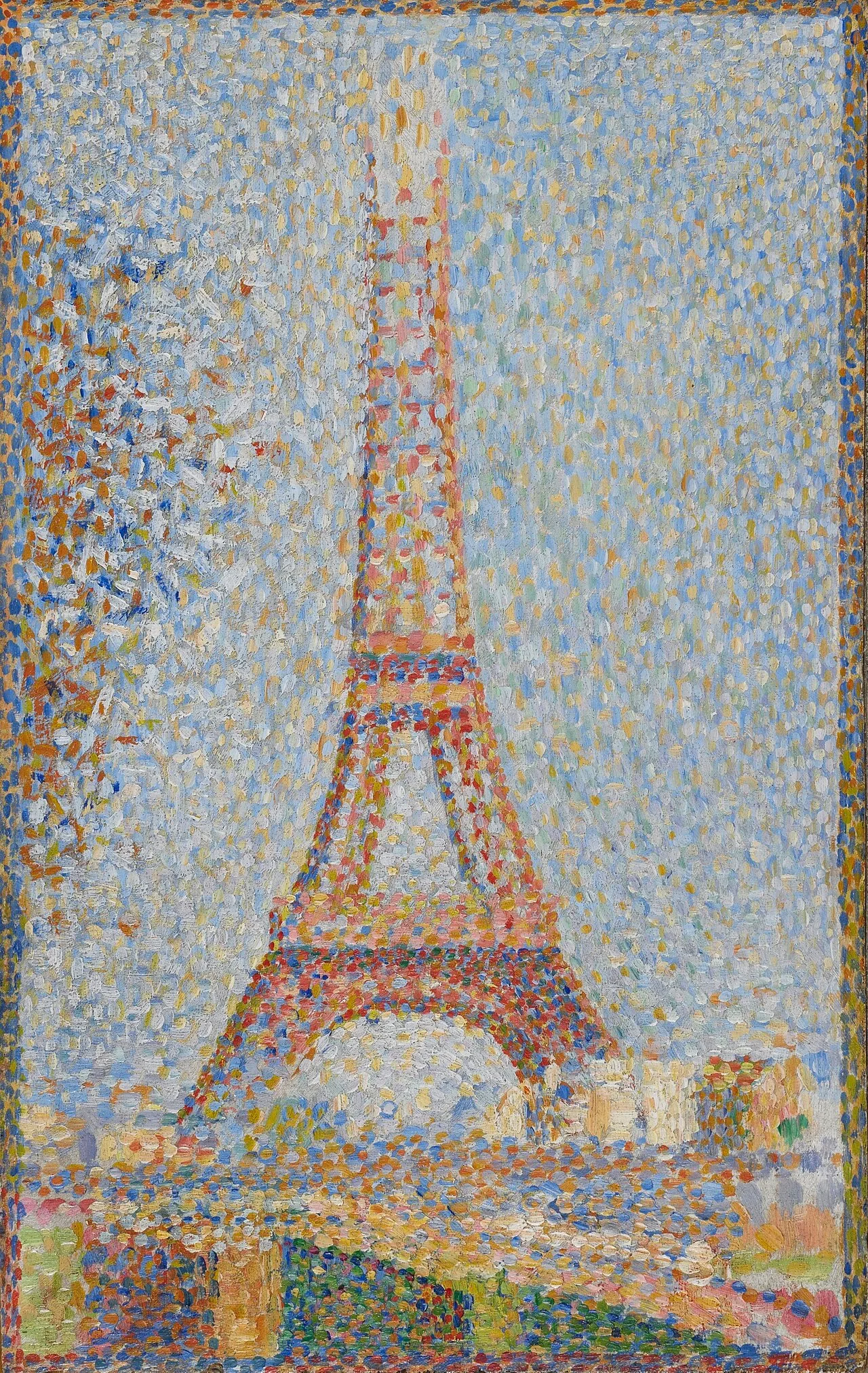
Georges Seurat, "La Tour Eiffel" (ca. 1889). Oil on panel, 24 x 15.2 cm. Fine Arts Museums of San Francisco. Seurat painted the Eiffel Tower shortly after its completion for the 1889 World's Fair, using the pointillist technique he had developed. The tower was new, controversial, and the tallest structure in the world. Seurat painted it in tiny dots of pure color — a thoroughly modern subject rendered in a thoroughly modern technique. Image via Wikimedia Commons.
Cubism and the Gallery System
By 1900, the Salon was losing its monopoly. A new institution had emerged: the commercial gallery. Daniel-Henry Kahnweiler, a German-born art dealer who opened his gallery in Paris in 1907, was the first to understand that a dealer could do more than sell paintings. Kahnweiler signed exclusive contracts with Picasso, Braque, Gris, and Leger. He organized their exhibitions, promoted them to critics, placed their work in collections, and built their market value. He invented the modern gallery system.
Cubism, which Picasso and Braque developed between 1907 and 1914, was the first movement that was entirely a product of the gallery system. The Salon never showed Cubist work. The public saw Cubism through gallery exhibitions and through the writings of critics like Guillaume Apollinaire. Kahnweiler's gallery at 28 rue Vindimire was the center. For more on the movement itself, see our guide to Cubism and seeing all sides at once.
The gallery system replaced the Salon because it was better at handling modern art. A gallery could show controversial work without a jury. A gallery could build a long-term relationship between an artist and a collector. A gallery could promote a movement, not just individual works. Paris had more galleries than any other city, and that is why artists kept moving there.
The Museums
Paris also built the museums that preserved and displayed the work. The Louvre, opened as a public museum in 1793 during the French Revolution, was the first great public art museum. It housed the French royal collection, plus works looted by Napoleon's armies across Europe. The Louvre set the standard for what a public museum could be — a place where art was accessible to everyone, not just the aristocracy. For more on visiting the Louvre today, see our guide to the Louvre and how to enjoy it.
The Musee d'Orsay, opened in 1986 in a former railway station, houses the art of the period 1848-1914 — exactly the period when Paris was the art capital. The Orsay has the largest collection of Impressionist and Post-Impressionist paintings in the world. The Centre Pompidou, opened in 1977, houses modern art from 1905 onward. The Musee de l'Orangerie has Monet's Water Lilies. The Musee Picasso has the largest Picasso collection in the world. The Musee Marmottan Monet has the largest Monet collection. No other city has this density of art museums.
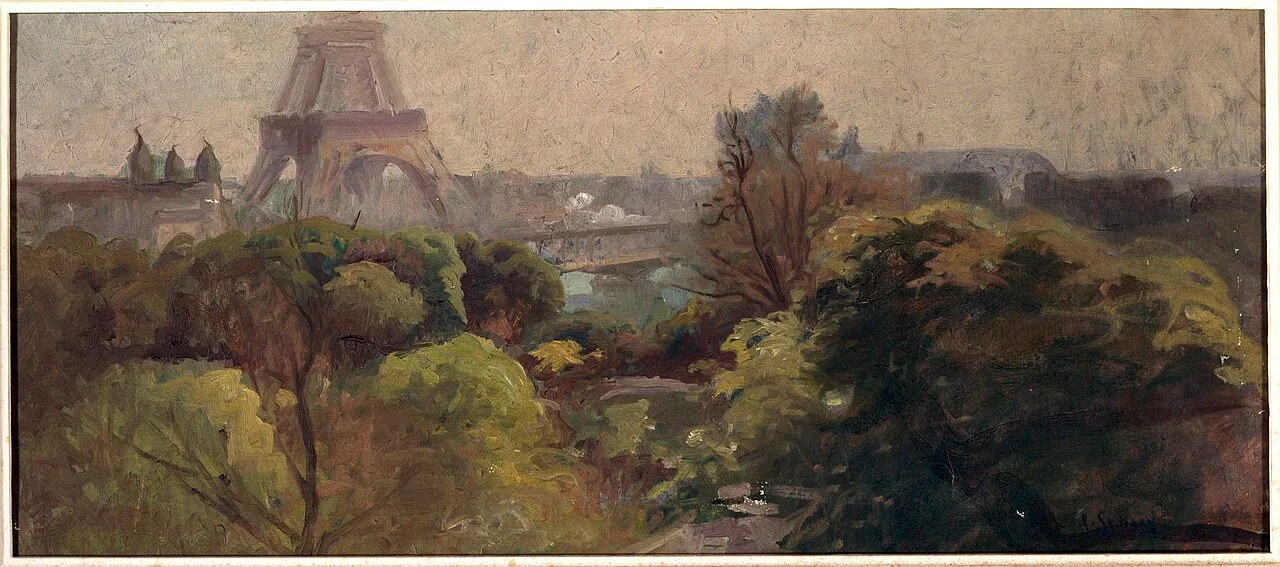
Adolphe-Ernest Gumery, "La Tour Eiffel, vue du jardin Delessert" (1903). Oil on canvas. Musee Carnavalet, Paris. By 1903, the Eiffel Tower was 14 years old and already the symbol of Paris. Gumery painted it from a garden on the Left Bank, showing the tower as part of the city's daily life — not a novelty but a landmark. Image via Wikimedia Commons.
The School of Paris and the Interwar Years
Between 1910 and 1940, Paris was home to what is now called the School of Paris — a loose grouping of artists from across Europe and beyond who lived and worked in the city. Picasso (Spanish), Modigliani (Italian), Chagall (Russian-Jewish), Soutine (Lithuanian-Jewish), Brancusi (Romanian), Zadkine (Russian), Giacometti (Swiss) — none of them were French by birth. Paris attracted them because it was the place where art was taken seriously, where galleries would show experimental work, and where a community of artists could be found.
The cafes of Montparnasse — Le Dome, La Coupole, La Rotonde — were the social infrastructure of the School of Paris. Artists met there, argued there, and sold paintings to collectors who came there. The Montparnasse galleries — especially those run by Leopold Zborowski and Paul Guillaume — were the commercial infrastructure. For more on one of the key figures of this period, see our guide to Marc Chagall and Jewish modernism.
What Remains
After World War II, the center of the art world shifted to New York. Abstract Expressionism, Pop Art, Minimalism — these were American movements, shown in American galleries, collected by American museums. Paris lost its position as the capital. But it did not lose its infrastructure. The Ecole des Beaux-Arts still trains artists. The museums are still among the best in the world. The gallery system, though smaller than New York's or London's, is still active. And the French state still spends more on art and culture per capita than almost any other country.
Paris remains the city where modern art was born. The Impressionists painted along the Seine. The Cubists worked in Montmartre. The School of Paris gathered in Montparnasse. The Surrealists met at the Cafe de Flore. Every major modern art movement that existed between 1860 and 1940 had a Paris address. That density of history is what makes Paris different from every other art city. For a structured way to study that history, see our guide on how to teach yourself art history.
Final Thoughts
Paris became the art capital of the world because it built the institutions that made art a public, professional, and commercial activity. The Salon made art visible. The Ecole made art teachable. The galleries made art sellable. The museums made art permanent. No other city combined all four. The result was a century of artistic innovation that no other city has matched.
If you want to understand modern art, you have to understand Paris. Start at the Musee d'Orsay for Impressionism and Post-Impressionism. Go to the Centre Pompidou for Cubism, Surrealism, and the School of Paris. Go to the Louvre for the academic tradition that the modernists broke from. Then walk to Montmartre and Montparnasse and see where the artists lived. For more on the movements that defined the period, see our guide to Expressionism and our guide to Dadaism. For a broader view of where art is today, see our guide to modern vs contemporary art.


