
Edvard Munch described the experience that led to "The Scream" (1893) in his diary. He was walking with friends at sunset when the sky turned blood red and he felt, as he wrote, "an infinite scream passing through nature." He stopped, trembling, while his friends walked on. Then he painted the moment, but not as it appeared from outside. He painted it as it appeared from inside his terror: the landscape swirling, the colors unhinged from any natural sky, the horizon line rippling like a sound wave coming from inside his own skull.
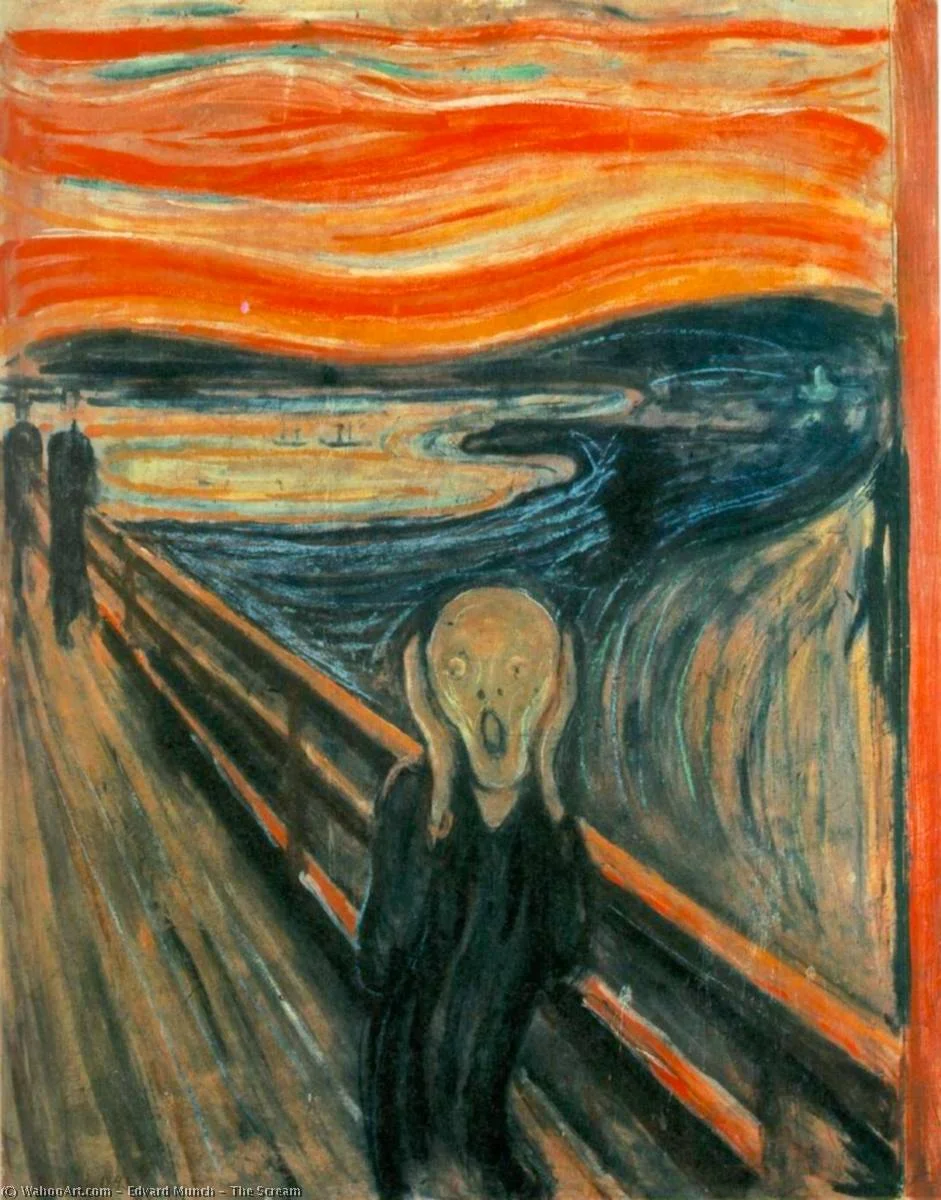
Edvard Munch, The Scream (1893). The painting that established Expressionism's central value: distortion as a record of inner experience rather than outer appearance. Image: public domain, via Wikimedia Commons
That painting, which now exists in four versions across different media and is one of the most reproduced images in art history, is also a technical document of what Expressionism was actually doing. It is not a record of what Munch saw. It is a record of what anxiety feels like when you translate it into paint. The movement that developed across Northern Europe between roughly 1905 and 1930 made that distinction its central value. Distorted bodies, unhinged colors, aggressive brushwork: these were not failures of technical skill. They were the technique.
This guide covers the major movements and artists of Expressionism, its visual language, its collision with the Nazis in 1937, and the long shadow it cast across the rest of the 20th century and into the present.
The Precursors: Van Gogh and Munch
Expressionism as an organized movement began in 1905, but its most important precedents were established decades earlier. Vincent van Gogh used color and brushwork not to describe appearances but to communicate states of feeling. The urgent spiral brushstrokes of "Starry Night" (1889) are not a depiction of how a night sky looks but of how it feels to look at one when you are in the grip of something larger than yourself. The sickly, oppressive yellows of his room at Saint-Paul-de-Mausole asylum do not describe a room. They describe being confined in one. The threatening flatness of the wheat fields in his final weeks is a painted emotion, not a painted landscape.
Munch pushed further and more systematically. His series "The Frieze of Life," developed through the 1890s, set out to paint the complete arc of human emotional experience: love, longing, jealousy, fear, and death. In "The Sick Child" (1885-1886), he showed his dying sister through a surface scraped and reworked so aggressively that the canvas carries the texture of grief as a physical thing. In "Anxiety" (1894), he placed figures with hollow, mask-like faces against the same blood-red sky as "The Scream." By the mid-1890s, Munch had already established that the external world in painting could be the inner world projected outward, and that distortion was not an error but an argument.
Die Brücke: Dresden and Berlin, 1905-1913
The first organized Expressionist movement was Die Brücke (The Bridge), founded in Dresden in 1905 by four architecture students: Ernst Ludwig Kirchner, Fritz Bleyl, Erich Heckel, and Karl Schmidt-Rottluff. The name signaled their ambition to be a bridge between the exhausted conventions of academic painting and a new honesty about inner experience. They were looking for an art that would strip away politeness.
Their visual references were wide and deliberate: German medieval woodcuts with their bold black lines and compressed space, art from African and Pacific Islander traditions that they encountered in ethnographic museums (and whose cultural contexts they largely ignored, as was standard for European artists of the period), and the raw directness of children's drawings. The result was a style with bold outlines, colors that had no relationship to natural appearances, angular figures, and an urgency that made conventional academic painting look like something designed to be politely enjoyed and forgotten.
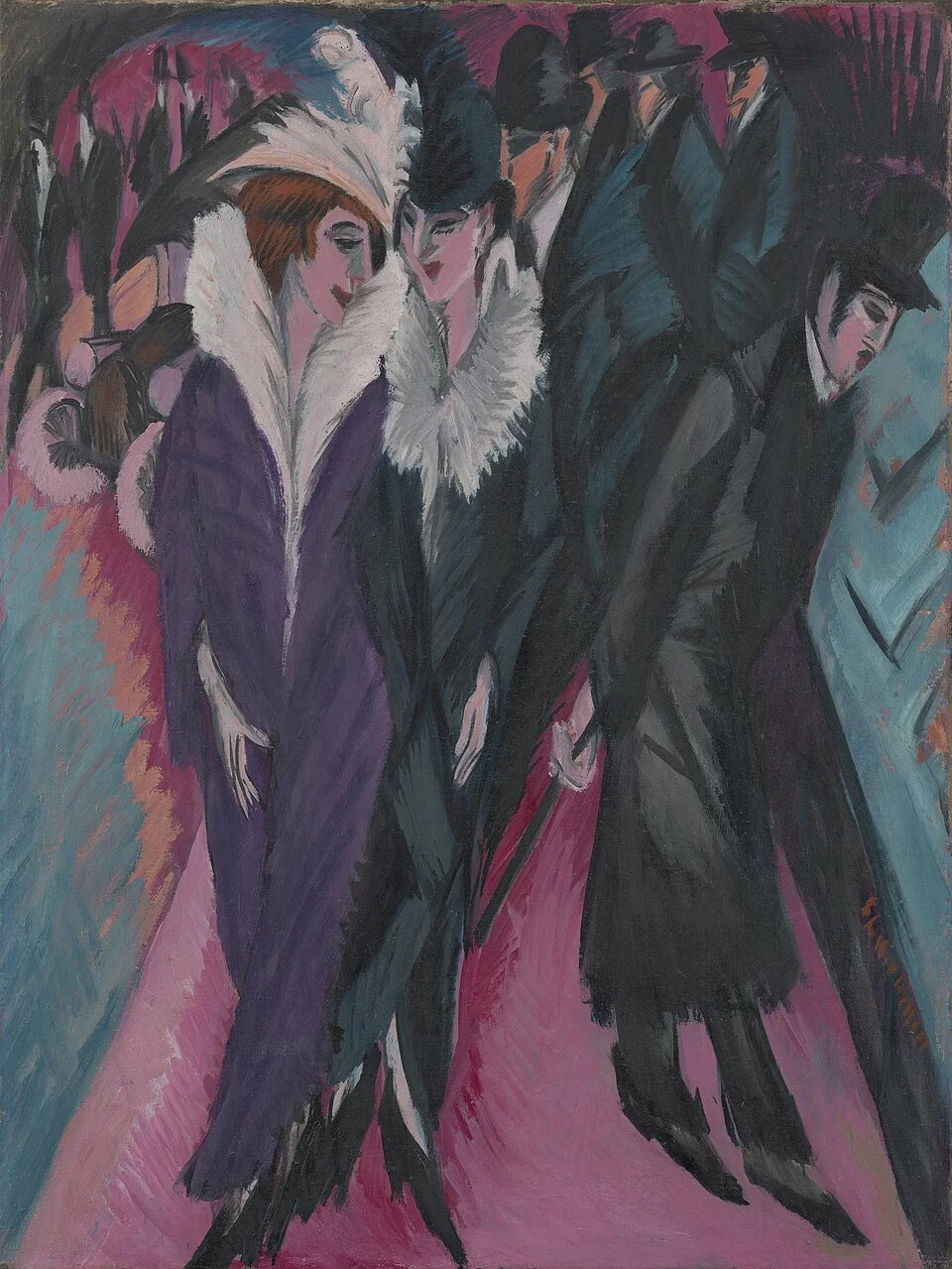
Ernst Ludwig Kirchner, Street, Berlin (1913), MoMA. The Berlin Street Scenes: elongated women in large hats, faceless men in top hats, acid green and electric pink against black. Paintings of alienation in a modern city. Image: public domain, via Wikimedia Commons
Ernst Ludwig Kirchner (1880-1938) is the movement's most distinctive and, ultimately, most tragic figure. When Die Brücke moved to Berlin in 1910, Kirchner's work changed. The Dresden nudes in forest landscapes gave way to the "Berlin Street Scenes" (1913-1915): elongated women in large hats on city streets, faceless men in top hats, the figures angular and predatory, the colors acid green and electric pink against black. These paintings are not sociological documents of the sex trade in Wilhelmine Berlin. They are paintings of alienation, of a modern city that moves through its inhabitants the way machinery moves through raw material.
Kirchner was conscripted in 1914 and had a psychological breakdown that he never fully recovered from. He spent the rest of his life in the Swiss Alps, painting mountain landscapes. When the Nazis seized or destroyed 639 of his works as "degenerate" in 1937, he shot himself the following year. His life and the movement's history are inseparable in a way that goes beyond biography.
Der Blaue Reiter: Munich and Pure Abstraction, 1911-1914
Where Die Brücke was raw and anchored in social observation, Der Blaue Reiter (The Blue Rider), formed in Munich in 1911 around Wassily Kandinsky, Franz Marc, and August Macke, moved toward pure abstraction and spiritual inquiry. The two groups shared the rejection of academic naturalism but arrived at completely different destinations.
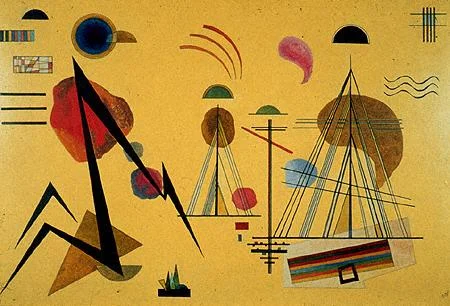
Wassily Kandinsky, Line Spot (1927). Kandinsky's move toward pure abstraction, where color and form carry emotional and spiritual meaning without any reference to the visible world. Image: public domain, via Wikimedia Commons
Kandinsky's contribution to art history is hard to overstate. He is widely credited with making the first purely abstract paintings, works in which color and form carry emotional and spiritual meaning without any reference to the visible world. His theoretical text "Concerning the Spiritual in Art" (1911), published by the Kandinsky archive at the Centre Pompidou, proposed that each color had specific psychological effects independent of context: yellow was aggressive and energetic, blue was spiritual and receding, a circle was calm, a triangle was dynamic. Whether or not you accept this as a theoretical system, it produced paintings of extraordinary formal intelligence and emotional directness.
Franz Marc died at the Battle of Verdun in 1916, age 36. His "The Large Blue Horses" (1911) at the Walker Art Center in Minneapolis shows three horses in an idealized field, their forms simplified to near-abstraction, their deep blue color functioning as both description and aspiration. Marc painted animals as a form of spiritual access to a world uncorrupted by human consciousness. The painting is beautiful and a little desperate, which is appropriate for work made in the years immediately before the war that would end both Marc's life and the cultural optimism his paintings assumed.
Austrian Expressionism: Schiele and Kokoschka
In Vienna, Expressionism developed differently. Shaped by Freudian psychoanalysis and the specific claustrophobia of the late Austro-Hungarian Empire, the Viennese version was more intimate, more focused on the body, and more explicitly interested in psychological states that polite society preferred to conceal.
Egon Schiele (1890-1918) produced drawings and paintings of bodies that still have the capacity to unsettle: contorted figures with gaunt limbs, visible joints, hollow eyes, often in states of vulnerability or erotic tension that feel simultaneously clinical and charged. Schiele treated the body as a surface on which psychological states were literally written, making visible desires and anxieties that social convention suppressed. His line was angular, searching, and often left areas of the body deliberately incomplete while rendering others with obsessive precision. He died of the 1918 influenza pandemic at 28, three days after his pregnant wife. His entire mature career lasted about a decade and produced a body of work that still looks like nothing else in European art.
Oskar Kokoschka worked in a more turbulent register, his portraits showing subjects as if the painter were looking at them through a high fever. "Bride of the Wind" (1913-1914), now at the Kunstmuseum Basel, shows two figures wrapped together in an atmosphere of agitation and dissolution, the paint surface itself unstable and churning. It is one of the most viscerally unsettling paintings of its decade.
Expressionism After the War: Dix, Grosz, and the Nazis
The First World War did not end Expressionism. It amplified it. George Grosz and Otto Dix used Expressionist distortion as a language for atrocity and political critique in Weimar Germany. Dix's triptych "The War" (1929-1932), now in the Albertinum in Dresden, shows soldiers decomposing in trenches, gas attacks, and mutilated survivors in a format that deliberately references Matthias Grunewald's Isenheim Altarpiece: a sacrilegious parallel between Christ's suffering and the industrial slaughter of the Western Front. It is one of the most powerful antiwar images ever made, and it was not made from the safe distance of hindsight. Dix served on the front and chose to depict what he had seen.
The Nazis identified Expressionism as the embodiment of cultural degeneracy and organized the notorious "Entartete Kunst" (Degenerate Art) exhibition in Munich in 1937, displaying confiscated works with mocking labels designed to provoke contempt. The exhibition instead attracted enormous crowds. More than 650 works were subsequently sold, burned, or otherwise destroyed. Many artists fled Germany; those who stayed were largely silenced.
Expressionism's formal inheritance migrated to New York with the German and Austrian emigres of the 1930s, where the emotional urgency and gestural directness it had established fed directly into Abstract Expressionism. In the 1980s, Neo-Expressionism brought raw figuration back to international prominence: Georg Baselitz and Anselm Kiefer in Germany, Jean-Michel Basquiat and Eric Fischl in New York.
Final Thoughts
Expressionism established something that had not been established before: that distortion is a legitimate artistic tool rather than a deficiency, that color should serve feeling rather than description, and that a painting's primary obligation is to emotional truth rather than surface appearance. That claim sounds obvious now because it has been so thoroughly absorbed into how we think about art. In 1905, when Kirchner and his colleagues were painting angular nudes with shocking color combinations in a Dresden studio, it was radical enough to change everything that came afterward.
"The Scream" remains the movement's single most recognizable image because it captures something that transcends its historical moment: the experience of feeling so large it cannot be contained by any normal-looking surface. That Munch painted it in four versions across different media, that it exists as oil paint, tempera, pastel, and crayon, suggests how much he himself understood that the image was not the point. The feeling it represented was the point. For the visual strategies Expressionism developed to communicate emotion without literal depiction, the guide on how art communicates emotion without words traces these techniques directly. And for the Romantic tradition that laid the philosophical groundwork for Expressionism's insistence that feeling is more truthful than reason, the guide to Romanticism covers the relevant history.


