
When Claude Monet died in December 1926 at the age of 86, he had been painting water lilies for nearly thirty years. The garden at Giverny, which he had designed and built and modified over decades to serve as a subject for his painting, was both his greatest creation and the container for his greatest work. The roughly 250 paintings in the "Nymphaeas" (Water Lilies) series represent the most sustained engagement with a single subject in the history of Western art. They also span a transformation from the relatively conventional Impressionism of the 1890s to the vast, abstract-verging canvases of the last decade that left no bank, no horizon, no clear boundary between water and sky, and which American Abstract Expressionists would cite in the 1950s as a direct influence on their own practice.
The series is too large and too varied to discuss as a single work. This guide focuses on the major phases of the project, the circumstances that shaped them, and the monumental final chapter: the eight large panels installed in the Orangerie in Paris that Monet donated to the French state as a memorial gift after World War I. The Musee de l'Orangerie describes the installation as "the crowning achievement of Monet's career" and notes that the oval rooms were designed specifically to create an immersive experience without precedent in Western painting.
Giverny and the Garden as Artwork
Monet arrived in Giverny, Normandy in 1883, renting the house that he would purchase in 1890. He immediately began transforming the property's garden, planting it with a concentration and expertise that reflected his lifelong interest in horticulture. In 1893 he purchased an adjacent plot of land and diverted a stream to create the water garden: a pond planted with water lilies, surrounded by weeping willows and bamboo, crossed by a Japanese-style wooden footbridge that would appear in numerous paintings.
The water garden was initially controversial with local farmers, who worried that his exotic plants would contaminate their water supply. Monet prevailed, and by the turn of the century the garden had become what he designed it to be: a living work of art that he could observe and paint through every hour of the day and every season of the year. The garden was both his studio and his subject, and he understood the boundary between them as deliberately blurred. The Giverny Foundation maintains detailed records of the garden's plant species and layout, and the garden is open to visitors today, restored to the state it was in during Monet's lifetime.
The Series Begins: 1896 to 1900
Monet's first Water Lilies series, exhibited at Durand-Ruel's gallery in Paris in 1900, showed the pond from a relatively conventional viewpoint: banks visible at the edges, the Japanese bridge visible in several canvases, the lilies and reflections in the central field. These paintings are still recognizably Impressionist in their approach. Discrete brushstrokes build up the surface. The light of a specific hour is captured. An identifiable landscape is depicted. For the broader context of Monet's career and the movement he helped found, see our guide to Impressionism and our artist profile of Claude Monet and the garden at Giverny.
Failing Eyesight and Changing Vision
From around 1905 onward, Monet began experiencing vision problems that he initially dismissed as transient. By 1912 he had received a diagnosis of cataracts in both eyes. Cataracts progressively yellow the lens of the eye, filtering out blue and violet light and making the visual world appear increasingly warm-toned and murky. Monet's paintings from this period show a marked shift toward reds, yellows, and browns, with the cooler blues and greens he had used in the 1890s becoming rarer.
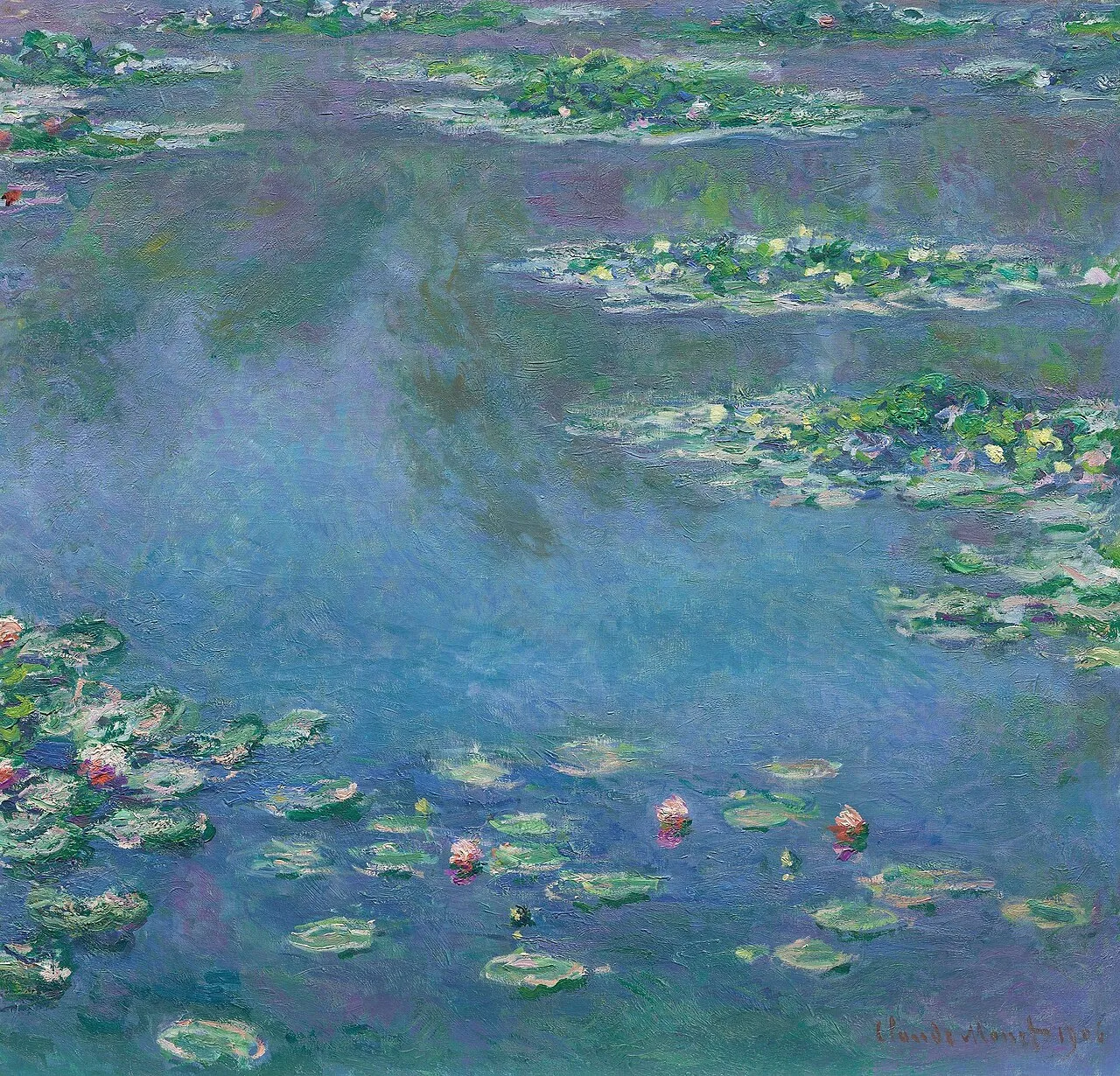
Claude Monet, "Water Lilies" (1906), oil on canvas, 87.6 x 92.7 cm. Art Institute of Chicago. One of the middle-period Nymphaeas, this painting shows Monet's movement away from depicting the pond's banks and toward the surface alone, with lilies, reflections, and sky merging into a single visual field. Image: Public domain, via Wikimedia Commons
He resisted cataract surgery for years, fearing it would damage his remaining vision permanently. In January 1923, at age 82, he finally underwent operations on both eyes. The recovery was prolonged and difficult, and Monet was dissatisfied with the results. He now saw certain colors differently from before and had to adjust his entire approach to mixing pigments. Some historians have suggested that the late large-scale Water Lilies panels, with their turbulent, gestural quality, were painted partly in the period of compromised vision before surgery, and represent not a failure of technique but a different kind of seeing. The National Institutes of Health has published analysis of how Monet's cataracts affected his color perception, confirming that the warm-toned palette of his late work corresponds to the known effects of nuclear cataracts on color vision.
The Orangerie Panels: Monet's Greatest Achievement
In 1918, moved by the end of World War I and by the death of his closest friend Georges Clemenceau, Monet conceived the idea of donating a series of monumental Water Lilies panels to the French state as a memorial to those who had died. The plan went through various configurations before its final form was established: eight panels of different dimensions, arranged in two oval rooms in the Orangerie museum in the Tuileries Gardens in Paris, creating an immersive environment in which the viewer is surrounded by painted water on all sides.
The Orangerie installation is Monet's greatest achievement and one of the most extraordinary spaces in Western art. The eight panels together span 91 meters of painted surface. The oval rooms were designed by the architect Camille Lefevre specifically for the paintings, with natural light entering from above through translucent glass ceilings that change throughout the day. The effect is of standing inside the garden itself, the boundary between the viewer and the painted surface dissolved in a way that anticipates by decades the immersive installations of contemporary art. For more on how immersive environments work, see our guide to installation art.
The Bridge to Abstract Expressionism
The American Abstract Expressionists who encountered the Orangerie in the late 1940s, after it had been closed during the Occupation, recognized what Monet had achieved. Clement Greenberg wrote about the direct relationship between late Monet and Abstract Expressionism. The late Water Lilies panels, with their all-over surface, lack of focal point, and scale that fills the viewer's visual field, anticipate the strategies that Pollock and Rothko would use in the 1950s. The connection is not incidental. Pollock saw the Orangerie panels. Rothko's chapel paintings function on the same principle of envelopment through scale. Our guide to Abstract Expressionism covers this inheritance in detail.
The Water Lilies are the clearest example of how Impressionism, often dismissed as merely decorative, was actually the foundation of the most ambitious strand of twentieth-century painting. Monet started as a painter of visible landscapes and ended as a painter of pure visual sensation, and the Water Lilies series documents that transformation step by step across thirty years. For more on how Monet's approach to light and color changed painting, see our guide to the psychology of color in art. And for a broader look at how art movements build on each other, our guide to the evolution of art styles traces the trajectory from Realism through Impressionism to contemporary practice.
Visiting the Orangerie
The Orangerie is open daily in Paris (closed Tuesday). If you visit, allow at least 30 minutes in the oval rooms and pay attention to how the light changes in different parts of the rooms as the sun moves. The experience is different in the morning and the afternoon, in summer and winter, because the natural light from the ceiling is part of the installation. Monet designed it that way. The paintings are not static objects. They change with the light, just as the garden at Giverny changed with the light, and just as the paintings themselves were made by a man whose own light was failing. What is your favorite from the Water Lilies series? Share in the comments below.


