
Berthe Morisot exhibited in 7 of the 8 Impressionist exhibitions, more than any other artist except Camille Pissarro. Mary Cassatt showed in 4. Eva Gonzalès died at 34, her career cut short before she could fully participate. Marie Bracquemond showed in 3 before her husband, the artist Félix Bracquemond, discouraged her from continuing. As ARTnews notes, "Morisot, one of few women exhibiting with the Impressionists, has offered fertile ground for feminist art historians looking to diversify art's histories." Yet for decades, the history of Impressionism was written as if these women barely existed. Rozsika Parker and Griselda Pollock demonstrated how early twentieth-century art history largely erased women's contributions to art, including Morisot's. The 1987 retrospective "Berthe Morisot: Impressionist" (Mount Holyoke College Art Museum; National Gallery of Art, Washington; Kimbell Museum of Art, Fort Worth) helped restore Morisot's public profile in the United States, both reflecting and stimulating scholarly interest. Four additional retrospectives followed between 1997 and 2012. In 2025-26, the "Manet & Morisot" exhibition at the Legion of Honor Museum, San Francisco (October 11, 2025 to March 1, 2026) and the Cleveland Museum of Art gave Morisot equal billing with Édouard Manet, the arch modernist described as the "father" of Impressionism. The exhibition goes further, claiming that Morisot did not just exist within a circle of famous men, but actually influenced the direction of modern painting.
The recovery of women Impressionists is one of the most significant revisions in art history. It began with feminist scholars in the 1970s, Parker, Pollock, Tamar Garb, and has accelerated through major exhibitions and retrospectives. The 150th anniversary of the first Impressionist exhibition in 1874, celebrated in 2024, finally included women's work "no longer sidelined or necessarily understood in different terms than the art of men." This guide covers the women of Impressionism: Berthe Morisot (7 of 8 exhibitions, "The Cradle," the Manet & Morisot exhibition), Mary Cassatt (4 exhibitions, "The Child's Bath," the mother-and-child series), Eva Gonzalès (Manet's only formal student, died at 34), Marie Bracquemond (3 exhibitions, discouraged by her husband), how feminist art history recovered them, why they were sidelined, and what their recovery means for art history.
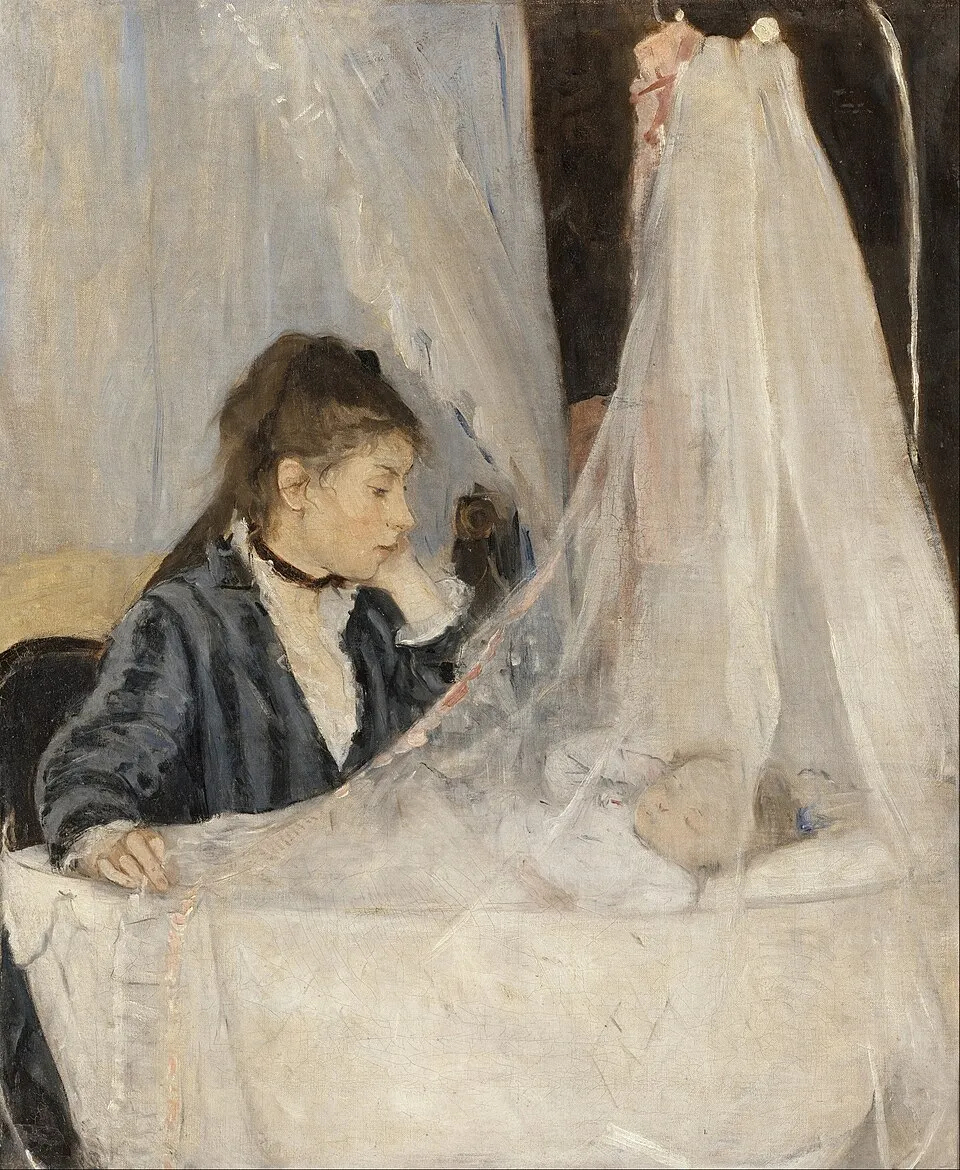
Berthe Morisot, "The Cradle" (1872). Oil on canvas, 56 x 46 cm. Musée d'Orsay, Paris. Morisot exhibited in all but one of the previous six Salons before joining the Impressionists. She showed in 7 of the 8 Impressionist exhibitions, more than any other artist except Camille Pissarro (Cleveland Museum of Art). Image via Wikimedia Commons.
Berthe Morisot: The Quintessential Impressionist
Morisot was a respected painter, best known for her landscapes, and had been tutored by Jean-Baptiste-Camille Corot, the influential Barbizon school painter. She showed in 7 of the 8 Impressionist exhibitions. The collector Charles Ephrussi wrote that Morisot "grinds flower petals on her palette" to produce "something subtle, lively, and charming, something one senses rather than sees." That description gets at what makes her work distinctive. Her brushwork is the fastest and most fluid of any Impressionist. Stand in front of "The Cradle" at the Musée d'Orsay and you see paint laid down in strokes that barely seem to touch the canvas, as if she caught the scene before it could move.
The Manet connection shaped her reception for over a century. They met copying paintings at the Louvre in 1868 and their families, both from a similar social class, became close in the years that followed. Morisot would eventually marry Manet's brother Eugène. Manet painted her portrait 11 times. The "Manet & Morisot" exhibition (2025-26, Legion of Honor and Cleveland Museum of Art) is the first major exhibition dedicated to the artistic exchange between Édouard Manet, considered the father of modern painting, and Berthe Morisot, the only woman among the founding members of the Impressionist movement. Thirty-six paintings and seven works on paper on loan from museums and private collections in the United States and Europe reveal the artists' singular friendship.
Here is the part that rewrites the history. By the mid-1870s, Manet had begun to follow Morisot's example, emulating her choice of subjects, brilliant colors, and rapid, fluttering brushstrokes. Not the other way around. Curator Emily Beeny argues in the exhibition catalog that Manet borrowed Morisot's motif of the child in his own attempts to reckon with a modernizing city, most visibly in "The Railway" (1873). Manet worked in his studio, producing pictures that he hoped would look dashed off in one session but that in fact were created with extensive revisions. Morisot was skilled at working swiftly and decisively outdoors and under changing conditions of weather and light. The difference is visible on the canvas. He revised. She committed. For more on the broader movement, see our complete guide to art movements.
Mary Cassatt: American in Paris
Mary Cassatt (1844-1926) was an American painter and printmaker who exhibited in 4 of the 8 Impressionist exhibitions. She was the only American officially associated with the Impressionist group. Her compressed compositions and patterned surfaces create intimacy through clarity and design. She is best known for her mother-and-child paintings, and that subject is where the real argument of her work lives.
Motherhood in Morisot and Cassatt is never merely an exercise in sentimentality. It is a site of psychological complexity, physical intensity, and social meaning. In their work, reading, bathing, sewing, holding children, writing letters, arranging hair, or sitting at the threshold of the home become major pictorial events. They are treated with the same seriousness that earlier traditions reserved for grand narrative. Morisot and Cassatt redirected that hierarchy. They showed that drawing rooms, nurseries, balconies, windows, gardens, dressing spaces, and theater boxes were not marginal to modern life. They were among the places where modern identity, social discipline, emotional attachment, and self presentation were most intensely formed.
It is also important that these intimate scenes were made for public exhibition and collection. Morisot and Cassatt did not keep private life private. They brought it into the sphere of criticism, display, and art history. Cassatt was also a printmaker. She was influenced by Japanese woodblock prints (ukiyo-e) and created a series of color prints that are among the most innovative works of the Impressionist era. Her "The Bath" (1893) and "Woman Bathing" (1890-91) demonstrate her mastery of the medium. For more on individual works, see our guide to famous paintings explained.
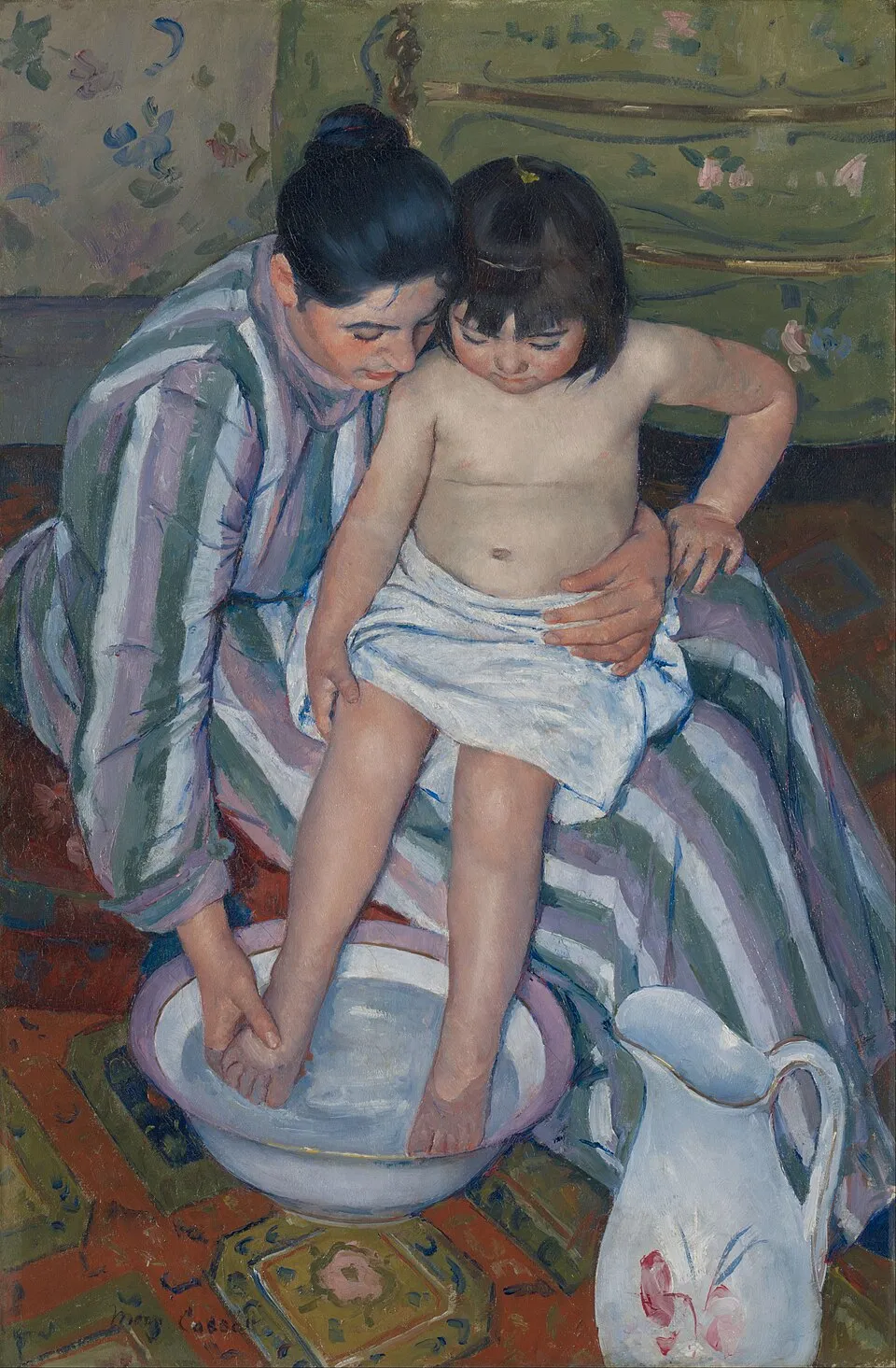
Mary Cassatt, "The Child's Bath" (1893). Oil on canvas. Art Institute of Chicago. Cassatt showed in 4 of the 8 Impressionist exhibitions. Image via Wikimedia Commons.
Eva Gonzalès and Marie Bracquemond: The Other Two
Eva Gonzalès (1849-1883) was Manet's only formal student. She was a painter who exhibited at the Salon rather than with the Impressionists, influenced by Manet's style but developing her own approach. She died in childbirth at age 34, the same year as Manet's death. Her career was cut short before she could fully participate in the Impressionist movement. By the 150th anniversary exhibitions in 2024, the work of Mary Cassatt and, to a lesser extent, Eva Gonzalès and Marie Bracquemond is no longer sidelined or necessarily understood in different terms than the art of men.
Marie Bracquemond (1840-1916) showed in 3 of the 8 Impressionist exhibitions. She was discouraged from continuing her career by her husband, the artist Félix Bracquemond, who was critical of her work and resentful of her association with the Impressionists. This is a pattern of domestic suppression that mirrors the broader erasure of women from art history. Her "On the Terrace at Sèvres" (1880) is one of the most beautiful Impressionist paintings, yet she produced relatively few works due to her husband's discouragement.
Focusing on Morisot, Cassatt, Gonzalès, and Bracquemond, Tamar Garb observed in her 1986 study that "few people will have heard of the women Impressionists." That was 1986. By 2024, the 150th anniversary of the first Impressionist exhibition, "Paris 1874" included paintings by all four. To learn how to study this material yourself, see our guide on how to teach yourself art history.
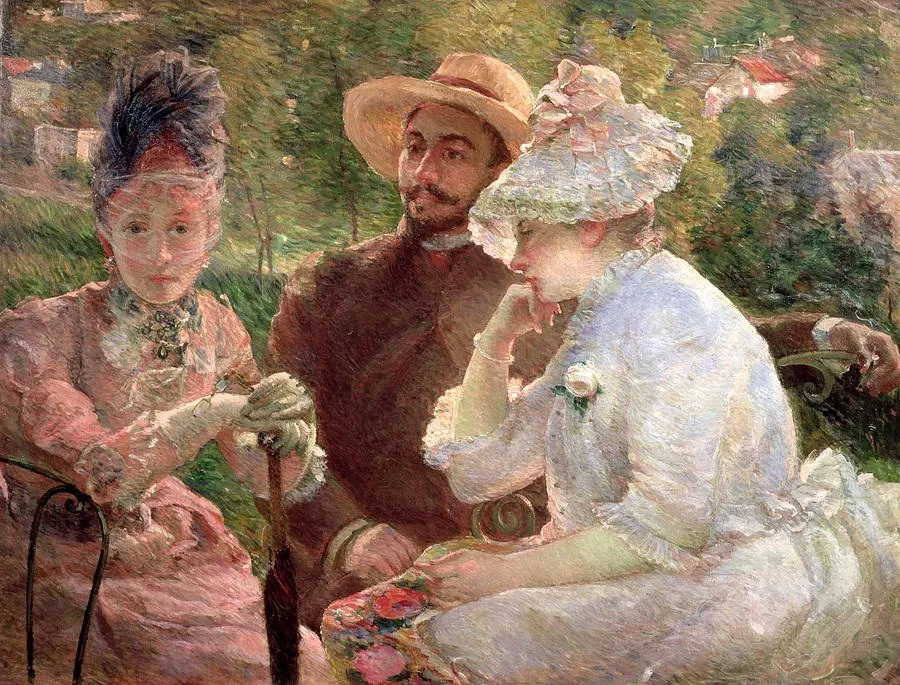
Marie Bracquemond, "On the Terrace at Sèvres" (1880). Oil on canvas. Musée du Petit Palais, Geneva. Bracquemond was one of "the women Impressionists," Morisot, Cassatt, Eva Gonzalès, and Bracquemond, identified by Tamar Garb in her 1986 study. Image via Wikimedia Commons.
How Feminist Art History Recovered Them
The recovery began with scholars. Rozsika Parker and Griselda Pollock demonstrated how early twentieth-century art history largely erased women's contributions to art, including Morisot's. Tamar Garb's 1986 study "Women Impressionists" and her 1987 monograph "Berthe Morisot" (with Kathleen Adler) were foundational. These were not biographical exercises. They were arguments that the canon had been constructed in a way that systematically excluded women, and that the exclusion distorted the history.
The exhibitions followed. Prominent examples include "Les femmes impressionnistes: Mary Cassatt, Eva Gonzalès, Berthe Morisot" (Musée Marmottan Monet, Paris; Isetan Art Museum, Tokyo; Hiroshima Museum of Art; Takashimaya Ground Hall, Osaka; Hakodake Museum of Art, Hokkaidō, 1993-95), "Mujeres Impresionistas: La otra mirada" (Museo de Bellas Artes de Bilbao, 2001-02), and "Women Impressionists" (Schirn Kunsthalle Frankfurt; Fine Arts Museums of San Francisco, 2008), the last of which displayed 150 works by these four artists. The retrospective "Berthe Morisot: Impressionist" (Mount Holyoke College Art Museum; National Gallery of Art, Washington; Kimbell Museum of Art, Fort Worth, 1987) helped restore Morisot's public profile in the United States. Four additional retrospectives followed between 1997 and 2012 in the United States and Europe. Since 2018, two major monographic Morisot exhibitions have toured four countries: "Berthe Morisot: Woman Impressionist" (Quebec, Philadelphia, Dallas, and Paris, 2018-19) and "Berthe Morisot: Shaping Impressionism" (London, 2023).
The 2025-26 season is dense. Slated are "Impression, Morisot" (Palazzo Ducale, Genoa, October 12, 2024 to February 23, 2025), "Morisot/Pétrovitch" (Musée Marmottan Monet, Paris, April 9 to September 15, 2025), and "Manet and Morisot" (Legion of Honor Museum, San Francisco, October 11, 2025 to March 1, 2026). The scale and frequency of these exhibitions affirm Morisot's consolidated position within the canon of French Impressionism, made possible by the feminist scholars who have focused their attention on her since the 1970s. For the social context behind this recovery, see our piece on art and society.
Why They Were Sidelined, and What Recovery Means
The gender structure of 19th-century France restricted women's access to art education. Women could not attend the École des Beaux-Arts until 1897. They could not draw from the nude, the core of academic training, until the late 19th century. Morisot was trained as a landscape painter and was skilled at working swiftly and decisively outdoors and under changing conditions of weather and light, a skill she developed because she was excluded from the studio-based academic training that men received. The exclusion produced the style. That is worth pausing on. The thing that made her work look different from Manet's was not talent or temperament. It was structural.
The domestic subjects compounded the problem. The most prestigious subjects still tended to be public action, historical narrative, and forms of spectacle associated with masculine access to the city. Morisot and Cassatt painted domestic interiors, women, children, subjects that the art establishment considered minor. They redirected that hierarchy. They showed that drawing rooms, nurseries, balconies, windows, gardens, dressing spaces, and theater boxes were not marginal to modern life.
The erasure was slow and deliberate. Morisot's reputation waned after her death. At the time of her 1987 retrospective, her most recent retrospective had taken place at the Galerie Bernheim-Jeune in Paris in 1941, a 46-year gap. Cassatt's retrospective exhibition of 1970 (National Gallery of Art, Washington; the Whitney Museum of American Art, New York; the Art Institute of Chicago) never traveled beyond the United States. The work was there. The institutions were not interested.
Morisot and Cassatt did not merely add feminine experience to a preexisting visual language. They redefined the language itself. The recovery of women Impressionists is not about adding names to a list. It is about changing what we think Impressionism was, not just boulevards and cafés and ballet dancers (the male subjects of Degas, Renoir, Caillebotte), but also drawing rooms and nurseries and gardens and theater boxes (the female subjects of Morisot, Cassatt, Bracquemond). Their modernity is built from relation rather than distance, from intimacy rather than spectacle, and from rooms and thresholds rather than streets alone. If you are new to this material, start with our guide on art for beginners, and consider the parallel case of Hilma af Klint, another woman written out of a movement she helped invent.
Final Thoughts
Berthe Morisot exhibited in 7 of the 8 Impressionist exhibitions, more than any other artist except Camille Pissarro. Mary Cassatt showed in 4. Eva Gonzalès died at 34. Marie Bracquemond showed in 3 before her husband discouraged her from continuing. Parker and Pollock demonstrated how early twentieth-century art history largely erased women's contributions to art, including Morisot's. The recovery began with feminist scholars in the 1970s. Tamar Garb's 1986 study identified "the women Impressionists," observing that "few people will have heard of the women Impressionists." The 1987 Morisot retrospective helped restore her public profile. Four more retrospectives followed (1997-2012). Since 2018, two major monographic Morisot exhibitions have toured four countries. The 2025-26 "Manet & Morisot" exhibition (Legion of Honor, San Francisco, October 11, 2025 to March 1, 2026; Cleveland Museum of Art) is the first major exhibition dedicated to the artistic exchange between Manet and Morisot, with thirty-six paintings and seven works on paper, and goes further, claiming that Morisot did not just exist within a circle of famous men, but actually influenced the direction of modern painting. By the mid-1870s, Manet had begun to follow Morisot's example. The 150th anniversary of the first Impressionist exhibition in 1874, celebrated in 2024, finally included women's work "no longer sidelined or necessarily understood in different terms than the art of men." The recovery is not about adding names. It is about changing what we think Impressionism was.
Go see Morisot's "The Cradle" (1872) at the Musée d'Orsay. Go see Cassatt's "The Child's Bath" (1893) at the Art Institute of Chicago. If you are in San Francisco before March 1, 2026, go see "Manet & Morisot" at the Legion of Honor, thirty-six paintings and seven works on paper that show, for the first time in a major exhibition, that by the mid-1870s, Manet had begun to follow Morisot's example. Look at the brushstrokes. Morisot's are swift, fluttering, alive. She grinds flower petals on her palette. Manet's are deliberate, revised, studio-bound. He painted in his studio, producing pictures that he hoped would look dashed off in one session but that in fact were created with extensive revisions. She painted outdoors, skilled at working swiftly and decisively outdoors and under changing conditions of weather and light. The difference is visible. The influence is visible. The history is being rewritten, one painting at a time. For more on how to look closely, see our guide on how to look at art, and for context read the 19thc-artworldwide.org review of Berthe Morisot à Nice.


