
On February 5, 1916, Hugo Ball and Emmy Hennings opened a nightclub in a former butcher's shop at Spiegelgasse 1 in Zurich's Niederdorf district. They called it the Cabaret Voltaire. The building was around the corner from Lenin's apartment, where he was planning a revolution that would change the political map of Europe. Inside the Cabaret Voltaire, a different kind of revolution was starting. It was called Dada, and it declared that the civilization responsible for the First World War did not deserve the art it produced.
The war was the context. By 1916, the Battle of the Somme had killed or wounded more than a million soldiers. Verdun was grinding through the French and German armies at a rate that made "casualty" seem like an insufficient word. Zurich was neutral territory, a place where draft dodgers, deserters, pacifists, and exiles from across Europe gathered because it was one of the few places they could. The artists who founded Dada were not in Zurich by choice. They were there because their home countries were trying to kill them or make them kill others.
This guide covers the founding at the Cabaret Voltaire, the key figures across Zurich, Berlin, and New York, the techniques Dada invented, and why the movement's anti-art stance remains relevant. The Cabaret Voltaire, still operating as a museum and performance space at the same address, is currently presenting two exhibitions that extend Dada's legacy into the present: "DadaZwischenSprachen" (June 5, 2026 to January 10, 2027) and "Suzanne Perrottet: After Dada, After Dance" (through May 17, 2026).
The Cabaret Voltaire and the Invention of Dada
The Cabaret Voltaire operated for only about five months, from February to early summer 1916. During that time it hosted readings, performances, and exhibitions that were deliberately designed to provoke. Ball recited sound poems that stripped language of meaning, reducing it to phonetic sounds. Tristan Tzara, a Romanian poet who became Dada's chief propagandist, read poems that he claimed to compose by pulling words from a hat. Marcel Janco made masks that the performers wore during chaotic, improvised dances. Richard Huelsenbeck, a German poet, read simultaneous poems in multiple languages at once, creating a wall of noise that made comprehension impossible.
The name "Dada" was chosen, according to most accounts, by Ball and Tzara in a process that was itself Dadaist. They stuck a knife into a dictionary and let it fall where it would. The word landed on "dada," French for "hobbyhorse." The name was meaningless, which was the point. Ball wrote in his diary: "Dada is a new tendency in art. Dada is a new tendency in art. Dada is a new tendency in art." The repetition was not a mistake. It was a demonstration that repetition empties language of content, which was exactly what Dada was trying to do.
No audio or film recordings of the original Cabaret Voltaire performances exist. All surviving recordings date from later periods, some made by the aging Dadaists themselves. The current exhibition "DadaZwischenSprachen" at the Cabaret Voltaire addresses this gap directly, showing how the movement's language experiments materialized through prints, reports, sketches, scores, and manifestos. The exhibition also asks what happened to the voices of women in early Dada, a question that has driven recent scholarship on the movement.
Marcel Duchamp and the Readymade
Marcel Duchamp (1887-1968) was not in Zurich. He was in New York, where he had moved in 1915, but his work was known to the Zurich group and his ideas ran parallel to theirs. Duchamp's contribution to Dada was the readymade: ordinary manufactured objects that he selected, sometimes modified, and presented as art.
"Fountain" (1917) is the most famous readymade and the most provocative. Duchamp submitted it to the first exhibition of the Society of Independent Artists in New York, a show that claimed to accept any work by any artist who paid the entry fee. He signed a porcelain urinal "R. Mutt" and submitted it under the title "Fountain." The society's board, which included Duchamp himself, voted to reject it. The rejection exposed the hypocrisy of the society's open admission policy and raised a question that has not been answered in over a century: what makes something art? Is it the object itself, the artist's intention, the institutional context, or the viewer's response?
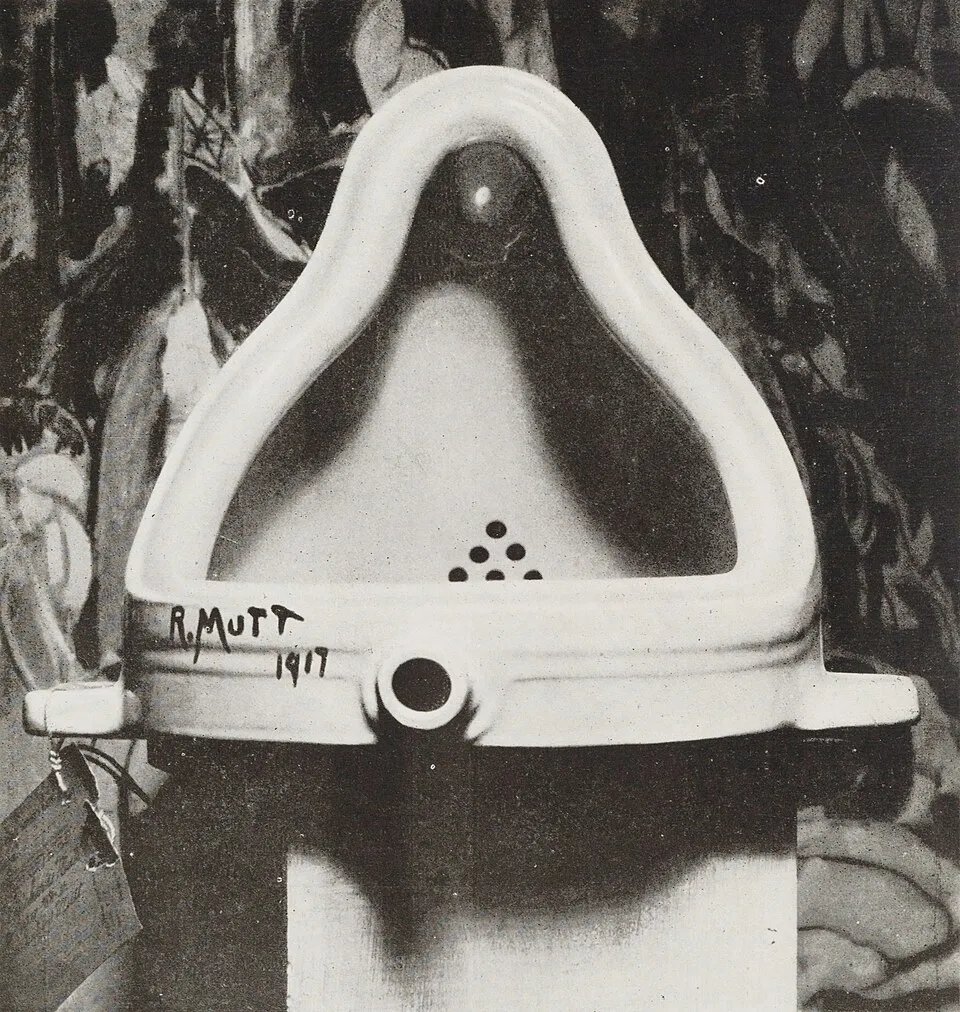
Marcel Duchamp, "Fountain" (1917). Photograph by Alfred Stieglitz, published in The Blind Man no. 2, May 1917. The original was lost. Wikimedia Commons.
The original "Fountain" was lost, probably thrown away by the society's board. Duchamp authorized a series of replicas in the 1960s, which are now in museums including the Tate Modern, the Pompidou Centre, and the Philadelphia Museum of Art. The fact that the most influential artwork of the 20th century survives only as a replica of a mass-produced plumbing fixture is itself a Dada gesture. Duchamp's readymades directly influenced Conceptual Art, which emerged in the 1960s with the argument that the idea behind an artwork is more important than the physical object. For more on Duchamp's broader influence, see our post on Surrealism and dream logic.
Hannah Hoch and Berlin Dada's Photomontage
Berlin Dada was more politically aggressive than Zurich Dada. It emerged in 1917-18 as the war was ending and Germany was collapsing into revolution. The Berlin group included Raoul Hausmann, Richard Huelsenbeck, George Grosz, John Heartfield, and Hannah Hoch. Their version of Dada was less a philosophical rejection of meaning and more a direct assault on the Weimar Republic's political establishment, military leadership, and bourgeois culture.
Hannah Hoch (1889-1978) was the only woman associated with the Berlin Dada group, and her work is among the most sophisticated the movement produced. She developed the technique of photomontage: cutting images from newspapers and magazines and reassembling them into compositions that were simultaneously political critique and formal experiment. Her masterpiece is "Cut with the Kitchen Knife Dada Through the Last Weimar Beer-Belly Cultural Epoch in Germany" (1919-20), a large-scale photomontage measuring 90 by 144 centimeters.
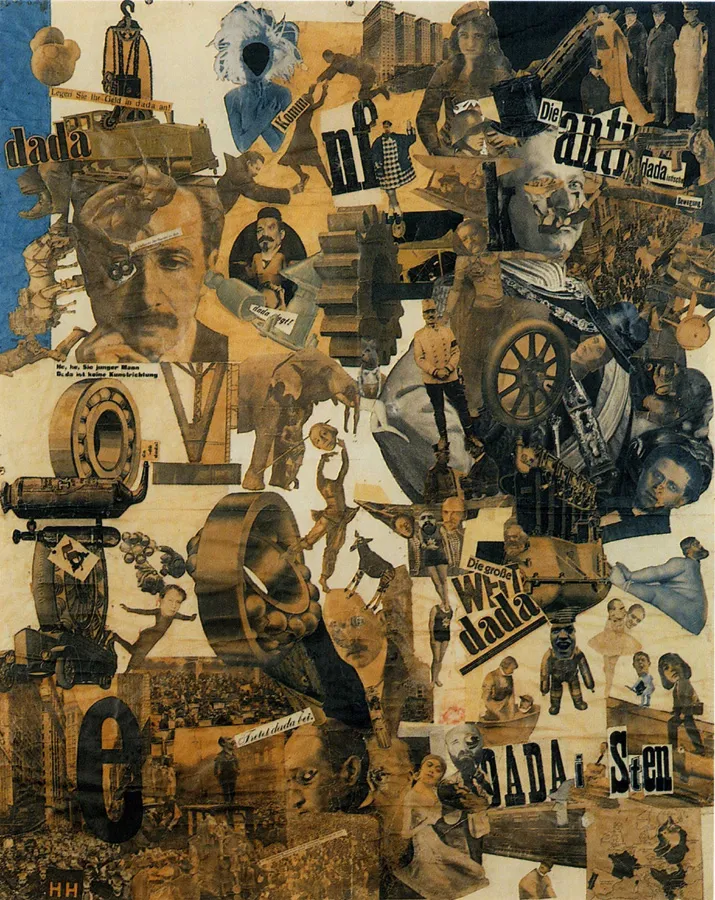
Hannah Hoch, "Cut with the Kitchen Knife Dada Through the Last Weimar Beer-Belly Cultural Epoch in Germany" (1919-20). Collage. Nationalgalerie, Berlin. Wikimedia Commons.
The work is dense with images cut from the Berliner Illustrirte Zeitung and other periodicals. The abdicated Kaiser Wilhelm II appears alongside Field Marshal Paul von Hindenburg, President Friedrich Ebert, circus performers, athletes, actresses, and Hoch herself. The images float among gears, ball-bearings, and machinery. The title equates Hoch's scissors with a kitchen knife, symbolically cutting through the patriarchal domains of Weimar politics and public life. The work was prominently displayed at the First International Dada Fair in Berlin in 1920, where it attracted attention and controversy.
Hoch's position within Berlin Dada was complicated. The male Dadaists treated her with a mixture of respect and condescension. Hausmann, her partner at the time, called her "the good Dadaist" in a tone that was not entirely complimentary. Recent scholarship has recovered Hoch's significance as both an artist and a theorist of photomontage, and the current Cabaret Voltaire exhibition "DadaZwischenSprachen" asks directly: "What happened to the voices of women?" in early Dada. The companion exhibition "Suzanne Perrottet: After Dada, After Dance" (through May 17, 2026) centers another long-overlooked woman in Dada's history, a dancer and pedagogue who moved between avant-garde networks while developing an independent approach to movement and performance.
The Techniques Dada Invented
Dada's contribution to art technique is larger than its contribution to aesthetics. The movement invented or popularized several methods that became standard tools of 20th-century art:
Photomontage, pioneered by Hoch, Hausmann, and Heartfield in Berlin, involved cutting and reassembling photographic images from mass media. The technique was a direct response to the propaganda use of photography during the war. If newspapers could manipulate photographs to support the war effort, artists could manipulate them to undermine it. Heartfield's later anti-Nazi photomontages, produced in the 1930s, are a direct extension of this Dada technique.
The readymade, invented by Duchamp, involved selecting a manufactured object and presenting it as art without modification or with minimal modification. The readymade challenged the assumption that art requires skill, craft, or even the artist's physical involvement in making the object. This idea is the foundation of Conceptual Art and remains the most debated proposition in modern art.
Sound poetry, performed by Ball and Tzara at the Cabaret Voltaire, stripped language of semantic meaning and reduced it to phonetic sounds. Ball's "Karawane" (1916) consists of nonsense syllables arranged in a rhythm. The poem cannot be translated or paraphrased because it has no content to translate. It is pure sound, and as such it questions whether language is a vehicle for meaning or a physical event.
Chance operations, used by Tzara and later by John Cage, involved making artistic decisions through random processes rather than conscious choice. Tzara's hat-pulling method for composing poems was a chance operation. The idea that randomness could produce art was a direct challenge to the Romantic belief in the artist's genius and intention.
Why Dada Still Provokes
Dada declared itself dead in 1922, when Tzara, Breton, and others held a meeting in Paris to plan a "Dada trial" that devolved into infighting. The movement lasted roughly six years. But its techniques and ideas became permanent features of 20th-century art. Surrealism, which emerged from Dada in 1924, took the interest in the unconscious and the irrational and systematized it. Collage became a standard technique. The readymade became a philosophical problem that every art student still confronts. Performance art traces its lineage back to the Cabaret Voltaire.
The question Dada asked is still the question that matters: what is art for? If the answer is to decorate the homes of the wealthy, then Dada was an attack on art. If the answer is to challenge assumptions and expose the structures that produce meaning, then Dada was the most honest art movement of the 20th century. The current wave of exhibitions at the Cabaret Voltaire suggests that the question is still live. "DadaZwischenSprachen" runs through January 10, 2027, exploring how Dada's linguistic experiments connect to contemporary debates about technology, art, and ways of life. The exhibition includes works by contemporary artists including Katalin Ladik and Babi Badalov alongside historical documents, demonstrating that Dada's impulse to disrupt language and meaning continues to generate new work.
Final Thoughts
Dada was the only art movement that honestly assessed the civilization that produced it. The First World War killed millions of people and destroyed the Enlightenment faith in progress, reason, and the steady improvement of human life. Dada's response was to reject the art of that civilization, not because art was bad, but because the civilization was. The movement's techniques, photomontage, the readymade, sound poetry, chance operations, became permanent tools of artistic practice. Its questions, about what art is for and who gets to decide what counts as art, are still being asked.
If you want to go deeper, the Museum of Modern Art's Dada resource provides a good overview. The Tate's glossary entry on Dada is also useful. You can explore our posts on Surrealism and Conceptual Art for the movements that grew out of Dada, and our art movements timeline for broader context. For the connection to performance, see our piece on performance art and the body as medium, and for collage, our post on collage from Cubism to Hannah Hoch. Our art history cheat sheet situates Dada within the larger story.


