
On July 19, 1937, the Nazi regime opened two art exhibitions in Munich, deliberately staged as opposites. The Great German Art Exhibition, housed in a brand-new building called the Haus der Deutschen Kunst, displayed approved works: idealized Germanic landscapes, heroic nudes, peasant mothers, mythological scenes. A short walk away, in the cramped galleries of the Hofgarten arcade, the Degenerate Art exhibition (Entartete Kunst) displayed over 650 works confiscated from German museums, hung deliberately close together under harsh lighting, with handwritten labels mocking them as the products of Jewish influence, mental illness, and racial degeneracy. The artists included Kandinsky, Klee, Dix, Grosz, Ernst, Nolde, and Kirchner. The Degenerate Art exhibition drew more than two million visitors, roughly four times the number who visited the Great German Art show. Whatever the regime intended, the result was to give Germany's entire avant-garde one last public viewing before the works were sold, destroyed, or burned.
No government in history has been indifferent to visual art. The connection between political power and visual representation runs from the pharaohs of ancient Egypt through the Catholic Church's strategic deployment of Baroque painting to the Soviet Union's systematic use of Socialist Realism. Art is not a luxury that politics tolerates. It is a tool of power that political systems actively seek to control, direct, or suppress. This guide covers the major intersections between political authority and visual art, with particular attention to the 20th century, when the stakes became as high as they have ever been.
The Roman Imperial Model: Art as Political Communication
The Romans developed the systematic use of visual art for political communication with an explicitness that would not be equaled until the 20th century. The Ara Pacis (Altar of Peace, 13-9 BCE), commissioned by Augustus, presents a continuous narrative frieze of the imperial family in procession alongside mythological scenes linking Augustus's reign to Rome's divine origins. The Column of Trajan (113 CE) spirals upward with 200 meters of continuous carved relief depicting Trajan's Dacian campaigns: a permanent stone newspaper reporting the emperor's military achievements in specific, legible detail.
Augustus's program of artistic patronage was so comprehensive that art historian Paul Zanker, in his 1987 study "The Power of Images in the Age of Augustus," argued that the visual culture of the Augustan period was the primary vehicle through which the new imperial ideology was communicated to a largely illiterate population. The visual arts could reach everyone. Text could not. This insight, that images do political work that words cannot, runs through every subsequent episode in this history.
Soviet Socialist Realism: The Most Comprehensive State Art System
The Soviet Union developed the most comprehensive state apparatus for controlling visual art in history. After the initial period of revolutionary avant-garde experimentation in the 1920s, when movements including Constructivism, Suprematism, and Productivism flourished under the assumption that radical art and radical politics were natural allies, Stalin consolidated power in the early 1930s and imposed Socialist Realism as the mandatory style for all Soviet art.
Socialist Realism required that art be accessible to the masses (meaning representational and easily legible), optimistic in its vision of the socialist future, and heroic in its depiction of workers, soldiers, and Party leadership. Paintings showed steel workers bathed in warm light, peasants celebrating the harvest, Lenin addressing crowds with electrifying authority. The style was borrowed from 19th-century academic Realism but stripped of its capacity for social criticism and redirected toward uncritical affirmation. The Tate's summary of Socialist Realism describes it as "a form of art that was intended to be intelligible to the masses" while serving as "a vehicle for the education of the masses in the spirit of socialism."
Artists who failed to conform risked not merely exclusion from exhibitions but imprisonment, forced labor in the Gulag, or execution. The sculptor Naum Gabo emigrated. The painter Kazimir Malevich, creator of Suprematism, died in poverty under state surveillance in 1935. The composer Dmitri Shostakovich survived by writing music that could be read as conformist on the surface while containing ironic complexity detectable only by those who knew what to listen for. Art under totalitarianism develops its own language of concealment, and the ability to read between the official lines becomes a survival skill for both artists and audiences.
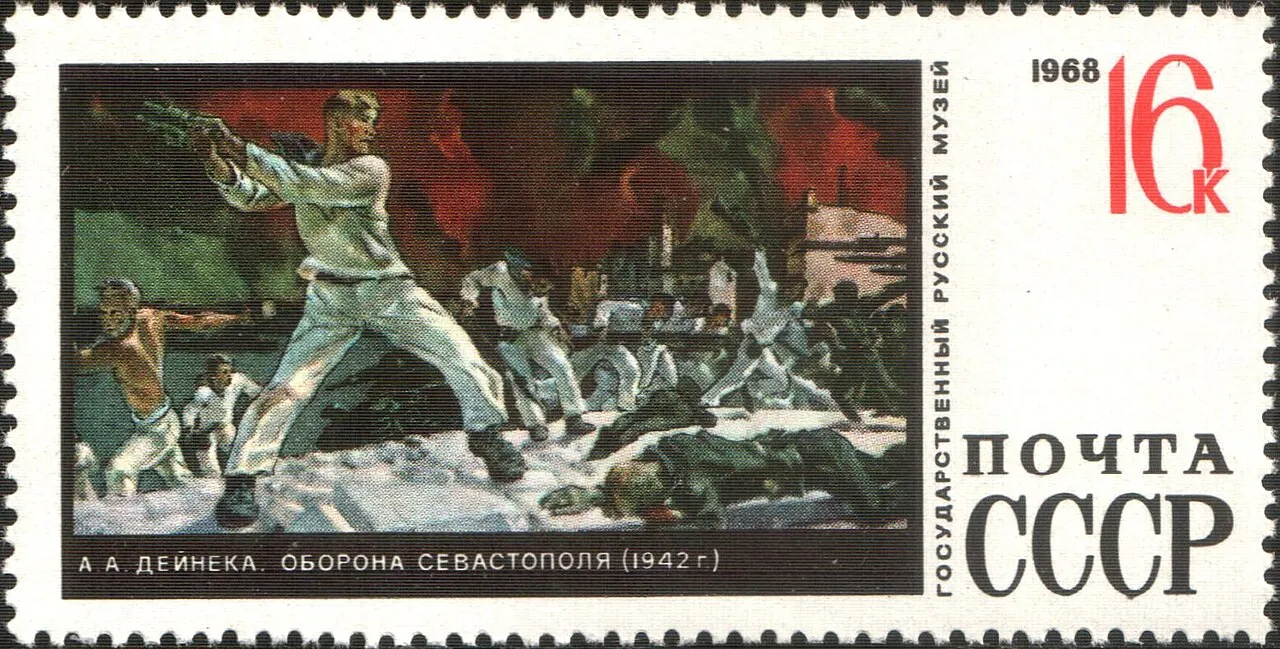
Alexander Deineka, "The Defence of Sevastopol" (1942), oil on canvas, 200 x 400 cm. Russian Museum, Saint Petersburg. A defining example of Soviet Socialist Realism during the Great Patriotic War: heroic workers and soldiers, bright color, accessible legibility, and unambiguous ideological content. Image: Soviet postage stamp, public domain, via Wikimedia Commons
Nazi Germany: The Dual Strategy of Promotion and Suppression
The Nazi regime's relationship to art operated on a dual strategy: promoting an official art of blood-and-soil nationalism and heroic classicism, and simultaneously attacking and suppressing modern art as evidence of cultural decay. The 1937 Munich exhibitions were the most visible expression of this strategy, but the broader campaign was systematic. Approximately 20,000 works were confiscated from German museums between 1937 and 1938. Many were sold at auction in Switzerland for foreign currency. Others were burned in the courtyard of the Berlin fire station on March 20, 1939, in a deliberate echo of book burnings.
Several of the targeted artists fled Germany. Ernst Ludwig Kirchner, founder of Die Brucke and one of the most important German Expressionists, took his own life in Switzerland in 1938 after his work was removed from museums and he was declared degenerate. Others survived and continued working in exile. The episode demonstrates a recurring pattern in the history of political art suppression: the attempt to destroy an artistic tradition often produces the opposite of its intention. The Degenerate Art exhibition gave more people a chance to see modern German art than any previous exhibition had, and the destruction of works made the surviving ones more historically significant, not less. The guide to Art Censorship Through History covers this episode and its parallels.
The WPA Murals: Art as Democratic Infrastructure
The New Deal response to the Great Depression included, through the Works Progress Administration Federal Art Project (1935-43), the most ambitious government arts program in American history. Thousands of artists were employed to create public murals, sculptures, photographs, prints, and posters for post offices, schools, hospitals, and other public buildings across the country. The program produced an estimated 225,000 works of art by over 10,000 artists who would otherwise have been unemployed.
The political philosophy behind the WPA program was democratic rather than propagandistic. The federal government was not dictating subject matter or style. It was providing employment and the means of production, trusting artists to make work that reflected the values and experiences of American communities. The result was art that genuinely engaged with American life: murals showing the history of local communities, the experience of industrial labor, the diversity of immigrant cultures. Thomas Hart Benton, Grant Wood, and Ben Shahn developed a Social Realist tradition that was recognizably American without being nationalist in the Soviet or Nazi sense. The distinction matters. State-sponsored art is not inherently propaganda. It depends on whether the state dictates the content or provides the conditions for artists to work freely. The Frida Kahlo spotlight, Frida Kahlo, covers the Mexican muralist tradition that provided the WPA's most direct model.
Cold War Culture: When the CIA Funded Abstract Art
One of the most remarkable revelations of Cold War history is that the CIA covertly funded American abstract art as a weapon in the cultural competition with the Soviet Union. Beginning in the late 1940s, the CIA's Congress for Cultural Freedom supported the promotion of Abstract Expressionism in European exhibitions, publications, and cultural events. The argument was strategic: American Abstract Expressionism, with its emphasis on individual freedom and gesture, its rejection of political content and state direction, was the visual antithesis of Soviet Socialist Realism. Promoting it served American foreign policy by demonstrating the cultural superiority of liberal democracy.
The artists involved, including Pollock, de Kooning, and Rothko, were largely unaware of the government interest in their work. Several had leftist political views that would have made them uncomfortable allies for the CIA. The episode raises a question that does not have a clean answer: does a work of art become propaganda if it is used for political purposes without the artist's knowledge or consent? The art did not change. The institutional context around it did. The guide to Abstract Expressionism covers the movement itself.
Contemporary Political Art: From State Control to Representation
Since the 1960s, art's engagement with politics has shifted from the question of state control toward questions of representation, identity, and whose stories get told. The Civil Rights Movement in the United States, anti-apartheid struggle in South Africa, feminist art movements globally, and post-colonial cultural production have all used visual art as a vehicle for claims about representation and justice that the mainstream art world had excluded.
Jean-Michel Basquiat's paintings of the 1980s placed African American history, police violence, and the commodification of Black culture directly into the high-art context of New York galleries, creating works that could not be received as purely aesthetic objects. His engagement with the tension between the art market's appetite for his work and the political content of that work is one of the defining stories of late 20th-century art. The spotlight on Jean-Michel Basquiat covers his practice in full. Ai Weiwei, who has used his art practice as a direct form of political activism against the Chinese government, represents another version of this engagement: art as resistance that the state cannot easily suppress without the suppression itself becoming a subject of global attention.
The relationship between art and political power is not a historical curiosity. It is an ongoing negotiation about who controls the images that shape how people understand themselves and their world. For the longer art history context, see The Complete Guide to Art Movements. Which political use of art do you find most troubling or most powerful? Share in the comments.


