Walk into the Hagia Sophia in Istanbul and look up. The 13th-century mosaic of Christ Pantocrator stares back at you from the dome: gold background, formal frontal gaze, right hand raised in blessing. For over a thousand years, this image functioned not as decoration but as a theological claim about the nature of God and what it meant to encounter the divine. The gold is not background. In Byzantine theology, it represents uncreated divine light, which exists outside ordinary time and space. The gaze is not artistic convention. It is understood as a real encounter between the viewer and the person depicted.
Most of the art that fills the world's greatest museums was originally made to function like that mosaic: as a vehicle for something that went beyond aesthetics. A Tibetan thangka painting, a carved Hindu temple wall, a page of Quranic calligraphy, a Byzantine icon on an egg-tempera panel, these are not decorative objects that also happened to be used in religious contexts. They are objects whose meaning is entirely defined by their religious function. Understanding why each tradition made the images it did changes what you see when you look at them.
Christianity: Two Centuries of Fighting About Pictures
Christianity has been arguing about images almost since it began. The Second Commandment prohibits graven images. The Incarnation, God taking on a human body in the person of Christ, seems to legitimize depicting that body. Both arguments are compelling, and both have produced powerful visual traditions.
The Byzantine Iconoclast Controversy ran from 726 to 843 CE and was more violent than most people realize. Emperor Leo III ordered the removal of images from churches in 726. The Christ mosaic above the Chalke Gate in Constantinople was pulled down. Monks who defended icons were tortured and killed. The theologian John of Damascus, writing from outside Byzantine territory in Muslim-controlled Jerusalem, argued that icons were not representations of the divine nature but of Christ's human nature, which God had voluntarily taken on and which could therefore be depicted. Venerating an icon was honoring the person it depicted, not the painted wood. The Second Council of Nicaea affirmed this position in 787 CE and established the theological framework that shaped Eastern Christian art permanently.
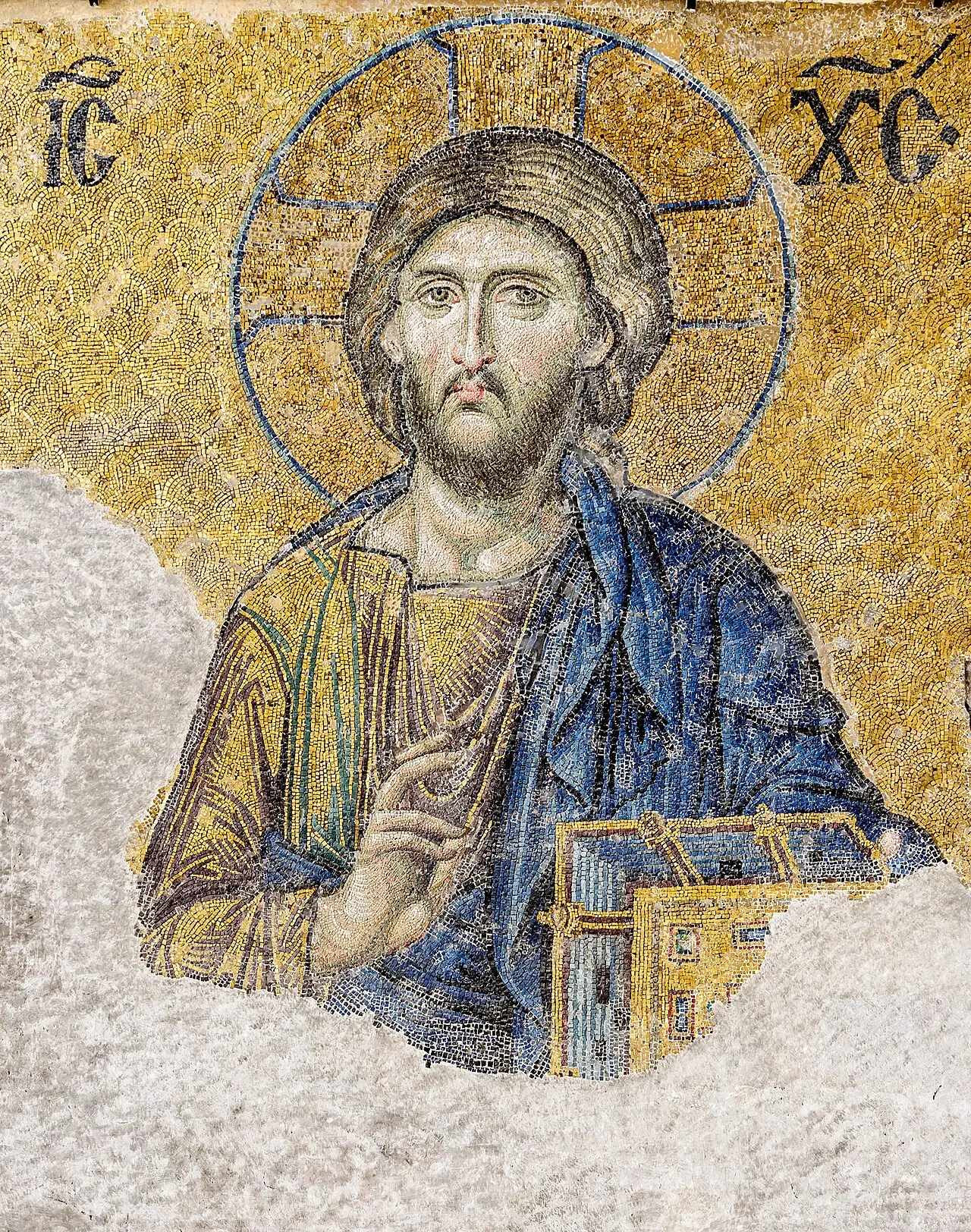
Christ Pantocrator mosaic, Hagia Sophia, Constantinople (Istanbul), 13th century. The gold background signifies divine light outside ordinary time. The frontal gaze was understood in Byzantine theology as a real, not merely symbolic, encounter between viewer and depicted person. Image: Public domain, via Wikimedia Commons
The Protestant Reformation brought the argument back to Western Christianity in the 16th century, this time with hammers. In Zurich in 1524, Ulrich Zwingli oversaw the whitewashing of church interiors and the removal of all images. In the Netherlands, the Beeldenstorm of 1566 saw Protestant crowds smash statues and slash altarpieces across hundreds of churches over several weeks. The English Reformation under Henry VIII and Edward VI was equally destructive. The Catholic Church's response, which art historians call the Counter-Reformation, deliberately weaponized images in the opposite direction: the Baroque painting tradition that produced Caravaggio, Rubens, and Bernini was an institutional decision to use overwhelming sensory experience to pull viewers into religious emotion. Our guide to Baroque Art: Drama, Light, and the Power of the Catholic Church covers this in detail. The full story of Byzantine icons is in our guide to Byzantine Art: Gold, Icons, and the Sacred Image.
Islam: What a Prohibition Produces
The common claim that Islam prohibits images is too simple. The Quran does not explicitly forbid depictions of living beings. The prohibition comes from the Hadith literature, the recorded sayings and practices of the Prophet Muhammad, which includes traditions condemning image-makers for attempting to imitate God's creative act. In practice, this produced a strong tradition of avoiding representational imagery in religious contexts: mosques, Quranic manuscripts, and other sacred objects do not typically depict humans or animals.
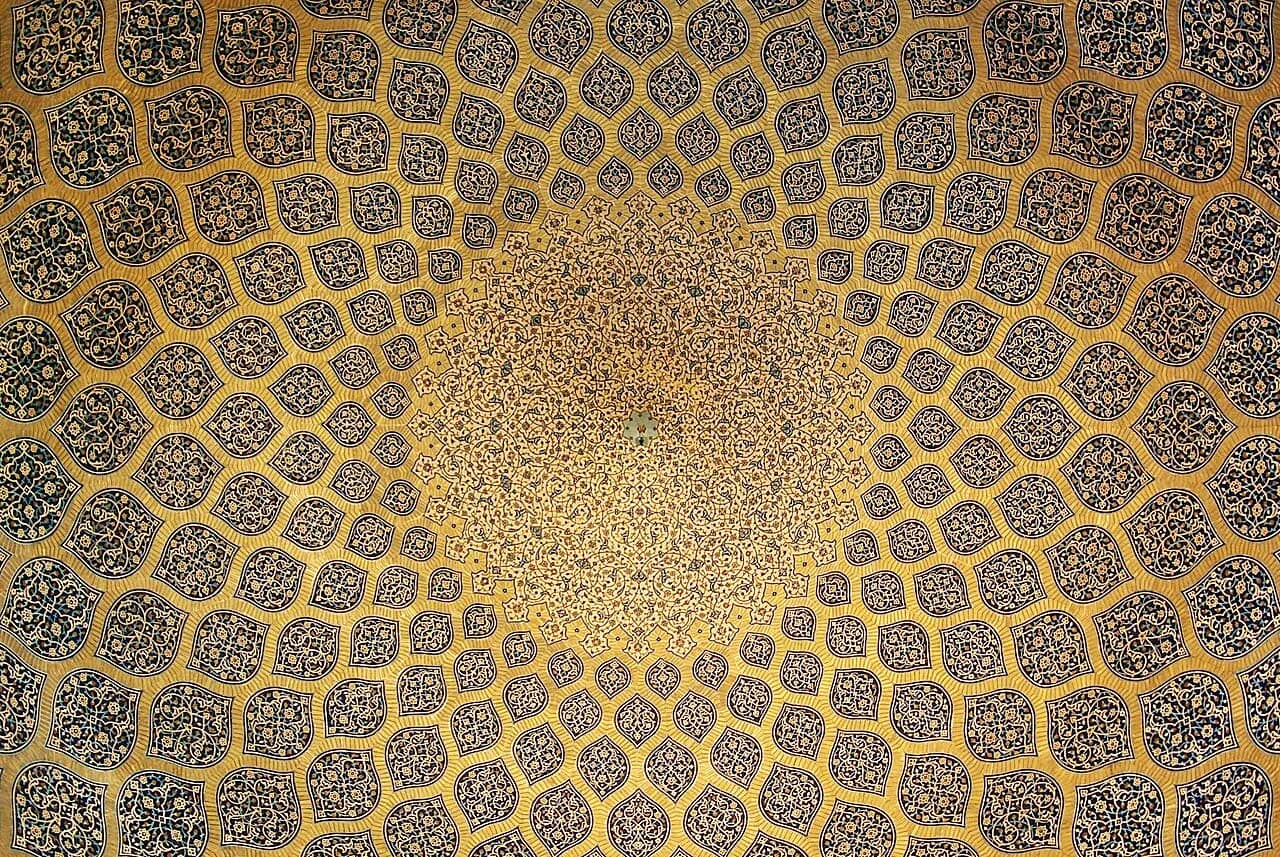
What filled that space is one of the great achievements in visual history. Islamic geometric art, the infinitely repeating patterns of interlocking stars, polygons, and arabesques that cover mosque interiors from the Alhambra in Granada to the Friday Mosque in Isfahan, reaches levels of mathematical complexity that were not fully understood by Western mathematicians until the 20th century. Researchers Peter Lu and Paul Steinhardt, writing in Science in 2007, demonstrated that the geometric patterns on 15th-century Islamic buildings incorporated the same quasi-crystalline geometry that Western mathematics did not formally describe until 1973. The artisans who made these patterns did not have that mathematical framework. They had a visual tradition sophisticated enough to arrive at the same forms independently.
Calligraphy occupied an even higher position than geometry. The Arabic script that writes the Quran is the Word of God in a direct sense: the Quran is understood as the literal speech of God, and writing it in a beautiful hand places the divine word in material form. Scripts like Kufic, Thuluth, and Naskh were developed over centuries with the same care that European painters devoted to figural representation. Secular Islamic art, produced in court rather than religious contexts, did include figurative imagery: Persian illustrated manuscripts, Mughal portrait painting, and Ottoman miniatures are among the great figurative traditions of world art. But that secular tradition remained separate from the religious one.
Buddhism: From Empty Throne to Global Image
The earliest surviving Buddhist art, from the carved stone railings at the Sanchi stupa in Madhya Pradesh, India (dating to roughly 100 BCE), contains no images of the Buddha at all. His presence is indicated by symbols: an empty throne, a set of footprints, a Bodhi tree, a wheel representing the dharma he set in motion. This was not a failure of skill. The sculptors at Sanchi produced figures of extraordinary quality. The absence was intentional: the Buddha had passed beyond ordinary existence into a state that could not be adequately represented without misrepresenting it.
This changed in the Gandhara region of what is now Pakistan and Afghanistan during the 1st century CE, where Buddhist sculptors began depicting the Buddha in human form. The Gandharan Buddha images draw partly on Hellenistic sculptural conventions that had spread to the region through Alexander the Great's conquests two centuries earlier: the figures have the proportions and draped robes of Greek sculpture, combined with specifically Buddhist iconographic markers including the ushnisha (the cranial protuberance that indicates supernatural wisdom), elongated earlobes from the weight of royal jewels he renounced, and mudras (ritual hand positions) each carrying specific doctrinal meaning. This combination of Greek form and Buddhist content produced an image type that spread across Central, East, and Southeast Asia, adapting to every local artistic tradition it encountered.
Tibetan thangka paintings represent a later Buddhist visual tradition with entirely different purposes. A thangka depicting a specific deity for meditation practice is not a decorative image but a precisely coded visual document: each figure must be painted in specific colors, with specific attributes, in specific postures, according to iconographic manuals that encode doctrinal teachings in visual form. A practitioner using the thangka as a meditation support is not looking at a picture. They are engaging with a visual system that trains the mind toward specific states of awareness. Our guide to Mandalas: Meaning, History, Types, and Symbol Guide covers this visual tradition in depth.
Hinduism: The God Is in the Image
Hindu sacred images work on a completely different theological principle from anything in the Western or Buddhist traditions. The Sanskrit concept of darshan, often translated as "auspicious sight," describes what happens when a worshipper looks at a consecrated image (murti) in a temple: they see the deity, and the deity sees them. This is not metaphorical. A murti is not a representation of a god in the sense that a Christian painting represents Christ. After a formal consecration ceremony (prana pratishtha, "installation of breath"), the murti is understood as the actual residence of the deity in material form.
This theological principle generated one of the most ambitious sculptural programs in world art. The exterior walls of Hindu temples from the 1st millennium CE onward are covered with carved figures in stone: gods, goddesses, celestial musicians, erotic couples, demons, and guardians in compositions that can include thousands of individual figures on a single building. The Kandariya Mahadeva temple at Khajuraho (c. 1030 CE) has approximately 900 figures on its exterior surfaces. The Sun Temple at Konark (13th century CE), though now partially collapsed, originally had carved figures covering virtually every surface of its massive base platform.
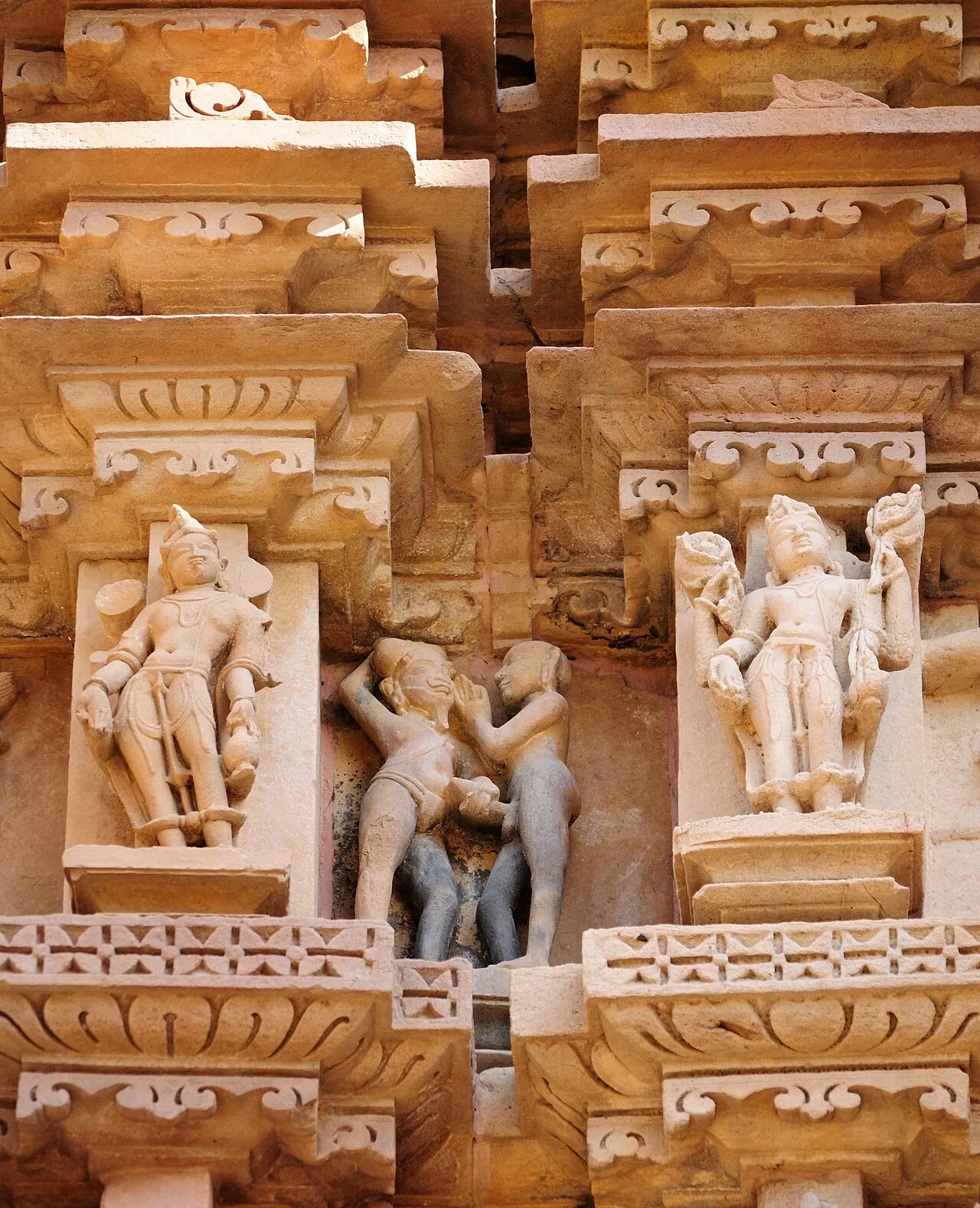
Kandariya Mahadeva temple, Khajuraho, Madhya Pradesh, India (c.1030 CE). The approximately 900 carved figures on the exterior represent a complete cosmological program, not decorative excess. Image: Public domain, via Wikimedia Commons
The erotic imagery on Hindu temples, which draws so much attention from Western visitors, is not pornographic in the way Western critics have sometimes assumed. Art historian Devangana Desai, in her study "The Religious Imagery of Khajuraho" (1996), documents the cosmological and ritual functions of the mithuna figures: they appear at threshold zones of the temple, guarding the transition between the secular world outside and the sacred space within. They represent the energy of creation that the worshipper must pass through and transcend on their way toward the innermost sanctum, where the deity resides in darkness.
When Images Are Destroyed
One of the most consistent patterns across all these traditions is the periodic destruction of religious images: the Byzantine iconoclasts of the 8th century, the Protestant reformers of the 16th, the Taliban's demolition of the Bamiyan Buddha statues in March 2001, the Islamic State's destruction of Assyrian artifacts at the Mosul Museum in 2015. The impulse is always the same: images carry power, and destroying them is a way of destroying the power they embody.
What is striking is how consistently the destroyers are right about the power of images, even when they are wrong about everything else. The Bamiyan Buddhas, carved into a cliff face in Afghanistan between the 3rd and 6th centuries CE, were the largest Buddha statues in the world. Their destruction took the Taliban two weeks and required explosives, anti-aircraft guns, and dynamite. That effort tells you something about how much power they believed the images held. The effort was, in a warped way, a tribute to what the images meant.
For the full context of how images have been suppressed and destroyed across art history, see our guide to Art Censorship Through History: What Gets Banned and Why. Which tradition of sacred art do you find most visually compelling, and why? Share your thoughts in the comments.