Look at Fan Kuan's "Travelers Among Mountains and Streams" (c. 1000 AD), now in the National Palace Museum in Taipei, and the first thing you notice is scale. A vertical silk scroll nearly seven feet tall, it shows a sheer cliff face that fills most of the composition. At the base, almost invisible, a small group of travelers and pack mules moves along a path. The cliff dwarfs them absolutely. Mist erases the middle distance. The mountain is not a backdrop to the human journey. The humans are a footnote to the mountain.
This deliberate reversal of scale is not an accident or a failure of Western-style perspective. It is a philosophical statement. Chinese landscape painting, known as "shanshui" (literally "mountain-water"), is not primarily about depicting nature. It is about expressing the relationship between the human spirit and the natural world, and in that relationship, the human being is not the measure of all things. Nature is vast, ancient, and indifferent to individual scale. To paint it honestly is to acknowledge that truth.
Chinese landscape painting is one of the most sophisticated visual traditions in history, developing over more than a thousand years of continuous practice and producing works that feel as fresh and relevant today as they did in the Song dynasty. This guide explains the philosophy behind it, the techniques that make it distinctive, and the major artists and periods that define the tradition.
The Philosophy Behind Shanshui
Western landscape painting, when it developed as a major genre in 17th-century Holland and later in Romantic Europe, was primarily concerned with light, atmosphere, and the emotional resonance of natural settings. The natural world was a scene for human feeling. Chinese landscape painting operates from a different set of premises entirely.
The philosophical roots of shanshui run through three traditions: Daoism, Buddhism, and Confucianism. From Daoism, landscape painting inherited the idea of "qi," the vital energy that flows through all things. Mountains are not inert rock. They are concentrations of cosmic energy, nodes in the circulation of the universe. Rivers carry qi along their courses. Mist is qi in transition. To paint a landscape correctly is to capture this energy, not just its surface appearance.
From Buddhism, and particularly Chan Buddhism (known in Japan as Zen), landscape painting inherited an interest in emptiness and the mind's relationship to the visible world. The blank areas in a Chinese landscape painting are not unpainted. They are sky, mist, and water rendered through absence. The painter decides what to leave out as carefully as what to include.
From Confucianism, landscape painting inherited the idea that moral and aesthetic cultivation are inseparable. The learned gentleman-painter, the "wenren" or literati painter, was expected to paint not to please a patron or display technical virtuosity but to express his own character and cultivation. A painting was a record of the painter's inner life as much as an image of the external world.
The Four Masters and the Art of Brushwork
Chinese ink painting technique is fundamentally about the brush. Unlike Western oil painting, where paint can be mixed, blended, and overpainted indefinitely, Chinese ink painting requires decisions to be made before the brush touches the paper or silk. There is no erasure. Every stroke is final. This creates a relationship between painter and work that is closer to calligraphy than to Western painting, and in fact the same brushes and the same disciplines apply to both.
Artists developed an elaborate vocabulary of brush strokes called "cun" (texture strokes) for describing different rock surfaces. Some strokes suggest smooth, water-worn boulders. Others suggest sharp, fractured cliff faces. Others describe the particular character of a mountain seen through rain. Learning to read these strokes is like learning to read a writing system: once you understand the vocabulary, the landscape reveals itself as a set of deliberate marks, each one encoding information about texture, depth, and atmosphere.
Fan Kuan: Monumental Scale and Presence
Fan Kuan (active c. 960 to 1030 AD) is one of the most celebrated painters in Chinese history, and his "Travelers Among Mountains and Streams" is the painting most often cited as the pinnacle of the Northern Song landscape tradition. The vertical format, the massive central peak, and the tiny human figures establish what art historian James Cahill called "the monumental style," in which nature overwhelms human scale rather than accommodating it.
Look closely at the rock surfaces in Fan Kuan's painting and you can see thousands of tiny parallel brushstrokes describing texture and solidity. The waterfall cutting through the right side of the cliff adds a vertical element that the eye follows downward to the figures. The mist concealing the middle section of the mountain creates a sense of impossible height, as if the peak exists in a different atmosphere from the valley below.
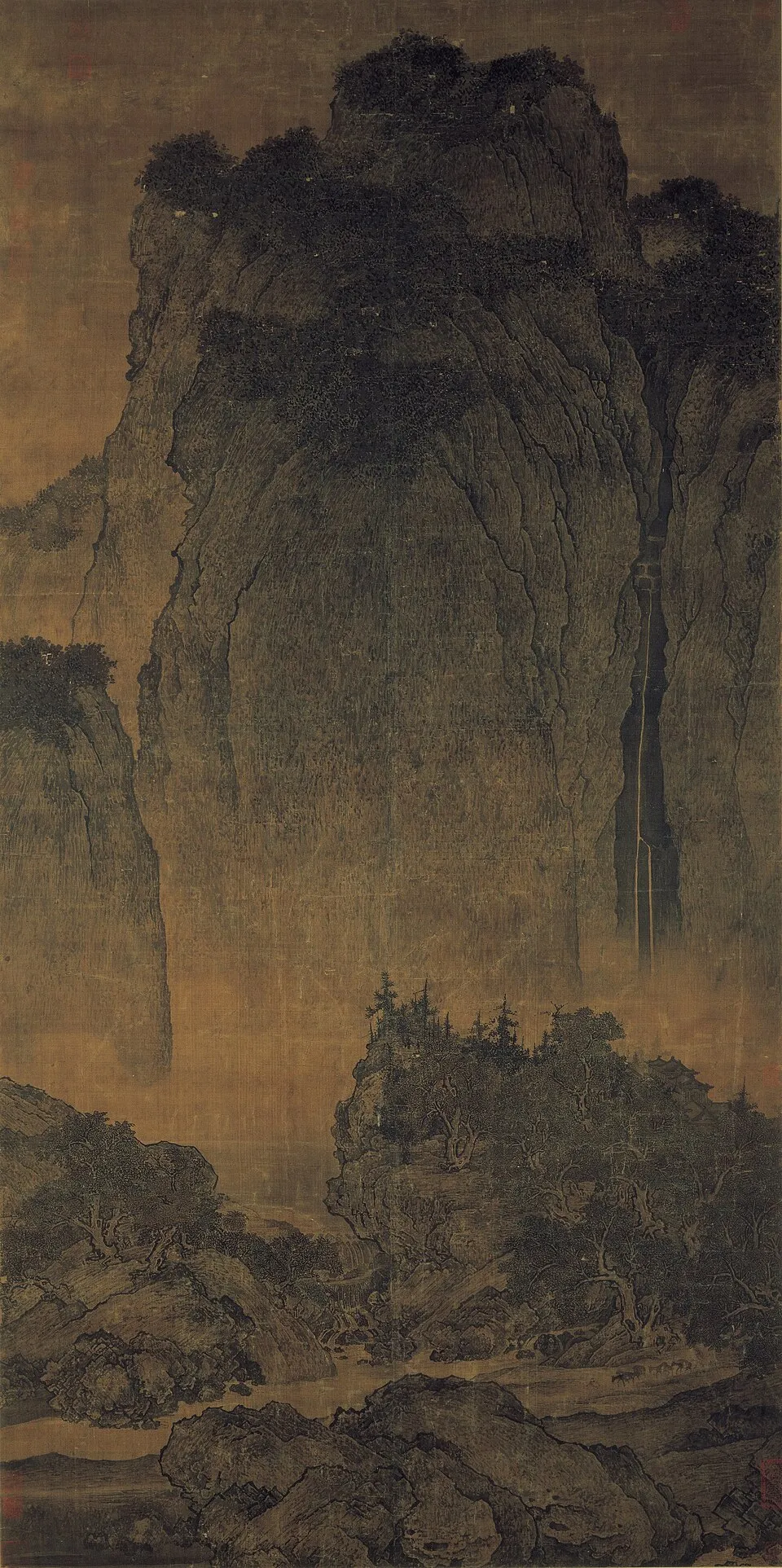
Fan Kuan, "Travelers Among Mountains and Streams" (c. 1000 AD), ink and slight color on silk, 206.3 x 103.3 cm. National Palace Museum, Taipei. The tiny caravan at the base of the cliff is barely visible, establishing the monumental scale relationship between human beings and natural forces. Image: Public domain, via Wikimedia Commons
Guo Xi and the Multiple Perspective System
Guo Xi (c. 1020 to 1090 AD) was the leading court painter of the Northern Song dynasty and the author of an important treatise on landscape painting called "The Lofty Message of Forests and Streams." His masterwork, "Early Spring" (1072), also in the National Palace Museum, shows how Chinese landscape painters achieved depth without linear perspective.
Chinese landscape painting uses three distances: the "high distance" view looking up at mountains, the "deep distance" view looking through mountains into valleys, and the "level distance" view across flat water or plains. These three views can coexist in a single composition, allowing the painter to create a panoramic sense of space that no single-point Western perspective could achieve. "Early Spring" navigates all three, taking the viewer simultaneously upward, inward, and across the composition in a spatial experience that is genuinely different from anything in Western art. As the Metropolitan Museum's Chinese landscape painting guide notes, this system of multiple perspectives reflects a fundamentally different conception of space: not a window the viewer looks through, but a world the viewer moves through.
The Literati Turn: Emotion Over Description
By the Yuan dynasty (1271 to 1368), a profound shift had taken place in Chinese landscape painting. The literati painters, scholars and poets who painted as an expression of cultivated identity rather than professional craft, began to argue that technical accuracy was less important than expressive quality. A technically imperfect painting that captured the painter's spirit was worth more than a technically perfect painting that merely described surfaces.
Ni Zan (1301 to 1374) is the most radical example of this approach. His sparse, almost minimalist landscapes consist of a few rocks and bamboo shoots in the foreground, a wide empty middle distance of water, and a low horizon of distant hills. The human figure is entirely absent. Ni Zan himself wrote: "I use the painting of bamboo to express the untrammeled spirit in my breast; then how can I be concerned whether it looks like bamboo or not?" This is an explicit statement that the painting is about the painter's inner state, not about bamboo.
This literati philosophy, which placed expressive authenticity above descriptive accuracy, would prove enormously influential not just in China but in Japan, where it shaped the ink painting traditions discussed in our guide to Japanese art, and eventually in the West, where it resonates with everything from Abstract Expressionism to contemporary mark-making.
Reading the Empty Space
One of the most important skills in appreciating Chinese landscape painting is learning to read what is not there. Large areas of untouched paper or silk in a Chinese landscape are not blank. They are mist, sky, or water, rendered by the painter's decision to leave them alone. The boundary between a mountain and the mist surrounding it is often not a drawn edge but an absence of marks. The mountain ends where the painter stopped painting. The mist begins there.
This approach to empty space is philosophically connected to the Daoist concept of "wu," non-being, which is understood not as nothing but as the potential that makes all things possible. A wheel hub is made of spokes, but it is the empty center that makes the wheel useful. A room is made of walls, but it is the empty space inside that makes it habitable. Empty space in a Chinese painting functions the same way: it gives the painted elements room to breathe, to exist, to be what they are.
When you look at a Chinese landscape painting for the first time, resist the impulse to focus only on the painted marks. Spend time with the unpainted areas. Ask what they suggest, what kind of light or atmosphere fills them, what distance or mystery they create. This is the entry point into the painting's real meaning. Our guide to color and visual perception can also help develop sensitivity to tonal relationships in monochromatic work like this.
Chinese Landscape Painting Today
Chinese landscape painting did not end with the literati tradition. It remained a living practice through the Qing dynasty and into the 20th century, when artists like Qi Baishi (1864 to 1957) and Zhang Daqian (1899 to 1983) developed new approaches that incorporated Western technique while maintaining the philosophical foundations of the shanshui tradition. Zhang Daqian's late work, in particular, includes large-scale splash-ink landscapes that combine traditional composition with an almost Abstract Expressionist handling of ink and color.
In the early 21st century, a new generation of Chinese artists continues to work with ink on paper and silk, engaging both with ancient precedents and with contemporary global art discourse. Artists like Liu Dan use the traditional vocabulary of rock and mist to create works that feel startlingly contemporary. Their paintings demonstrate that shanshui is not a historical relic but an active set of ideas with relevance to any visual culture grappling with how to represent nature, emptiness, and human scale. Major museum collections of Chinese landscape painting include the National Palace Museum in Taipei, the Palace Museum in Beijing, the Metropolitan Museum of Art in New York, and the Freer Gallery of Art in Washington, D.C.
Final Thoughts
Chinese landscape painting offers one of the most philosophically rich approaches to representing the natural world ever developed. Its core insights, that nature is not a backdrop for human drama but a vast presence in its own right, that empty space is active rather than passive, and that a painting expresses the painter's character as much as the world it depicts, are as useful for looking at art today as they were a thousand years ago.
The next time you stand in front of a Chinese landscape painting in a museum, resist the urge to decode it quickly. Let the empty spaces work on you. Follow the mist up toward the mountain. Notice where the tiny human figures are placed and how they change the scale of everything around them. You will find a visual language that rewards patient attention in ways that very little else does. For a broader understanding of how art traditions around the world have approached form and space, read our guide to the evolution of art styles from Realism to Contemporary. What do you find most surprising about Chinese landscape painting? Leave a comment below.