
In 1767, a young painter named Jean-Honore Fragonard painted a woman on a swing. She is kicking off her shoe toward a statue of Cupid. Her husband, off to the side, pushes the swing. Her lover, hidden in the bushes, looks up her dress. The painting is funny, erotic, and completely irresponsible. It is also the most famous Rococo painting ever made, and it captures everything the style was about: pleasure, intimacy, and the deliberate avoidance of anything serious.
Rococo emerged in France in the early 1700s, during the reign of Louis XV. It grew out of the Baroque art of the previous century but stripped away the drama, the religious intensity, and the political weight. What remained was decoration: pastel colors, curved lines, shells, flowers, and scenes of aristocratic leisure. It dominated European art for roughly 60 years before Neoclassicism and the French Revolution destroyed it.
This guide covers the three defining painters (Watteau, Boucher, Fragonard), the outsider Chardin, the relationship between Rococo and aristocratic power, and why a style that looks frivolous still rewards serious attention.
Antoine Watteau and the Fete Galante
Antoine Watteau (1684 to 1721) invented a new category of painting called the fete galante: scenes of aristocrats in parkland settings, conversing, making music, and flirting. The Academie Royale officially recognized the category in 1717, which meant that a painter could now be admitted to the Academy on the strength of subjects that had no precedent in classical or religious tradition.
"Pilgrimage to Cythera" (1717) was Watteau's reception piece to the Academie. The painting shows couples departing from the island of Cythera, the mythical birthplace of Venus. The mood is melancholy. The lovers are leaving, not arriving. Their bodies turn away from the island, and the garlands of roses that decorate the statue of Venus seem to be wilting. This sadness is what separates Watteau from later Rococo painters. The figures in his paintings seem aware that the pleasure they are pursuing is temporary.
As Smarthistory's analysis of Pilgrimage to Cythera explains, Watteau's painting is not a celebration of pleasure but a meditation on its passing. The couples move through a landscape that is beautiful and slightly dangerous, and the painting asks whether love is a destination or a departure. Watteau died of tuberculosis at 36 in 1721, and his influence on the next generation of Rococo painters was enormous. None of them matched his sadness.
Francois Boucher and the Court of Louis XV
Francois Boucher (1703 to 1770) was the court painter of Madame de Pompadour, Louis XV's official mistress and the most powerful woman in France. His output was staggering: over 10,000 drawings, 1,000 paintings, and designs for tapestries, porcelain, and stage sets. He was the visual director of the Rococo style, and his work appeared on everything from palace walls to soup tureens.
"Madame de Pompadour" (1756) is his finest portrait. The king's mistress is painted surrounded by flowers, books, and decorative objects. She looks intelligent and composed, not merely decorative. Boucher understood that Pompadour's power came from her mind as much as from her position, and the portrait reflects that. She is wearing an elaborate garden dress, but her expression is what holds the painting.
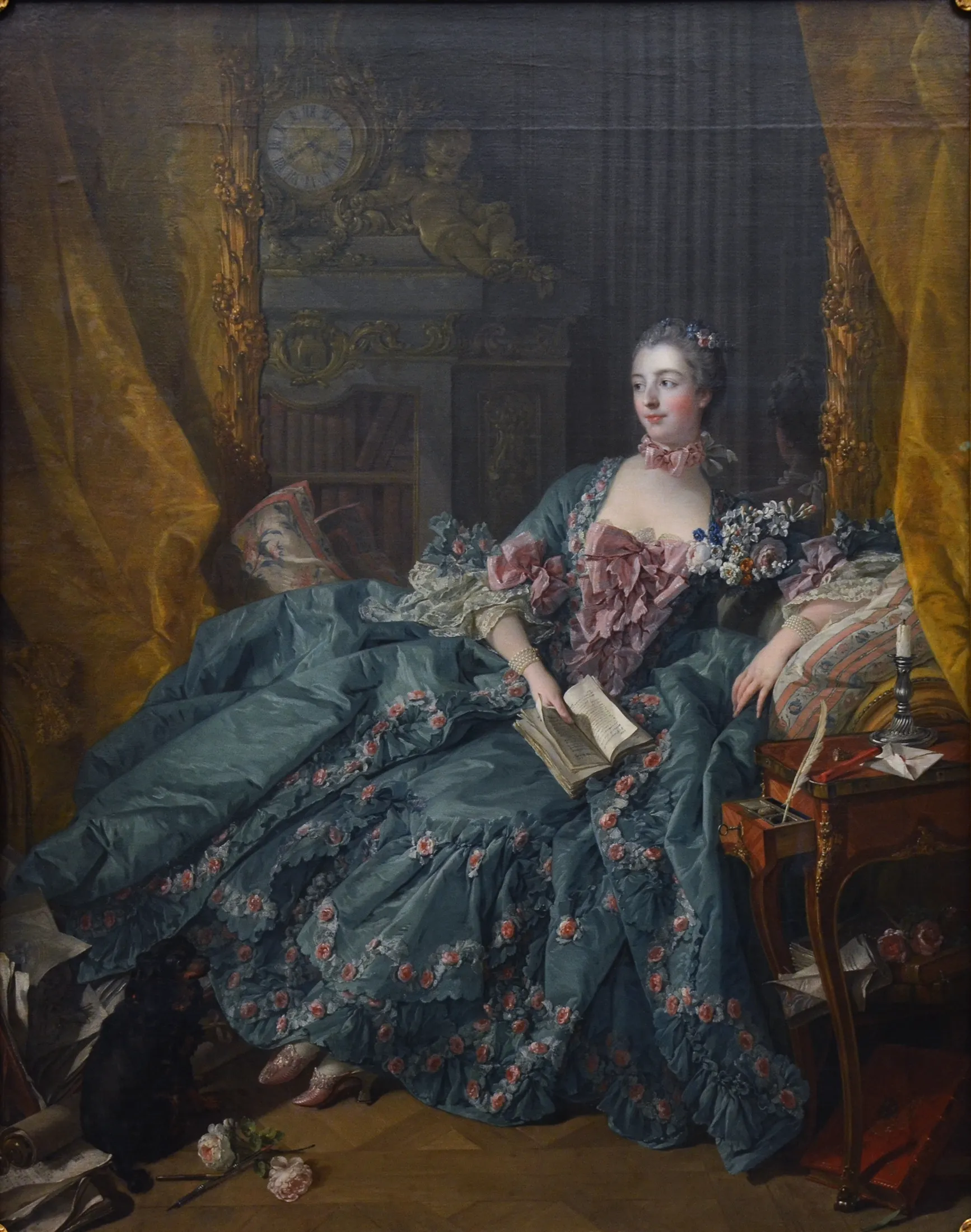
Francois Boucher, "Madame de Pompadour" (1756). Oil on canvas. Alte Pinakothek, Munich. Image: Public domain, via Wikimedia Commons
Boucher's mythological paintings, including "The Rising of the Sun" (1753) and "The Setting of the Sun" (1752), present Venus and Apollo in pastel colors, with bodies arranged as decorative compositions rather than narrative scenes. The criticism came from Denis Diderot, the Enlightenment philosopher and art critic, who called Boucher's work "decadent" and said he was "everything, except truth." Diderot's attack was part of a broader shift in taste that would eventually produce Neoclassicism. As TheArtStory's overview of Rococo notes, Boucher's rejection by Diderot was not just about aesthetics. It was about what art should be for, and Diderot believed art should serve moral purpose rather than decorative pleasure.
Fragonard and the Erotic Rococo
Jean-Honore Fragonard (1732 to 1806) was Boucher's student and the painter who pushed Rococo to its most extreme. "The Swing" (1767 to 1768) is 81 by 64 centimeters and is now at the Wallace Collection in London. It was commissioned by Baron Saint-Julien, who specifically requested a painting of his mistress on a swing with himself hidden below. The painting is a comedy of infidelity, staged in a garden with soft pink and green light. The husband pushes the swing. The lover watches from the bushes. The mistress kicks off her shoe. Everyone in the painting knows what is happening, and nobody seems to mind.
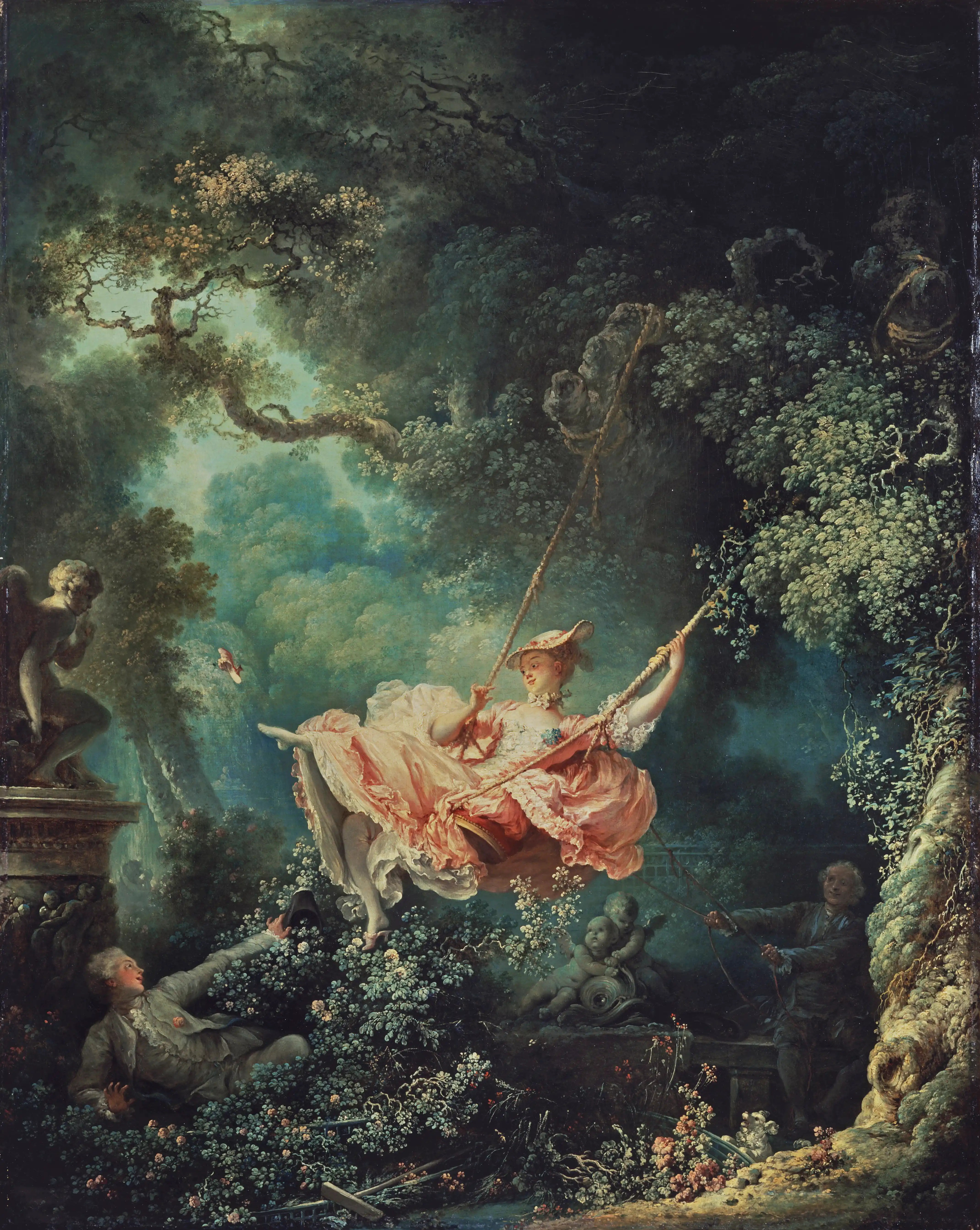
Jean-Honore Fragonard, "The Swing" (1767-68). Oil on canvas, 81 x 64 cm. Wallace Collection, London. Image: Public domain, via Wikimedia Commons
The "Progress of Love" series (1771 to 1773) was four paintings commissioned by Madame du Barry for her pavilion at Louveciennes. She rejected them, possibly because they were too knowing, too ironic about the very romance they depicted. The rejection was a blow, and it signaled that Rococo's audience was already shrinking.
Fragonard's rapid decline was political. The Revolution destroyed his clientele. He died in 1806, largely forgotten, and was not rediscovered until the Goncourt brothers championed him in the 1860s. The Goncourts argued that Fragonard's brushwork, his color, and his attention to surfaces were virtues, not vices, and their reading shaped how Rococo has been understood ever since. The Impressionists, Renoir above all, learned from Rococo's loose brushwork and bright palette. For more on that legacy, see our post on Impressionism.
Chardin: The Rococo Outsider
Jean-Baptiste-Simeon Chardin (1699 to 1779) worked in the same period as Boucher and Fragonard but painted completely different subjects. Still lifes and domestic scenes were his territory, and he had no interest in aristocratic leisure or erotic mythology.
"The Ray" (1728) is a dead skate fish hanging on a wall, a cat investigating, kitchen utensils scattered. The painting is 114 by 146 centimeters and is now at the Musee d'Orsay. It is ugly by Rococo standards. No pastel colors, no aristocratic leisure, no eroticism. It is also one of the most powerful still lifes in European painting. Chardin painted dead fish and kitchen pots with the same attention that Boucher gave to Venus, and the comparison is not flattering to Boucher.
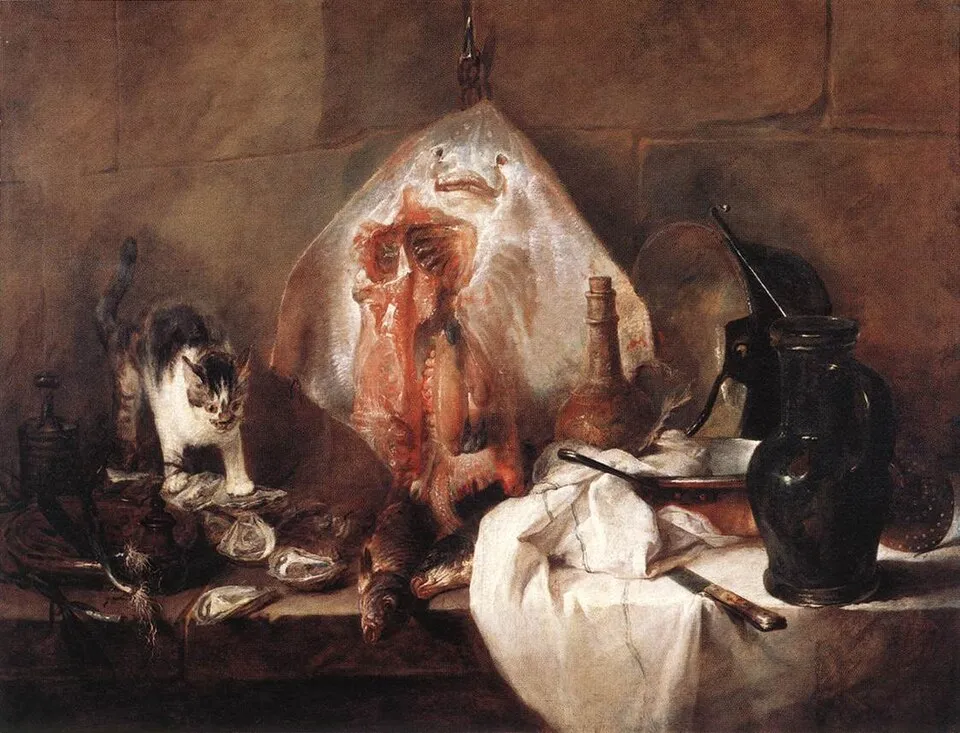
Jean-Baptiste-Simeon Chardin, "The Ray" (1728). Oil on canvas, 114 x 146 cm. Musee d'Orsay, Paris. Image: Public domain, via Wikimedia Commons
"The Governess" (1739) and "Soap Bubbles" (c. 1734) show scenes of middle-class domestic life, painted with the same careful observation as his still lifes. Chardin proves that the Rococo period was not monolithic. While Boucher painted goddesses for the court, Chardin painted kitchens for the middle class. The Rococo period contained its own critique. As the Getty Center's "Rococo to Revolution" exhibition page explains, Chardin's domestic scenes were not a rejection of Rococo but a parallel tradition, one that treated ordinary life with the seriousness that Boucher reserved for mythology.
Chardin is the greater painter, but Fragonard is the greater artist. His willingness to paint pleasure without moral justification is itself a kind of courage. Chardin painted what was there. Fragonard painted what people wanted, and the difference between those two projects is the difference between observation and imagination.
Rococo and the Politics of Pleasure
Rococo was the art of a ruling class that was about to be destroyed. The aristocracy that commissioned Watteau, Boucher, and Fragonard was the same aristocracy that the Revolution executed, exiled, or stripped of power in 1789. The connection between style and politics is not incidental. Rococo's refusal to engage with moral or civic subjects was a choice. While David was painting the Oath of the Horatii (1784) and arguing for civic virtue, Fragonard was painting The Swing (1767) and arguing for nothing at all.
The rehabilitation of Rococo began with the Goncourt brothers in the 1860s and continued with the Impressionists, who saw in Rococo's loose brushwork and bright palette a predecessor for their own work. The 2026 auction market has reinforced this reassessment. In March 2026, Christie's Paris sold the Arthur Georges Veil-Picard collection, a group of about 30 18th-century French paintings and drawings that had been hidden for nearly a century. The sale totaled 9.4 million euros, with Fragonard's "The Happy Family" selling for 2.87 million euros, well above its estimate. A rediscovered Watteau drawing sold for 838,200 euros. The Louvre pre-empted two Hubert Robert interior scenes for 2.44 million euros. As the Observer reported, Old Master sales rose 68.7 percent in 2025 to $282.5 million, with Rococo works driving a significant portion of that growth.
The Veil-Picard sale also confirmed that Fragonard's "Happy Family" will be exhibited at the Musee Jean-Honore Fragonard in Grasse from June 19 to October 18, 2026, as part of the exhibition "Fragonard, l'enfant cheri de Grasse." The exhibition focuses on Fragonard's depictions of childhood and maternal tenderness, a theme largely overlooked in his oeuvre. Curator Carole Blumenfeld has argued that Fragonard's sensitivity to childhood reflects a proto-feminist awareness that was unusual for his time, and the exhibition assembles about 30 paintings, some never before shown publicly.
Final Thoughts
Rococo lasted roughly 60 years, from about 1710 to 1770, and produced paintings of extraordinary technical refinement and emotional lightness. Its association with aristocratic excess made it unfashionable for 150 years. Its rediscovery by the Goncourts and the Impressionists restored its reputation, and today it is valued for the same qualities that once condemned it: intimacy, color, and the courage to paint pleasure without apology.
The 2026 market data tells a story that the Goncourts would have recognized. Collectors are paying attention to Rococo again, and the prices are rising because the supply of major works is finite. The Veil-Picard sale proved that a Fragonard or a Watteau appearing at auction is still an event capable of drawing museum pre-emptions and fierce competition. For a broader view of where Rococo sits in the history of art, see our art movements timeline and our art history cheat sheet.
The Wallace Collection in London has "The Swing" and an exceptional collection of Rococo paintings. Admission is free. If you want to understand Rococo, stand in front of "The Swing" for ten minutes. Notice how Fragonard uses pink and green to create a world that feels simultaneously real and artificial. Notice how the composition draws your eye upward, from the lover in the bushes to the shoe flying through the air. The painting is a joke, and it is also one of the most perfectly composed paintings in European art. Rococo is like that. It looks easy, and it is not. For more on the compositional techniques at work, see our guide to composition in art, and for the color theory behind those pinks and greens, our guide to color theory.


